In the Gospel passage for the 10th Sunday in Ordinary Time (Mark 3:20-35), Jesus says to his disciples and the crowd, “If a kingdom is divided against itself, that kingdom cannot stand.” (verse 24). This is in response to the scribes claim that Jesus is driving out demons by or through the prince of demons. Jesus’s words make sense. After all, one cannot bring peace and healing by or through chaotic means. With so much division and vitriol circulating throughout the world, it’s worth considering the heart in the matter.
In the days leading up to this Sunday, the Solemnity of the Most Sacred Heart of Jesus and the Memorial of the Immaculate Heart of the Blessed Virgin Mary are celebrated. When you consider the heart of Jesus, what qualities come to mind? How about when you think about Mary’s immaculate heart?
Based on Scripture, what are some concrete ways that their words and actions reflect these qualities? How does Mary receive unexpected news or events such as the Annunciation, at the Presentation in the temple, and Jesus’s arrest and crucifixion? How does Mary react and respond to the young Jesus when she finds him in the temple after 3 days apart? What does Mary do, and how does she do it, when the wine runs out at the wedding feast in Cana?
What kinds of words does Jesus use and what is his attitude in his encounters with the pharisees and scribes, his disciples, and the crowds? What do Jesus’s actions express? And how does Jesus respond and react during the Passion?
Contemplating the heart of Jesus and the heart of Mary in the happenings of today’s world, how or where do you see the qualities of their hearts coming to life through words and actions? Take time this week to notice the heart behind your words and actions as well as those in the happenings directly around you, in your country, and in the world.
Prayer: Immaculate heart of Mary, intercede on our behalf, so that lies, deception, and all who seek to distort what is true, just, and honorable may be revealed. Sacred heart of Jesus, help us to see through your eyes, and to speak, act, and love, with your heart. Amen.
With the Lord there is mercy, and fullness of redemption. – Psalm 130:7bc
On the Solemnity of the Most Holy Body and Blood of Christ also known as Corpus Christi, the Collect (opening prayer) is: “O God, who in this wonderful Sacrament have left us a memorial of your Passion, grant us, we pray, so to revere the sacred mysteries of your Body and Blood that we may always experience in ourselves the fruits of your redemption.”
Spend some time reflecting on this prayer and on the Sacrament of the Eucharist. What does it mean to you and how has it impacted you? Remember how you have experienced the fruits of the Lord’s redemption. What wonders has the Lord worked in your life? Take a few moments to express gratitude for these experiences and the awareness of them.
In the hymn One Bread, One Body, the lyrics direct us to mindfulness of our call, one and all, to unity as God’s people (the church):
One bread, one body, one Lord of all One cup of blessing which we bless And we, though many, throughout the Earth We are one body in this one Lord – John Foley, SJ (excerpt from One Bread, One Body)
Recall a time(s) when you have experienced unity and the fruits of the Lord’s redemption with others? In what ways have you witnessed the hand of the Lord? Give thanks for these times of common ground and the remembrance of them.
What hopes and desires do you have at this moment for awareness and unity in your life? your community? your country? and the world? Share these with the Lord. Ask the Lord for the grace to further appreciate and be inspired by experiences of the outpouring of His love.
Pray for one and all to have an open heart and mind to the well-being of all creation, and above all, to draw closer to God so as to embody (to speak and act in accord with) God’s desires as expressed through the example of Jesus.
How shall I make a return to the Lord for all the good he has done for me? The cup of salvation I will take up, and I will call upon the name of the Lord. – Psalm 116:12-13
In the First Reading for the Solemnity of the Holy Trinity (Deuteronomy 4:32-34, 39-40), Moses reminds the people of how God has been present to them in Egypt and the magnitude of what God has done for them. He then implores them to use these experiences to remain focused on God as well as God’s ways thru adherence to God’s statutes and commandments. There can be a tendency to think of statutes and commandments as confining, but when taken into consideration along with the bigger picture of God’s dedication and love for all of creation, they can be seen as providing concrete ways to create unity and exercise respect and dignity with a goal of freedom and protection for one and all.
With God there is always more than one side. The relationship is mutual and considers all parties. There are statutes and commandments, but there are also God’s actions, not just telling humanity how to be, but also leading the way and showing us by example. The verses in the Psalm (Ps 33:4-5, 6, 9, 18-19, 20, 22) describe the Lord’s words, actions, and persona as: upright, trustworthy, just, right, kind, effective, protective, and helpful. These attributes are also infused in the statutes and commandments. They are extended to us by God and in turn we are to extend them to each other.
In the Second Reading (Romans 8:14-17), St. Paul reminds us of our part in the Trinity. As “children of God” and “Joint heirs with Christ” we are not to be enslaved by fear, but rather to live in and be led by the Spirit of God. The passage begins with a salutation of “Brothers and Sisters.” This is not an uncommon greeting. Readings from the letters of St. Paul often begin with a salutation of “Brothers and Sisters,” perhaps to continually express the overall desire and focus on the goal of unity with the Lord and one and another. Imagine starting all your communications with “Brothers and Sisters” or adding “Brothers and Sisters” to communications you receive. How might that shape what you write/say and how you receive what is written/said to you?
Moving on to the Gospel passage known as the Commissioning of the Disciples (Matthew 28:16-20), the disciples, who have gone to Galilee as instructed by Jesus, encounter the risen Jesus. It is written, “they worshipped, but they doubted.” (verse 17). What’s it like to think that despite the existence of doubt, they were still seen as worthy, encountered Jesus, and were given the opportunity to serve as Jesus’ disciples? When situations arise, it can be tempting to give rise to doubt or to fall into a one thing or another, or all or nothing mindset. However, with the Lord, all are worthy, there are often many ways and different degrees to serve, and faith always triumphs over doubt.
Overall, the Solemnity of the Most Holy Trinity presents an opportunity to acknowledge, contemplate, and celebrate how one experiences the Father and the Son and the Holy Spirit. When you consider each aspect of the Trinity, what characteristics or attributes come to mind? How have you experienced these in your life and how has your prayer been influenced by them? In what ways are you inspired by the Holy Trinity individually and in your relationships? How might the Trinity influence you to overcome uncertainty or division and work toward unity, to better communicate or deepen relationships, or in any related discernment?
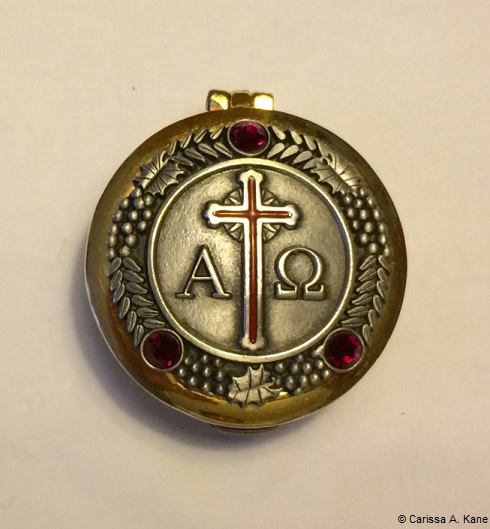
“I am the Alpha and the Omega,” says the Lord God, “the one who is and who was and who is to come, the almighty.” – Revelation 1:8
The goodness of your breath O God, filled me up, heart and soul and body, and got me started. The faithfulness of your presence Carries me along, and your spirit, Moves me to what is best.
How much? How many? What rank? It does not matter; not a single bit. Besides, who am I to measure?
You lead me through both highs and lows. You teach me how to be, and what to cherish. I am lifted up and over by your love and care. Amazing how you do it. Amazing! The glory is forever yours, and yours alone, Yet, you always share it.
When you send forth your spirit, they are created, and you renew the face of the earth. – Psalm 104:30
A long time ago, in a place that’s near, but that seems so far away, an experience that left a lasting impression occurred. I was preparing to leave for college orientation and one of my aunts was at my family’s home visiting. She came into mine and my sister’s room as I was packing some clothes and we had a conversation. I don’t recall how long it lasted or even what we were talking about, but I do recall how it felt to have here there. She was so caring and genuinely interested in being present to me in those moments. I often think of that day with fondness and remember feeling so loved by her, both then, and every time it’s come to mind since then. There were pearls of wisdom, simply in her presence.
I’m not sure that I ever told her how much that time together meant to me, but I will always remember it, along with her hugs, as if embracing one with all her heart and soul—the very definition of Love.
In the second reading for the 7th Sunday of Easter (1 John 4:11-16), it is written:
“Beloved, if God so loved us, we also must love one another. No one has ever seen God. Yet, if we love one another, God remains in us, and his love is brought to perfection in us.”
Consider taking some time to reflect on the verses above and how they come into play in daily life including interactions with those who are known by you and those who are yet to be known by you (strangers). In what ways might you better cooperate with God in working to bring love to perfection in you as well as through you?
Holy days and holidays ushered in between the rush, bring a slowing down, or temporary halt at best. Then, it’s back to the pace of pressure; quick and fast, As if the Lord did not make every day.
This is the day the Lord has made; let us rejoice in it and be glad. – Psalm 118:24
Neither grave, nor the gravity, Could hold Him down. That cross, though heavy, Not heavy enough, Nor could it ever be. A temporary thing, A passage, passing with time, The Begotten not gone.
That stone, though big, Not big enough, Nor could it ever be. A temporary thing, A passage, passing with time. The Begotten hidden, Not seen, not heard, But certainly not gone.
Then, Easter. Arriving between the quiet, Entering amid the stillness, And everything changes. Everything becomes new again, In the remembering of what is. Nothing ever stronger than What was, What is, and What shall ever be.
Just as Light cannot be kept from shining, And Truth, refusing to remain hidden, There is no greater shield or power than that created by Creator. We are more than passengers on borrowed time. More than temporary things or passages, passing with time. And in Him, with Him, and thru Him, Neither grave, nor the gravity, Can hold us down.
Breaking, broke, broken, Rescued, healed, awoken, Ever taken with your Way. For the sake of all, It’s all the same. No one more than the other, Each onto its own, But gathered in Your name.
Your grace O Lord, The longing of our hearts. Eloi, Eloi, lema sabachthani. At times, perhaps, We think we know, Yet thinking doesn’t make it so.
Your grace O Lord, The longing of our hearts. We feel one way or another, Sometimes many ways at once, Yet feeling doesn’t make it so.
Your grace O Lord, The longing of our hearts. With us, within us, Always within reach.
Your grace O Lord, Makes known your Way, The desire in our hearts, Yours and ours together, Rising up, makes it so.
The readings for the Third Sunday of Lent can be seen as a call to pay attention to the nature of relationships and what they lead or point to. In the First Reading (Exodus 20:1-17), God delivers the commandments, which are seemingly clear instructions, and by adhering to them, the people will prosper. Notice how God’s mercy far outweighs any punishment.
For I, the Lord, your God, am a jealous God, inflicting punishment for their ancestors’ wickedness on the children of those who hate me, down to the third and fourth generation; but showing love down to the thousandth generation of those who love me and keep my commandments. (Ex 20:5-6)
Also, notice that punishment is reserved for “those who hate me,” and their children. Hate is a pretty strong word and one can imagine some sort of pattern or learned behavior to reach that point or designation. In that light, perhaps this passage can be viewed as a Lenten invitation to be mindful of one’s actions, the sentiments from which they come, and what they might teach.
Looking at the Responsorial Psalm (Psalm 19:8-11), the response is “Lord, you have the words of everlasting life.” (Jn 6:68c). Again, drawing us to God’s words as priceless and wrapping up by trying to convey just how valuable they are: They are more precious than gold, than a heap of purest gold; sweeter also than syrup or honey from the comb. (Ps 19:11).
As for verses 8-10 of the Psalm, the first part of each line refers to the Lord’s “rules”—laws, decrees, precepts, commands, reverence, and ordinances. The second part of each phrase or sentence provides guidance by giving indicators that one can use to try to determine if they are obeying and honoring the Lord. How? By evaluating the situation and answering the question: Do I experience or have a sense of a refreshed soul/peace, wisdom, a rejoicing heart, enlightenment, endurance/inner strength, truth, or justice?
The law of the Lord is perfect, refreshing the soul; The decree of the Lord is trustworthy, giving wisdom to the simple.
The precepts of the Lord are right, rejoicing the heart; the command of the Lord is clear, enlightening the eye.
The fear of the Lord is pure, enduring forever; the ordinances of the Lord are true, all of them just.
In the Second Reading (1 Corinthians 1:22-25), St. Paul is encouraging the Corinthians, and us, to be careful about the way we go about seeking signs and wisdom. God certainly uses people, situations, and things to accomplish tasks and impart wisdom, however, as St. Paul says, “we proclaim Christ crucified.” That means, there is no substituting human thoughts, ideas, goals, etc. for God’s will and wisdom as the source or root that one allows to resonate with and guide their soul. Ultimately, things come down to what happens between each person and God, and one is not to blindly follow others thus giving what belongs to or originates with God (one’s soul and will) to another human being and/or their agenda.
In what ways do you take each situation to prayer with an openness to the fact that what is right and just in one situation may not be right and just or the best way in another situation? What’s it like to consider that the “rules” and their application are shaped by God’s love and mercy, and that this is by God’s design? In what ways do you leave room for love and mercy in situations and decisions?
Turning to the Gospel passage referred to as the Cleansing of the Temple (John 2:13-25), we can see Jesus’ disavowal of the perversion of the Temple and the rules and practices around and within it. The focus has become all about transactions and status. Jesus drives everyone out, saying to those profiting at the expense of the poor—those selling doves, “Take these out of here, and stop making my Father’s house a marketplace.” (Jn 2:16). In the verses that follow, Jesus refers to his body as the temple and foreshadows his crucifixion and resurrection. The passage ends with:
But Jesus would not trust himself to them because he knew them all, and did not need anyone to testify about human nature. He himself understood it well. (Jn 2:24-25)
Envision Jesus, who is the source of salvation and redemption, entering the temple area of your life—your heart. Imagine yourself receiving the peace, inner strength, and wisdom of Jesus as you sit together. What would you share? And, what would He who understands human nature well, impart to you in terms of what to drive out and what to keep?
The readings for the Second Sunday of Lent take us on a journey from sacrifice or letting go to service, embracing identity, and finally becoming one with it. In the first reading, Abraham shows a willingness to sacrifice or let go of whatever his ideas or plans might have been to listen to God and do as God asks (Genesis 22:1-18). Remember, Sarah and Abraham, in their more senior years and against all odds, had their son Isaac after having been barren. Imagine what it must have been like for Abraham to then be asked to sacrifice or let go of his and Sarah’s long-awaited arrival. Yet, Abraham exemplifies a faith that places trust in God (and God alone) above all. He proceeds to take steps toward what God has asked of him. As they left the servants behind and walked along, Isaac asks his father where the sheep is for their offering. Abraham replies, “God will provide the sheep for the burnt offering.” Once they finish building an altar and placing the wood, Abraham moves toward sacrificing his and Sarah’s only child. However, the angel stops him as Isaac’s demise is not what God wills. As Abraham said, God does provide the sheep for sacrifice: “Abraham looked up and saw a single ram caught by its horns in the thicket. So Abraham went and took the ram and offered it up as a burnt offering in place of his son.” And the wisdom of his response to God’s requests and promptings shows that being faithful is to nurture a will that is open to and guided by God. For it is this kind of will that does not lead to demise or destruction.
Continuing to look to what it is to be faithful to God, the response for the Psalm is “I will walk before the Lord, in the land of the living” (Psalm 116:9). How do you feel motivated by Abraham’s example of striving to serve God with a united heart and mind? Try to envision or embody the spirit of walking before God in all that you say and do this week.
Turning to the second reading (Romans 8:31b-34), St. Paul encourages us to remember and embrace our identity when he writes: “If God is for us, who can be against us?” When one is operating with a desire to do God’s will and in the scope of being part of creation in God’s image, there is a sense of inner strength, awareness, and reverence for what is good and just while at the same time a sense of lightness and freedom or free will. It is important to pause every so often to examine what’s going on internally and from where one’s words and actions are flowing. Invite Jesus to the conversation and ask the Lord for the grace to be aligned compatibly with God in each situation you face.
In this week’s Gospel, we read about the Transfiguration of Jesus (Mark 9:2-10), the ultimate image of embracing one’s identity and becoming one with it for the greater good.
Jesus took Peter, James, and John and led them up a high mountain apart by themselves. And he was transfigured before them, and his clothes became dazzling white, such as no fuller on earth could bleach them. Then Elijah appeared to them along with Moses, and they were conversing with Jesus. Then Peter said to Jesus in reply, “Rabbi, it is good that we are here! Let us make three tents: one for you, one for Moses, and one for Elijah.” He hardly knew what to say, they were so terrified. Then a cloud came, casting a shadow over them; from the cloud came a voice, “This is my beloved Son. Listen to him.” Suddenly, looking around, they no longer saw anyone but Jesus alone with them.
As they were coming down from the mountain, he charged them not to relate what they had seen to anyone, except when the Son of Man had risen from the dead. So they kept the matter to themselves, questioning what rising from the dead meant. – Mark 9:2-10
Recall a time where you felt affirmed or reaffirmed and had a sense of confidence in who you are as God’s beloved, leading to spiritual growth or renewal. Ask the Lord for the grace of that experience to extend to today, offering you wisdom, insight, and openness to whatever you may need.
You must be logged in to post a comment.