His Warmth…

Although the colder air that accompanies this time of year in the Northeast can be quite refreshing, after some time, it can leave one wanting for the warmth of shelter, a soft blanket, or hot beverage to offset the chill.

In the Gospel passage for the Fourth Sunday of Advent (Matthew 1:18-24), we learn about the warmth of St. Joseph’s response to his betrothed, with whom he had not yet lived or had relations with, being pregnant. Imagine the response, gossip, or chill in the air, created by those around Mary and Joseph. Yet, even before his dream in which the Lord appeared, reassuring him of Mary’s faithfulness, Joseph had decided to respond in a way that was filled with warmth, gentleness, and mercy:

This is how the birth of Jesus Christ came about.
When his mother Mary was betrothed to Joseph,
but before they lived together,
she was found with child through the Holy Spirit.
Joseph her husband, since he was a righteous man,
yet unwilling to expose her to shame,
decided to divorce her quietly. –
v. 18-19

Envision yourself in Joseph’s shoes. He is described here as being righteous. What do you make of his initial decision to quietly divorce?

Reflecting on situations that are on your mind and in your heart, how do you seek righteousness? What does it look like? And what qualities does it manifest?

As the Gospel passage continues, Joseph has a dream in which the Lord visits him.

“Joseph, son of David,
do not be afraid to take Mary your wife into your home.
For it is through the Holy Spirit
that this child has been conceived in her.
She will bear a son and you are to name him Jesus,
because he will save his people from their sins.” –
v. 20-21

Recall a time when you had made a decision and then something occurred that reaffirmed your decision or created a new sense of the situation. What happened? What were you praying for, and how did things turn out? How were you saved or blessed? What was the warmth of God like?

Invite the Lord to revisit this with you. What grace from this experience awaits you today?

Spend some time contemplating the verses below and noticing what word, phrase, or image speaks to your heart most:

All this took place to fulfill what the Lord had said through the prophet:
Behold, the virgin shall conceive and bear a son,
and they shall name him Emmanuel,
which means “God is with us.” –
v. 22-23

Continuing to pray with what caught your attention, ask the Lord to grant you insight so that you may see, or have a greater sense of, “God is with us.”

Before ending this prayer time, return to the image of St. Joseph.

When Joseph awoke,
he did as the angel of the Lord had commanded him
and took his wife into his home. –
v. 24

As you strive to be faithful to God, what inspires you? What do you need from the Lord to draw comfort and strength from Him, as you journey through your days, while also reflecting the warmth of His presence.

Let the Lord enter; he is king of glory. – Psalm 24:7c,10b

Waterfall

The Temple…

Lots handed out, or so it seems.
Making the best, letting it go.
Sojourners weathered… worn, but blessed.

Persevering Hope and Great Love,
No doom nor great gloom can upend
The temple within The Temple.

Released into pockets of space
Throughout the passages of time,
All of creation, born sacred.

Water and Spirit flowing free
By the earnest beat of One Heart,
Bringing Light, bringing Life, to all.

Waterfall

Be still and know that I am God. – Psalm 46

Roadside view into great wide open

All Souls

In the eye of one’s heart—soul,
Each step on this great journey
Giving not away, but way
To the will of Greater Glory.

Lives come and pass, to behold,
With examples that linger
And great lessons that remain;
Teach what to hold or let go.

In sacred remembrance,
All souls living on the earth
Have been given the honor
To seek what is wise and true,
And choose what is eternal.

Roadside view into great wide open

The Lord is my shepherd; there is nothing I shall want. – Psalm 23:1

Saving Power…

Taking the plunge, one by one,
each day breaks through, something new;
Your wisdom and grace abound.

You come to us, work through us,
dignify our worth, our place.
How great when we allow it!

Kindness, compassion, mercy,
Your word, all within our reach,
to embrace, not turn around.

Brute force is never Your way.
Choice upon choice, you give us,
filled with hope, to seek what’s best.

Guiding light softly spoken,
gentle nudging, Love of loves,
Always with us, through and through,
Saving Power seeking heart.

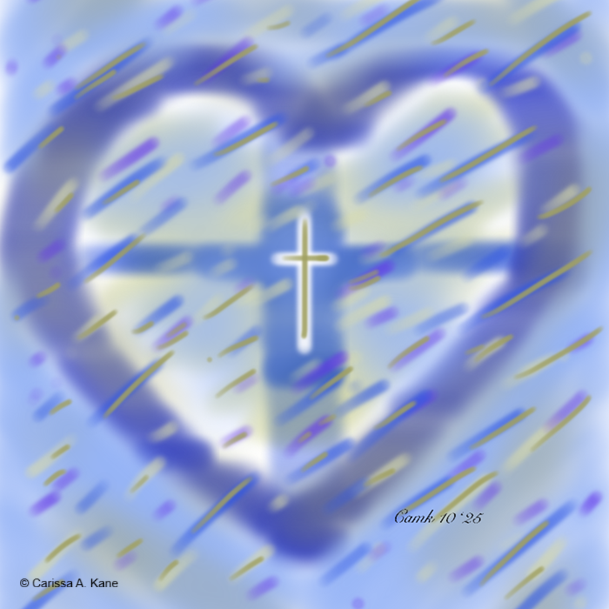
Heart with a cross in the center

The Lord has revealed to the nations his saving power. – (cf. Psalm 98: 2b)

Celtic Healing Cross

You, have redeemed the world…

“The Holy Scriptures were not given to us that we should enclose them in books, but that we should engrave them upon our hearts.” ― St. John Chrysostom

Praying with the scripture readings for the Feast of the Exaltation of the Holy Cross (Numbers 21:4b-9; Psalm 78:1b-2, 34-38; Philippians 2:6-11; and John 3:3-17), contemplate what it means to engrave them upon your heart.

In the First Reading, we hear of the Israelites, at wit’s end, upset by their situation in the desert, and making it known to Moses. We also learn of the punishing arrival of saraph serpents, leading to the surmise of many, and the subsequent realization of sin and prayer for relief. Following this, Moses prays for the people to be spared from the serpents, and the Lord replies, “Make a saraph and mount it on a pole, and if any who have been bitten look at it, they will live.” (Numbers 21:8).

What do you make of the notion that to be cured, or to overcome the serpent’s bite, requires looking at the bronze serpent mounted on the pole?

Take some time to consider a situation or area in which your patience is worn thin, or where you have been bitten. What has your reaction or response been? And how might you ask for, and receive, God’s grace to move toward peace and healing—a better way?

The response for the Psalm (Psalm 78:1b-2, 34-38) is, “Do not forget the works of the Lord!” (Ps 78:7b). Like it was in the desert for the Israelites and Moses, it can be tempting for anyone to react or respond out of feelings of discontent or anger, when it feels like needs are not being met or answers are nowhere to be found. This psalm invites us to recall what is true. None of us are without mistakes and missteps along the way. Still though, God is merciful and forgiving. This psalm encourages us to recall and remember the ways that God has been, and is, steadfast toward us.

Think about your experience of God turning something bad into something good?

Throughout the week, in moments with or without concern or upset, pause to acknowledge and give praise to God for God’s faithfulness to you. Allow yourself the space and invite God into it, to help you to see the entire picture, and to remember what is true.

In the Letter of St. Paul to the Philippians (Philippians 2:6-11), it is written:

Christ Jesus, though he was in the form of God,
did not regard equality with God something to be grasped.
Rather, he emptied himself,
taking the form of a slave,
coming in human likeness;
and found human in appearance,
he humbled himself,
becoming obedient to death,
even death on a cross.
Because of this, God greatly exalted him
and bestowed on him the name
that is above every name,
that at the name of Jesus
every knee should bend,
of those in heaven and on earth and under the earth,
and every tongue confess that
Jesus Christ is Lord,
to the glory of God the Father.

Continuing to pray with the thoughts, feelings, and situations that have come to mind and heart thus far, where might the words emptied, humbled, exalted, and bestowed—the past tense verbs used by St. Paul to describe actions of Jesus and God—be applicable or come into play? Ask the Lord to help you to identify ways that these words operate in your life, and what purpose they might be serving.

Turning to the Gospel passage (John 3:13-17), Jesus is mid-conversation with Nicodemus, a Pharisee who has come to see Jesus in the darkness of night. Nicodemus is trying to understand what Jesus means by, “no one can see the kingdom of God without being born from above.” (Jn 3:3).

What does being born from above mean to you?

For the Feast of the Exaltation of the Holy Cross, we are reminded of where, and who, we currently are—our place as well as our call—eternal life through Jesus.

In the Gospel passage, Jesus refers to Moses lifting up the bronze serpent in the desert and says, “so must the Son of Man be lifted up, so that everyone who believes in him may have eternal life.” (Jn 3:14-15). He knows that Nicodemus will be familiar with and understand what has been written in Scripture. However, an earmark of Jesus is to elevate and help us along toward living Scripture. This is what he is trying to do, when he follows up with:

“For God so loved the world that he gave his only Son, so that everyone who believes in him might not perish but might have eternal life. For God did not send his Son into the world to condemn the world, but that the world might be saved through him.” (Jn 3:16-17).

Enter into conversation with Jesus about these two verses, inviting him to elevate and help you along in your journey toward living Scripture, or living it more fully. When your prayer time comes to a close, add the following:

We adore you, O Christ, and we bless you,
because by your Cross you have redeemed the world. – St. Francis of Assisi

Celtic Healing Cross

Hearts being lifted up by a butterfly.

Begin with Love…

The readings for the Fifth Sunday of Easter can be seen as encouragement toward, and an opportunity to reflect throughout the week on perseverance, praise, promise, and practice, but most of all, Love.

In the First Reading (Acts 14:21-27), Paul and Barnabas continue their travels, preaching to and teaching the Gentiles about the Way. In this scripture passage, it is written:

“They strengthened the spirits of the disciples and exhorted them to persevere in the faith, saying, ‘It is necessary for us to undergo many hardships to enter the kingdom of God.’” (v. 22).

Think about some of the hardships you have encountered or are currently experiencing. Where have you found strength to persevere? What about moments of peace? How do you desire God to be present to you regarding these challenges? Take some time to bring these areas to prayer and express what is in your heart as you do.

The First Reading ends with the following verses:

“From there they sailed to Antioch, where they had been commended to the grace of God for the work they had now accomplished. And when they arrived, they called the church together and reported what God had done with them and how he had opened the door of faith to the Gentiles.” (v.26-27).

Continuing to reflect on the questions above, your prayer, and these closing verses, what insight or inspiration comes to you?

——————–

In the Responsorial Psalm (Psalm 145:8-13), the response comes from verse 1 of the Psalm which is, “I will extol you, my God and king; I will bless your name forever and ever.” While it expresses the psalmist’s deep sense of gratitude to God, the verses that follow it speak to characteristics of God:

“The Lord is gracious and merciful,
slow to anger and of great kindness.
The Lord is good to all
and compassionate toward all his works.” (v. 8-9)
.

In what ways have you encountered, and do you continue to encounter, grace, mercy, patience, and kindness through God, both directly and indirectly? In what ways do you embody and promote these characteristics to others?

The verses of the Psalm continue:

“Let all your works give you thanks, O Lord,
and let your faithful ones bless you.
Let them discourse of the glory of your kingdom
and speak of your might.” (v. 10-11)
.

“Let them make known your might to the children of Adam,
and the glorious splendor of your kingdom.
Your kingdom is a kingdom for all ages,
and your dominion endures through all generations.” (v. 12-13).

What strikes you most about the above verses, in terms of the reception of the Creator and the response of the created? As you contemplate this, what events or circumstances come to mind and what feelings do they give rise to? Where and how do praise and gratitude come into play? Pray with this, sharing your thoughts and feelings with the Lord, and allowing yourself to listen to or get a sense of the Lord’s response.

——————–

The Second Reading comes from the Book of Revelation (Revelation 21:1-5a):

“Then I, John, saw a new heaven and a new earth.
The former heaven and the former earth had passed away,
and the sea was no more.
I also saw the holy city, a new Jerusalem,
coming down out of heaven from God,
prepared as a bride adorned for her husband.
I heard a loud voice from the throne saying,
‘Behold, God’s dwelling is with the human race.
He will dwell with them and they will be his people
and God himself will always be with them as their God.
He will wipe every tear from their eyes,
and there shall be no more death or mourning, wailing or pain,
for the old order has passed away.’
The One who sat on the throne said,
‘Behold, I make all things new.’”

After reading the above passage, when you read, “God’s dwelling is with the human race.”, what comes to mind, and what feelings accompany it?

As you continue to reflect, envision yourself, arm in arm with the Lord, walking along a path, in a place of your choosing. Share the thoughts and feelings that are stirring within you and allow the Lord to respond. Notice the way you receive or embrace each other as you communicate? What characteristics of the Lord do you experience and what ones do you exude to the Lord?

Recalling the last verse in this passage, “The One who sat on the throne said, ‘Behold, I make all things new.’”, what is your current level of trust in these words? Taking to heart God’s words as God’s promise, and your current reality, what happens? Share what’s going on inside you with the Lord including the areas that pose a challenge to your belief?

As your prayer time comes to its closing, what desire is in your heart? And what is the Lord’s desire for you?

——————–

The Gospel passage for the Fifth Sunday of Easter (John 13:31-33a, 34-35) takes us back to the Last Supper, after Jesus has washed the feet of the disciples and Judas has taken leave of Jesus and the others present.

“When he had left, Jesus said,
‘Now is the Son of Man glorified, and God is glorified in him.
If God is glorified in him,
God will also glorify him in himself,
and God will glorify him at once.
My children, I will be with you only a little while longer.
I give you a new commandment: love one another.
As I have loved you, so you also should love one another.
This is how all will know that you are my disciples,
if you have love for one another.’”

What’s it like to sit with the notion of the glory of God being in you? In what ways does, and can, being mindful of this truth enrich and/or enlighten your words and actions? In practice, how does it inspire a cooperative spirit with the flow of God’s love in and through you?

Where do we begin? Begin with the heart.” – Julian of Norwich

Easter Hope and Joy

Not for One, but for the Many…

“Christ is risen from the dead, and by His death He has trampled upon death,
and has given live to those, who are in the tombs.” – the Troparion of Pascha

Taking it on the level,
as only You, Lord, can do.
Giving what humanity,
can only aspire to grasp.

Falling down, then getting up,
pushed time upon time again.
Light of Life into darkness,
You brought life—heart, mind, and soul.

Impostors come, and they go,
but Your Spirit, Lord, remains.
Waiting our reception, Lord,
not for one, but for the many.

Easter Hope and Joy

Moonlight through clouds

Light Giving Glory…

Looking up at the nighttime sky,
Your artistry on full display.
Shades of hope… brighter, better times,
Memories reckoning what was,
Speculation of what will be,
But then light, your glorious light,
Bringing me back to my senses.
Troubled, wretched waters may be,
Times for standing up together,
Praying that this beat finds its end.
Looking up at the nighttime sky,
Your artistry on full display.
The stones are crying out for all.
Forsaken? No, nor shall any be.

Moonlight through clouds

Wood and Nails by The Porter’s Gate

Yellow flowers representing hope

Rooted in What?

The Gospel for the Fifth Sunday of Lent (John 8:1-11) can be seen as providing an opportunity to consider what’s at the root of one’s reactions and the ensuing responses or decisions to the situations or news that arises from day to day.

Read the passage below to familiarize yourself with the situation described.

Jesus went to the Mount of Olives.
But early in the morning he arrived again in the temple area,
and all the people started coming to him,
and he sat down and taught them.
Then the scribes and the Pharisees brought a woman
who had been caught in adultery
and made her stand in the middle.
They said to him,
“Teacher, this woman was caught
in the very act of committing adultery.
Now in the law, Moses commanded us to stone such women.
So what do you say?”
They said this to test him,
so that they could have some charge to bring against him.
Jesus bent down and began to write on the ground with his finger.
But when they continued asking him,
he straightened up and said to them,
“Let the one among you who is without sin
be the first to throw a stone at her.”
Again he bent down and wrote on the ground.
And in response, they went away one by one,
beginning with the elders.
So he was left alone with the woman before him.
Then Jesus straightened up and said to her,
“Woman, where are they?
Has no one condemned you?”
She replied, “No one, sir.”
Then Jesus said, “Neither do I condemn you.
Go, and from now on do not sin any more.”
– John 8:1-11

Next, take some time to revisit this reading from different perspectives.

First, put yourself in the shoes of the crowd. You’ve come to see and listen to this new teacher. What has drawn you to him?

Envision yourself listening to Jesus preach when suddenly, there’s an interruption. A group of men push there way through the crowd, pulling along and forcibly putting a woman into the middle of the gathering. Then they publicly call her out and ask the new teacher what he has to say about the impending doom called for by the law. What’s your first thought or feeling? What do you imagine the expression on Jesus’s face is as this is happening?

Allow yourself time to process and discuss with Jesus what it’s like to be in the crowd, witnessing this occurrence.

Next, put yourself in the shoes of the scribes and Pharisees. What do you imagine led them to essentially drag the woman, not only to where Jesus was, but also to where there was a crowd around him? The passage tells us they wanted to test Jesus. What about consideration of the woman?

Invite Jesus into the thoughts and feelings that come up as you contemplate this perspective. Ask Jesus to show you if there are areas where you might be prioritizing something to the extent that it causes a blind eye toward side effects, such as disregard for the circumstances and/or well-being of others.

Now, put yourself in the shoes of the woman caught in adultery. What’s it like to envision being forcibly taken from one place to another, put in the middle of a crowd, having your transgressions publicized, and being used as a pawn, as you await your fate, which doesn’t look good according to Mosaic law, and may or may not be determined by this new teacher?

Again, share your thoughts and feelings with Jesus. Ask him to impart wisdom and grace to you in whatever challenges you face. Also ask him to reveal anything that might be detracting from your ability to be at your best and/or to choose what is best in His eyes.

Finally, put yourself in Jesus’s shoes. You’re preaching to a crowd that has gathered around you. You see and sense the need in each person’s face. Your heart, full of peace, love, and purpose, is moved with compassion. As you’re speaking, the scribes and Pharisees arrive with the woman in tow. What do you notice most as this interruption is occurring? What’s happening internally, and from where does your response come?

Allow yourself time to pray and reflect on this experience with Jesus. What insight does Jesus want you to prioritize at this moment in your life? In what ways, and toward what, is your heart, full of peace, love, and purpose, moved with compassion?

Where can Divinity meet, and raise, your humanity for the greater glory of God?

Yellow flowers representing hope

Hope rooted in the Lord, is well placed; with the Lord, nothing is impossible.

Love equals Goodness

But for Goodness…

Raise a glass and tip your hat to Goodness.
Don’t be fooled or led astray,
Goodness is in all places;
No corner can escape it.

Even in the most common
Or the tiniest of things,
Goodness is awaiting us
To turn, and let Goodness in.

What of clouds, and darkness then?
What of violent, hateful things?
Big and bad, though they may be,
They are no match for Goodness.

Do not fear, do not distress,
But grab a hold of Goodness.
Better yet, say a prayer;
let Goodness, grab a hold of you.

Love equals Goodness

Taste and see that the Lord is good;
blessed is the stalwart one who takes refuge in him. – Psalm 34:9