Yellow flowers representing hope

Rooted in What?

The Gospel for the Fifth Sunday of Lent (John 8:1-11) can be seen as providing an opportunity to consider what’s at the root of one’s reactions and the ensuing responses or decisions to the situations or news that arises from day to day.

Read the passage below to familiarize yourself with the situation described.

Jesus went to the Mount of Olives.
But early in the morning he arrived again in the temple area,
and all the people started coming to him,
and he sat down and taught them.
Then the scribes and the Pharisees brought a woman
who had been caught in adultery
and made her stand in the middle.
They said to him,
“Teacher, this woman was caught
in the very act of committing adultery.
Now in the law, Moses commanded us to stone such women.
So what do you say?”
They said this to test him,
so that they could have some charge to bring against him.
Jesus bent down and began to write on the ground with his finger.
But when they continued asking him,
he straightened up and said to them,
“Let the one among you who is without sin
be the first to throw a stone at her.”
Again he bent down and wrote on the ground.
And in response, they went away one by one,
beginning with the elders.
So he was left alone with the woman before him.
Then Jesus straightened up and said to her,
“Woman, where are they?
Has no one condemned you?”
She replied, “No one, sir.”
Then Jesus said, “Neither do I condemn you.
Go, and from now on do not sin any more.”
– John 8:1-11

Next, take some time to revisit this reading from different perspectives.

First, put yourself in the shoes of the crowd. You’ve come to see and listen to this new teacher. What has drawn you to him?

Envision yourself listening to Jesus preach when suddenly, there’s an interruption. A group of men push there way through the crowd, pulling along and forcibly putting a woman into the middle of the gathering. Then they publicly call her out and ask the new teacher what he has to say about the impending doom called for by the law. What’s your first thought or feeling? What do you imagine the expression on Jesus’s face is as this is happening?

Allow yourself time to process and discuss with Jesus what it’s like to be in the crowd, witnessing this occurrence.

Next, put yourself in the shoes of the scribes and Pharisees. What do you imagine led them to essentially drag the woman, not only to where Jesus was, but also to where there was a crowd around him? The passage tells us they wanted to test Jesus. What about consideration of the woman?

Invite Jesus into the thoughts and feelings that come up as you contemplate this perspective. Ask Jesus to show you if there are areas where you might be prioritizing something to the extent that it causes a blind eye toward side effects, such as disregard for the circumstances and/or well-being of others.

Now, put yourself in the shoes of the woman caught in adultery. What’s it like to envision being forcibly taken from one place to another, put in the middle of a crowd, having your transgressions publicized, and being used as a pawn, as you await your fate, which doesn’t look good according to Mosaic law, and may or may not be determined by this new teacher?

Again, share your thoughts and feelings with Jesus. Ask him to impart wisdom and grace to you in whatever challenges you face. Also ask him to reveal anything that might be detracting from your ability to be at your best and/or to choose what is best in His eyes.

Finally, put yourself in Jesus’s shoes. You’re preaching to a crowd that has gathered around you. You see and sense the need in each person’s face. Your heart, full of peace, love, and purpose, is moved with compassion. As you’re speaking, the scribes and Pharisees arrive with the woman in tow. What do you notice most as this interruption is occurring? What’s happening internally, and from where does your response come?

Allow yourself time to pray and reflect on this experience with Jesus. What insight does Jesus want you to prioritize at this moment in your life? In what ways, and toward what, is your heart, full of peace, love, and purpose, moved with compassion?

Where can Divinity meet, and raise, your humanity for the greater glory of God?

Yellow flowers representing hope

Hope rooted in the Lord, is well placed; with the Lord, nothing is impossible.

The Pilot…

To get somewhere, one needs to know where they are in relation to where they want to be and then to come up with a travel plan. However, oftentimes the path or trajectory shifts or ends up being different due to changing circumstances such as weather, terrain, and/or other unexpected issues. And while there are rules of navigation, the ability to adapt and adjust is crucial just as much as precision is.

One way to consider the readings for the Fifth Sunday of Lent is not only as tools, but precision tools for navigation. In the first reading (Jeremiah 31:31-34), the prophet reveals that God is making some adjustments. This is not a change in commitment level or objective, but rather a change in approach.

I will place my law within them, and write it upon their hearts; I will be their God, and they shall be my people. They will no longer teach their friends and relatives, “Know the Lord!” Everyone, from least to greatest, shall know me—oracle of the Lord—for I will forgive their iniquity and no longer remember their sin.” (verses 33-34)

God’s communication is going to be directed straight to God’s people (not requiring a “go-between” or a 3rd person account), making it more personal and approachable as well as accepting and forgiving—all hallmarks of a healthy relationship.

In the responsorial psalm (Psalm 51:3-4, 12-13, 14-15), the psalmist expresses a desire for God to wash away their wrongdoing and states:

“A clean heart create for me, O God, and a steadfast spirit renew within me. Cast me not out from your presence, and your Holy Spirit take not from me.” (verses 12-13)

Since a heart cannot be clean or pure when it’s holding onto transgressions, resentments, or cold feelings toward oneself or others, the psalmist first asks for God’s mercy (for these things holding them back to be lifted from them). Once the obstacle(s) is removed, the way toward a heart that is unwavering in faithfulness to God is opened because the heart is better able to receive the wisdom and guidance of the Holy Spirit.   

In the Letter to the Hebrews, St. Paul uses two words, in the passage for the second reading (Hebrews 5:7-9), that are sometimes received less enthusiastically than words like mercy and compassion. They are “reverence” and “obedience.” St. Paul writes of Jesus: “…he was heard because of his reverence” and “…he learned obedience from what he suffered”. Jesus’s relationship with God was open and honest; it was sacred. Jesus walked this earth, rooted in a desire to do God’s will and always seeking God as his source of strength and wisdom to face what he needed to face. When taken in the light of Jesus’ example, these words, “reverence” and “obedience”, when chosen with one’s free will express an attitude of humility and faithfulness to God, and of God to us.

Coming to the Gospel (John 12:20-33), Jesus’s words here strike at the heart of navigating. That is, holding onto or maintaining focus on the end goal despite the challenges that arise along the way.

It is written:

“Jesus answered them, “The hour has come for the Son of Man to be glorified. Amen, amen, I say to you, unless a grain of wheat falls to the ground and dies, it remains just a grain of wheat; but if it dies, it produces much fruit.” (verse 23-24).

If one is going to get to their destination, they can’t stay in one place or state of being. A change, shift or movement toward what one desires is necessary.

“I am troubled now. Yet what should I say? ‘Father, save me from this hour’? But it was for this purpose that I came to this hour.” (verse 27)

Jesus knows his purpose or mission through his relationship with God. What are you and God aiming for as you navigate? (If unsure, consider what is fulfilling or rings true with the soul, bringing a sense of peace.)

“Father, glorify your name.” Then a voice came from heaven, “I have glorified it and will glorify it again.” (verse 28)

When two wills move together, there is resonance in words and actions. However, there can only be one pilot.

“Now is the time of judgment on this world; now the ruler of this world will be driven out.” (verse 31)

Jesus knows who’s leading the way and encourages us toward awareness as well.

May the strength of God pilot us,
may the wisdom of God instruct us,
may the hand of God protect us,
may the word of God direct us.
Be always ours this day and for evermore. – St. Patrick

The Reason for Hope…

Today, March 25th, is the Solemnity of the Annunciation of the Lord. The readings for this day, are a reminder, “God is with us” (Isaiah 8:10), “for nothing will be impossible for God.” (Luke 1:37), and guidance to contemplate relationship with God. An opportunity to consider how one responds to the call of the ever present God of love, mercy, and redemption. What happens at the thought of “I come to do your will.” (Psalm 40:8a, 9a; Hebrews 10:7b, 9a), or Mary’s response of “Behold, I am the handmaid of the Lord.” (Luke 1:38)?

Spending time with the road traveled by the Prophet Isaiah, the Psalmist, Mary, and St. Paul, one can draw inspiration, perhaps more easily, because we know, or we can read about the ways in which God was with them and enabled them to fulfill the path that was theirs, in the face of trials and tribulations.   

In the first reading for the Fifth Sunday of Lent, it is written, “I will put my spirit in you that you may live, and I will settle you upon your land; thus you shall know that I am the Lord. I have promised, and I will do it, says the Lord.” (Ezekiel 37:14).

The verses that follow this passage, are referred to as the joining of the two sticks. That is, God’s intention or call… God’s will for the tribes of Juda and Joseph to come together and for the people to be united.

“Thus says the Lord God: I will soon take the Israelites from among the nations to which they have gone and gather them from all around to bring them back to their land. I will make them one nation in the land, upon the mountains of Israel, and there shall be one king for them all. They shall never again be two nations, never again be divided into two kingdoms.” – Ezekiel 37:21-22

Thinking about this in terms of the division in families, communities, and the world at large today, in what ways do you see the Spirit of God shining through in your life, your community, and the world?

With the Lord there is mercy and fullness of redemption. – Psalm 130:7

Where do you experience love, mercy, and unity? And how do you desire to be an agent or a partner in not only carrying, but also sharing the essence of these attributes of God?

Looking around and sitting with personal challenges and the state of the world today can be daunting at times. There is much that is awry and issues that can seem insurmountable. With these realities it can be tempting to not look around or to not focus much attention or thought on the problems that exist. However, not ignoring what’s going on, is part of what it means to carry the cross—to live in reality, whatever it may be, praying and proceeding with hope that is eternal, and that resides in and seeks to be guided by God, for whom nothing is impossible.      

As St. Paul writes, “If the Spirit of the one who raised Jesus from the dead dwells in you, the one who raised Christ from the dead will give life to your mortal bodies also, through his Spirit dwelling in you.” (Romans 8:11). How do you desire the Spirit of the Lord to be present to you at this moment? In what areas do you desire greater light and life?  

In lots of ways, the times we are experiencing lend themselves to the deception that we are dealing with the impossible and that throwing the towel in, or walking away is the answer. Yet, faith beckons one to pause and to notice. Who or what is deeming the situation a lost cause? What is the source? Is it a human summation? From what spirit does it come?

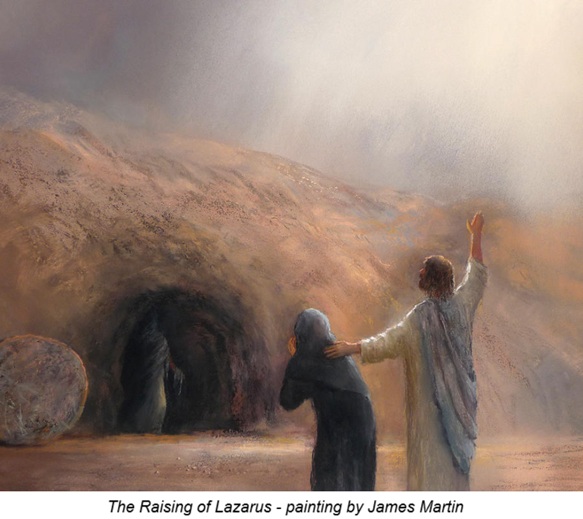
In chapter 11 of the Gospel According to John, verses 1-45, we read about the raising of Lazarus. In order to go to the home of his good friends, Mary, Martha, and the now deceased Lazarus, Jesus must return to the town where people have tried to stone him, more than once. In addition, by the time Jesus arrives there, it has been four days since Lazarus’ lifeless body was placed in the tomb. Many would deem this situation hopeless or impossible. Why does Jesus go back to the place where he is mocked, and people are seeking his demise? Why does Jesus even attempt to raise Lazarus who is clearly beyond resuscitation?

Because Jesus is Life! He is full of love and mercy, the embodiment of God, and death, in any of its forms, cannot and will not defeat Him, or those who belong to Him. For it is through Him, that all things are possible.      

Now a man was ill, Lazarus from Bethany,
the village of Mary and her sister Martha.
Mary was the one who had anointed the Lord with perfumed oil
and dried his feet with her hair;
it was her brother Lazarus who was ill.
So the sisters sent word to him saying,
“Master, the one you love is ill.”
When Jesus heard this he said,
“This illness is not to end in death,
but is for the glory of God,
that the Son of God may be glorified through it.”
Now Jesus loved Martha and her sister and Lazarus.
So when he heard that he was ill,
he remained for two days in the place where he was.
Then after this he said to his disciples,
“Let us go back to Judea.”
The disciples said to him,
“Rabbi, the Jews were just trying to stone you,
and you want to go back there?”
Jesus answered,
“Are there not twelve hours in a day?
If one walks during the day, he does not stumble,
because he sees the light of this world.
But if one walks at night, he stumbles,
because the light is not in him.”
He said this, and then told them,
“Our friend Lazarus is asleep,
but I am going to awaken him.”
So the disciples said to him,
“Master, if he is asleep, he will be saved.”
But Jesus was talking about his death,
while they thought that he meant ordinary sleep.
So then Jesus said to them clearly,
“Lazarus has died.
And I am glad for you that I was not there,
that you may believe.
Let us go to him.”
So Thomas, called Didymus, said to his fellow disciples,
“Let us also go to die with him.”
When Jesus arrived, he found that Lazarus
had already been in the tomb for four days.
Now Bethany was near Jerusalem, only about two miles away.
And many of the Jews had come to Martha and Mary
to comfort them about their brother.
When Martha heard that Jesus was coming,
she went to meet him;
but Mary sat at home.
Martha said to Jesus,
“Lord, if you had been here,
my brother would not have died.
But even now I know that whatever you ask of God,
God will give you.”
Jesus said to her,
“Your brother will rise.”
Martha said to him,
“I know he will rise,
in the resurrection on the last day.”
Jesus told her,
“I am the resurrection and the life;
whoever believes in me, even if he dies, will live,
and everyone who lives and believes in me will never die.
Do you believe this?”
She said to him, “Yes, Lord.
I have come to believe that you are the Christ, the Son of God,
the one who is coming into the world.”
When she had said this,
she went and called her sister Mary secretly, saying,
“The teacher is here and is asking for you.”
As soon as she heard this,
she rose quickly and went to him.
For Jesus had not yet come into the village,
but was still where Martha had met him.
So when the Jews who were with her in the house comforting her
saw Mary get up quickly and go out,
they followed her,
presuming that she was going to the tomb to weep there.
When Mary came to where Jesus was and saw him,
she fell at his feet and said to him,
“Lord, if you had been here,
my brother would not have died.”
When Jesus saw her weeping and the Jews who had come with her weeping,
he became perturbed and deeply troubled, and said,
“Where have you laid him?”
They said to him, “Sir, come and see.”
And Jesus wept.
So the Jews said, “See how he loved him.”
But some of them said,
“Could not the one who opened the eyes of the blind man
have done something so that this man would not have died?”
So Jesus, perturbed again, came to the tomb.
It was a cave, and a stone lay across it.
Jesus said, “Take away the stone.”
Martha, the dead man’s sister, said to him,
“Lord, by now there will be a stench;
he has been dead for four days.”
Jesus said to her,
“Did I not tell you that if you believe
you will see the glory of God?”
So they took away the stone.
And Jesus raised his eyes and said,
“Father, I thank you for hearing me.
I know that you always hear me;
but because of the crowd here I have said this,
that they may believe that you sent me.”
And when he had said this,
He cried out in a loud voice,
“Lazarus, come out!”
The dead man came out,
tied hand and foot with burial bands,
and his face was wrapped in a cloth.
So Jesus said to them,
“Untie him and let him go.”
Now many of the Jews who had come to Mary
and seen what he had done began to believe in him. – John 11:1-45

It Travels and Echoes…

Waking up to the sounds of birds singing to each other,
Calling back and forth,
Noise bouncing here and there—echoes,
Do they realize how far their voices reach?
What is their intention?
What’s that now?
What do they say?
Something familiar, something new,
They whistle in possibilities,
And the newness of the day.
What is my intention?
How does it travel?
What do I say?
Do I realize the blessing that comes with this new day?

The Lord has done great things for us; we are filled with joy. – Psalm 126:3