Waiting to Arrive…

Looking out at the thin ice in the quiet stillness of early morning, I think, “How fragile life is.” As I sit and watch, I feel tired… stretched thin. Until this moment, it has been so busy… too busy.

I survey the area. It seems motionless. I think, “The time is now.” Everyone…everything must wait.

While time continues to tick, I linger, allowing more than just a chance to be still and listen. With each minute that passes, I feel a calm and steady strength growing from deep within. How resilient Life is.

ThinIce

My eyes are ever upon the LORD, who frees my feet from the snare. – Psalm 25:15

Lady Luck…

As I proceeded toward the steps and the front door, I could see something… a bug, moving on the frame around the door. With each step, I could see it more clearly. I was thinking, “It couldn’t be, it’s too cold,” but as I got closer to the front door, I saw that in fact it was a ladybug. What a pleasant surprise, in stark contrast to the spotting of the brown stink bugs that are common this time of year.

As I watched the ladybug crawling around for a few moments, I could not help but smile. Although it was a small thing, on a rather chilly day, this friendlier, more palpable kind of bug brought a sense of wonder and joy to me as the weather progresses toward winter where I live.

What a great way to prepare to enter the house. What a great way to prepare to enter any place for that matter. To go forth thinking… feeling… remembering the truth of what it means to be begotten by God. That is blessed!

Gifts and blessings come in packages of all types and sizes. Look for and welcome the unexpected. Receive all that each moment brings. Strive to remain faithful regardless of circumstances. Trust that what God has in store is always the best.

You will show me the path to life,
fullness of joys in your presence,
the delights at your right hand forever. – Psalm 16:11

LadyBug

The Point of Letting Go…

“The jar of flour did not go empty, nor the jug of oil run dry…” (1 Kings 17:16). Why? Because the Lord ordained it to be so.

In those days, Elijah the prophet went to Zarephath.
As he arrived at the entrance of the city,
a widow was gathering sticks there; he called out to her,
“Please bring me a small cupful of water to drink.”
She left to get it, and he called out after her,
“Please bring along a bit of bread.”
She answered, “As the LORD, your God, lives,
I have nothing baked; there is only a handful of flour in my jar
and a little oil in my jug.
Just now I was collecting a couple of sticks,
to go in and prepare something for myself and my son;
when we have eaten it, we shall die.”
Elijah said to her, “Do not be afraid.
Go and do as you propose.
But first make me a little cake and bring it to me.
Then you can prepare something for yourself and your son.
For the LORD, the God of Israel, says,
‘The jar of flour shall not go empty,
nor the jug of oil run dry,
until the day when the LORD sends rain upon the earth.'”
She left and did as Elijah had said.
She was able to eat for a year, and he and her son as well;
the jar of flour did not go empty,
nor the jug of oil run dry,
as the LORD had foretold through Elijah.

– 1 Kings 17:10-16

God sent Elijah to the widow and her son during a period of famine. God’s plan, always, is to provide sustenance for those who are receptive to it. Oftentimes in order to receive the grace that God has in store, one must let go of something that is “other.” More often than not, it involves changing; adjusting, fine-tuning, or altogether shedding that which we may have resigned ourselves to holding onto.

Certainly, it would have been easy as well as justifiable for the widow at Zarephath to hold onto the last of her flour and oil rather than to share any portion of it with Elijah, the stranger in her midst. At first, it seems to be her intention to do just that. However, she listens to the prophet’s words and trusts the way in which they resonate with her.

Although the prophet, and the widow and her son are different, the same God leads each of them. It is in cooperation with God that they recognize this in each other, and in doing so, become one with the grace waiting to be bestowed upon them.

God calls and sends Elijah to a new place. The same God helps the widow to let go of what little she has, instead of clinging to it, and to trust that it will be enough for all… and it is.

YellowFall2

More than You and Me…

Any unity which does not have its origin in the multitudes is tyranny. – Blaise Pascal

It can be wonderful how a sense of togetherness can propel us to new heights. Unity bridges the gap, closing the chasm that can be created by differences of any kind. Oftentimes, the joy that accompanies unity helps in continuing on the path toward the wisdom and knowledge of what to let go of and how to rise above all that may stand in the way.

In the book, Confession, Leo Tolstoy wrote, “I understood, not with my intellect but with my whole being, that no theories of the rationality of existence or of progress could justify such an act; I realized that even if all the people in the world from the day of creation found this to be necessary according to whatever theory, I knew that it was not necessary and that it was wrong. Therefore, my judgments must be based-on what is right and necessary and not on what people say and do; I must judge not according to progress but according to my own heart.” This statement was written about an execution that the author had witnessed in the mid-1800s, but the insight it shares, is timeless.

Oftentimes, the intentions of those in charge or a group united in purpose can be mistaken for unity. However, unity is both powerful and healing in all directions, not just on one side. It is not the child of negotiation or compromise to reach agreement, but rather embodies a spirit of choosing right doing whatever that might entail. By oneself or in self-interest… without God, unity simply cannot be.

Standing together is fine, but standing in unity is best.

Jesus summoned the twelve and said to them,
“You know that those who are recognized as rulers over the Gentiles
lord it over them,
and their great ones make their authority over them felt.
But it shall not be so among you.
Rather, whoever wishes to be great among you will be your servant;
whoever wishes to be first among you will be the slave of all.
For the Son of Man did not come to be served
but to serve and to give his life as a ransom for many.”

– Mark 10:42-45

OnFire


This Alone…

As a child, I remember being struck by the great change in Moses’ appearance at one point when he came down from the mountain. Moses, as portrayed by the actor Charlton Heston in The Ten Commandments, now had a face that was aglow and silver streaked hair. I recall watching intently and listening, wanting to know more about what had happened between him and God. It was clear that Moses’ experience was a pretty big deal, changing not only his appearance, but also seemingly strengthening his resolve and helping him to journey onward once more.

In the Book of Numbers (chapter 11, verses 25-29), it is written that the Lord imparted some of the spirit that had been given to Moses unto a number of others, seventy elders to be exact. Just verses before that, Moses had asked and questioned the Lord about the current situation. He also expressed his thoughts and feelings regarding the struggle to lead the people through the wilderness while trying to deal with their growing unhappiness. In verse 11, Moses said to the Lord, “I cannot carry all this people by myself, for they are too heavy for me.”

The Lord hears Moses and responds, lessening the weight Moses feels upon his shoulders, reminding him that he is not alone, and providing what he needs to continue his part in carrying out God’s will. Eldad and Medad, who we are told were on the list of the seventy elders, but who were not in the group that had gathered to receive the spirit, also began prophesying. When this is reported to Moses, Joshua, his “assistant,” is of the mind that Eldad and Medad must be stopped at once. However, Moses, his heart fixed on God’s will and his desire to cooperate with it steady and strong, is not only able to see the truth, but also to speak it.

We are all God’s people… all called to be prophets… all called to participate in carrying out, and cooperating with, God’s will.

Moses believed and bought into God’s grace, placing it, rightfully, above human judgment and understanding. He took the leap. Do we?

Knock, and He’ll open the door
Vanish, and He’ll make you shine like the sun
Fall, and He’ll raise you to the heavens
Become nothing, and He’ll turn you into everything. – Rumi

ThisAlone

The LORD came down in the cloud and spoke to Moses.
Taking some of the spirit that was on Moses,
the LORD bestowed it on the seventy elders;
and as the spirit came to rest on them, they prophesied.

Now two men, one named Eldad and the other Medad,
were not in the gathering but had been left in the camp.
They too had been on the list, but had not gone out to the tent;
yet the spirit came to rest on them also,
and they prophesied in the camp.
So, when a young man quickly told Moses,
“Eldad and Medad are prophesying in the camp, “
Joshua, son of Nun, who from his youth had been Moses’ aide, said,
“Moses, my lord, stop them.”
But Moses answered him,
“Are you jealous for my sake?
Would that all the people of the LORD were prophets!
Would that the LORD might bestow his spirit on them all!” – Numbers 11:25-29

Before (and with) the Lord…

A good amount of each day is spent traveling from one spot to another. Sometimes the distance is short—a few steps here or there—and sometimes it is longer. For sure, there is a lot of physical movement by each of us as well as around us throughout any given day. Add to this the movements that occur within that are not “physical,” such as a change of heart, a new or different perspective, and so on.

In Psalm 116, the psalmist writes, “I shall walk before the LORD in the land of the living” (verse 9). Notice how the psalmist does not write, “I shall run before the Lord,” “I shall stand before the Lord,” or “I shall sit before the Lord.” The psalmist uses the word, “walk.”

“I shall walk before the Lord.” It is intentional, measured, and purposeful, as if to say, “As I go about my way in this life, I will move with meaning, ever mindful of the Lord’s presence.” A tall order, yes, but not impossible one step… one moment at a time.

The journey is meant to be something that is striven for, without succumbing to a notion or drive toward perfection. Mistakes and mishaps, trials and tribulations are par for the course, and the more one can acknowledge and look to learn from them, the less distraction they will cause while walking through them. More than anything, it is about a heart that is open and willing, filled with desire for constant contact and union with the Lord, while in the land of the “living.”

In the Gospel of Mark, chapter 8, verses 27-35, Jesus asks his disciples about who they believe him to be. Peter immediately answers, “You are the Messiah.” Peter knows and believes in Jesus as the Savior, but he, like the others, does not know what that really means. When Jesus then tells them that he will be beaten and killed, and about his resurrection, Peter responds just as fervently as he did when professing Jesus as the Messiah. However, where Peter says to the Lord, “Yes!” loud and clear, now when Jesus tells him something that is unexpected, unpleasant, and most likely the exact opposite of what he has envisioned or hoped for, Peter says to the Lord, “No!” loud and clear. While his passion may be the same, in that moment, he loses sight of the Lord and with that, his response moves away from being intentional, measured, and purposeful. Jesus recognizes this immediately and responds, “Get behind me, Satan. You are thinking not as God does, but as human beings do.”

As Peter continues striving to walk with the Lord both before and after the death and resurrection of Jesus, he learns as he moves and grows in trust, wisdom, and understanding. We, also disciples, are called to move in the same way… and we can, too.

How do I walk not only before the Lord, but also with and in the Lord as I go about each day… each moment?

We must not mind insulting men, if by respecting them we offend God. – Saint John Chrysostom

BiddefordPoolSunset

Jesus and his disciples set out
for the villages of Caesarea Philippi.
Along the way he asked his disciples,
“Who do people say that I am?”
They said in reply,
“John the Baptist, others Elijah,
still others one of the prophets.”
And he asked them,
“But who do you say that I am?”
Peter said to him in reply,
“You are the Christ.”
Then he warned them not to tell anyone about him.

He began to teach them
that the Son of Man must suffer greatly
and be rejected by the elders, the chief priests, and the scribes,
and be killed, and rise after three days.
He spoke this openly.
Then Peter took him aside and began to rebuke him.
At this he turned around and, looking at his disciples,
rebuked Peter and said, “Get behind me, Satan.
You are thinking not as God does, but as human beings do.”

He summoned the crowd with his disciples and said to them,
“Whoever wishes to come after me must deny himself,
take up his cross, and follow me.
For whoever wishes to save his life will lose it,
but whoever loses his life for my sake
and that of the gospel will save it.” – Mark 8:27-35


Bigger than the Shadows…

Observing the valley and the mountain across the way from the top of a ridgeline, the magnificence of the landscape, despite shadows cast by some of the clouds, was undeniable. We found ourselves in awe of the vastness and beauty all around us. It was so much so, that neither the clouds nor the fog that rolled in or the passing rain shower could dull our spirits or lessen the sense of appreciation and joy in our hearts. Recalling the experience, if I had to name it or add a caption, it would simply be, “The Glory of God: Always Bigger than the Shadows.” How true.

In the Gospel of Mark, the Pharisees and scribes ask Jesus, “Why do your disciples not follow the tradition of the elders but instead eat a meal with unclean hands” (Mark 7:5)? Jesus sees the shadows for what they are and responds by shedding light and guiding people to Truth.

As Jesus replies to the Pharisees and scribes, he tells them, “You nullify the word of God in favor of your tradition that you have handed on. And you do many such things” (Mark 7:13). Then he turns his attention back to the people. It is written, “He summoned the crowd again and said to them, ‘Hear me, all of you, and understand. Nothing that enters one from outside can defile that person; but the things that come out from within are what defile.’”

While the shadows may attempt to obscure or distort the view, the truth is always revealed to those whose hearts honestly desire and work to see and live within Truth, as they make their way.

“God of might, giver of every good gift, put into our hearts the love of your name, so that, by deepening our sense of reverence, you may nurture in us what is good, and by your watchful care, keep safe what you have nurtured.” (Collect for September 2, 2018)

Shadow

Now when the Pharisees with some scribes who had come from Jerusalem gathered around him, they observed that some of his disciples ate their meals with unclean, that is, unwashed, hands.

(For the Pharisees and, in fact, all Jews, do not eat without carefully washing their hands, keeping the tradition of the elders. And on coming from the marketplace they do not eat without purifying themselves. And there are many other things that they have traditionally observed, the purification of cups and jugs and kettles [and beds].)

So the Pharisees and scribes questioned him, “Why do your disciples not follow the tradition of the elders but instead eat a meal with unclean hands?”

He responded, “Well did Isaiah prophesy about you hypocrites, as it is written:

‘This people honors me with their lips,
but their hearts are far from me;
In vain do they worship me,
teaching as doctrines human precepts.’

You disregard God’s commandment but cling to human tradition.”

He went on to say, “How well you have set aside the commandment of God in order to uphold your tradition!

For Moses said, ‘Honor your father and your mother,’ and ‘Whoever curses father or mother shall die.’

Yet you say, ‘If a person says to father or mother, “Any support you might have had from me is qorban”’ (meaning, dedicated to God), you allow him to do nothing more for his father or mother.

You nullify the word of God in favor of your tradition that you have handed on. And you do many such things.”

He summoned the crowd again and said to them, “Hear me, all of you, and understand. Nothing that enters one from outside can defile that person; but the things that come out from within are what defile.”

When he got home away from the crowd his disciples questioned him about the parable.

He said to them, “Are even you likewise without understanding? Do you not realize that everything that goes into a person from outside cannot defile, since it enters not the heart but the stomach and passes out into the latrine?” (Thus he declared all foods clean.)

“But what comes out of a person, that is what defiles. From within people, from their hearts, come evil thoughts, unchastity, theft, murder, adultery, greed, malice, deceit, licentiousness, envy, blasphemy, arrogance, folly. All these evils come from within and they defile.” – Mark 7:1-23

Through the Tunnel…

As we drove into the darkness of the tunnel, the bright, sunny day behind us, I lifted my sunglasses, resting them on top of my head. Now what had been too dark, was still dim compared to before, but bright enough to see with the lights along the inside walls. We traveled forward, staying strictly within one lane, continuing at a steady pace, and eventually we could see sunlight once more as we neared the other end of the tunnel and the road opened up before us.

Sometimes, among the mountains, hills, and valleys of life, there are the plateaus, pitfalls, and tunnels too. Through it all though, the grace of God lives and breathes. It seeps into each and every crevice, pours into spaces that are wide, washes over and takes root wherever there is a soul willing to give into it… ready to succumb.

The goodness of God exists from beginning to end, in every place, and at all times.

1_HarborTunnelVision

2_SunriseBaltimore

3_Broccoli

4_Butterfly2

5_Doe

6_FerrisWheel

7_Flowers

8_ManMadeNature

9_Shenandoah2

10_Woodchuck

11_Carousel

12_DrivingByPotomac

13_PurplePrickly

14_Shenandoah5

15_Shenandoah

16_SunsetCanobie

Trust and You Will See…

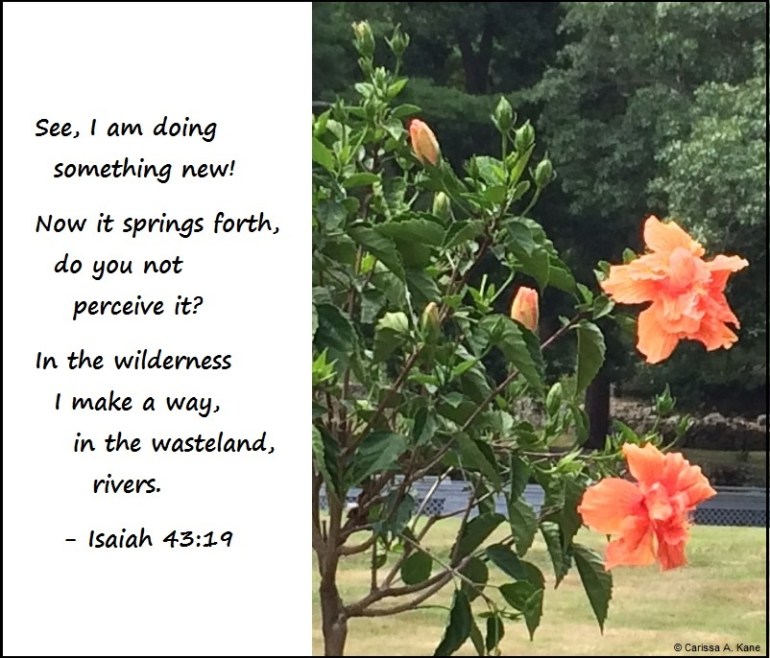
Yes! I can see it! Something new!

Noticing the flowers that were in full bloom among those that were just breaking out of the bud, and alongside those that were still tightly wound, enclosed in leaves of green, it was easy to take in the beauty of what was there and find joy in the anticipation of what seemed sure to be… more flowers.

When my children were much younger they had a few classroom activities throughout their preschool and early elementary school years that highlighted the cycle of life for plants and animals. I remember both their interest and their awe at each new stage or milestone. I also recall their lack of interest during the times of “stagnancy”… when it seemed nothing was happening.

One year there was the small clay pot filled with soil that eventually sprouted a stalk and green beans. For what seemed like an eternity to my children—two weeks—the pot of soil seemed the same, day after day. However, with care and proper attention, beneath the surface, buried in the soil, the seed was changing and growing the whole time. Then one day, the stalk was there. It seemed like it came out of nowhere.

It is so much easier to trust that something worthwhile lies ahead, is coming into existence, or is already happening when one can see or sense even the tiniest of signs. This is no secret. Not only do we know it, but so does God.

Seek signs, but first ask God for them.

I sought the LORD, and he answered me,
delivered me from all my fears. – Psalm 34:5

TrustAndYouWillSee

145 Reasons, and More…

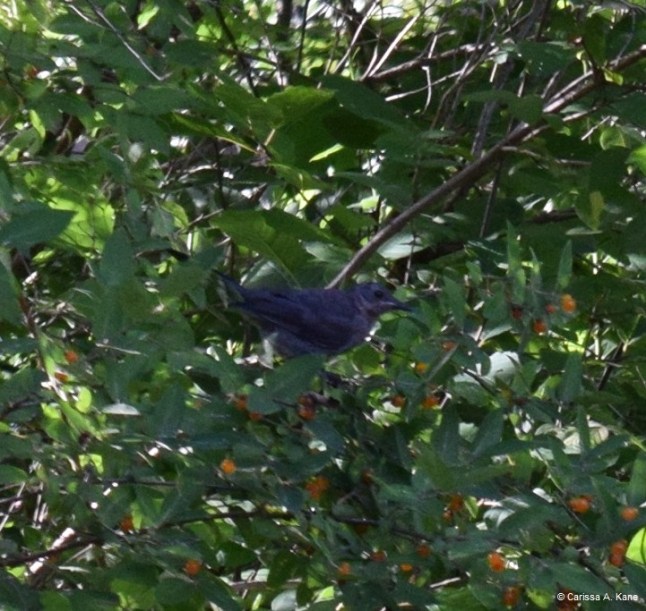
As they sing, the birds convey a sense of joy as if to say, “All is well,” with a confidence that comes from deep within and extends far beyond the earth and sky. Listening to their song is like listening to a parable, a more basic or simple presentation of the message at hand. Divine messages, signs, evidence, or assurances are all around, all the time.

Despite this, human nature is consistently tempted to tend toward throwing up our hands when situations seem impossible or the odds seem stacked against us. Yet, time and again, and perhaps when we least expect it, the stars align and “I Am” shines ever bright, reminding us that all things are possible for and through God.

The disciples, Philip and Andrew, basically tell Jesus that there are too many people, too little money, and too few items of food (John 6:1-15). They believe the situation is impossible and that there is no way for them to make a difference. Instead of forgetting themselves (and what they may be capable of, or limited to, on their own), they forget who is with them—Jesus!

This reaction or response, when faced with needs that are greater than what is known or visibly available to meet them, is nothing new. In the Old Testament in the second book of Kings, it is written, “A man came from Baal-shalishah bringing the man of God twenty barley loaves made from the first fruits, and fresh grain in the ear. Elisha said, ‘Give it to the people to eat.’ But his servant objected, ‘How can I set this before a hundred?’ Elisha again said, ‘Give it to the people to eat, for thus says the LORD: You will eat and have some left over.’ He set it before them, and when they had eaten, they had some left over, according to the word of the LORD” (2 Kings 4:42-44).

Faith calls us to remember and to grow strong in our belief that when genuinely striving to be faithful to God, ultimately, the odds are with us. Faith calls us to think beyond ourselves and to say with our entire being, “I believe. Show me how. Show me the way, Jesus,” and then to listen, trusting as we follow, “The hand of the Lord feeds us, answering all our needs” (Psalm 145:16).

BlackbirdBerries

Jesus went across the Sea of Galilee.
A large crowd followed him,
because they saw the signs he was performing on the sick.
Jesus went up on the mountain,
and there he sat down with his disciples.
The Jewish feast of Passover was near.
When Jesus raised his eyes
and saw that a large crowd was coming to him,
he said to Philip,
“Where can we buy enough food for them to eat?”
He said this to test him,
because he himself knew what he was going to do.
Philip answered him,
“Two hundred days’ wages worth of food would not be enough
for each of them to have a little.”
One of his disciples,
Andrew, the brother of Simon Peter, said to him,
“There is a boy here who has five barley loaves and two fish;
but what good are these for so many?”
Jesus said, “Have the people recline.”
Now there was a great deal of grass in that place.
So the men reclined, about five thousand in number.
Then Jesus took the loaves, gave thanks,
and distributed them to those who were reclining,
and also as much of the fish as they wanted.
When they had had their fill, he said to his disciples,
“Gather the fragments left over,
so that nothing will be wasted.”
So they collected them,
and filled twelve wicker baskets with fragments
from the five barley loaves
that had been more than they could eat.
When the people saw the sign he had done, they said,
“This is truly the Prophet, the one who is to come into the world.”
Since Jesus knew that they were going to come and carry him off
to make him king,
he withdrew again to the mountain alone.

– John 6:1-15