Familiarity…

What is it that turns the less familiar or unknown into something to be wary of? What is it that stirs up friction, creates angst, and seeks to build fortresses around what is “known” and against what is new or different? While familiarity can be a good thing, it can also get in the way of better things.

At times, what is known can pull at strings, hoping to stretch nerves thin, to direct hearts and minds to narrow ends, and to fill wide, open space with falsehoods. Yes, what’s familiar and comfortable can and will, at times, masquerade around as one beneficial thing or another, while really playing on deep seated or hidden worries, and selling deception as truth.

In the Gospel passage for the 12th Sunday in Ordinary Time (Matthew 10:26-33), Jesus says, “Fear no one…,” “Do not be afraid…,” “Do not be afraid…” As you think about your day-to-day life, envision yourself looking around and listening. Take notice. What do you see and hear? What thoughts and feelings are evoked? And, more importantly, where, or to whom, does it lead you?

“God made Truth with many doors to welcome every believer who knocks on them.” – Khalil Gibran

This is why it’s so important to take time to pause for prayer and to reflect on not only the direction in which one is travelling, but also to notice who or what is prompting or leading one’s movement.

Throughout Scripture we see God engaging with creation in a way that shows flexibility, mercy, forgiveness, and a give and take that always leaves room for growth of heart and mind, and thus, greater understanding that includes reason, but also often extends beyond it. We also see free will, and the twists and turns and outcomes, often unexpected by the human mind, that flow from it. We see many examples of people acting, reacting, and responding out of fear that sells itself as die-hard commitment to tradition, or presents itself as self-preservation, pride, greed, jealousy, and more. There are also many examples of people rising above the circumstances, in ways alternative to the times in which they lived. And through it all, we see, time and again, God’s flexibility through unwavering love, patience, compassion, forgiveness, integrity, and understanding.

What’s an image from Scripture that comes to mind when you think about interactions between God and a person or group of people? Go to a passage that includes one of the interactions, read it, and then spend some time reflecting on it. What are you most drawn to in the passage? What qualities of God touch your heart most deeply? What is God revealing to you and wanting you to know at this moment?
What’s it like to think that maybe everything you’ve ever known is just a fraction of every good thing that awaits you on the other side of resistance to the unfamiliar?
Ignited by the Spirit…

Do you recall being in a group of people, partaking in an experience, whatever it might have been, and having anything that might normally serve to create a wedge or cause a disturbance, fade away? What was that like?

Oftentimes, when such experiences occur, it’s because there is a shared focus and desire that outweighs all the things that might otherwise interfere and distract individuals away from being influenced by the Spirit that moves them toward embracing what is mutually beneficial to all. In other words, it happens when one lets go and detaches from being driven by what is more immediately self-serving or earthly. This then leaves room to be led by the Spirit.

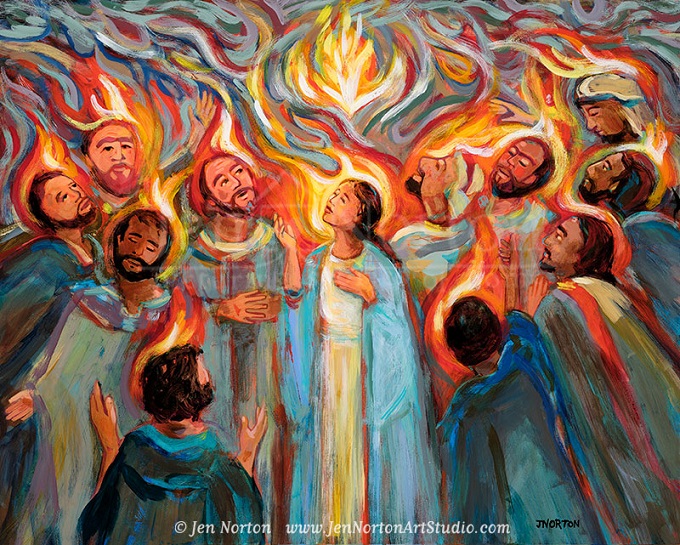
In chapter 2 of the Acts of the Apostle’s, it is written,

And they were all filled with the Holy Spirit
and began to speak in different tongues,
as the Spirit enabled them to proclaim.

Now there were devout Jews from every nation under heaven staying in Jerusalem.
At this sound, they gathered in a large crowd,
but they were confused
because each one heard them speaking in his own language.
They were astounded, and in amazement they asked,
“Are not all these people who are speaking Galileans?
Then how does each of us hear them in his native language?” – Acts 2:4-8

This is an example of the Spirit breaking down barriers that would seek to prevent the Good News from being shared, lived, and spread across the face of the earth. Reading on, we learn more about the many different places from which the crowd came. Undoubtedly, they also had different ideas on how to live and how to go about doing things.

We are Parthians, Medes, and Elamites,
inhabitants of Mesopotamia, Judea and Cappadocia,
Pontus and Asia, Phrygia and Pamphylia,
Egypt and the districts of Libya near Cyrene,
as well as travelers from Rome,
both Jews and converts to Judaism, Cretans and Arabs,
yet we hear them speaking in our own tongues
of the mighty acts of God.” – Acts 2:9-11

What’s it like to contemplate the way that the Spirit enabled the disciples of Jesus, who were, for all intents and purposes, more alike than not, to communicate with those who spoke different languages and were foreign to them?

Notice how the Spirit enabled the disciples, and further defined the notion of discipleship, to become more diverse while at the same time bringing about greater unity. Also consider the posture of the disciples. In chapter 1 of the Acts of the Apostles, we read that they, “devoted themselves with one accord to prayer” and we see that play out in the choice of Matthias to join them (v. 15-26) as well as in their choices going forward. Again, they are united in prayer with hearts that desire to be led to “do the right thing” (what is good and just) more so than choosing based on personal preference or bias. This is what happens when there is a genuine striving to do what is best.

On this Pentecost, in a world that continues to face such great division and strife, the words of Thomas Merton seem so appropriate, “My dear brothers and sisters, we are already one. But we imagine we are not. And what we have to recover is our original unity. What we have to be, is what we are.”

Take some time to meditate on these words. Pray with what comes to mind and how your heart is moved. What does the Spirit want to show you?

When you send forth your spirit, they are created, and you renew the face of the earth. – Ps 104:30

Ascending…

In the perpetual quest
So quietly pursued,
Rising up and reaching out.
Catching to the eye,
Inviting to the soul,
A symbol and a sign,
Whether seen by one or not.

Aspiring to something greater.
Ascending from the earth,
Leaving worms to worm it out.
So simple, yet so not.

Seeking to be found,
Finding what is sought,
Staying true, ever knowing,
Not so much is all that deep.
Not so much is lasting.

The earth is crying,
Tearing everywhere,
Calling out for something real.
Not just some trick or worse,
Not a passing trend or racket.

And authenticity, if it’s true,
Can’t be bought.

May the eyes of your hearts be enlightened, that you may know what is the hope that belongs to God’s call. (Ephesians 1:18)

Emmaus…

Today, April 22, 2023, as we head into the 3rd Sunday of Easter, we celebrate Earth Day. The earth has been around for over 4.5 billion years, and Earth day? It has been celebrated for 53 years—since 1970.

Despite the comparatively young age of Earth Day, an appreciation for, and the call to honor and preserve the beauty of our planet, nature, and all creation has been ongoing for a far greater time than has been documented. In fact, it’s part of the plan, and path of life. Yet, as with many things, it can become a battle ground… a place for sides to be formed, to rise up against each other, to hold firm, to lose sight, and to stall any attempts at dialogue and resolution, never mind love and mercy.

In the readings for the 3rd Sunday of Easter (Acts 2:14, 22-23; Ps 16:1-2,5, 7-8, 9-10, 11; 1 Pt 1:17-21, and Lk 24:13-35), there lies an invitation to connect more strongly with the path of life as being bigger, and sweeping more broadly, than the circle in which any one individual, or group, travels. So often when we think we know, we don’t. The issues at hand are always more than what we can see, and the way that any one individual may or may not be affected, cannot be used to color the experience of all of humankind. How, after all, is it possible to be open to Divinity, without being open to possibilities?

Turning to Scripture, it seems that those who sought to crucify Jesus, were so sure that he was a threat. It’s clear that His ways were not in line enough with theirs and one can imagine how that might jeopardize their sense of identity, authority, power, and control. We can see how their ability to move in ways that embraced and imbued love, truth, justice, and mercy was hindered by their inability to recognize that they were seeing and acting through their own, limited understanding. There was no room for God on the path to which they were so deeply committed, and this led to them receiving and reacting in fear and seeking even greater control, rather than responding with love.

On the other hand, Jesus, who reacted with love and was inspired by God, could not be held down, even by death.

This man, delivered up by the set plan and foreknowledge of God,
you killed, using lawless men to crucify him.
But God raised him up, releasing him from the throes of death,
because it was impossible for him to be held by it.
For David says of him:
I saw the Lord ever before me,
with him at my right hand I shall not be disturbed.
Therefore my heart has been glad and my tongue has exulted;
my flesh, too, will dwell in hope,
because you will not abandon my soul to the netherworld,
nor will you suffer your holy one to see corruption.
You have made known to me the paths of life;
you will fill me with joy in your presence. – Acts 2:23-28

This is the message of our faith, and the model that we are to follow. Our faith and hope is to be placed in God, and doing so, our words and actions will reflect the Way of God. The Way where our eyes are opened and our hearts burn with desire to be in the service of Love, wherever it leads.

On the road to Emmaus, the two disciples requested of Jesus, “Stay with us” (Lk 24:29).

In our striving, we must do the same, and like the disciples, we must also leave room for the breaking of bread and having hearts that are open to receive, with the love of Jesus, whatever may be revealed.

“You cannot get through a single day without having an impact on the world around you. What you do makes a difference, and you have to decide what kind of difference you want to make.” – Jane Goodall

In the Fabric…

It’s challenging, to say the least, to live in a world where tangible assets not only overwhelmingly drive motivation, but also speculation and modes of operation. And even more than that, status and materialism push humankind toward pursuits that are often so far removed from the stirrings and movements of grace that seek to connect and strengthen hearts.

St. Ignatius of Loyola wrote, “For it is not knowing much, but realizing and relishing things interiorly, that contents and satisfies the soul.” Yet, as suggested in Ecclesiastes, the human condition is such that we continue to toil under the sun to know more, do more, win more, and so on. But for what kind of gain? and at what cost?

Here is one who has labored with wisdom and knowledge and skill,
and yet to another who has not labored over it,
he must leave property.
This also is vanity and a great misfortune.
For what profit comes to man from all the toil and anxiety of heart
with which he has labored under the sun?
All his days sorrow and grief are his occupation;
even at night his mind is not at rest.
This also is vanity. – Ecc 2:21-23

Looking around, or tuning in to the pulse of society, one can only wonder, with that beat, what kind of “more” will ever be enough? And in the process, what happens to the hearts involved? There’s ebb and flow of course, but in what ways and to what degree do they drift? And at what point does the unfamiliar become all too familiar?

Turning to Psalm 95, the psalmist writes, “If today you hear God’s voice, harden not your hearts.” Before that, a call to turn back to the One who knows.

Teach us to number our days aright,
that we may gain wisdom of heart. – Ps 90:12

Remember, ask and you shall receive. However, as always, there’s choice in how one responds.

St. Paul urges us forward, let go of that which binds one to the earth and drags one down. Instead, be grounded to, as well as through, that which is elevated and fulfilling in a far greater way.

If then you were raised with Christ, seek what is above, where Christ is seated at the right hand of God.
Think of what is above, not of what is on earth. – Col 3:1-2

Be true… be not only baptized into Christ, but also put on Christ. Think about it. How does the heart and mind of Christ infuse your soul? How does it influence choices as you face challenges and navigate this world?

In the Gospel according to Luke (chapter 12:13-21), Jesus tells the parable of the rich man who had such a surplus at harvest that he replaced his barns with even bigger ones so he could essentially rest on his laurels and live off all that he had store up. While this parable can lead one to reflect on possessions and sharing or helping others from what one has, it can also be a catalyst to considering more closely how one’s pursuits affect the fabric of one’s being. Aside from the tangible, from what has one’s heart moved away? To what has one’s heart moved toward? And most importantly, where is God in all of that?

I Believe…

I believe that sometimes society seems to be hanging by a thread, but that’s not all I believe…

I believe that God creates similarities, differences, and various dimensions intentionally, rather than carbon copies, or only one kind or way of being.

I believe freedom resides within and is a gift from God entrusted to each, to do with as one wills—as in free will.

I believe that it’s up to each to choose for themselves that which affects, most especially, oneself.

I believe and, also trust, that God has more wisdom than all of us together, seeing things we cannot see and understanding in ways which humans simply cannot.

I believe that to love like Jesus is to love like God—with great depth and breadth, yet personal and unique onto each of us as if we were the only one.

I believe that where hearts and minds are open to the Spirit that is Holy, unity and diversity not only live, but also thrive.

I believe that true victory does not rob others from choosing for themselves, and that what some may celebrate as a “win,” God does not.

I believe the compassion and mercy of God is all encompassing, and that clearly humankind’s is often not.

Most of all, I believe that the greater glory belongs to God, all of “this” will fade away, and that ultimately, through the hearts that are willing, God’s unifying way of love, compassion, and mercy prevails.

I believe that sometimes society seems to be hanging by a thread, but maybe sometimes that’s what we need to be.

And Mary kept all these things, reflecting on them in her heart. – Luke 2:19

Clearly…

In chapter 13, verse 34 of the Gospel according to John, Jesus says, “I give you a new commandment: love one another. As I have loved you, so you also should love one another.” And, throughout the Gospels, there are many examples of Jesus’ love shown through his words, actions, reactions, and responses. Yet, to love as Jesus loved, can be very challenging, and maybe even feel impossible at times.

However, in the First Letter to the Corinthians (15:45-49), St. Paul really puts the focus on the keys to unlocking the ability to love as Jesus did. In comparing the first Adam to the last Adam (Jesus), St. Paul puts a reminder out there to not get caught up in the things of the world. The things that are material or mainly have to do with personal gain, in the end, will be immaterial. Furthermore, like with Adam and Eve, these things have a way of distorting our vision and pulling us away from the spirit of God.

So, too, it is written, the first man, Adam, became a living being,
the last Adam a life-giving spirit.
But the spiritual was not first;
rather the natural and then the spiritual.
The first man was from the earth, earthly;
the second man, from heaven.
As was the earthly one, so also are the earthly,
and as is the heavenly one, so also are the heavenly.
Just as we have borne the image of the earthly one,
we shall also bear the image of the heavenly one. – 1 Corinthians 15:45-49

St. Paul is saying, remember the truth of who you are, and stay connected to it. There is no loving as Jesus did, without being able to embrace the grace of God in whose image we are created. There is no loving as Jesus did, without the spirit of God helping us to strip away the human inclination toward the world’s view of any situation or thing. It is only through the grace of God, that we can be authentic, operating in the image of God that we are, seeing beyond the haze to what really matters, and then proceeding to receive and respond to the world around us from the place that is eternal.

“To be yourself in a world that is constantly trying to make you something else is the greatest accomplishment.” – Ralph Waldo Emerson

Love Lifts Up and Over, If You Let It…

In the First Letter of John, chapter 4, verse 12, it is written:

No one has ever seen God. Yet, if we love one another, God remains in us, and his love is brought to perfection in us. – 1 John 4:12

While it may be true that no one has ever seen God, Love and the goodness of God can be experienced daily, in any number of ways and through an unlimited number of people, places, and things. Think about a situation that recently brought peace, joy, laughter, gratitude, etc. into your heart. In what direction did you feel motivated as a result?

Think about who and what you love, in both the past and now. In what ways do you feel inspired as you reflect on this?

Tomorrow, October 4, is the feast day of St. Francis of Assisi. He was born Giovanni di Pietro di Bernardone and is perhaps most widely known for the Prayer of Saint Francis (and inspirational song) – “Make me a channel of your peace/Where there is hatred, let me bring your love…” as well as for being a lover of animals and the inspiration behind the practice of the blessing of animals.

Being born into a wealthy family, St. Francis’ life began in financial and material security. However, rather than a life focused on increasing or holding onto the guarantees that would come with money (status, power, and influence), he chose a journey far more challenging, but one that would lead toward the riches and rewards of a spiritual life—peace.

St. Francis wrote, “It was easy to love God in all that was beautiful. The lessons of deeper knowledge, though, instructed me to embrace God in all things.”

As you imagine embracing God (Love) in all things, what situations come to mind? Where are the places that are easy to carry and exude the love of God that resides within you? Where are the places that present a challenge, causing the light of God within you to diminish, and love to be held back or rebuked?

In the Gospel according to Mark, it is written:

And people were bringing children to him that he might touch them,
but the disciples rebuked them.
When Jesus saw this he became indignant and said to them,
“Let the children come to me;
do not prevent them,

for the kingdom of God belongs to such as these.
Amen, I say to you,
whoever does not accept the kingdom of God like a child
will not enter it.”
Then he embraced them and blessed them,
placing his hands on them. – Mark 10:13-16

Jesus’s example is one of embracing the moment, and all that it holds, with love despite the responses, reactions, or expectations of his disciples and others. With Jesus, everyone is invited… there is room in his heart for everyone.

Now imagine the situations that are easy for you to embrace with love and those that are not, as both belonging to the kingdom of God. What is that like?

Continuing to reflect on these situations, what is most important to you, and how or where does that fit in with your faith as you strive to live by it? Share your thoughts and feelings on this with Jesus. What invitation might Jesus be extending to you?

Above all the grace and the gifts that Christ gives to his beloved is that of overcoming self. – St. Francis of Assisi

Reach…

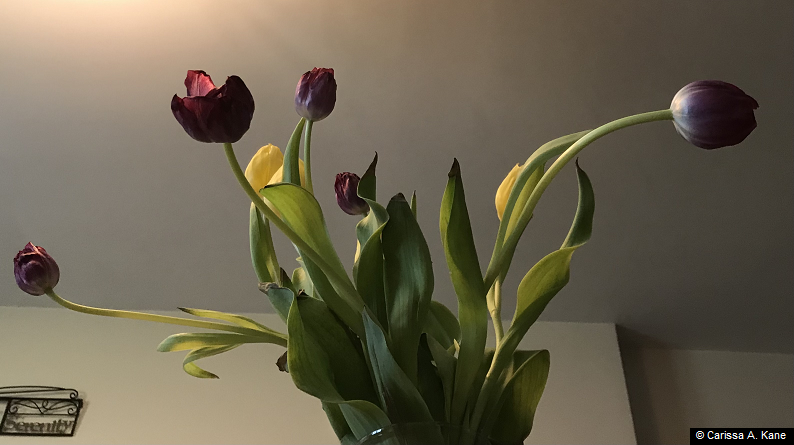
They started out a neatly organized bouquet of tulips, bulbs closed and standing upright in a vase, but with time, each came into its own. Still tulips though, and called by name, no matter the style or type of display. Some still upright. Some bending, turning, twisting, as if being called toward something else altogether, but again, all still called by name—side by side—together.

More than humane… a compelling lesson for humanity. Nothing new… it is as it has always been. In opening up, reaching out, and stretching toward another… letting go of “other,” change is made. What is true and meaningful, is more than comprehension. When the peace within one’s heart, reaches out, it permeates from soul to soul, and only then, is it about becoming.

Just as he said to the disciples who met him on the road to Emmaus, Jesus says to us, “You are witnesses of these things.” (Luke 24:48). As followers of Jesus, what did they do with that?

Fast forward to today… As disciples of Jesus, what do we do with all to which we have become witnesses? How do we stand with both the crucified and risen Jesus?

When he saw the crowds, he went up the mountain, and after he had sat down, his disciples came to him.
He began to teach them, saying:

“Blessed are the poor in spirit,
for theirs is the kingdom of heaven.

Blessed are they who mourn,
for they will be comforted.

Blessed are the meek,
for they will inherit the land.

Blessed are they who hunger and thirst for righteousness,
for they will be satisfied.

Blessed are the merciful,
for they will be shown mercy.

Blessed are the clean of heart,
for they will see God.

Blessed are the peacemakers,
for they will be called children of God.

Blessed are they who are persecuted for the sake of righteousness,
for theirs is the kingdom of heaven.

Blessed are you when they insult you and persecute you and utter every kind of evil against you [falsely] because of me.

Rejoice and be glad, for your reward will be great in heaven.
Thus they persecuted the prophets who were before you.

– Matthew 5:1-12

Act Naturally…

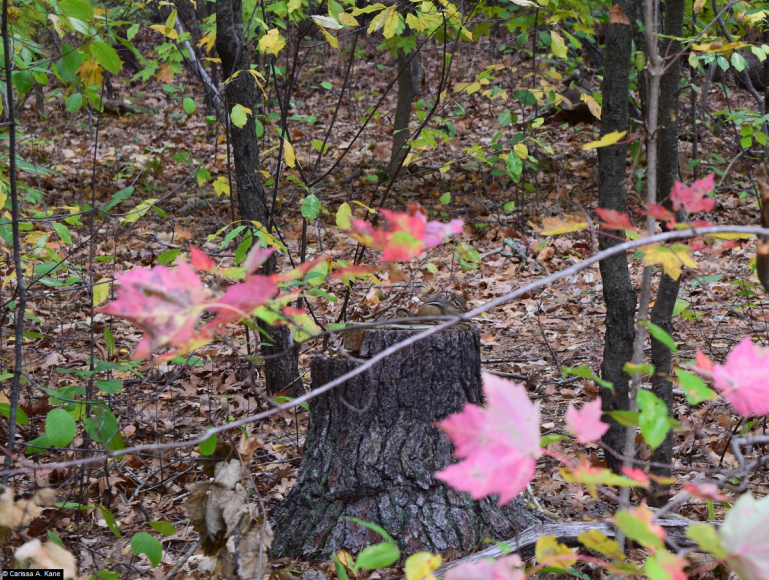
John Muir shared the thought that in every walk with nature, one receives far more than one seeks. Pausing to look at some of the changing leaves and noticing the contrast between them and those already on the ground, I came across another scene. A chipmunk, also pausing, long enough to possibly be considered a companion in an otherwise seemingly empty stretch of woods. A brief, but amusing and uplifting experience, perhaps captured best, for both creatures on this day, in the words of another naturalist, Henry David Thoreau, who wrote, “I took a walk in the woods and came out taller than the trees.”   

Reading chapter 22 in the Gospel according to Matthew, the section that contains verses 15-22 starts with, “Then the Pharisees went off and plotted…” The words and the image they conjure, are such a stark contrast to that of my experience in nature, earlier in the day. What a difference a spirit of inclusion, acceptance, respect, and mutual existence might have made back then. What a difference it might make now.

Nature is all around us, and we are part of it. Yet, all this time gone by, still, we fight it. All these years later, still, we resist joining together. Perhaps, one by one, we might learn to be companions to each other, and the plotting will end. Then, maybe… we might see, how foolish we have been.

If we surrendered to earth’s intelligence, we could rise up rooted like trees.
– Rainer Maria Rilke

The Pharisees went off
and plotted how they might entrap Jesus in speech.
They sent their disciples to him, with the Herodians, saying,
“Teacher, we know that you are a truthful man
and that you teach the way of God in accordance with the truth.
And you are not concerned with anyone’s opinion,
for you do not regard a person’s status.
Tell us, then, what is your opinion:
Is it lawful to pay the census tax to Caesar or not?”
Knowing their malice, Jesus said,
“Why are you testing me, you hypocrites?
Show me the coin that pays the census tax.”
Then they handed him the Roman coin.
He said to them, “Whose image is this and whose inscription?”
They replied, “Caesar’s.”
At that he said to them,
“Then repay to Caesar what belongs to Caesar
and to God what belongs to God.” – Matthew 22:15-22

Musical inspiration: The King of Love My Shepherd Is