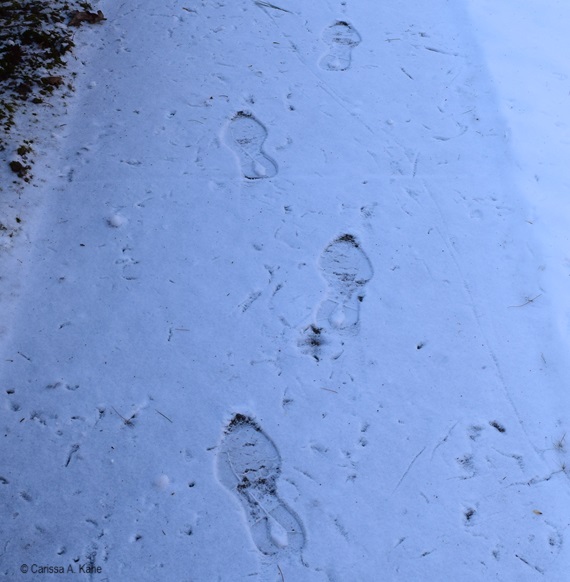
Sometimes due to the weather or one’s location, for example in the snow, on the sand at a beach, or stepping out of a pool, the impact of where one has traveled can be clearly seen. Most often though, we tread without leaving any physical indications at all.
The response for today’s Psalm is derived from Psalm 86, verse 11ab: Teach me your way, O Lord, that I may walk in your truth.
The text for the complete verse is as follows:
Teach me, Lord, your way that I may walk in your truth, single-hearted and revering your name. – Psalm 86:11
Reflect on the places to which you have traveled and/or spent time over the past few days, or the past week. As you remember where you have been, what comes to mind?
In what ways would you say that you experienced walking in God’s truth, single-hearted and revering God’s name? Were there places or situations where you were more grounded and fully present to the moment?
As you allow yourself to imagine revisiting these places, take time to notice or re-notice things.
Next, have a conversation with the Lord and share whatever thoughts and feelings arise within you. Ask to be shown what the Lord sees in these experiences and wants you to see as you continue striving in discipleship.
When your conversation is completed, pray:
Teach me, Lord, your way that I may walk in your truth, single-hearted and revering your name. – Ps 86:11
Spending the better part of the week surrounded by a plethora of books and various other media, it’s interesting to think about the variety of characteristics held within, as well as characters passing through, a public library.
Looking at the rows upon rows of books that are all around, it’s hard not to be fascinated by the fact that there’s always more to learn. This is not as in a conquest, but rather as in an opportunity, if one is open to it. And even more than that, no matter how vast, neatly ordered, and organized the books and other media may be, the contents of them serve everyone best, only when contemplated and taken into consideration with the range of human experience and love, and the knowledge it imparts into one’s heart.
Frequently viewed as a destination for those searching knowledge, know-how, a place to work, or a group of one sort or another, the library is also a place for those seeking shelter from outside. However, regardless of the time of day or reason for entering, when the library is open, none are turned away. Instead, they are welcome to come in as they are, and become a unique part of the inviting, peaceful environment. Imagine that in a place full of books!
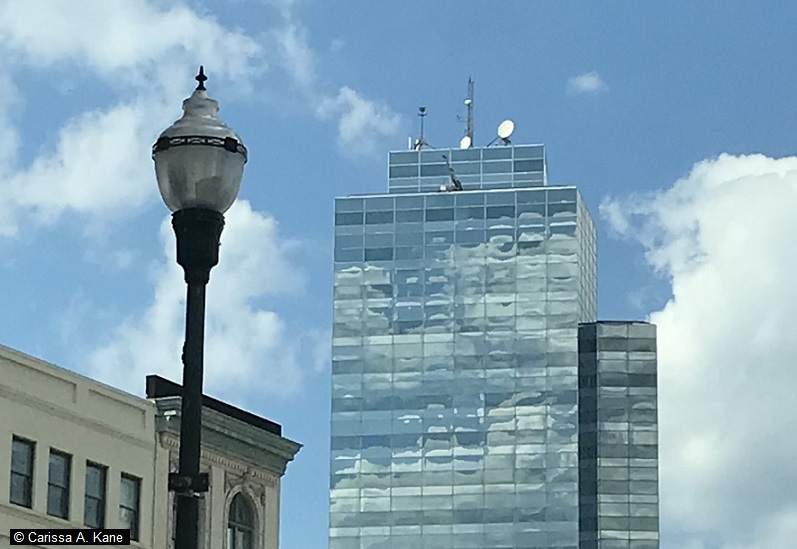
Sometimes we think we know, but until we seek to look beyond the distortions, we honestly cannot.
Recall an experience of bumping into someone that you know, in a place and at a time that you normally wouldn’t expect to see them? Initially, you might be surprised for good or less, or perhaps it might take a few moments to fully recognize the person. Maybe some memories of them come to mind.
Next, imagine that you kept encountering that same person over the course of several weeks. What would you think? What would you feel?
Now envision being one of Jesus’ disciples and having the experience of Jesus’ appearing to you, here and there, in the time between his Resurrection and Ascension. How would you react or respond after the profound experience of his crucifixion, his Resurrection, and being in the environment of belief and disbelief created by it all?
Would you be devoted to trying to see a pattern to Jesus’ appearances to try to predict when you might see him next? Would you commit yourself to trying to figure out the reasons why he was appearing? How hard would you work to come to some sort of knowledge about these occurrences? In what ways would you characterize your approach?
Focusing more closely on Jesus and his third appearance at the Sea of Tiberias (John 21), how determined would your mind be, and how open would your heart be, to the presence of Jesus who is in the form of the person on the shore, unknown and at a distance? How about to yourself or the person on the shore, thought of as being known? Would you cast the net again? What would you discover?
Simon Peter said to them, “I am going fishing.” They said to him, “We also will come with you.” So they went out and got into the boat, but that night they caught nothing. When it was already dawn, Jesus was standing on the shore; but the disciples did not realize that it was Jesus. Jesus said to them, “Children, have you caught anything to eat?” They answered him, “No.” So he said to them, “Cast the net over the right side of the boat and you will find something.” So they cast it, and were not able to pull it in because of the number of fish. So the disciple whom Jesus loved said to Peter, “It is the Lord.” When Simon Peter heard that it was the Lord, he tucked in his garment, for he was lightly clad, and jumped into the sea. – Jn 21:3-7
In what ways do you allow Jesus to be present to you in the unexpected? In what ways do you invite Jesus to help you to be present, to hold situations up to the light, to receive God’s wisdom so that you can embody the thoughts and feelings needed not only to embrace the moment, but also to receive and recognize the grace it holds, and how to share it?
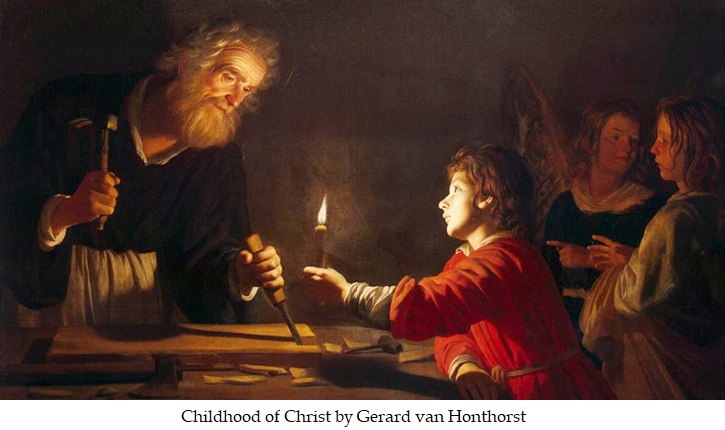
Sometimes, there are so many questions, and it can seem like so much work. Yet, as April turns to May and the Feast of St. Joseph The Worker arrives, so also does the opportunity to experience not only the light of longer days, but also renewal through the touch of Grace—peace, light, hope, and inspiration—that continues to blossom with the Easter season, and beyond.
How does grace touch and move your heart? And how is it reflected in your work?
In Greek mythology, keeping the gods and goddesses happy was central to life. So, temples were built, activities were held, sacrifices were made, all to please the gods and goddesses so that the people in turn might be helped along or rewarded rather than punished. Having recently seen a show that involved Greek mythology and the challenge of relationships, reading “…be reconciled to God,” in chapter 5, verse 20 of the Second Letter to the Corinthians, strikes a chord. And then there is the Gospel reading for the Fourth Sunday of Lent which includes the parable of the Prodigal Son (Luke 15:11-32), which really leads one to think about relationships. Combining the two, it can be intriguing to look more closely at the differences and similarities between one’s relationship with God and one’s relationships with others (family, friends, acquaintances, etc.). And perhaps consider further, the impact of both the things we can see and those we think we can see but cannot.
Looking to St. Paul and to the Prodigal Son, it’s all about stripping away the extraneous, drawing closer to what lies within, and trusting one’s experience. However, not one’s experience of self or others, but looking for, remembering and trusting one’s experience of God within the interactions and dealings we have with one another.
Imagine riding along from start to finish with Saul of Tarsus, soldier… warrior, active persecutor of early Christians who was literally knocked off his horse, called to conversion, and way down the road, became St. Paul.
Envision travelling with the Prodigal Son. The son who took his inheritance while his father was still living and turned his back on everyone and everything that he had previously known. He had to take his own path and have his own way; it was just something he needed to do. However, on that path, he lost everything, but then gained so much more than he could have ever dreamed of, by owning the truth and returning home, where he was immediately welcomed and embraced.
For St. Paul and the Prodigal Son, it turned out that the things that drove them… the things that sucked them in as being so important or so necessary, weren’t. And while it may have seemed to them as though they lost everything in the process of their falling, they did not. Both experienced the kindness and love of God both directly and through others—the grace that led them to pivot—and it is through that, that they came to know their true worth as God’s beloved, and that what really matters can never be taken away, only shared and magnified.
Looking into the world of nature, it can be very easy to come across what makes for a beautiful picture. Whether one’s eye is caught by a single object or multiple ones combining to create a scene that captivates and captures attention, it all starts with posture.
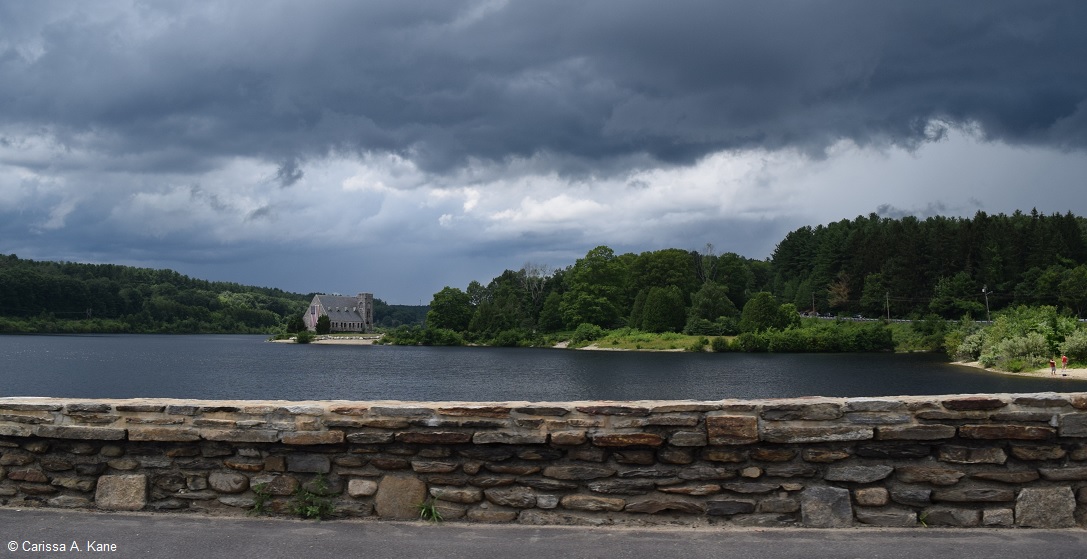
The picture below was taken at the base of a road on the way back down, after having traveled it to the top of a mountain. The way that everything came together and seemed to fall into place in the moments we happened upon it, was rather striking. As we were returning from the summit on a sunny, gorgeous day, the sun was quickly overtaken by fast moving clouds, and as we drove, we moved in and out of brief periods of rain. However, once we reached the base, things looked much brighter. Then, not much further along, we entered the scene. It was like stepping into a painted landscape.
Again, everything—road, rock wall, water, building, sand, trees, and sky—seemed to come together, bringing out the best of what that day and time could offer, and it was perfect. Unity and peace within rising above and beyond turbulence. Not only a pretty sight or precious thought, but also at the heart of faith and faithfulness—the way in which one works, lives, and cooperates with the grace of God, who resides within us, and in whose image, we are all created.
What one carries or holds onto as they journey, quite literally, impacts everything—reception, perception, reaction, response, etc.
Brothers and sisters: I, a prisoner for the Lord, urge you to live in a manner worthy of the call you have received, with all humility and gentleness, with patience, bearing with one another through love, striving to preserve the unity of the spirit through the bond of peace: one body and one Spirit, as you were also called to the one hope of your call; one Lord, one faith, one baptism; one God and Father of all, who is over all and through all and in all. – Eph 4:1-6
Inside seeking shelter on a very stormy day, I hear the wind howling… beckoning, come and see.
Looking out the window, great and mighty power, the surge before my eyes.
The wind, it whips and stirs. The waves, they’re in a frenzy, crashing down on all, in the way or not.
Rain, it’s driven sideways. I wonder if it minds.
Then, the birds. Something else. Just being birds, but more. Unphased by all the bother. Flying high, swooping low, drifting, diving, floating, gliding, in the winds that blow.
Beauty in the chaos. Stillness in the storm.
Trusting, not resisting.
All, it will be well.
Listening, not withdrawing, but drawing from within.
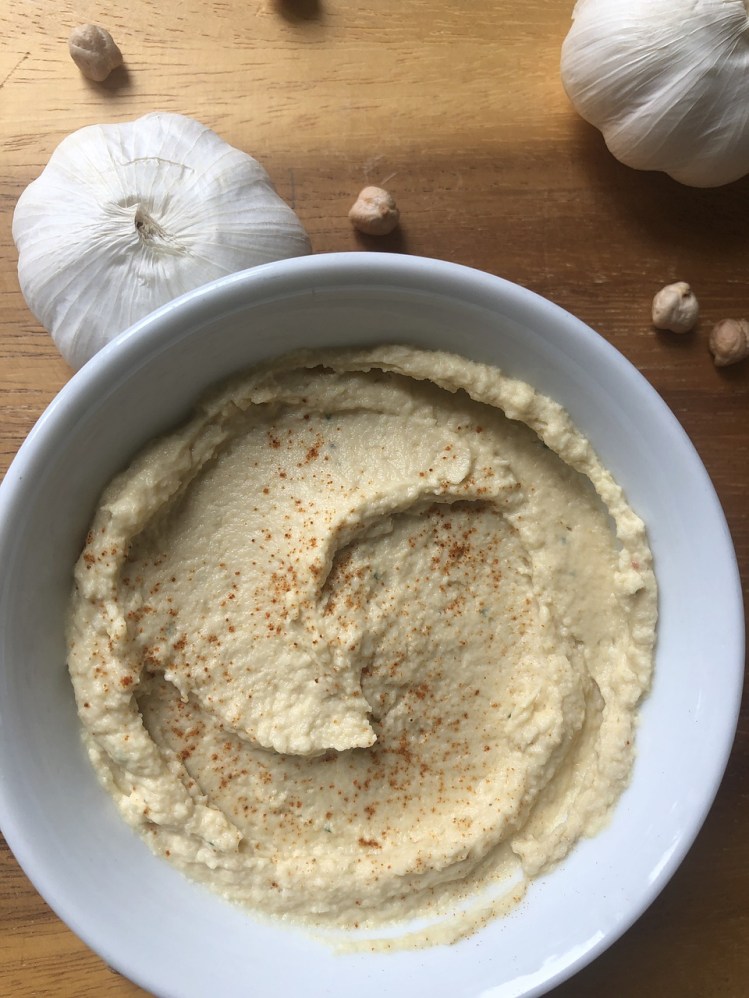
I did not learn to make hummus, with just the “right” amount of fresh garlic, salt, and lemon juice by eating it, reading a recipe, or watching my mother make it over, and over again. Rather, I learned by taking what I saw, remembering what I had tasted, and trying to make it myself, over, and over again. After all, the most helpful way to learn is by ongoing, active observance, repetition, participation, reflection, and openness to growth.
While experience is key, it is interesting that oftentimes as experience increases, awareness to room for improvement can lessen, or even disappear. With that, it may be more than tempting to take moments and situations for granted, rote, or with a “nothing new here” spirit. However, even the process of washing, rinsing, and repeating, holds newness and opportunity with each turn.
In the Gospel according to John, a week later, when the disciples were still locked in the room, Jesus appeared again (Jn 20:26). What was it like for the disciples who had seen the risen Jesus the first time he had appeared? Was it just a been there, done that, repeat for them, or were they able to experience the second appearance in a new or deeper way?
What was the attitude in the room? Were the disciples who had previously seen Jesus able to receive this visitation as being as much for them as it was for Thomas? To whom was Jesus speaking when he said to Thomas, “Have you come to believe because you have seen me?”
In the Gospel according to Mark, chapter 16, verse 11, it is written that when Mary Magdalene told the disciples that the risen Jesus had appeared to her outside the tomb, they did not believe without seeing either. Did the disciples remember this, when Thomas said, “Unless I see the mark of the nails in his hands and put my finger into the nailmarks and put my hand into his side, I will not believe.”(Jn 20:27)?
What did Thomas think, when Jesus said to him, “Have you come to believe because you have seen me? Blessed are those who have not seen and have believed.” (John 20:29)? What did he feel? Perhaps, he felt bad that he did not believe what he had been told by the other disciples. Or, perhaps Thomas felt joy that Jesus heard his need, and responded to it, allowing him to experience the risen Jesus himself.
After all, whether making hummus , dealing with faith, or anything else for which there may be “recipes” or popular thought, there is always more than what is on the page, for “Experience is the teacher of all things” (attributed to Julius Ceasar).
In all times, but most especially in those that are challenging, we must consider experience, both our own and that of others. What has it been like? Do we remember the times and places where we have doubted, questioned, or disagreed, and, do we extend the same courtesy, patience, peace, and understanding that Jesus extends to us, to others?
On the evening of that first day of the week, when the doors were locked, where the disciples were, for fear of the Jews, Jesus came and stood in their midst and said to them, “Peace be with you.” When he had said this, he showed them his hands and his side. The disciples rejoiced when they saw the Lord. Jesus said to them again, “Peace be with you. As the Father has sent me, so I send you.” And when he had said this, he breathed on them and said to them, “Receive the Holy Spirit. Whose sins you forgive are forgiven them, and whose sins you retain are retained.” Thomas, called Didymus, one of the Twelve, was not with them when Jesus came. So the other disciples said to him, “We have seen the Lord.” But he said to them, “Unless I see the mark of the nails in his hands and put my finger into the nailmarks and put my hand into his side, I will not believe.” Now a week later his disciples were again inside and Thomas was with them. Jesus came, although the doors were locked, and stood in their midst and said, “Peace be with you.” Then he said to Thomas, “Put your finger here and see my hands, and bring your hand and put it into my side, and do not be unbelieving, but believe.” Thomas answered and said to him, “My Lord and my God!” Jesus said to him, “Have you come to believe because you have seen me? Blessed are those who have not seen and have believed.” Now Jesus did many other signs in the presence of his disciples that are not written in this book. But these are written that you may come to believe that Jesus is the Christ, the Son of God, and that through this belief you may have life in his name. – John 20:19-31
Believe it or not, it seems easier to believe that which is tangible. Thus, the saying, “I’ll believe it when I see it!” Yet, in reality, what one believes actually comes from within. Belief is born out of that which echoes the perceived experience of one’s heart and mind.
As perception changes, the things that resonate and to which one is receptive change too. As a result, internally, one is moved to also change, hopefully for the better. Thus the words of Maya Angelou, “Do the best you can until you know better. Then when you know better, do better.”
This is really what human nature is all about—we are created to continually evolve—called to conversion each and every day. It is important to remember that when it comes to love, and what is truly good, honorable, and just, there is always room for growth! How much? That’s up to the individual—again it comes back to perception.
During Lent and throughout the year, the practicing, and living out, of what one believes, can, and often does, take so many forms. After all, faith is living… breathing… active. It is not intended to be stale, or fixed in place or time, but to be celebrated with body, heart, and mind. Not to be carried along, but to carry us through and to broaden the depth with which we see God, ourselves, and other, as one.
Seek, and you will find what brings you closer. It’s not about “should” or “if,” but rather what is. The journey is yours and God’s together. Trust, and you will discover.
Jesus came to a town of Samaria called Sychar, near the plot of land that Jacob had given to his son Joseph. Jacob’s well was there. Jesus, tired from his journey, sat down there at the well. It was about noon.
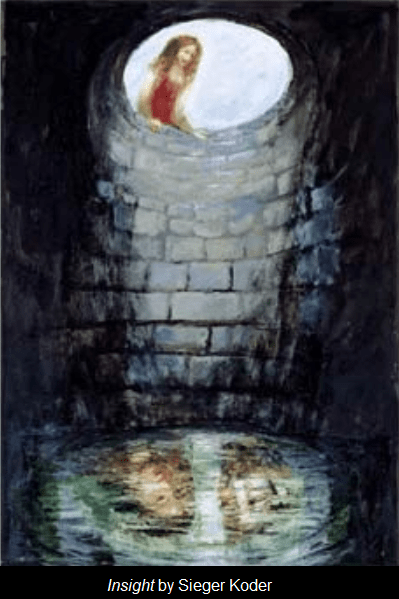
A woman of Samaria came to draw water. Jesus said to her, “Give me a drink.” His disciples had gone into the town to buy food. The Samaritan woman said to him, “How can you, a Jew, ask me, a Samaritan woman, for a drink?” —For Jews use nothing in common with Samaritans.— Jesus answered and said to her, “If you knew the gift of God and who is saying to you, ‘Give me a drink, ‘ you would have asked him and he would have given you living water.” The woman said to him, “Sir, you do not even have a bucket and the cistern is deep; where then can you get this living water? Are you greater than our father Jacob, who gave us this cistern and drank from it himself with his children and his flocks?” Jesus answered and said to her, “Everyone who drinks this water will be thirsty again; but whoever drinks the water I shall give will never thirst; the water I shall give will become in him a spring of water welling up to eternal life.” The woman said to him, “Sir, give me this water, so that I may not be thirsty or have to keep coming here to draw water.”
Jesus said to her, “Go call your husband and come back.” The woman answered and said to him, “I do not have a husband.” Jesus answered her, “You are right in saying, ‘I do not have a husband.’ For you have had five husbands, and the one you have now is not your husband. What you have said is true.” The woman said to him, “Sir, I can see that you are a prophet. Our ancestors worshiped on this mountain; but you people say that the place to worship is in Jerusalem.” Jesus said to her, “Believe me, woman, the hour is coming when you will worship the Father neither on this mountain nor in Jerusalem. You people worship what you do not understand; we worship what we understand, because salvation is from the Jews. But the hour is coming, and is now here, when true worshipers will worship the Father in Spirit and truth; and indeed the Father seeks such people to worship him. God is Spirit, and those who worship him must worship in Spirit and truth.” The woman said to him, “I know that the Messiah is coming, the one called the Christ; when he comes, he will tell us everything.” Jesus said to her, “I am he, the one speaking with you.”
At that moment his disciples returned, and were amazed that he was talking with a woman, but still no one said, “What are you looking for?” or “Why are you talking with her?” The woman left her water jar and went into the town and said to the people, “Come see a man who told me everything I have done. Could he possibly be the Christ?” They went out of the town and came to him. Meanwhile, the disciples urged him, “Rabbi, eat.” But he said to them, “I have food to eat of which you do not know.” So the disciples said to one another, “Could someone have brought him something to eat?” Jesus said to them, “My food is to do the will of the one who sent me and to finish his work. Do you not say, ‘In four months the harvest will be here’? I tell you, look up and see the fields ripe for the harvest. The reaper is already receiving payment and gathering crops for eternal life, so that the sower and reaper can rejoice together. For here the saying is verified that ‘One sows and another reaps.’ I sent you to reap what you have not worked for; others have done the work, and you are sharing the fruits of their work.”
Many of the Samaritans of that town began to believe in him because of the word of the woman who testified, “He told me everything I have done.” When the Samaritans came to him, they invited him to stay with them; and he stayed there two days. Many more began to believe in him because of his word, and they said to the woman, “We no longer believe because of your word; for we have heard for ourselves, and we know that this is truly the savior of the world.” – John 4:5-42
One evening, a long time ago, as a teenager, I was travelling by car with a few friends, when the driver had to jam on the brakes, to avoid an accident. Prior to that moment, there was lots of chatter going on as we drove. However, as the car swerved to stay on the road, narrowly missed a sign that had been to the right of the car, but was now on the left side, and finally screeched to a halt, the noise ceased. In those seconds, it was as if we had shifted into slow motion and were transported into a vacuum, void of all sound. Hearts pounding, we just sat there, recognizing the potential disaster we had escaped. Then, after catching our breaths, we drove on, continuing in silence all the way home. None of us spoke about what had happened.
Throughout life, sometimes events can suddenly thunder into presence of mind, body, and soul. They can do so in such a powerful way that all that is left behind is silence. In chapter 9 of the Gospel according to Mark, the Transfiguration of Jesus is described as both an awesome and frightening experience for the apostles, Peter, James, and John. What transpired, was completely unexpected. In verse 6, Jesus is described as somewhat speechless in terms of how to respond to his companions—“He hardly knew what to say, they were so terrified.”
Clearly, this event shook the apostles; stopping them in their tracks, and reshaping the manner in which they would receive and respond to what was to come, whether consciously or subconsciously. While it seems fitting that the occurrence would happen on a mountain top, what happened would have been a life altering experience, regardless of where it took place or how it was understood at the time. In the Transfiguration of Jesus, eyes were wide open and seeds were firmly planted.
Oftentimes, the Divine is overlooked, dismissed, forgotten, or left behind simply because it’s easier, more convenient, or perhaps preferred, to believe and hold onto experiences that happen where and how one might expect them to occur. Yet, God is not deterred. On that evening so long ago, I remember being shaken and stirred. I also remember the deafening silence all the way home. And in that, the memory etched… to return, here and there. Only with time, and a lot of it, could I see that God was with us that night.
How patient God is! A reminder of the opportunity that openness to the wisdom of each moment, whether it is here and now, in the past, or yet to come, brings. No matter the locale or the emotions an experience evokes, God is with us, with a desire to take hold, to call us forward, and to help us remember as we do, the wisdom that is all around us.
Jesus took Peter, James, and John and led them up a high mountain apart by themselves. And he was transfigured before them, and his clothes became dazzling white, such as no fuller on earth could bleach them. Then Elijah appeared to them along with Moses, and they were conversing with Jesus. Then Peter said to Jesus in reply, “Rabbi, it is good that we are here! Let us make three tents: one for you, one for Moses, and one for Elijah.” He hardly knew what to say, they were so terrified. Then a cloud came, casting a shadow over them; from the cloud came a voice, “This is my beloved Son. Listen to him.” Suddenly, looking around, they no longer saw anyone but Jesus alone with them.
As they were coming down from the mountain, he charged them not to relate what they had seen to anyone, except when the Son of Man had risen from the dead. So they kept the matter to themselves, questioning what rising from the dead meant. – Mk 9:2-10
Pausing to notice the growing banks of snow around the house this morning, the distant past, a time when the banks were even taller, at least double the size, came to mind. It was a Sunday afternoon and after weeks with multiple storms, the time and effort spent helping to remove and reposition snow disappeared almost instantly. Suddenly, there we were, in a time and space where all that mattered was what we shared—from one side of the driveway to the other… from one heart to another, the anticipation, joy, and excitement in taking turns sitting at the top and then sliding down the “mountain” of snow.
In those moments, it seemed like such a simple thing that came to be. Yet, today, in the midst of shoveling heavy snow, it was a great reminder. There are always challenges and hard work along the way, and sometimes it can seem like there is no end in sight, or break to be had, but there always is. And, in life, all that ever really matters is the experiences we share and the spirit in which we share them.
Love is the beauty of the soul. – Saint Augustine.









 HopeThatFloats
You must be logged in to post a comment.