Looking out the window, branches all around. Open arms holding up the snow, or the snow resting on open arms? Both clinging to each other, or one melting into the other? Does it really matter? Still, looking out the window. Still, branches upon branches. Some sturdier than others, some swaying more than others. Does it really matter? More looking out the window, at those branches and that snow. Through it all, they just keep gently staying. Perhaps, that’s all that really matters.
Shine like lights in the world as you hold on to the word of life. – Phil 2:15d,16a
In chapter 13, verse 34 of the Gospel according to John, Jesus says, “I give you a new commandment: love one another. As I have loved you, so you also should love one another.” And, throughout the Gospels, there are many examples of Jesus’ love shown through his words, actions, reactions, and responses. Yet, to love as Jesus loved, can be very challenging, and maybe even feel impossible at times.
However, in the First Letter to the Corinthians (15:45-49), St. Paul really puts the focus on the keys to unlocking the ability to love as Jesus did. In comparing the first Adam to the last Adam (Jesus), St. Paul puts a reminder out there to not get caught up in the things of the world. The things that are material or mainly have to do with personal gain, in the end, will be immaterial. Furthermore, like with Adam and Eve, these things have a way of distorting our vision and pulling us away from the spirit of God.
So, too, it is written, the first man, Adam, became a living being, the last Adam a life-giving spirit. But the spiritual was not first; rather the natural and then the spiritual. The first man was from the earth, earthly; the second man, from heaven. As was the earthly one, so also are the earthly, and as is the heavenly one, so also are the heavenly. Just as we have borne the image of the earthly one, we shall also bear the image of the heavenly one. – 1 Corinthians 15:45-49
St. Paul is saying, remember the truth of who you are, and stay connected to it. There is no loving as Jesus did, without being able to embrace the grace of God in whose image we are created. There is no loving as Jesus did, without the spirit of God helping us to strip away the human inclination toward the world’s view of any situation or thing. It is only through the grace of God, that we can be authentic, operating in the image of God that we are, seeing beyond the haze to what really matters, and then proceeding to receive and respond to the world around us from the place that is eternal.
“To be yourself in a world that is constantly trying to make you something else is the greatest accomplishment.” – Ralph Waldo Emerson
According to the ancient Greek philosopher Plato, “No one is more hated than he who speaks the truth.” This certainly seems the case for Jesus in chapter 4, verses 21-30 of the Gospel according to Luke. In fact, Jesus expands upon this observation. Not only does the truth and those who speak it, tend to garner disdain or be less than popular, but this is kicked up a notch, often occurring with greater intensity and less receptivity, the closer to home one is.
In this passage, Jesus gives two examples for his fellow Nazoreans to ponder. First, there is the widow in Sidon. What is it that led Elijah to her and her son, saving them from a sure death during the great famine? Second, there is Naaman the Syrian, who was cleansed of leprosy. How is it that Elisha was sent to Naaman rather than one of his own people suffering from leprosy?
After taking great offense at Jesus’ words (“No prophet is accepted in his native place”) and examples, the crowd seeks to extinguish him. One can only wonder if anyone in the crowd was able to step back and further consider the situation and what had transpired. Were they able to remove themselves from the sting of the truth long enough to recognize that their anger was misdirected, and to move toward healing and greater peace?
In today’s volatile and often chaotic world, it can be easy to choose a side or make a judgment and cling to it. However, oftentimes, in doing so, it can also be easy to become rigid, and to lose sight and insight into what really matters. Not only that, but also to possibly overlook Grace, which is always revealing itself in ever-changing and evolving ways.
In chapter 4 of the Gospel according to Luke, Jesus was inviting the people of Nazareth toward greater faith and into a new way of being. He is calling us in the same way today, reminding us that we cannot receive God, who made the earth and all that inhabits it, if we are not willing to change and receive the grace of a still greater way.
For true life does not occur where the air is stale and stagnant, and where all cannot breathe, but rather where it is new, fresh, and flowing free.
Jesus began speaking in the synagogue, saying: “Today this Scripture passage is fulfilled in your hearing.” And all spoke highly of him and were amazed at the gracious words that came from his mouth. They also asked, “Isn’t this the son of Joseph?” He said to them, “Surely you will quote me this proverb, ‘Physician, cure yourself,’ and say, ‘Do here in your native place the things that we heard were done in Capernaum.’” And he said, “Amen, I say to you, no prophet is accepted in his own native place. Indeed, I tell you, there were many widows in Israel in the days of Elijah when the sky was closed for three and a half years and a severe famine spread over the entire land. It was to none of these that Elijah was sent, but only to a widow in Zarephath in the land of Sidon. Again, there were many lepers in Israel during the time of Elisha the prophet; yet not one of them was cleansed, but only Naaman the Syrian.” When the people in the synagogue heard this, they were all filled with fury. They rose up, drove him out of the town, and led him to the brow of the hill on which their town had been built, to hurl him down headlong. But Jesus passed through the midst of them and went away. – Luke 4:21-30
Looking up into the darkness, preparing for the show that is about to begin, and “knowing” what is to come. Fireworks on New Year’s Eve or Day is a longstanding tradition around the world. Their origin is as a part of practices meant to ward off evil spirits, driving them away with loud booms and flashes of light. In our times, fireworks can be startling, but most often they bring a sense of both awe and knowing.
Passing from one year to the next, it seems so natural to think in terms of progression. Where have I been? Where am I going? And while human nature tends to lean toward the notion of being in control, it also often leans toward a kind of mapping and planning that can take one away from the heart and light of creation, and life’s true meaning.
Life like fireworks, our expectations so great. Hearing booms followed by colors and rays of light. Looking for a magnificent display each time, each year, bigger and better than before, A man-made quest.
In the process, we stretch and strive. All caught up, are we really rising above, going beyond, settling down, or drifting into the air, as trails of smoke?
While soaring and shining, what do we leave behind in the dust, are we led, or are we leading, and what do we carry with us?
Be humble for you are made of earth. Be noble for you are made of stars. – Serbian proverb
When Jesus was born in Bethlehem of Judea, in the days of King Herod, behold, magi from the east arrived in Jerusalem, saying, “Where is the newborn king of the Jews? We saw his star at its rising and have come to do him homage.” When King Herod heard this, he was greatly troubled, and all Jerusalem with him. Assembling all the chief priests and the scribes of the people, He inquired of them where the Christ was to be born. They said to him, “In Bethlehem of Judea, for thus it has been written through the prophet: And you, Bethlehem, land of Judah, are by no means least among the rulers of Judah; since from you shall come a ruler, who is to shepherd my people Israel.” Then Herod called the magi secretly and ascertained from them the time of the star’s appearance. He sent them to Bethlehem and said, “Go and search diligently for the child. When you have found him, bring me word, that I too may go and do him homage.” After their audience with the king they set out. And behold, the star that they had seen at its rising preceded them, until it came and stopped over the place where the child was. They were overjoyed at seeing the star, and on entering the house they saw the child with Mary his mother. They prostrated themselves and did him homage. Then they opened their treasures and offered him gifts of gold, frankincense, and myrrh. And having been warned in a dream not to return to Herod, they departed for their country by another way. – Matthew 2:1-12
For many Christians the crescendo of what it means to be Christian is celebrated with great veracity around Christmas, and then again around Easter. Preparing to celebrate Christmas, we read and listen to Gospel passages, finding inspiration, hope, solace, and more, as we envision the journey of Mary and Joseph, and the birth of Jesus. Yet, with every liturgy or service throughout the year, we celebrate and are reminded of God’s love for us, the example of Jesus, and the call to discipleship. And all year long, we profess our belief that throughout the ages, from the beginning of time, there is one Word, one God, one Way, and one People.
At Christmastime, may the heightened awareness of Love (God) in our hearts bring us together to a place where we become blind to all that separates and pulls us apart. Instead, may we see one Light, one Truth, one Story as we celebrate the birth of our Lord. And, as God’s generosity comes alive for us, may we welcome it to the inn, allowing it to abound within and all around, melting the ties that otherwise bind us to “other,” away from God and one another.
In those days a decree went out from Caesar Augustus that the whole world should be enrolled. This was the first enrollment, when Quirinius was governor of Syria. And Joseph too went up from Galilee from the town of Nazareth to Judea, to the city of David that is called Bethlehem, because he was of the house and family of David, to be enrolled with Mary, his betrothed, who was with child. While they were there, the time came for her to have her child, and she gave birth to her firstborn son. She wrapped him in swaddling clothes and laid him in a manger, because there was no room for them in the inn.
Now there were shepherds in that region living in the fields and keeping the night watch over their flock. The angel of the Lord appeared to them and the glory of the Lord shone around them, and they were struck with great fear. The angel said to them, “Do not be afraid; for behold, I proclaim to you good news of great joy that will be for all the people. For today in the city of David a savior has been born for you who is Christ and Lord. And this will be a sign for you: you will find an infant wrapped in swaddling clothes and lying in a manger.” And suddenly there was a multitude of the heavenly host with the angel, praising God and saying: “Glory to God in the highest and on earth peace to those on whom his favor rests.” – Luke 2:1-14
It can be easy to envision the poor widow putting her coins into the treasury, knowing the value to be considered far less than others had contributed. One might even draw a picture that perhaps includes elements representing shame, grief, loss, loneliness, and so on, overcome by giving all she had (“her whole livelihood”) and Jesus celebrating her for that. Then, from that picture, one might possibly be drawn toward a singular conclusion about verses 41-44 of chapter 12 in the Gospel according to Mark as a call to examine one’s level of charity.
It’s interesting though to reflect further on this passage. There are no words attributed to the widow, and no mention of a personal encounter between her and Jesus. The passage starts with an observation by Jesus that turns into a teaching directly to his disciples, not the poor widow, or anyone else who was putting money into the treasury. It is about more than coins and goes beyond levels of giving, extending to something greater.
Going back to the beginning of the Poor Widow’s Contribution, in verse 41, it is written, “Jesus sat down opposite the treasury and observed how the crowd put money into the treasury.” There are no interactions with those who are giving. Rather, Jesus takes in what is transpiring.
He sees the difference between the way the poor widow and the crowd, especially those with greater possessions (“Many rich people put in large sums.”), are carrying themselves. He then draws his disciples close, reveals what he sees, and tries to help them to see it as well. Jesus’s teaching, as always, is about showing the Way and helping those who follow him to become more aware, see more clearly, make better choices, and live more authentically.
Jesus wants the disciples, and us, to see that what the poor widow has given, she has given from “her whole livelihood”—her heart. This is the source of the widow’s might and is where our strength comes from as well. It is where the Lord resides.
I will place my law within them, and write it upon their hearts; I will be their God, and they shall be my people. – Jeremiah 31:33
By giving the two coins, the widow is giving her heart to the Lord, not allowing herself to be defined by her possessions, the opinions of others, or worldly cares, but instead sacrificing and letting them go, and listening to the law within her—placing trust for her well-being, first and foremost, in the Lord.
How can we look past the coins, and do the same?
In the course of his teaching Jesus said to the crowds, “Beware of the scribes, who like to go around in long robes and accept greetings in the marketplaces, seats of honor in synagogues, and places of honor at banquets. They devour the houses of widows and, as a pretext recite lengthy prayers. They will receive a very severe condemnation.”
Jesus sat down opposite the treasury and observed how the crowd put money into the treasury. Many rich people put in large sums. A poor widow also came and put in two small coins worth a few cents. Calling his disciples to himself, he said to them, “Amen, I say to you, this poor widow put in more than all the other contributors to the treasury. For they have all contributed from their surplus wealth, but she, from her poverty, has contributed all she had, her whole livelihood.” – Mark 12:38-44
Henri Nouwen wrote, “Self-knowledge and self-love are the fruit of knowing and loving God. You can see better then what is intended by the great commandment to “love the Lord your God with all your heart, with all your soul, and with all your mind, and to love your neighbor as yourself.” Laying our hearts totally open to God leads to a love of ourselves that enables us to give wholehearted love to our fellow human beings. In the seclusion of our hearts we learn to know the hidden presence of God; and with that spiritual knowledge we can lead a loving life.”
In other words, authentic love starts within, builds and grows through self-discovery and conscious connection to God. It is by this process that hearts are moved toward love in the way they exist and what they exude to the outside world.
In chapter 12 of the Gospel according to Mark, we see an example of interactions similar to those that are so prevalent these days. It is very clear that there are two sides with two very different objectives. What’s going on in the hearts and minds of each side? What’s the priority?
The chapter starts with Jesus telling the Parable of the Tenants—tenant farmers who refuse to pay the owner of the vineyard and beat and/or kill the people sent to collect the owner’s due. They even kill the vineyard owner’s son—they do not recognize him. Knowing that Jesus is calling them out in the telling of this parable, the Pharisees, scribes, and elders want to arrest him.
What makes them so quick to become so defensive? Did they stop to look inside and invite God into the process before labeling Jesus as the enemy and beginning to determine a course of action? What makes them so offended by Jesus’ words and actions?
As the chapter continues, Pharisees and Herodians, and then Sadducees are sent to question Jesus about taxes (should they pay Caesar or not? – verses 13-17) and about resurrection (how is the law of marriage applied for the widower of seven brothers and with no descendants? – verses 18-27). And Jesus’ nature continues to shine through as he continues to speak truth, conveying and citing the Word of God in his replies. He does not get rattled or fall for the attempts to manipulate him.
“Repay to Caesar what belongs to Caesar and to God what belongs to God” (verse 17).
“When they rise from the dead, they neither marry nor are given in marriage, but they are like the angels in heaven. As for the dead being raised, have you not read in the Book of Moses, in the passage about the bush, how God told him, ‘I am the God of Abraham, [the] God of Isaac, and [the] God of Jacob’? He is not God of the dead but of the living. You are greatly misled” (verses 25-27).
Despite knowing, not speculating, but actually knowing what they are trying to do, Jesus does not become defensive or aggressive, or try to avoid them and their questions—he has nothing to hide. He simply answers the questions truthfully, shedding light and putting focus on the real issue—the motives behind behavior. This leads to the question always worth asking, “In all honesty, who or what is being served, and how?” In this case, and in any day and age, lack of integrity and inability to recognize, and live in, truth is not of service to God, or anyone for that matter.
This brings us to the verses of chapter 12 referred to as “The Greatest Commandment”:
One of the scribes came to Jesus and asked him, “Which is the first of all the commandments?” Jesus replied, “The first is this: Hear, O Israel! The Lord our God is Lord alone! You shall love the Lord your God with all your heart, with all your soul, with all your mind, and with all your strength. The second is this: You shall love your neighbor as yourself. There is no other commandment greater than these.” The scribe said to him, “Well said, teacher. You are right in saying, ‘He is One and there is no other than he.’ And ‘to love him with all your heart, with all your understanding, with all your strength, and to love your neighbor as yourself’ is worth more than all burnt offerings and sacrifices.” And when Jesus saw that he answered with understanding, he said to him, “You are not far from the kingdom of God.” And no one dared to ask him any more questions. – Mark 12:28-34
Loving God with all of one’s being followed by loving one’s neighbor as oneself is to be the object of one’s striving day in and day out. As any human being can attest, this can be challenging and sometimes a downright struggle, and when left to our own devices it’s impossible. However, when we look at chapter 12 of the Gospel according to Mark, we can see in Jesus’ example of facing adversity with peace, honesty, and integrity, how a close relationship with God broadens the horizon, opening hearts and minds to the true meaning of Scripture, influencing speech and action, and revealing truth to all who are willing to embrace and engage in it over everything else (ambitions, possessions, self-interest, etc.).
With Jesus, the invitation is always open, and it doesn’t matter what you bring to the table, so much as a desire for what is true, what you are willing to let go of in order to learn, and the spirit with which you carry it out into the world.
In the last chapter of the Book of Joshua (Jos 24), Joshua, who succeeded Moses, is nearing death when he gathers the tribes of Israel and speaks the words of the Lord. First, the Lord helps the people to remember the truth of their journey together and God’s presence throughout. Then, the ageless choice, just as poignant today as back in Joshua’s times and prior, is offered: “…choose today whom you will serve…” (Jos 24:15).
Oftentimes the way of society tends toward reaching heights higher than, obtaining more than, and being waited upon or served as if elevated in position. And in that striving and the push to achieve, there are all sorts of temptations moving in and out, and throughout, trying to slide into place without notice, shifting motivation away from what might truly be good. Then, there is also the voice of reason—Truth, seeking balance, calling for heart and soul to live and breathe in all that drives the choices being made, actions being taken, and the spirit in which they are carried out.
So how does one proceed with so many competing interests? More simply, slowing down with prayerful moments that lead to the choosing in each, and every, day.
This past Wednesday was the feast day of Alberto Hurtado Cruchaga, S.J. He was born in 1901 and lived in Chile, becoming a Jesuit priest who served the poor and worked for social justice until his death in 1952. The following prayer is his prayer. It seeks integrity, hope, and faith in God and reminds one of Truth—all things are possible with God.
Prayer of St. Alberto Hurtado Cruchaga, S.J.
Lord, help me to speak the truth in front of the strong and not say lies to gain the applause of the weak.
If you give me fortune, don’t take happiness away from me. If you give me strength, don’t take reason away from me. If you give me success, don’t take humility away from me. If you give me humility, don’t take dignity away from me.
Help me always see the other side of the medal. Do not let me blame others of treason for not thinking like me. Teach me to love people as myself and to judge myself as others.
Do not let me fall into pride if I triumph nor in despair if I fail. Rather, remind me that failure is the experience which precedes triumph.
Teach me that forgiving is the grandest for the strong and that revenge is the primitive sign of the weak.
If you take away my fortune, leave me with hope. If you take away success, leave me with the strength to triumph from the defeat.
If I fail people, give me the courage to ask pardon. If the people fail me, give me the courage to forgive. Lord, if I forget You, don’t forget me.
Driving through a countryside, a few years ago, on a quiet summer day, we started to come across farm after farm sprinkled with round bales of hay. Not seeing much activity, we continued the journey, enjoying being surrounded by the scenery and its peace.
Then, after some time, we came to a place where the farmland, still wide open and stretching far ahead, seemed to suddenly meet the mountains. It seemed both so out of place and so appropriate at the same time. A beautiful sight to behold and, having never traveled this road before, completely unexpected.
Taking in our surroundings, I started to wonder what it was like at the foot of that mountain that seemed so way off in the distance. What might be waiting there, or on the other side?
While I may have been tempted to stay where I was and speculate from afar, maybe even labeling what was there—obstacle or challenge… perfect match… gift unclaimed… perhaps, none, some, or all, of the above, it was the beauty that lies within, connecting to the beauty directly before my eyes, that drew me in, reaching into my soul, and calling to me… remember.
What lies behind us and what lies in front of us pales in comparison to what lies within us. – Ralph Waldo Emerson
On the last and greatest day of the feast, Jesus stood up and exclaimed, “Let anyone who thirsts come to me and drink. As Scripture says:
Rivers of living water will flow from within him who believes in me.”
He said this in reference to the Spirit that those who came to believe in him were to receive. There was, of course, no Spirit yet, because Jesus had not yet been glorified. – John 7:37-39
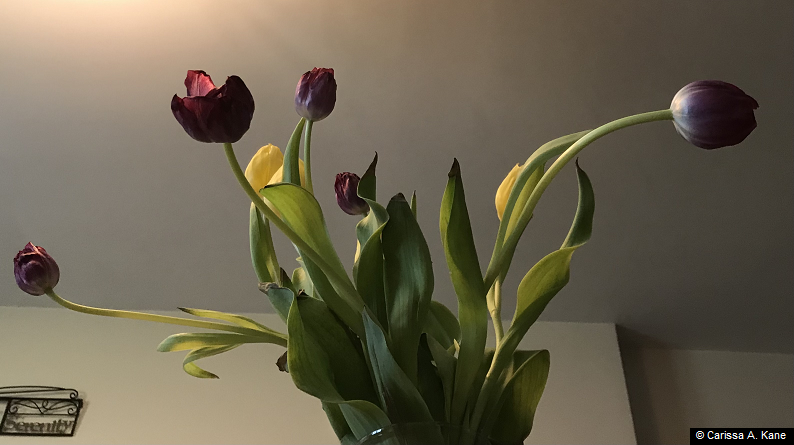
They started out a neatly organized bouquet of tulips, bulbs closed and standing upright in a vase, but with time, each came into its own. Still tulips though, and called by name, no matter the style or type of display. Some still upright. Some bending, turning, twisting, as if being called toward something else altogether, but again, all still called by name—side by side—together.
More than humane… a compelling lesson for humanity. Nothing new… it is as it has always been. In opening up, reaching out, and stretching toward another… letting go of “other,” change is made. What is true and meaningful, is more than comprehension. When the peace within one’s heart, reaches out, it permeates from soul to soul, and only then, is it about becoming.
Just as he said to the disciples who met him on the road to Emmaus, Jesus says to us, “You are witnesses of these things.” (Luke 24:48). As followers of Jesus, what did they do with that?
Fast forward to today… As disciples of Jesus, what do we do with all to which we have become witnesses? How do we stand with both the crucified and risen Jesus?
When he saw the crowds, he went up the mountain, and after he had sat down, his disciples came to him. He began to teach them, saying:
“Blessed are the poor in spirit, for theirs is the kingdom of heaven.
Blessed are they who mourn, for they will be comforted.
Blessed are the meek, for they will inherit the land.
Blessed are they who hunger and thirst for righteousness, for they will be satisfied.
Blessed are the merciful, for they will be shown mercy.
Blessed are the clean of heart, for they will see God.
Blessed are the peacemakers, for they will be called children of God.
Blessed are they who are persecuted for the sake of righteousness, for theirs is the kingdom of heaven.
Blessed are you when they insult you and persecute you and utter every kind of evil against you [falsely] because of me.
Rejoice and be glad, for your reward will be great in heaven. Thus they persecuted the prophets who were before you.
















 HopeThatFloats
You must be logged in to post a comment.