Food for Life…

Starting in childhood, I remember holding onto an item or two (pictures, tickets, and other such mementos) from each event that was a milestone or that seemed special to me. I would place them in a metal tin for safekeeping. Every so often, I would get the tin, open it, and reminisce about the events connected to the items.

As I got older and life got busier and busier, the tin was opened less. Over time, some of the items came to hold meaning far beyond events associated with them. Or, maybe over time, the deeper meaning surrounding them had room to make itself known.

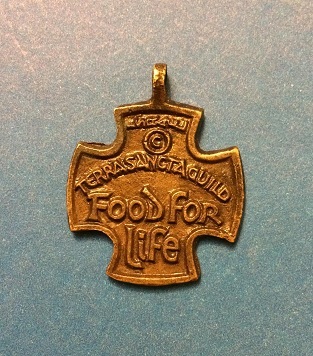
To this day, one of these items that I have held onto is a pendant. I do not recall exactly how it came into my possession, but I have had it for at least four decades now. Despite liking it and wanting to hold onto it, however, I do not recall ever actually wearing it.

In reading the Gospel according to Luke, chapter 15, verses 1-32 (the lost sheep, the lost coin, the lost son), I find myself thinking about the metal tin, the pendant, and the things (living or not), that one might consider as belonging to oneself. For many years, the pendant resided in the tin, tucked away, out of site, perhaps in some ways lost.

In time, it was only in looking more closely that I could see more clearly. What the pendant had come to represent needed to be stripped away in order to reveal the truth of what it was really all about. It was a rediscovering of sorts as the underlying message became the center—heart and soul.

2  1

Relationship with God and one another can often be confused with or portrayed in terms of possession—man-made attempts of one kind or another to gain control, authority or whatever else it may be. However, at every turn, and despite all that is damaged or taken away, often by those entrusted to lead the way, the grace of God is not, nor will it ever be, something to be possessed by only some, or restrained and restricted by limitations contrived by the human mind.

Authentic relationship with God, and one another, builds up in ways that are just and true… meaningful and beneficial to many. It is never about possession or forced wills, but instead honesty, transparency, and striving toward unity. God is, after all, Universal.

Tax collectors and sinners were all drawing near to listen to Jesus,
but the Pharisees and scribes began to complain, saying,
“This man welcomes sinners and eats with them.”
So to them he addressed this parable.
“What man among you having a hundred sheep and losing one of them
would not leave the ninety-nine in the desert
and go after the lost one until he finds it?
And when he does find it,
he sets it on his shoulders with great joy
and, upon his arrival home,
he calls together his friends and neighbors and says to them,
‘Rejoice with me because I have found my lost sheep.’
I tell you, in just the same way
there will be more joy in heaven over one sinner who repents
than over ninety-nine righteous people
who have no need of repentance.

“Or what woman having ten coins and losing one
would not light a lamp and sweep the house,
searching carefully until she finds it?
And when she does find it,
she calls together her friends and neighbors
and says to them,
‘Rejoice with me because I have found the coin that I lost.’
In just the same way, I tell you,
there will be rejoicing among the angels of God
over one sinner who repents.”

Then he said,
“A man had two sons, and the younger son said to his father,
‘Father give me the share of your estate that should come to me.’
So the father divided the property between them.
After a few days, the younger son collected all his belongings
and set off to a distant country
where he squandered his inheritance on a life of dissipation.
When he had freely spent everything,
a severe famine struck that country,
and he found himself in dire need.
So he hired himself out to one of the local citizens
who sent him to his farm to tend the swine.
And he longed to eat his fill of the pods on which the swine fed,
but nobody gave him any.
Coming to his senses he thought,
‘How many of my father’s hired workers
have more than enough food to eat,
but here am I, dying from hunger.
I shall get up and go to my father and I shall say to him,
“Father, I have sinned against heaven and against you.
I no longer deserve to be called your son;
treat me as you would treat one of your hired workers.”’
So he got up and went back to his father.
While he was still a long way off,
his father caught sight of him,
and was filled with compassion.
He ran to his son, embraced him and kissed him.
His son said to him,
‘Father, I have sinned against heaven and against you;
I no longer deserve to be called your son.’
But his father ordered his servants,
‘Quickly bring the finest robe and put it on him;
put a ring on his finger and sandals on his feet.
Take the fattened calf and slaughter it.
Then let us celebrate with a feast,
because this son of mine was dead, and has come to life again;
he was lost, and has been found.’
Then the celebration began.
Now the older son had been out in the field
and, on his way back, as he neared the house,
he heard the sound of music and dancing.
He called one of the servants and asked what this might mean.
The servant said to him,
‘Your brother has returned
and your father has slaughtered the fattened calf
because he has him back safe and sound.’
He became angry,
and when he refused to enter the house,
his father came out and pleaded with him.
He said to his father in reply,
‘Look, all these years I served you
and not once did I disobey your orders;
yet you never gave me even a young goat to feast on with my friends.
But when your son returns,
who swallowed up your property with prostitutes,
for him you slaughter the fattened calf.’
He said to him,
‘My son, you are here with me always;
everything I have is yours.
But now we must celebrate and rejoice,
because your brother was dead and has come to life again;
he was lost and has been found.’” – Luke 15:1-32

The Ways of Wisdom…

Typically, the shortest route, or what seems like the most direct one, is a heavy favorite. Often making a straight line more appealing or desirable from the outset. In the Bible, straight paths are referred to on a number of occasions.

Over time, these examples of paths being made straight (or clear) by the grace of God, have often been reworded and turned into moral directives, such as “follow the straight and narrow.”

What is “the straight and narrow”? From whom does it come? And, why follow it?

Turning back to scripture, perhaps Wisdom is the straight and narrow (no nonsense) from God, calling and moving us, with a desire to make the way clear and lead us closer to God, by way of the Holy Spirit.

Who can know God’s counsel,
or who can conceive what the Lord intends?
For the deliberations of mortals are timid,
and unsure are our plans.
For the corruptible body burdens the soul
and the earthen shelter weighs down the mind that has many concerns.
And scarce do we guess the things on earth,
and what is within our grasp we find with difficulty;
but when things are in heaven, who can search them out?
Or who ever knew your counsel, except you had given wisdom
and sent your holy spirit from on high?
And thus were the paths of those on earth made straight,
And people learned what pleases you,
And were saved by Wisdom. – Wisdom 9:13-18

In the Gospel according to Luke, chapter 14, verses 25-33, there is wisdom in Jesus’ words about discipleship, however unconventional his initial words may be. When Jesus uses a form of the word, “hate,” in conjunction with one’s closest of relatives and oneself, certainly, this would be unexpected as well as shocking to those who were with him. So much for wisdom being refined or in a pretty package.

Next, Jesus explains further. Discipleship comes with trials and tribulations. Not only that, but it also requires an awareness and desire as well as a resolve to faithfulness and commitment to God, above all. Jesus calls us to be “all in.”

What does this mean from a practical standpoint? What does being “all in” look like? More often than not, it is what it feels like, more than what it looks like.

Wisdom, if heeded, carries one in various directions at various times (often unexpected or unconventional), while creating and sustaining a sense of following the straight and narrow. Just as God is infinite and ever-present, so are the ways of being a good and faithful disciple.

Wisdom

Great crowds were traveling with Jesus,
and he turned and addressed them,
“If anyone comes to me without hating his father and mother,
wife and children, brothers and sisters,
and even his own life,
he cannot be my disciple.
Whoever does not carry his own cross and come after me
cannot be my disciple.
Which of you wishing to construct a tower
does not first sit down and calculate the cost
to see if there is enough for its completion?
Otherwise, after laying the foundation
and finding himself unable to finish the work
the onlookers should laugh at him and say,
‘This one began to build but did not have the resources to finish.’
Or what king marching into battle would not first sit down
and decide whether with ten thousand troops
he can successfully oppose another king
advancing upon him with twenty thousand troops?
But if not, while he is still far away,
he will send a delegation to ask for peace terms.
In the same way,
anyone of you who does not renounce all his possessions
cannot be my disciple.” – Luke 14:25-33

Reserved Seating…

Beginning in the early years of life, one comes to see that seating can be tricky, sometimes even turning contentious. From a very young age, many children are introduced to musical chairs. To be first (often synonymous with best) and beat out others in securing a coveted seat, of which there are too few, is the goal of the game. If you do not get a seat, you’re out of the game—eliminated.

Across the years as well as across various different areas of life, securing a “good” seat seemingly remains a key to many things. Whether one is attending an event related to school, sports, dinner, entertainment, travel, the celebration of milestones, etc., it seems human nature to aim for a seat with a prime view. In the Gospel according to Luke (chapter 14: 7-14), Jesus encourages us to refrain from this way of being and not to take the coveted seat, or hold it for those who are held in esteem or known to us.

Rather than aiming to obtain a particular spot, or slide into a position, we are to trust that what is passed up or given away, if it is truly for us, will come back to us. In addition, Jesus instructs us to be gracious, making room physically, as well as in our hearts and minds, for others. Calling us to look at and examine our reservations. What are the spots being held back or blocked off? What is preventing seating for all?

FerrisWheel

He told a parable to those who had been invited,
noticing how they were choosing the places of honor at the table.
“When you are invited by someone to a wedding banquet,
do not recline at table in the place of honor.
A more distinguished guest than you may have been invited by him,
and the host who invited both of you may approach you and say,
‘Give your place to this man,’
and then you would proceed with embarrassment
to take the lowest place.
Rather, when you are invited,
go and take the lowest place
so that when the host comes to you he may say,
‘My friend, move up to a higher position.’
Then you will enjoy the esteem of your companions at the table.
For every one who exalts himself will be humbled,
but the one who humbles himself will be exalted.”
Then he said to the host who invited him,
“When you hold a lunch or a dinner,
do not invite your friends or your brothers
or your relatives or your wealthy neighbors,
in case they may invite you back and you have repayment.
Rather, when you hold a banquet,
invite the poor, the crippled, the lame, the blind;
blessed indeed will you be because of their inability to repay you.
For you will be repaid at the resurrection of the righteous.” – Luke 14:7-14

Each Step’s Value…

From as early as I can recall, I have been intrigued by the way things move and the impact they have. Whether on land, in or under water, or in space, it has been fascinating to me to read about and to see the way humankind has worked with care, and continues to, in order to understand the lay of the land, sea, air, and space, and all that is living. It is amazing that given the proper conditions and environment, damage can be reversed, and restoration and/or regeneration is more often possible than not. However, even in those cases where it is not, all is not lost. Knowledge and understanding… wisdom is gained, making it possible to move forward in new or different ways for those who follow. Nothing is in vain.

In the process of going about one’s business each day, there is a lot of navigating, some expected and some not. In the Book of Proverbs it is written: “Survey the path for your feet, and all your ways will be sure” (4:26). Where am I moving and in what way? How do I proceed as I go about my business? What is it that moves me in the direction I am heading? In what or in whom do I find a sense of security?

In the Gospel according to Luke, chapter 13, verses 22-30, Jesus, as always, moves with purpose and meaning, and his footprints are laden with lessons and examples of how to live. He leaves more than a path to follow. Jesus imparts love, truth (sometimes truth that can be very challenging), and wisdom.

As he travels, Jesus makes an impression that lasts far beyond his physical presence. And through it all, he is never stagnant or fixated in any one place or on any one population. As he moves through different towns and villages, he does not turn away a single soul who comes to him. Even when it might seem like he is going to (e.g. the Syrophoenician woman – Mark 7:24-30). With Jesus, there is room for all those who desire and strive to receive his peace and healing—to live and be with him.

Sometimes, it can be tempting to think of, or to seek, Jesus in what the human mind might label as “positive” experiences or outcomes, not recognizing his presence in all of life’s circumstances. In verses 22-30 of Luke, chapter 13, he is upfront, as always, about the fact that following him is not easy. On, and of, the earth, there are no guarantees. However, while we may be bound by human limitations, our spirits are not. In turning to Jesus, all that is eternal can be brought to life, both here and now, as well as forever, enabling and empowering us to be the voice of all that is truly good and to rise above situations and circumstances that may be difficult rather than avoiding them. It is in this way that one is able to examine the path and move secure, regardless of the conditions or the footing along the way.

APlace

Jesus passed through towns and villages,
teaching as he went and making his way to Jerusalem.
Someone asked him,
“Lord, will only a few people be saved?”
He answered them,
“Strive to enter through the narrow gate,
for many, I tell you, will attempt to enter
but will not be strong enough.
After the master of the house has arisen and locked the door,
then will you stand outside knocking and saying,
‘Lord, open the door for us.’
He will say to you in reply,
‘I do not know where you are from.
And you will say,
‘We ate and drank in your company and you taught in our streets.’
Then he will say to you,
‘I do not know where you are from.
Depart from me, all you evildoers!’
And there will be wailing and grinding of teeth
when you see Abraham, Isaac, and Jacob
and all the prophets in the kingdom of God
and you yourselves cast out.
And people will come from the east and the west
and from the north and the south
and will recline at table in the kingdom of God.
For behold, some are last who will be first,
and some are first who will be last.” – Luke 13:22-30

Weight or Wait…

Over the past week, childhood memories of not being old enough to do whatever it might have been that older siblings or kids in the neighborhood were doing have surfaced in attempts to be understanding while navigating and responding to the “why?” of age being a determining factor to the negative.  What is it that can make waiting such a chore? What is it that can make the waiting that comes with life feel more like weight bearing down upon or holding one back than like a time that is on the way and simply has not yet arrived?

It can be difficult at times to take the long view or to see “the waiting” as a friend, creating space and readying one for what is to come. Perhaps sometimes, in the waiting, we are being waited upon. Maybe looked to, to open up or to make a move rather than being mostly on one side of the equation or the other. Oftentimes in waiting, one realization or another comes along, lessening the load and shifting the balance back to peace.

Peace

Truly, the Lord is waiting to be gracious to you,
truly, the Lord shall rise to show you mercy;
For the Lord is a God of justice:
happy are all who wait for the Lord! – Isaiah 30:18

Coming Together and Falling into Place…

Over the past number of weeks, I have had the opportunity to sit in a passenger seat beside my son as he learns to drive a car. I would be lying if I did not admit to the experience as being more than a little intense, and perhaps a little scary, at times. However, as time has passed and miles driven have accumulated, it has become more enjoyable, feeling more like a privilege as milestones—watching turns become easy, successful navigation of rotaries, crossing busy intersections, traveling roads with higher speed limits, etc.—have been reached. The process and progress seem to be coming together and everything (knowledge, skills, confidence, and belief) falling into place.

Thinking back on the beginning of this journey with my son, it all started, like many things, with overcoming any trepidation and taking a leap of faith. Gaining strength from the desire within—“I want to.” Then, with some support and encouragement, a vision—“I think I can.” Finally, moving into action and proceeding with patience—“I know I can, because I am.”

On the countless roads we travel, sometimes old or familiar, sometimes new, a reminder that while the surface and surroundings may change, underneath, and at the heart of whatever matter it may be, it is really all the same. Walk (or drive), but go by faith.

APlaceB

By faith Abraham, when called to go to a place he would later receive as his inheritance, obeyed and went, even though he did not know where he was going. By faith he made his home in the promised land like a stranger in a foreign country; he lived in tents, as did Isaac and Jacob, who were heirs with him of the same promise. For he was looking forward to the city with foundations, whose architect and builder is God. And by faith even Sarah, who was past childbearing age, was enabled to bear children because she considered him faithful who had made the promise. And so from this one man, and he as good as dead, came descendants as numerous as the stars in the sky and as countless as the sand on the seashore.

All these people were still living by faith when they died. They did not receive the things promised; they only saw them and welcomed them from a distance, admitting that they were foreigners and strangers on earth. People who say such things show that they are looking for a country of their own. If they had been thinking of the country they had left, they would have had opportunity to return. Instead, they were longing for a better country—a heavenly one. Therefore God is not ashamed to be called their God, for he has prepared a city for them. – Hebrews 11:8-16


Waving…

Sometimes walking or climbing to navigate and continue onward. Sometimes stopping to more fully appreciate the beauty all around, to take a breath or two of fresh air, or simply to rest. Depending on the time and the day, perhaps depending on the air, the path is very clear, or not so much. Yet, even in those moments of uncertainty or when it looks like there is no passageway to be found, before long there is an opening, and the way to proceed is there, revealed.

Sometimes turning back, it may seem to have disappeared, a distant memory, but not lost. Lingering, leaving the sense that somewhere down the road, it will be there once again. For now, carry on, but also, remember… trust… believe.

Teach us to count our days aright, Lord, that we may gain wisdom of heart. – Psalm 90:12

Maneuver

Blow the Horn…

I remember being instructed throughout childhood, “Do not be afraid to ask questions or to ask for help.” In addition, I also recall a teacher I had in elementary school who would often encourage students to ask any question they might have, saying, “The only stupid questions are the ones not asked.” She would then go on to explain that typically, for every student that asks a question, there is at least one other student, if not more, who whether or not they have the same question, somehow stand to benefit from hearing the answer.

Chapter 18, verse 23 of the Book of Genesis reads:

Then Abraham drew nearer (to the Lord) and said:
“Will you sweep away the innocent with the guilty? 

Knowing the Lord intends to address the depravity and numerous wrongs being committed in Sodom and Gomorrah, Abraham (having in mind his nephew, Lot, who resides in Sodom) asks this question and then follows it up with a couple more.

Suppose there were fifty righteous people in the city; would you really sweep away and not spare the place for the sake of the fifty righteous people within it?

Far be it from you to do such a thing, to kill the righteous with the wicked, so that the righteous and the wicked are treated alike! Far be it from you! Should not the judge of all the world do what is just?” – Genesis 18:24-25

Despite being encouraged in my early years to ask away when questions would arise, Abraham’s questions to the Lord, and the manner in which he asks them, used to seem so bold, and almost out of line or disrespectful to me. Questions were to be asked, but not ones like these, and certainly not of God, or those ordained as chosen to serve God’s people.

Now older, such a notion seems so archaic to me as well as one of detriment. It is especially curious, given the fact that Scripture provides many examples of the faithful asking God similar types of questions, sometimes even telling God, “Here is what (or how) I need You to be in this situation.” Not only that, but God’s response is always one of compassion, love, and mercy, not one that is punitive or that takes offense.

The honesty with which Abraham, and others after him, communicate and relate
to God—their prayer—is answered.

Faithfulness begets faithfulness.

The Answer to Prayer – Luke 11:9-13

“And I tell you, ask and you will receive; seek and you will find; knock and the door will be opened to you.

For everyone who asks, receives; and the one who seeks, finds; and to the one who knocks, the door will be opened.

What father among you would hand his son a snake when he asks for a fish?

Or hand him a scorpion when he asks for an egg?

If you then, who are wicked, know how to give good gifts to your children, how much more will the Father in heaven give the holy Spirit to those who ask him?”

Horn1

I will give thanks to you, O LORD, with all my heart,
for you have heard the words of my mouth;
in the presence of the angels I will sing your praise;
I will worship at your holy temple
and give thanks to your name.

Because of your kindness and your truth;
for you have made great above all things
your name and your promise.
When I called you answered me;
you built up strength within me.

The LORD is exalted, yet the lowly he sees,
and the proud he knows from afar.
Though I walk amid distress, you preserve me;
against the anger of my enemies you raise your hand.

Your right hand saves me.
The LORD will complete what he has done for me;
your kindness, O LORD, endures forever;
forsake not the work of your hands.

Lord, on the day I called for help, you answered me. – Psalm 138:1-3,6-8

Buck…

After a brief wait of silence and darkness, there it was—a buck. It entered into view, sauntered around, and then moved on, disappearing just as it had appeared. I quietly watched, in awe of its tranquil but purposeful movement and noticing its antlers. Perhaps this was the older version of the same buck that passed through a couple of months earlier. If so, my how it had grown in a relatively short period. Beyond its features, especially its antlers that were more pronounced, it seemed more sure-footed and astute in the way it carried itself.

Over the past few months, I have had the opportunity to see the nighttime movement of a number of animals as captured by a family member’s trail camera. It has been both interesting and fascinating to observe the way these creatures move about, crossover, and pass through the yard and woods behind it. They appear uninhibited, but at the same time quiet, reserved, and respectful.

In the hours of the night and into the dawn, the environment not only holds peace, but also gives it. It is one with room for pensive pauses and calming paces. Sometimes, what the darkness of night offers can be encouraging and uplifting, just as much as that of day.

Strength and wisdom come, inner stillness enlightening each night and every day.

Buck1

Buck3

A psalm of David.
LORD, who may abide in your tent?
Who may dwell on your holy mountain?

Whoever walks without blame,
doing what is right,
speaking truth from the heart;

Who does not slander with his tongue,
does no harm to a friend,
never defames a neighbor;
Who disdains the wicked,
but honors those who fear the LORD;
Who keeps an oath despite the cost,
lends no money at interest,
accepts no bribe against the innocent.

Whoever acts like this
shall never be shaken. – Psalm 15

Neighbors…

Over the years, I have been fortunate to witness as well as to experience, on many occasions, the care, kindness, and concern of neighbors. While the word “neighbor” may conjure the image of those living in closest proximity, in actuality, regardless of location, preferences, opinions, etc. any fellow human being or living thing is neighbor. Thinking of both those next door and those far away, through countless occurrences and interactions, it seems that, certainly, one of the greatest gifts to come with each heart is the ability to feel compassion and express mercy. However, whether or not one is locked-in and striving to live from this God-given capacity, allowing it to influence thoughts, words, and actions, is another thing.

In the story of the Good Samaritan (Luke 10), the one who may have been least expected to do so, the Samaritan, is the only one to rise to the occasion, allowing the Spirit to lead him. He stops at the sight of the victim, placing emphasis on his fellow human being (his neighbor) who is in need. He does the proper thing, rather than the easiest or most convenient thing. He seeks not revenge, nor to add insult to injury, but to lessen the blemish made by the robber, also a neighbor. In doing so, he does his part to let the light of God within him grow and shine, and in turn, he is helping, through the grace of God, to keep the one that seeks to cast down humanity at bay.

There is not a flower that opens, not a seed that falls into the ground, and not an ear of wheat that nods on the end of its stalk in the wind that does not preach and proclaim the greatness and the mercy of God to the whole world. – Thomas Merton

2Daisy

There was a scholar of the law who stood up to test Jesus and said,
“Teacher, what must I do to inherit eternal life?”
Jesus said to him, “What is written in the law?
How do you read it?”
He said in reply,
“You shall love the Lord, your God,
with all your heart,
with all your being,
with all your strength,
and with all your mind,
and your neighbor as yourself.”
He replied to him, “You have answered correctly;
do this and you will live.”

But because he wished to justify himself, he said to Jesus,
“And who is my neighbor?”
Jesus replied,
“A man fell victim to robbers
as he went down from Jerusalem to Jericho.
They stripped and beat him and went off leaving him half-dead.
A priest happened to be going down that road,
but when he saw him, he passed by on the opposite side.
Likewise a Levite came to the place,
and when he saw him, he passed by on the opposite side.
But a Samaritan traveler who came upon him
was moved with compassion at the sight.
He approached the victim,
poured oil and wine over his wounds and bandaged them.
Then he lifted him up on his own animal,
took him to an inn, and cared for him.
The next day he took out two silver coins
and gave them to the innkeeper with the instruction,
‘Take care of him.
If you spend more than what I have given you,
I shall repay you on my way back.’
Which of these three, in your opinion,
was neighbor to the robbers’ victim?”
He answered, “The one who treated him with mercy.”
Jesus said to him, “Go and do likewise.” – Luke 10:25-37