Reflections on spirituality, life, meaning, and purpose
Menu
Search
Author: Carissa A. Kane
Carissa A. Kanehttps://hopethatfloats.wordpress.comI am passionate about spirituality and the journey to deepen and grow in relationship with God.
My desire to live a life rooted in the Divine, and to journey with others who wish to do so, has grown, as have I, through the joys and sorrows, the struggles, victories and challenges of life.
I feel blessed to be a child of God, wife, mother, writer, spiritual director, and retreat director.
Today, April 22, 2023, as we head into the 3rd Sunday of Easter, we celebrate Earth Day. The earth has been around for over 4.5 billion years, and Earth day? It has been celebrated for 53 years—since 1970.
Despite the comparatively young age of Earth Day, an appreciation for, and the call to honor and preserve the beauty of our planet, nature, and all creation has been ongoing for a far greater time than has been documented. In fact, it’s part of the plan, and path of life. Yet, as with many things, it can become a battle ground… a place for sides to be formed, to rise up against each other, to hold firm, to lose sight, and to stall any attempts at dialogue and resolution, never mind love and mercy.
In the readings for the 3rd Sunday of Easter (Acts 2:14, 22-23; Ps 16:1-2,5, 7-8, 9-10, 11; 1 Pt 1:17-21, and Lk 24:13-35), there lies an invitation to connect more strongly with the path of life as being bigger, and sweeping more broadly, than the circle in which any one individual, or group, travels. So often when we think we know, we don’t. The issues at hand are always more than what we can see, and the way that any one individual may or may not be affected, cannot be used to color the experience of all of humankind. How, after all, is it possible to be open to Divinity, without being open to possibilities?
Turning to Scripture, it seems that those who sought to crucify Jesus, were so sure that he was a threat. It’s clear that His ways were not in line enough with theirs and one can imagine how that might jeopardize their sense of identity, authority, power, and control. We can see how their ability to move in ways that embraced and imbued love, truth, justice, and mercy was hindered by their inability to recognize that they were seeing and acting through their own, limited understanding. There was no room for God on the path to which they were so deeply committed, and this led to them receiving and reacting in fear and seeking even greater control, rather than responding with love.
On the other hand, Jesus, who reacted with love and was inspired by God, could not be held down, even by death.
This man, delivered up by the set plan and foreknowledge of God, you killed, using lawless men to crucify him. But God raised him up, releasing him from the throes of death, because it was impossible for him to be held by it. For David says of him: I saw the Lord ever before me, with him at my right hand I shall not be disturbed. Therefore my heart has been glad and my tongue has exulted; my flesh, too, will dwell in hope, because you will not abandon my soul to the netherworld, nor will you suffer your holy one to see corruption. You have made known to me the paths of life; you will fill me with joy in your presence. – Acts 2:23-28
This is the message of our faith, and the model that we are to follow. Our faith and hope is to be placed in God, and doing so, our words and actions will reflect the Way of God. The Way where our eyes are opened and our hearts burn with desire to be in the service of Love, wherever it leads.
On the road to Emmaus, the two disciples requested of Jesus, “Stay with us” (Lk 24:29).
In our striving, we must do the same, and like the disciples, we must also leave room for the breaking of bread and having hearts that are open to receive, with the love of Jesus, whatever may be revealed.
“You cannot get through a single day without having an impact on the world around you. What you do makes a difference, and you have to decide what kind of difference you want to make.” – Jane Goodall
Meet me at the Intersection. You know the place. The one where our wills meet, And where differences are laid aside. The one where hearts meld for all.
Meet me at the Intersection. You know the place. The one where face to face, Our guards recline and fears subside, As we recall the beauty of our Oneness.
Meet me at the Intersection. You know the place. The one, and only One, Where we help each other, And the choices made, Regardless of their ilk, Shine with greater Glory.
Meet me at the Intersection. You know the place. The one where we walk, hand in hand, And there is no wedge between us. Where we recall, together is our destiny.
Meet me at the Intersection, You know the place. For there is no other way, But the Way—open, just, and free, As life, in all its Glory, rises to its fullness.
When Jesus and the disciples drew near Jerusalem and came to Bethphage on the Mount of Olives, Jesus sent two disciples, saying to them, “Go into the village opposite you, and immediately you will find an ass tethered, and a colt with her. Untie them and bring them here to me. And if anyone should say anything to you, reply, ‘The master has need of them.’ Then he will send them at once.” This happened so that what had been spoken through the prophet might be fulfilled: Say to daughter Zion, “Behold, your king comes to you, meek and riding on an ass, and on a colt, the foal of a beast of burden.” The disciples went and did as Jesus had ordered them. They brought the ass and the colt and laid their cloaks over them, and he sat upon them. The very large crowd spread their cloaks on the road, while others cut branches from the trees and strewed them on the road. The crowds preceding him and those following kept crying out and saying: “Hosanna to the Son of David; blessed is he who comes in the name of the Lord; hosanna in the highest.” And when he entered Jerusalem the whole city was shaken and asked, “Who is this?” And the crowds replied, “This is Jesus the prophet, from Nazareth in Galilee.” – Matthew 21:1-11
Today, March 25th, is the Solemnity of the Annunciation of the Lord. The readings for this day, are a reminder, “God is with us” (Isaiah 8:10), “for nothing will be impossible for God.” (Luke 1:37), and guidance to contemplate relationship with God. An opportunity to consider how one responds to the call of the ever present God of love, mercy, and redemption. What happens at the thought of “I come to do your will.” (Psalm 40:8a, 9a; Hebrews 10:7b, 9a), or Mary’s response of “Behold, I am the handmaid of the Lord.” (Luke 1:38)?
Spending time with the road traveled by the Prophet Isaiah, the Psalmist, Mary, and St. Paul, one can draw inspiration, perhaps more easily, because we know, or we can read about the ways in which God was with them and enabled them to fulfill the path that was theirs, in the face of trials and tribulations.
In the first reading for the Fifth Sunday of Lent, it is written, “I will put my spirit in you that you may live, and I will settle you upon your land; thus you shall know that I am the Lord. I have promised, and I will do it, says the Lord.” (Ezekiel 37:14).
The verses that follow this passage, are referred to as the joining of the two sticks. That is, God’s intention or call… God’s will for the tribes of Juda and Joseph to come together and for the people to be united.
“Thus says the Lord God: I will soon take the Israelites from among the nations to which they have gone and gather them from all around to bring them back to their land. I will make them one nation in the land, upon the mountains of Israel, and there shall be one king for them all. They shall never again be two nations, never again be divided into two kingdoms.” – Ezekiel 37:21-22
Thinking about this in terms of the division in families, communities, and the world at large today, in what ways do you see the Spirit of God shining through in your life, your community, and the world?
With the Lord there is mercy and fullness of redemption. – Psalm 130:7
Where do you experience love, mercy, and unity? And how do you desire to be an agent or a partner in not only carrying, but also sharing the essence of these attributes of God?
Looking around and sitting with personal challenges and the state of the world today can be daunting at times. There is much that is awry and issues that can seem insurmountable. With these realities it can be tempting to not look around or to not focus much attention or thought on the problems that exist. However, not ignoring what’s going on, is part of what it means to carry the cross—to live in reality, whatever it may be, praying and proceeding with hope that is eternal, and that resides in and seeks to be guided by God, for whom nothing is impossible.
As St. Paul writes, “If the Spirit of the one who raised Jesus from the dead dwells in you, the one who raised Christ from the dead will give life to your mortal bodies also, through his Spirit dwelling in you.” (Romans 8:11). How do you desire the Spirit of the Lord to be present to you at this moment? In what areas do you desire greater light and life?
In lots of ways, the times we are experiencing lend themselves to the deception that we are dealing with the impossible and that throwing the towel in, or walking away is the answer. Yet, faith beckons one to pause and to notice. Who or what is deeming the situation a lost cause? What is the source? Is it a human summation? From what spirit does it come?
In chapter 11 of the Gospel According to John, verses 1-45, we read about the raising of Lazarus. In order to go to the home of his good friends, Mary, Martha, and the now deceased Lazarus, Jesus must return to the town where people have tried to stone him, more than once. In addition, by the time Jesus arrives there, it has been four days since Lazarus’ lifeless body was placed in the tomb. Many would deem this situation hopeless or impossible. Why does Jesus go back to the place where he is mocked, and people are seeking his demise? Why does Jesus even attempt to raise Lazarus who is clearly beyond resuscitation?
Because Jesus is Life! He is full of love and mercy, the embodiment of God, and death, in any of its forms, cannot and will not defeat Him, or those who belong to Him. For it is through Him, that all things are possible.
Now a man was ill, Lazarus from Bethany, the village of Mary and her sister Martha. Mary was the one who had anointed the Lord with perfumed oil and dried his feet with her hair; it was her brother Lazarus who was ill. So the sisters sent word to him saying, “Master, the one you love is ill.” When Jesus heard this he said, “This illness is not to end in death, but is for the glory of God, that the Son of God may be glorified through it.” Now Jesus loved Martha and her sister and Lazarus. So when he heard that he was ill, he remained for two days in the place where he was. Then after this he said to his disciples, “Let us go back to Judea.” The disciples said to him, “Rabbi, the Jews were just trying to stone you, and you want to go back there?” Jesus answered, “Are there not twelve hours in a day? If one walks during the day, he does not stumble, because he sees the light of this world. But if one walks at night, he stumbles, because the light is not in him.” He said this, and then told them, “Our friend Lazarus is asleep, but I am going to awaken him.” So the disciples said to him, “Master, if he is asleep, he will be saved.” But Jesus was talking about his death, while they thought that he meant ordinary sleep. So then Jesus said to them clearly, “Lazarus has died. And I am glad for you that I was not there, that you may believe. Let us go to him.” So Thomas, called Didymus, said to his fellow disciples, “Let us also go to die with him.” When Jesus arrived, he found that Lazarus had already been in the tomb for four days. Now Bethany was near Jerusalem, only about two miles away. And many of the Jews had come to Martha and Mary to comfort them about their brother. When Martha heard that Jesus was coming, she went to meet him; but Mary sat at home. Martha said to Jesus, “Lord, if you had been here, my brother would not have died. But even now I know that whatever you ask of God, God will give you.” Jesus said to her, “Your brother will rise.” Martha said to him, “I know he will rise, in the resurrection on the last day.” Jesus told her, “I am the resurrection and the life; whoever believes in me, even if he dies, will live, and everyone who lives and believes in me will never die. Do you believe this?” She said to him, “Yes, Lord. I have come to believe that you are the Christ, the Son of God, the one who is coming into the world.” When she had said this, she went and called her sister Mary secretly, saying, “The teacher is here and is asking for you.” As soon as she heard this, she rose quickly and went to him. For Jesus had not yet come into the village, but was still where Martha had met him. So when the Jews who were with her in the house comforting her saw Mary get up quickly and go out, they followed her, presuming that she was going to the tomb to weep there. When Mary came to where Jesus was and saw him, she fell at his feet and said to him, “Lord, if you had been here, my brother would not have died.” When Jesus saw her weeping and the Jews who had come with her weeping, he became perturbed and deeply troubled, and said, “Where have you laid him?” They said to him, “Sir, come and see.” And Jesus wept. So the Jews said, “See how he loved him.” But some of them said, “Could not the one who opened the eyes of the blind man have done something so that this man would not have died?” So Jesus, perturbed again, came to the tomb. It was a cave, and a stone lay across it. Jesus said, “Take away the stone.” Martha, the dead man’s sister, said to him, “Lord, by now there will be a stench; he has been dead for four days.” Jesus said to her, “Did I not tell you that if you believe you will see the glory of God?” So they took away the stone. And Jesus raised his eyes and said, “Father, I thank you for hearing me. I know that you always hear me; but because of the crowd here I have said this, that they may believe that you sent me.” And when he had said this, He cried out in a loud voice, “Lazarus, come out!” The dead man came out, tied hand and foot with burial bands, and his face was wrapped in a cloth. So Jesus said to them, “Untie him and let him go.” Now many of the Jews who had come to Mary and seen what he had done began to believe in him. – John 11:1-45
Sitting in the audience as the story continues to unfold, there is a scene where one character calls out, asking, will you love me either way? Do you care if I win, or if I lose? Then comes the response, something along the lines of, to be honest, I don’t really care about those kinds of things.
Thinking about this exchange, it’s interesting how importance is assigned and judgments are made that are often based upon our (society’s) lack of understanding. And, in the process, these “ideals” often stir up false notions of what is good, righteous, and true, and even worse, they often fuel fear, in the competition to keep or attain the imaginary security living up to them brings.
The scripture readings for the Fourth Sunday of Lent show how these false ideals can lead to fear and judgment and get in the way of actual goodness, righteousness, and truth.
In the first reading (1 Samuel 16:1-13), we learn how David, the youngest of Jesse’s sons, was chosen by God to be anointed by Samuel. Upon encountering Jesse and his sons, Samuel’s assumption is that the one to be anointed will have certain characteristics that could be judged at first sight. However, it is written, “God does not see as a mortal, who sees the appearance. The Lord looks into the heart.” (v. 7b). It turns out that the last, and least likely to be judged as the chosen one, is in fact, chosen, and for qualities that cannot be readily seen.
As we go through life, we are constantly subject to judgment based on external values (clothing, education, mode of transportation, location of and type of housing, etc.). We are constantly being marketed to and pulled toward someone else’s notion of how to be and someone else’s definition of success. We also hear so much about first impressions. None of these things, however, really inform anyone of the most important feature of humankind—the heart, or the most important voice—that of the Creator. They are almost always based upon the external, and often look past qualities that convey deeper meaning, value, and purpose.
In Psalm 23, verses 1-6, it is written, “The Lord guides me along the way of righteousness.” (v. 3b). These words encourage us to trust, like David, that the path of righteousness is made known to us through God. If we were to look solely at man-made ideas about what’s important and how to live, depending on where we were and who we were surrounded by, we might be okay, but even if we were, the person or people leading us, would still be susceptible to falling away from what is good, just, and true. So, it’s important to have a relationship with God and to entrust oneself to the One who really knows the way that is best, and whose focus is the well-being of all hearts and souls.
St. Paul expands on this notion in the Letter to the Ephesians (Ephesians 5:8-14), when he writes, “For you were once darkness, but now you are light in the Lord. Live as children of light, for light produces every kind of goodness and righteousness and truth.” (v. 8-9).
When we look to the Gospel According to John (chapter 9, verses 1-41), we see the Pharisees, on the surface, defending the faith. However, what they are really defending is a way of operating that breeds fear and judgment and seeks to confine, control, and conform God’s ways to their ways. How do we know this?
Looking at the actions and responses of the Pharisees, we can see how they treat the blind man who was healed, his parents, and Jesus. Their hearts are closed. At one point, they say to the blind man who can now see (because of Jesus), “You were born totally in sin, and are you trying to teach us?” (v. 34). After saying this, they removed the man from their presence. All for answering them truthfully, when he was interrogated for a second time and said, “This is what is so amazing, that you do not know where he is from, yet he opened my eyes. We know that God does not listen to sinners, but if one is devout and does his will, he listens to him. It is unheard of that anyone ever opened the eyes of a person born blind. If this man were not from God, he would not be able to do anything.” (v. 30-33).
During this Season of Lent, it’s a great time to reflect on our words and actions, and with this Sunday’s Scripture passages, an even better time to consider how fear and judgment come into play in what we see and how we respond.
As pockets of clouds drifted across the clear night sky, the moon, at its fullest continued to reflect hope and promise in each passing moment, inspiring hope and promise with each passing thought. What is, what would be, what could be, beholden to One, the only One. There is I Am.
The response to the Psalm for the Third Sunday of Lent is, “If today you hear God’s voice, harden not your hearts.” (Ps 95:8). What does a hardened heart look like? Physically, it is one in which arteries may be clogged, or the lining may be thickening, to name a couple attributes. Overall though, it is a heart that is blocked in one way or another from working optimally or as designed. Spiritually, a hardened heart is also blocked in one way or another from working fully, as intended by God.
So how does one recognize a hardened heart? Well, as with many things, there are indicators as well as tests that can alert one to the status of their heart. And in faith, the directions always start at the beginning. “If today you hear God’s voice…”
What does God’s voice look, or sound like to you? What adjectives would you use to describe God?
Now, taking Light to life, what happens when you try to assign those same adjectives to describe the heart behind your words and actions throughout the day, the week, and more? In what situations do they fit? And in what situations, is there an invitation for greater growth and movement toward taking on the heart of Jesus?
A Lenten Prayer: Heart of Jesus, open our eyes and ears. Heart of Jesus, show us what our hearts are looking past. Heart of Jesus, help us to acknowledge what is, what would be, what could be. Heart of Jesus, guide us in your way. Heart of Jesus, bind our hearts to yours.
Walking alongside a beach, the sand is smooth and the waves gentle, like ripples in a lake, pond, or puddle. The path is peaceful and seemingly continuous, until the disruption up ahead; a trench created by water draining back toward the ocean. The chasm is too large to jump across, and there’s no way around it. Or at least no way to get to the other side without having to come off the beach and onto the cracked, uneven sidewalk, stepping through the cold water, or trudging down into and through the muddy-like sand. Pausing to ponder… how best to make it through what seems like the great divide?
In looking to the Gospel passage for the Second Sunday of Lent, Peter says, “Lord, it is good we are here.” This is because he recognizes the moment as a sacred one; something greater is happening here, and we need to take heed and behold it. As he continues speaking, the bright cloud appears, a shadow is cast by it, and a voice says, “This is my beloved Son, with whom I am well pleased; listen to him.” With this, the environment shifts for Peter, James, and John, and their posture changes, but they still recognize the moment as sacred, “they fell prostrate.”
As we try to navigate this world, it can be tempting to shy away, to want to hide, circumvent, or look the other way, and to carry on insulated from the chaos and division that swirls around us. Yet, faith calls us to face the shifting environment by placing our hope and trust in Jesus. Rather than losing heart, we are called to take on the heart of Jesus. And in doing so, even when the reality in front of us may be unpleasant or seem bleak, we are able to face it through the Light of God who helps us to know when and how to rise, and to recognize each moment in these turbulent times as being sacred; holding hope and promise. This is simply because, God is with us, making the dark clouds become bright and spreading light in the midst of darkness, even when, like Peter, James and John, we don’t see it coming.
Jesus took Peter, James, and John his brother, and led them up a high mountain by themselves. And he was transfigured before them; his face shone like the sun and his clothes became white as light. And behold, Moses and Elijah appeared to them, conversing with him. Then Peter said to Jesus in reply, “Lord, it is good that we are here. If you wish, I will make three tents here, one for you, one for Moses, and one for Elijah.” While he was still speaking, behold, a bright cloud cast a shadow over them, then from the cloud came a voice that said, “This is my beloved Son, with whom I am well pleased; listen to him.” When the disciples heard this, they fell prostrate and were very much afraid. But Jesus came and touched them, saying, “Rise, and do not be afraid.” And when the disciples raised their eyes, they saw no one else but Jesus alone.
As they were coming down from the mountain, Jesus charged them, “Do not tell the vision to anyone until the Son of Man has been raised from the dead.” – Mt 17:1-9
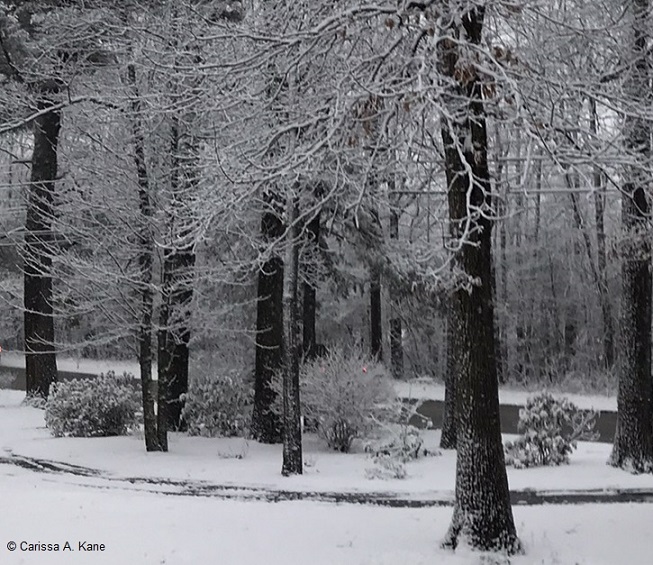
Covered with snow, the landscape so quiet, so still, so beautiful. The branches and shrubs become as if carefully wrapped, insulated from the elements, as well as by the elements. Becoming part of what’s on the outside pushing inward? Or, perhaps, it’s the outside becoming part of what’s inside and underneath, pushing outward? How will they lean, where will they fall, maybe, just maybe, they will stand upright, if anything at all.
A clean heart create for me, God; renew within me a steadfast spirit. – Ps 51:12
The Gospel for the First Sunday of Lent (Mt 4:1-11), is an account of the temptation of Jesus. We all experience variations of temptation throughout our lives. We all have weaknesses or tendencies that can lead us astray or take us away from being at or near our best, most genuine selves.
Looking to the example of Jesus, we can see his response to temptation, is first and foremost, to be aware and recognize it. Then second, to respond by remembering, and not only naming, but also reclaiming God as the source of all wellbeing. Jesus keeps God at the center throughout, and God’s grace enables him to overcome each temptation.
How can one apply this to real life experience in today’s world?
We can start by being aware and recognizing that temptation works in different ways. Sometimes it tries to move us toward “absolute” or limited views and the choices that flow from them, while at other times, temptation seeks to blur the lines between choices so that the best choice is left behind for the choice that seems good enough. Temptation tries, and keeps trying to find whatever hook will sink, to snag and pull one toward a more self-centered space and making a choice from there, instead of making it from a God-centered space where the choice is generative and beneficial beyond what one can surmise.
In the Gospel passage of the temptation of Jesus, Jesus shows us how to lean on the grace of God, and how to patiently endure to overcome temptation by living with God at the center—always in our hearts and minds. He reminds us that what has been written, holds true now, as well as forever.
One does not live on bread alone, but on every word that comes forth from the mouth of God. – Dt 8:3
He will command his angels concerning you and with their hands they will support you, lest you dash your foot against a stone. – Ps 91:11-12
You shall not put the Lord, your God, to the test. – Dt 6:16
The Lord, your God, shall you worship and him alone shall you serve. – Dt 6:13
Reflecting on each of Jesus’s responses above, what comes to mind in terms of your own experience of God’s grace in the face of a struggle or challenge you faced? Recall how God was present to you, and how you were, or became present to God? Share with God what that experience was like, and what it means to you today. What inspiration or insight might God want that experience to reveal to you today?
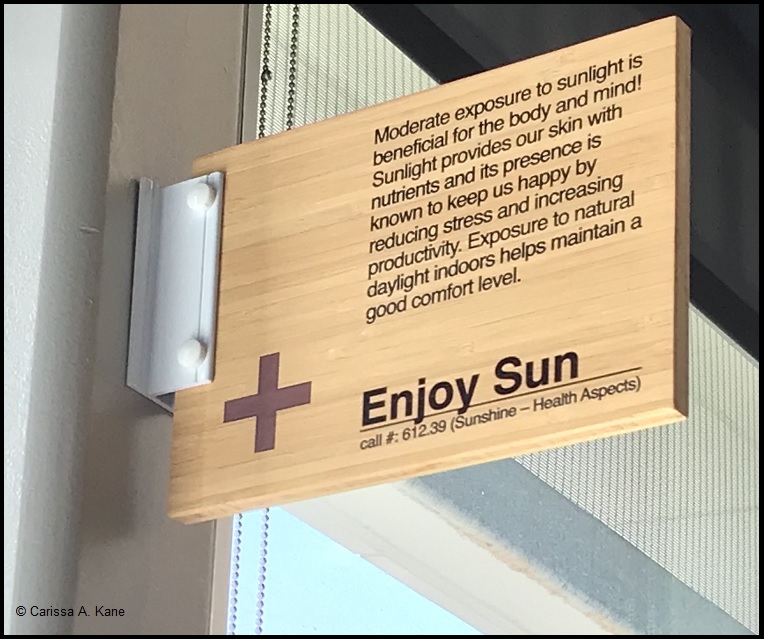
Standing up to take a break, stretch a little, and take a few steps around before returning to work in a temporary workspace for the day, the sign pictured below came into view. I read it and looked around some more. Taking in the environment and noticing more fully the ambience created by the natural light, gratitude and appreciation arose for the light and the souls who not only thought to share these interesting facts about sunlight and its benefits, but who also acted to shed the light, both in word and experience.
Oftentimes in the course of a day or week, we can be quick to move from task to task, and perhaps we miss the sign, put off the call, or rush through or past it, on the way to something else. Yet, much of the time, that thing, whatever it may be, that has a greater hold on our attention, robs us, “like a thief in the night,” of being present in a moment or for an opportunity to experience that which enlivens the soul, helps us to look beyond our own, often limited, schedules, scopes, or agendas, and reminds us of what’s really important—our connectedness, how we respect and appreciate each other—differences and all—and how we share our time and what we have, as blessings from Above.












 HopeThatFloats
You must be logged in to post a comment.