It’s Still Water…

Although we had come expecting to see a variety of colors, bright and beautiful, as in other spots around the water, what we came upon was much more subtle, but also bright and beautiful.

Standing at the water’s edge, initially, the stillness and clarity of the pond was so peaceful, drawing us closer, putting us in awe. Looking further out, ripples seemed to suddenly appear, although given the gentle, steady breeze, they were likely there all along, only becoming more prominent as one’s glance stretched past the calmness of the water that was closest by. Beyond the trembles, across, to the other side of the pond was more stillness. It was in the trees of mostly green, and further, the sky also steady and calm. Taken altogether, perhaps making a ripple sandwich. Oftentimes, the uneven spots are gently held between, or surrounded by, the ones that carry peace.

Rejoice

Let the hearts that seek the Lord rejoice; turn to the Lord and the Lord’s strength, constantly seek the Lord’s face. – Psalm 105:3-4

A Banner Time…

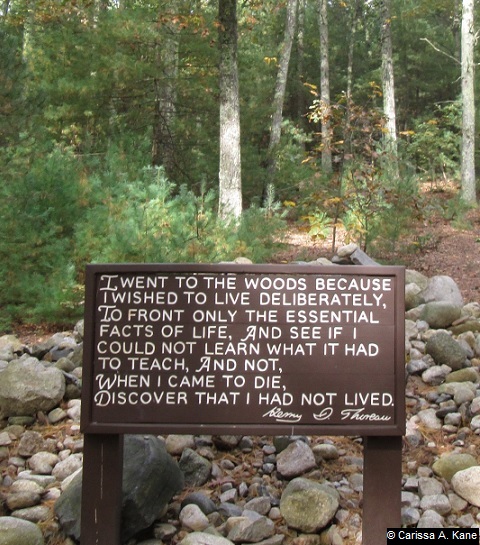
A few weeks ago, my daughter had an assignment in a design class to create a folder using images with which one might identify. Between discussion around the project and looking through some photographs from a recent trip to Walden Pond and the surrounding area, memories of creating banners and posters at various points throughout my childhood and in the ensuing years come to mind. One of the earliest memories is as a young Sunday school student finding joy in seeing all the banners made by different classrooms of students. The banners made with colors and using images that each class collectively picked were hung up around the church.  They were simply displayed, in the spirit of sharing so that everyone was free to receive them in whatever way they might.

In chapter 17 of the Book of Exodus, after Amelek has been defeated, it is written that Moses created an altar to the Lord, naming it Yahweh-nissi or “The Lord is my banner.” (Exodus 17:15). Victory had been achieved through the Lord, with Moses holding the staff of God raised up in his hands.

Throughout the Bible, God’s people are provided for; their needs do not go unmet. In times of trouble, it is never God who strays, but rather the people. There is example upon example of those who persist in identifying with, and embracing, the Lord as their banner. Ultimately, though different people and various kinds of situations are involved, each one always seems to arrive at a place where all things come together, reminding them, reminding us, that God is greater than any one story or situation could capture. Also calling us to remember, faithfulness to God is achieved in countless ways, even when others do not, or cannot, see it.

Given the task of creating a banner to be raised up and shared, what would it look like? In what ways would God be reflected in it? In my words and actions, how do I pay homage to who I am, who I was created to be, and “Take up the banner of the Lord! (Ex 17:16)”?

Thoreau

Beloved:
Remain faithful to what you have learned and believed,
because you know from whom you learned it,
and that from infancy you have known the sacred Scriptures,
which are capable of giving you wisdom for salvation
through faith in Christ Jesus.
All Scripture is inspired by God
and is useful for teaching, for refutation, for correction,
and for training in righteousness,
so that one who belongs to God may be competent,
equipped for every good work.

I charge you in the presence of God and of Christ Jesus,
who will judge the living and the dead,
and by his appearing and his kingly power:
proclaim the word;
be persistent whether it is convenient or inconvenient;
convince, reprimand, encourage through all patience and teaching. – 2 Timothy 3:14-4:2

According to the Word…

Consult not your fears but your hopes and your dreams. Think not about your frustrations, but about your unfulfilled potential. Concern yourself not with what you tried and failed in, but with what it is still possible for you to do. – Angelo Giuseppe Roncalli

In the fall of 1881, Angelo Giuseppe Roncalli was born in Northern Italy. He was the fourth of thirteen children in a family that worked fields for a landlord. They were sharecroppers.

It is probably fair to state that it was unlikely anyone, including Angelo Roncalli, would have imagined his life would inspire great change throughout the world, but it did. In the fall of 1958, he was elected Pope, taking the name John XXIII. His papacy, beginning a few years shy of his 80th birthday, was predicted to be a sort of “filling the gap.” In fact, many in the church’s upper echelon of leadership were expecting him to do very little while they were looking to line things up for the “right” successor upon his passing. However, Pope John XXIII continued with the same passion and Spirit-driven action that he had shown throughout his life.

St. John XXIII did, to the surprise and probably the dismay of many, much work during his papacy to encourage and steer the church toward greater integrity by emphasizing Truth, trying to live out the teachings of Jesus, and embodying a spirit of peace and unity. He called for change in the portrayal of Jesus’ death as the fault of the Jews and stopped the perpetuation of the term “faithless” with regards to our Jewish brothers and sisters. He sought to bring together the leaders of the United States and Russia in an attempt to help lessen animosities and work toward peace. He also called for the Second Vatican Council which led to numerous changes in the church, again trying to create a church more in line with the philosophy of Jesus.

While some of his words and actions may be disputed, as with any human being, he had a heart that desired and was devoted to peace and unity. Much of what he wrote, spoke, and did, came out of this place. It was his source of inspiration—the Spirit in which he lived.

Unfortunately, many do not experience church as a place of peace and unity, never mind a place of Truth. Despite this, how fortunate that the Spirit of God has depth and width broader than what the human mind can measure. How fortunate that spiritual nourishment and relationship with God are not bound and tied to any earthly thing, but rather expressed through those who are faithful, no matter where they may be.

We were all made in God’s image, and thus, we are all Godly alike. – Angelo Giuseppe Roncalli (a.k.a. Good Pope John and then St. John XXIII)

AccordingToTheWordOfGod

Humankind was created as God’s reflection:
in the divine image God created them;
female and male, God made them. – Genesis 1:27

Be the spirit that is willing to be true…

To one side of the landscape there was mostly a wall of green, and then what seemed like a path of orange with some red extending upward and to the right, as if to say, come along this way.

In the second letter to Timothy, Paul writes, “I remind you, stir into flame the gift of God…” (2 Timothy 1:6). Paul is in prison, and Timothy, to whom he has been a mentor, must proceed in the work he has been called to do, namely evangelizing. However, rather than just telling Timothy what he needs to do, Paul first calls on him to remember the truth.

“For God did not give us a spirit of cowardice but rather of power and love and self-control…” – v. 7

This is a call to action that encourages Timothy, and encourages us, to carry on with integrity, and in a manner that is befitting one created in the image of God. If Timothy were to look around to see what others were doing, or to focus on the fact that Paul has been imprisoned for his Spirit driven efforts (which go against the grain of the majority and popular opinion) perhaps he would stop and turn the other way. In fact, it would be likely that he would move away from taking an approach that is first and foremost, faithful to God, and instead be lead toward fulfilling earthly ambitions or needs, thus compromising, or at the expense of, the fulfillment of his heavenly call.

This would be sad… tragic and a monumental loss. However, with God there is always more than one chance to do the right thing. More than one chance to make truly life giving choices and to live the life that God dreams for us. The life that we see as having ups and downs through trials and tribulations, but that becomes even keeled when we face them, inspired and moved into action by the Spirit of God, bringing a sense of peace in each and every thing.

For the vision is a witness for the appointed time,
a testimony to the end; it will not disappoint.
If it delays, wait for it,
it will surely come, it will not be late. – Habakkuk 2:3

With a willing spirit, and through the grace of God, each leaf turns in time, regardless of its surroundings.

If today you hear his voice, harden not your hearts. – Psalm 95

StirIntoFlame

Beloved:
I remind you, to stir into flame
the gift of God that you have through the imposition of my hands.
For God did not give us a spirit of cowardice
but rather of power and love and self-control.
So do not be ashamed of your testimony to our Lord,
nor of me, a prisoner for his sake;
but bear your share of hardship for the gospel
with the strength that comes from God.

Take as your norm the sound words that you heard from me,
in the faith and love that are in Christ Jesus.
Guard this rich trust with the help of the Holy Spirit
that dwells within us. – 2 Timothy 1:6-8, 13-14

Blown by the Wind…

As the waves rose to the height of their ascent, each carried a line of mist as the force of the wind surfed across the top. Water and wind driving against each other, competing, wave after wave. Which would win? … As if only one could.

Be driven, not aimless, or as if by wind.
Be driven, not reckless… ruthless, or by tide.
Be driven, not fearful… anxious, or by mind.
Be driven by heart, soul, and Spirit combined.

WindBlown

Jesus said to the Pharisees:
“There was a rich man who dressed in purple garments and fine linen
and dined sumptuously each day.
And lying at his door was a poor man named Lazarus, covered with sores,
who would gladly have eaten his fill of the scraps
that fell from the rich man’s table.
Dogs even used to come and lick his sores.
When the poor man died,
he was carried away by angels to the bosom of Abraham.
The rich man also died and was buried,
and from the netherworld, where he was in torment,
he raised his eyes and saw Abraham far off
and Lazarus at his side.
And he cried out, ‘Father Abraham, have pity on me.
Send Lazarus to dip the tip of his finger in water and cool my tongue,
for I am suffering torment in these flames.’
Abraham replied,
‘My child, remember that you received
what was good during your lifetime
while Lazarus likewise received what was bad;
but now he is comforted here, whereas you are tormented.
Moreover, between us and you a great chasm is established
to prevent anyone from crossing who might wish to go
from our side to yours or from your side to ours.’
He said, ‘Then I beg you, father,
send him to my father’s house, for I have five brothers,
so that he may warn them,
lest they too come to this place of torment.’
But Abraham replied, ‘They have Moses and the prophets.
Let them listen to them.’
He said, ‘Oh no, father Abraham,
but if someone from the dead goes to them, they will repent.’
Then Abraham said, ‘If they will not listen to Moses and the prophets,
neither will they be persuaded if someone should rise from the dead.'” – Luke 16:19-31

An Homage…

Heading toward Boston, a favorite moment, for as long as I can recall, has been the moment at which the Rainbow Swash by Corita Kent, spread across a large gas tank, comes into view to the right of the highway. In my youth, I remember staring out the car window with anticipation, looking forward to seeing the splash of colors. I was too young to be aware of any controversy that may have swirled around those colors and that design.

Now much older, still, no matter the time of year… no matter the weather of a particular day, those stretches of color always seem so bright, jumping out as if for joy. So alive. Too alive to be held back or contained by a dreary backdrop of any kind.

Regardless of how something may or may not be intended, what springs up along the way can often be channeled into a source of guidance and inspiration for those following the Way. Frequently, controversy, unrest, and all that comes with it, can cause blindness to what is good, honorable, and true. Let go, and remember, nothing is beyond the grace of God.

“Love the moment and the energy of that moment will spread beyond all boundaries.” – Corita Kent

CoritaKentLove

God said: This is the sign of the covenant that I am making between me and you and every living creature with you for all ages to come: I set my bow in the clouds to serve as a sign of the covenant between me and the earth. – Genesis 9:12-13

Food for Life…

Starting in childhood, I remember holding onto an item or two (pictures, tickets, and other such mementos) from each event that was a milestone or that seemed special to me. I would place them in a metal tin for safekeeping. Every so often, I would get the tin, open it, and reminisce about the events connected to the items.

As I got older and life got busier and busier, the tin was opened less. Over time, some of the items came to hold meaning far beyond events associated with them. Or, maybe over time, the deeper meaning surrounding them had room to make itself known.

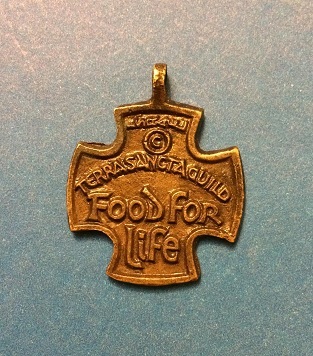
To this day, one of these items that I have held onto is a pendant. I do not recall exactly how it came into my possession, but I have had it for at least four decades now. Despite liking it and wanting to hold onto it, however, I do not recall ever actually wearing it.

In reading the Gospel according to Luke, chapter 15, verses 1-32 (the lost sheep, the lost coin, the lost son), I find myself thinking about the metal tin, the pendant, and the things (living or not), that one might consider as belonging to oneself. For many years, the pendant resided in the tin, tucked away, out of site, perhaps in some ways lost.

In time, it was only in looking more closely that I could see more clearly. What the pendant had come to represent needed to be stripped away in order to reveal the truth of what it was really all about. It was a rediscovering of sorts as the underlying message became the center—heart and soul.

2  1

Relationship with God and one another can often be confused with or portrayed in terms of possession—man-made attempts of one kind or another to gain control, authority or whatever else it may be. However, at every turn, and despite all that is damaged or taken away, often by those entrusted to lead the way, the grace of God is not, nor will it ever be, something to be possessed by only some, or restrained and restricted by limitations contrived by the human mind.

Authentic relationship with God, and one another, builds up in ways that are just and true… meaningful and beneficial to many. It is never about possession or forced wills, but instead honesty, transparency, and striving toward unity. God is, after all, Universal.

Tax collectors and sinners were all drawing near to listen to Jesus,
but the Pharisees and scribes began to complain, saying,
“This man welcomes sinners and eats with them.”
So to them he addressed this parable.
“What man among you having a hundred sheep and losing one of them
would not leave the ninety-nine in the desert
and go after the lost one until he finds it?
And when he does find it,
he sets it on his shoulders with great joy
and, upon his arrival home,
he calls together his friends and neighbors and says to them,
‘Rejoice with me because I have found my lost sheep.’
I tell you, in just the same way
there will be more joy in heaven over one sinner who repents
than over ninety-nine righteous people
who have no need of repentance.

“Or what woman having ten coins and losing one
would not light a lamp and sweep the house,
searching carefully until she finds it?
And when she does find it,
she calls together her friends and neighbors
and says to them,
‘Rejoice with me because I have found the coin that I lost.’
In just the same way, I tell you,
there will be rejoicing among the angels of God
over one sinner who repents.”

Then he said,
“A man had two sons, and the younger son said to his father,
‘Father give me the share of your estate that should come to me.’
So the father divided the property between them.
After a few days, the younger son collected all his belongings
and set off to a distant country
where he squandered his inheritance on a life of dissipation.
When he had freely spent everything,
a severe famine struck that country,
and he found himself in dire need.
So he hired himself out to one of the local citizens
who sent him to his farm to tend the swine.
And he longed to eat his fill of the pods on which the swine fed,
but nobody gave him any.
Coming to his senses he thought,
‘How many of my father’s hired workers
have more than enough food to eat,
but here am I, dying from hunger.
I shall get up and go to my father and I shall say to him,
“Father, I have sinned against heaven and against you.
I no longer deserve to be called your son;
treat me as you would treat one of your hired workers.”’
So he got up and went back to his father.
While he was still a long way off,
his father caught sight of him,
and was filled with compassion.
He ran to his son, embraced him and kissed him.
His son said to him,
‘Father, I have sinned against heaven and against you;
I no longer deserve to be called your son.’
But his father ordered his servants,
‘Quickly bring the finest robe and put it on him;
put a ring on his finger and sandals on his feet.
Take the fattened calf and slaughter it.
Then let us celebrate with a feast,
because this son of mine was dead, and has come to life again;
he was lost, and has been found.’
Then the celebration began.
Now the older son had been out in the field
and, on his way back, as he neared the house,
he heard the sound of music and dancing.
He called one of the servants and asked what this might mean.
The servant said to him,
‘Your brother has returned
and your father has slaughtered the fattened calf
because he has him back safe and sound.’
He became angry,
and when he refused to enter the house,
his father came out and pleaded with him.
He said to his father in reply,
‘Look, all these years I served you
and not once did I disobey your orders;
yet you never gave me even a young goat to feast on with my friends.
But when your son returns,
who swallowed up your property with prostitutes,
for him you slaughter the fattened calf.’
He said to him,
‘My son, you are here with me always;
everything I have is yours.
But now we must celebrate and rejoice,
because your brother was dead and has come to life again;
he was lost and has been found.’” – Luke 15:1-32

The Ways of Wisdom…

Typically, the shortest route, or what seems like the most direct one, is a heavy favorite. Often making a straight line more appealing or desirable from the outset. In the Bible, straight paths are referred to on a number of occasions.

Over time, these examples of paths being made straight (or clear) by the grace of God, have often been reworded and turned into moral directives, such as “follow the straight and narrow.”

What is “the straight and narrow”? From whom does it come? And, why follow it?

Turning back to scripture, perhaps Wisdom is the straight and narrow (no nonsense) from God, calling and moving us, with a desire to make the way clear and lead us closer to God, by way of the Holy Spirit.

Who can know God’s counsel,
or who can conceive what the Lord intends?
For the deliberations of mortals are timid,
and unsure are our plans.
For the corruptible body burdens the soul
and the earthen shelter weighs down the mind that has many concerns.
And scarce do we guess the things on earth,
and what is within our grasp we find with difficulty;
but when things are in heaven, who can search them out?
Or who ever knew your counsel, except you had given wisdom
and sent your holy spirit from on high?
And thus were the paths of those on earth made straight,
And people learned what pleases you,
And were saved by Wisdom. – Wisdom 9:13-18

In the Gospel according to Luke, chapter 14, verses 25-33, there is wisdom in Jesus’ words about discipleship, however unconventional his initial words may be. When Jesus uses a form of the word, “hate,” in conjunction with one’s closest of relatives and oneself, certainly, this would be unexpected as well as shocking to those who were with him. So much for wisdom being refined or in a pretty package.

Next, Jesus explains further. Discipleship comes with trials and tribulations. Not only that, but it also requires an awareness and desire as well as a resolve to faithfulness and commitment to God, above all. Jesus calls us to be “all in.”

What does this mean from a practical standpoint? What does being “all in” look like? More often than not, it is what it feels like, more than what it looks like.

Wisdom, if heeded, carries one in various directions at various times (often unexpected or unconventional), while creating and sustaining a sense of following the straight and narrow. Just as God is infinite and ever-present, so are the ways of being a good and faithful disciple.

Wisdom

Great crowds were traveling with Jesus,
and he turned and addressed them,
“If anyone comes to me without hating his father and mother,
wife and children, brothers and sisters,
and even his own life,
he cannot be my disciple.
Whoever does not carry his own cross and come after me
cannot be my disciple.
Which of you wishing to construct a tower
does not first sit down and calculate the cost
to see if there is enough for its completion?
Otherwise, after laying the foundation
and finding himself unable to finish the work
the onlookers should laugh at him and say,
‘This one began to build but did not have the resources to finish.’
Or what king marching into battle would not first sit down
and decide whether with ten thousand troops
he can successfully oppose another king
advancing upon him with twenty thousand troops?
But if not, while he is still far away,
he will send a delegation to ask for peace terms.
In the same way,
anyone of you who does not renounce all his possessions
cannot be my disciple.” – Luke 14:25-33

Reserved Seating…

Beginning in the early years of life, one comes to see that seating can be tricky, sometimes even turning contentious. From a very young age, many children are introduced to musical chairs. To be first (often synonymous with best) and beat out others in securing a coveted seat, of which there are too few, is the goal of the game. If you do not get a seat, you’re out of the game—eliminated.

Across the years as well as across various different areas of life, securing a “good” seat seemingly remains a key to many things. Whether one is attending an event related to school, sports, dinner, entertainment, travel, the celebration of milestones, etc., it seems human nature to aim for a seat with a prime view. In the Gospel according to Luke (chapter 14: 7-14), Jesus encourages us to refrain from this way of being and not to take the coveted seat, or hold it for those who are held in esteem or known to us.

Rather than aiming to obtain a particular spot, or slide into a position, we are to trust that what is passed up or given away, if it is truly for us, will come back to us. In addition, Jesus instructs us to be gracious, making room physically, as well as in our hearts and minds, for others. Calling us to look at and examine our reservations. What are the spots being held back or blocked off? What is preventing seating for all?

FerrisWheel

He told a parable to those who had been invited,
noticing how they were choosing the places of honor at the table.
“When you are invited by someone to a wedding banquet,
do not recline at table in the place of honor.
A more distinguished guest than you may have been invited by him,
and the host who invited both of you may approach you and say,
‘Give your place to this man,’
and then you would proceed with embarrassment
to take the lowest place.
Rather, when you are invited,
go and take the lowest place
so that when the host comes to you he may say,
‘My friend, move up to a higher position.’
Then you will enjoy the esteem of your companions at the table.
For every one who exalts himself will be humbled,
but the one who humbles himself will be exalted.”
Then he said to the host who invited him,
“When you hold a lunch or a dinner,
do not invite your friends or your brothers
or your relatives or your wealthy neighbors,
in case they may invite you back and you have repayment.
Rather, when you hold a banquet,
invite the poor, the crippled, the lame, the blind;
blessed indeed will you be because of their inability to repay you.
For you will be repaid at the resurrection of the righteous.” – Luke 14:7-14

Each Step’s Value…

From as early as I can recall, I have been intrigued by the way things move and the impact they have. Whether on land, in or under water, or in space, it has been fascinating to me to read about and to see the way humankind has worked with care, and continues to, in order to understand the lay of the land, sea, air, and space, and all that is living. It is amazing that given the proper conditions and environment, damage can be reversed, and restoration and/or regeneration is more often possible than not. However, even in those cases where it is not, all is not lost. Knowledge and understanding… wisdom is gained, making it possible to move forward in new or different ways for those who follow. Nothing is in vain.

In the process of going about one’s business each day, there is a lot of navigating, some expected and some not. In the Book of Proverbs it is written: “Survey the path for your feet, and all your ways will be sure” (4:26). Where am I moving and in what way? How do I proceed as I go about my business? What is it that moves me in the direction I am heading? In what or in whom do I find a sense of security?

In the Gospel according to Luke, chapter 13, verses 22-30, Jesus, as always, moves with purpose and meaning, and his footprints are laden with lessons and examples of how to live. He leaves more than a path to follow. Jesus imparts love, truth (sometimes truth that can be very challenging), and wisdom.

As he travels, Jesus makes an impression that lasts far beyond his physical presence. And through it all, he is never stagnant or fixated in any one place or on any one population. As he moves through different towns and villages, he does not turn away a single soul who comes to him. Even when it might seem like he is going to (e.g. the Syrophoenician woman – Mark 7:24-30). With Jesus, there is room for all those who desire and strive to receive his peace and healing—to live and be with him.

Sometimes, it can be tempting to think of, or to seek, Jesus in what the human mind might label as “positive” experiences or outcomes, not recognizing his presence in all of life’s circumstances. In verses 22-30 of Luke, chapter 13, he is upfront, as always, about the fact that following him is not easy. On, and of, the earth, there are no guarantees. However, while we may be bound by human limitations, our spirits are not. In turning to Jesus, all that is eternal can be brought to life, both here and now, as well as forever, enabling and empowering us to be the voice of all that is truly good and to rise above situations and circumstances that may be difficult rather than avoiding them. It is in this way that one is able to examine the path and move secure, regardless of the conditions or the footing along the way.

APlace

Jesus passed through towns and villages,
teaching as he went and making his way to Jerusalem.
Someone asked him,
“Lord, will only a few people be saved?”
He answered them,
“Strive to enter through the narrow gate,
for many, I tell you, will attempt to enter
but will not be strong enough.
After the master of the house has arisen and locked the door,
then will you stand outside knocking and saying,
‘Lord, open the door for us.’
He will say to you in reply,
‘I do not know where you are from.
And you will say,
‘We ate and drank in your company and you taught in our streets.’
Then he will say to you,
‘I do not know where you are from.
Depart from me, all you evildoers!’
And there will be wailing and grinding of teeth
when you see Abraham, Isaac, and Jacob
and all the prophets in the kingdom of God
and you yourselves cast out.
And people will come from the east and the west
and from the north and the south
and will recline at table in the kingdom of God.
For behold, some are last who will be first,
and some are first who will be last.” – Luke 13:22-30