At Our Best…

The readings for the Thirty-third Sunday in Ordinary Time extend an opportunity to think about one’s relationship with Jesus and reflect on how justice and perseverance come into play. In the first reading (Mal 3:19-20a), we read the phrase, “the sun of justice with its healing rays.” How have you experienced the healing rays of justice? In what ways do you impart the fruits of that healing in your daily life?

In the responsorial psalm (Ps 98:5-6, 7-8, 9), we read:

Let the rivers clap their hands,
the mountains shout with them for joy,
Before the Lord who comes,
who comes to govern the earth,
To govern the world with justice
and the peoples with fairness. – Psalm 98:8-9

Envision something that recently brought you joy and excitement. How did it impact the people and the environment around you? Was everyone happy? Was anyone affected in a way that was not beneficial? Where do sense Jesus was in this situation?

Now, let’s take a step back. Consider this: What is your understanding and experience of justice and fairness? Can you think of some examples of the two? Do they include situations where there may be no personal benefit involved? How is your understanding and application of justice and fairness influenced by the example of Jesus’s life, death, and resurrection, and the many parables he told?

In the second reading (2Thes 3:7-12), St. Paul reminds the Thessalonians of how he, Silvanus, and Timothy have behaved and urges them to do likewise.

Brothers and sisters:
You know how one must imitate us.
For we did not act in a disorderly way among you,
nor did we eat food received free from anyone.
On the contrary, in toil and drudgery, night and day
we worked, so as not to burden any of you.
Not that we do not have the right.
Rather, we wanted to present ourselves as a model for you,
so that you might imitate us.
In fact, when we were with you,
we instructed you that if anyone was unwilling to work,
neither should that one eat.
We hear that some are conducting themselves among you in a
disorderly way,
by not keeping busy but minding the business of others.
Such people we instruct and urge in the Lord Jesus Christ to work quietly
and to eat their own food. – 2Thes 3:7-12

As you contemplate St. Paul’s words to the Thessalonians calling on them to focus on their work and to persevere in faith so as not to become idle and then “disorderly,” by getting caught up or interfering in the business of others, what strikes you most? With the current state of many things in the world, what insight(s) can you draw from this passage? In what ways do you experience Jesus in the places that have been capturing your focus these days?

Looking to the Gospel passage (Lk 21:5-19 included below), Jesus speaks of what’s to come, understood as the end of days. He essentially tells those who are listening, do not fall prey to being distracted by the signs and chaos around you, and do not be worried about how to respond or react, but rather, stay focused on me, and I will help you to know what to say… what to do. The passage closes with Jesus saying, “By your perseverance you will secure your lives.” How do you know the difference between being driven by the perseverance of faith in Jesus and being driven by your own sheer will masked as perseverance of faith in Jesus?

The Gospel verses taken together, tell us that the answers are not predetermined or black and white, but are all encompassing, pure, and speak to the uniqueness of each moment that can often escape the human mind and heart. Jesus, through his abundant love and wisdom, knows the importance, and all the implications of each moment, far better than anyone else could ever know. So, when we stay focused on Jesus with a desire to follow him, we can overcome any obstacles in ways that imitate the example of Jesus and honor the glory of God. And in doing so, we receive the grace we need to meet each moment.

What’s it like to envision justice and perseverance of faith in Jesus as a call of discipleship to surrender to Jesus in each moment, remembering his example, no matter what the moment holds, with a willingness to evolve, allowing room for movement? How might this influence the things you celebrate, and the things you don’t?

“Power at its best is love implementing the demands of justice, and justice at its best is power correcting everything that stands against love.” – Martin Luther King, Jr.

While some people were speaking about
how the temple was adorned with costly stones and votive offerings,
Jesus said, “All that you see here–
the days will come when there will not be left
a stone upon another stone that will not be thrown down.”

Then they asked him,
“Teacher, when will this happen?
And what sign will there be when all these things are about to happen?”
He answered,
“See that you not be deceived,
for many will come in my name, saying,
‘I am he,’ and ‘The time has come.’
Do not follow them!
When you hear of wars and insurrections,
do not be terrified; for such things must happen first,
but it will not immediately be the end.”
Then he said to them,
“Nation will rise against nation, and kingdom against kingdom.
There will be powerful earthquakes, famines, and plagues
from place to place;
and awesome sights and mighty signs will come from the sky.

“Before all this happens, however,
they will seize and persecute you,
they will hand you over to the synagogues and to prisons,
and they will have you led before kings and governors
because of my name.
It will lead to your giving testimony.
Remember, you are not to prepare your defense beforehand,
for I myself shall give you a wisdom in speaking
that all your adversaries will be powerless to resist or refute.
You will even be handed over by parents, brothers, relatives, and friends,
and they will put some of you to death.
You will be hated by all because of my name,
but not a hair on your head will be destroyed.
By your perseverance you will secure your lives.” – Lk 21:5-19

Cloud of Witnesses…

With current day events, we hear and see a great deal about witnesses and influence or power. Yet, oftentimes, information can be skewed or lacking in merit, but still repeated and passed along as fact. This isn’t a new problem, though. Perhaps it is more rampant, but nonetheless it has always been the case that for any situation, it is best when sifted through more than once and held in context, but also alongside openness to truth, no matter what, and a desire to earnestly look at the entire picture. This cannot be done with a battlefield attitude or a mindset of “me against you” or “us against them.”

In chapter twelve of the letter to the Hebrews, St. Paul encourages the people as brothers and sisters, which is the way that he usually refers to the intended recipients of his letters and preaching, to let go of the things that hold them back, and to take comfort, draw strength, and be inspired by the example and sacrifice of Jesus Christ, as Lord and Savior. He starts out this passage reminding his audience of who they really are—brothers and sisters. Then, another reminder when he writes, “Since we are surrounded by so great a cloud of witnesses…” It’s interesting to pause there and not only sit with that image, but also reflect upon it in a personal way. Who is in your cloud of witnesses? How have they influenced you? And you them? Also, what is behind that influence?

Brothers and sisters:
Since we are surrounded by so great a cloud of witnesses,
let us rid ourselves of every burden and sin that clings to us
and persevere in running the race that lies before us
while keeping our eyes fixed on Jesus,
the leader and perfecter of faith. – Hebrews 12:1-2

The Touch of Grace…

Recall an experience of bumping into someone that you know, in a place and at a time that you normally wouldn’t expect to see them? Initially, you might be surprised for good or less, or perhaps it might take a few moments to fully recognize the person. Maybe some memories of them come to mind.

Next, imagine that you kept encountering that same person over the course of several weeks. What would you think? What would you feel?

Now envision being one of Jesus’ disciples and having the experience of Jesus’ appearing to you, here and there, in the time between his Resurrection and Ascension. How would you react or respond after the profound experience of his crucifixion, his Resurrection, and being in the environment of belief and disbelief created by it all?

Would you be devoted to trying to see a pattern to Jesus’ appearances to try to predict when you might see him next? Would you commit yourself to trying to figure out the reasons why he was appearing? How hard would you work to come to some sort of knowledge about these occurrences? In what ways would you characterize your approach?

Focusing more closely on Jesus and his third appearance at the Sea of Tiberias (John 21), how determined would your mind be, and how open would your heart be, to the presence of Jesus who is in the form of the person on the shore, unknown and at a distance? How about to yourself or the person on the shore, thought of as being known? Would you cast the net again? What would you discover?

Simon Peter said to them, “I am going fishing.”
They said to him, “We also will come with you.”
So they went out and got into the boat,
but that night they caught nothing.
When it was already dawn, Jesus was standing on the shore;
but the disciples did not realize that it was Jesus.
Jesus said to them, “Children, have you caught anything to eat?”
They answered him, “No.”
So he said to them, “Cast the net over the right side of the boat
and you will find something.”
So they cast it, and were not able to pull it in
because of the number of fish.
So the disciple whom Jesus loved said to Peter, “It is the Lord.”
When Simon Peter heard that it was the Lord,
he tucked in his garment, for he was lightly clad,
and jumped into the sea. – Jn 21:3-7

In what ways do you allow Jesus to be present to you in the unexpected? In what ways do you invite Jesus to help you to be present, to hold situations up to the light, to receive God’s wisdom so that you can embody the thoughts and feelings needed not only to embrace the moment, but also to receive and recognize the grace it holds, and how to share it?

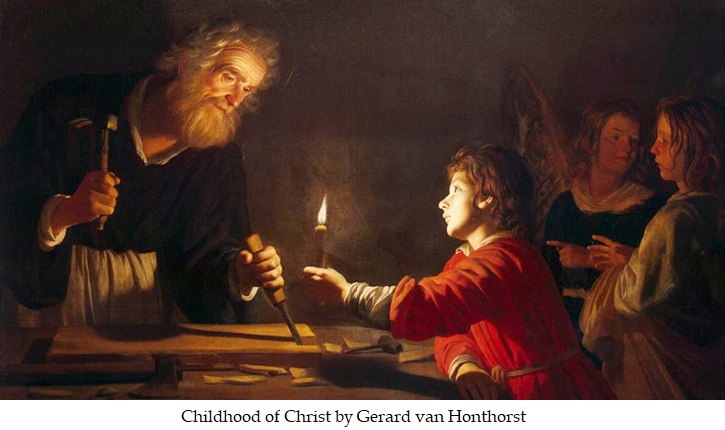
Sometimes, there are so many questions, and it can seem like so much work. Yet, as April turns to May and the Feast of St. Joseph The Worker arrives, so also does the opportunity to experience not only the light of longer days, but also renewal through the touch of Grace—peace, light, hope, and inspiration—that continues to blossom with the Easter season, and beyond.

How does grace touch and move your heart? And how is it reflected in your work?

In a Word…

If you had to describe Easter in one word, what word would you use? While there is a plethora of words that could be chosen, what words speak more profoundly to you today, and what one word would be most fitting to encapsulate the life, death, and resurrection of Jesus?

Reflecting on the Triduum, with all the words, images, and actions that take place from Holy Thursday thru the Easter Vigil, the word authenticity seems apropos. Jesus taught by example and told his disciples what was going to happen, and then it did happen. His words and actions were true from start to finish. However, Jesus was not alone in his authenticity (be who you are, do as you are).

Looking more intently at the words and actions of some of the other individuals closest to Jesus, one might come to see that they were also being themselves during those moments. For example, Judas succumbed to betraying Jesus through his real-life weakness, identifying more strongly with money and power than anything else at that time. Then there’s Peter denying Jesus three times. This is not a reflection of his sincerity and desire to follow Jesus, but rather just part of where he was and what he was capable of at that time. Many of the other disciples, ran and hid after Jesus was arrested. Some did not. For example, the many women who followed Jesus, and John who witnessed the crucifixion by Mary’s side.

Think about these individuals as fellow human beings who were at the same time and place in history, while having different experiences, internal dispositions, and outward responses to the same events. In what ways do you see the beauty of God’s mercy and love shine through loud and clear? What’s it like to know that regardless of shortcomings or strengths, Jesus loved and accepted them all, seeing their value as beloved and part of creation?

Oftentimes, we can look to label words, decisions, or actions as right or wrong. However, in the process, we neglect to see what we are forfeiting. Jesus, by seeing us for who we are, accepting us where we are, and loving us as we are, not only touches our hearts and enlightens our minds, but also moves us toward resurrection, turning authenticity into Alleluia.

Going about each day, there are many words that we speak and things that we do. What are the things said or done with purpose, and what kind? What do our words and actions mean to us, what inspires them, and how do they reflect eternal life to the world around us?

Give thanks to the LORD, for he is good,
his mercy endures forever. – Psalm 118:1

Where Do You Dwell?

While the outside world has so much to offer, sometimes it can feel like too much, making the idea of hiding away in the seclusion of a hermitage or something similar of greater appeal than it might be otherwise. Today, January 15th, is the feast of St. Paul the Hermit who was born and lived in Egypt until he died around the age of 112. Referred to as the “First Hermit,” little information is known of him.

However, what seems of most importance is known. That is, how St. Paul the Hermit became a hermit and how humankind came to know about him. Originally, at the age of 15 and an orphan, he went into a cave seeking refuge during the persecution of Christians, in the year 250 A.D., by Roman Emperor Decius. His intention was to come out of hiding and return home once the persecutions ended.

But, over the course of his time away from humankind, St. Paul found peace as well as a calling to remain in the desert living a solitary life of prayer as a hermit. So how did this information about St. Paul the Hermit come to be known? St. Anthony of Egypt is said to have come across St. Paul along his own journey toward Truth and self-discovery.

It’s interesting how St. Paul the Hermit was called to a life of seclusion, yet still, God called another, St. Anthony, to give witness to his life and death as holy. It’s also intriguing that St. Anthony was led to St. Paul the Hermit in the process of entertaining thoughts of himself as the most enduring hermit in existence… until he met St. Paul.

In the First Letter of St. Paul to the Corinthians, chapter 12, verses 4-11, St. Paul the Apostle writes about different kinds of spiritual gifts, different forms of service, and different workings that are dispersed to all, individually, but by the same God who creates them, and the same Spirit who brings them to fruition. With God, no one gift, or creation, is above the other, differentiation is by design, all are loved into existence, all are created for unity, and all are equally important.

So, while St. Paul the Hermit and St. Anthony of Egypt had similar callings and different paths, like us, humility is what leads them to a better place.

In everything, it is only through the grace of God that we can lay down human notions; truly understand, appreciate, take care of, and celebrate one another; and thus, partake in the unity—the heart of God– that is Creation.

Reach…

They started out a neatly organized bouquet of tulips, bulbs closed and standing upright in a vase, but with time, each came into its own. Still tulips though, and called by name, no matter the style or type of display. Some still upright. Some bending, turning, twisting, as if being called toward something else altogether, but again, all still called by name—side by side—together.

More than humane… a compelling lesson for humanity. Nothing new… it is as it has always been. In opening up, reaching out, and stretching toward another… letting go of “other,” change is made. What is true and meaningful, is more than comprehension. When the peace within one’s heart, reaches out, it permeates from soul to soul, and only then, is it about becoming.

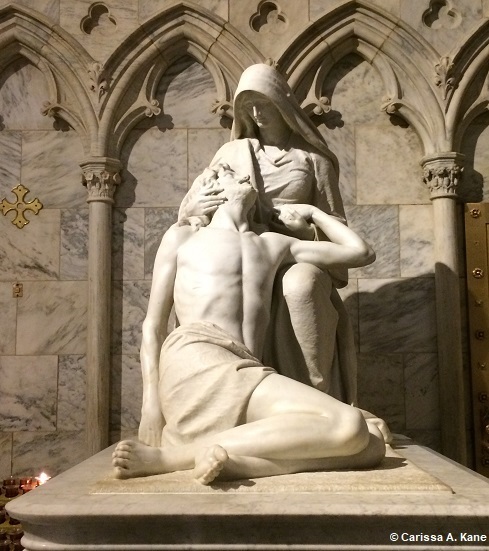
Just as he said to the disciples who met him on the road to Emmaus, Jesus says to us, “You are witnesses of these things.” (Luke 24:48). As followers of Jesus, what did they do with that?

Fast forward to today… As disciples of Jesus, what do we do with all to which we have become witnesses? How do we stand with both the crucified and risen Jesus?

When he saw the crowds, he went up the mountain, and after he had sat down, his disciples came to him.
He began to teach them, saying:

“Blessed are the poor in spirit,
for theirs is the kingdom of heaven.

Blessed are they who mourn,
for they will be comforted.

Blessed are the meek,
for they will inherit the land.

Blessed are they who hunger and thirst for righteousness,
for they will be satisfied.

Blessed are the merciful,
for they will be shown mercy.

Blessed are the clean of heart,
for they will see God.

Blessed are the peacemakers,
for they will be called children of God.

Blessed are they who are persecuted for the sake of righteousness,
for theirs is the kingdom of heaven.

Blessed are you when they insult you and persecute you and utter every kind of evil against you [falsely] because of me.

Rejoice and be glad, for your reward will be great in heaven.
Thus they persecuted the prophets who were before you.

– Matthew 5:1-12

To the Extreme…

Coming on the heels of much milder temperatures, colder ones that are typical for the time of year, in this part of the world, seem so extreme and unnatural.  Like stepping into a long blast of Arctic air, shocking to the bone, is how the expected can feel when it comes dressed in unexpected ways. It makes one take a step back, and perhaps reassess before continuing on, maybe different or more awake than before.

To the person entrenched in, or enslaved by (whether knowingly or not), everyday life, was that what it was like when the prophets of the Old Testament… John the Baptist… Jesus came onto the scene?

In each situation and with every experience, back then, and hear and now, today, it is fair to state that in the end, none are left unchanged. In each moment of every day, all testify to something or someone in one way or another.

So the question is not whether we will be extremists, but what kind of extremists we will be. Will we be extremists for hate or for love? Will we be extremists for the preservation of injustice or for the extension of justice? In that dramatic scene on Calvary’s hill three men were crucified. We must never forget that all three were crucified for the same crime–the crime of extremism. Two were extremists for immorality, and thus fell below their environment. The other, Jesus Christ, was an extremist for love, truth and goodness, and thereby rose above his environment.

– Martin Luther King, Jr.

ToTheExtreme

Here am I, Lord; I come to do your will. – Psalm 40

Awaken to the Light…

A few nights ago I had fallen asleep while other household members were still up and about. Suddenly though, I was awake again. Someone had turned on the hallway light, which extended its reach into the room where I was sleeping. And while the light was rather intrusive that night, more often than not, the light is exactly what we need.

According to the Gospel of Luke, Peter, John, and James accompanied Jesus up the mountain to pray, but at some point, the three disciples were “overcome by sleep” (Luke 9:32). During their sleep, Jesus is not only joined by the prophets Moses and Elijah, engaging in discussion with them, but also becomes transfigured, his appearance changing and his clothing giving off great light.

Peter, John and James, awoken seemingly by the intense light, witness Jesus’ transfiguration and the presence of the prophets alongside him. This is shortly followed by a cloud that envelops them, creating both darkness and fear. Yet it was in this cloud and undoubtedly their confusion about what was going on, that God speaks to them, shedding light by revealing the truth as well as providing instruction—“This is my chosen Son; listen to him” (Luke 9:35).   

While the disciples cannot account for what happened while they were sleeping, now that they are awake they do have a responsibility with regards to what they had witnessed. At the time appointed by Jesus (Matthew 17:9; Mark 9:9), they will give voice to what they saw and experienced that day on the mountain.

As we go through life, we all have moments where we experience or witness the glory of God. We also have moments where we witness the opposite of that. Whichever it may be, we are always called to testify and give witness to the truth.

The Light always wakes us up, but it is up to us how we respond.

ThePath_Akiane
In order to choose the right path we do not have to figure out the wrong one— we just need to follow the light. – The Path by Akiane Kramarik

Jesus took Peter, John, and James
and went up the mountain to pray.
While he was praying his face changed in appearance
and his clothing became dazzling white.
And behold, two men were conversing with him, Moses and Elijah,
who appeared in glory and spoke of his exodus
that he was going to accomplish in Jerusalem.
Peter and his companions had been overcome by sleep,
but becoming fully awake,
they saw his glory and the two men standing with him.
As they were about to part from him, Peter said to Jesus,
“Master, it is good that we are here;
let us make three tents,
one for you, one for Moses, and one for Elijah.”
But he did not know what he was saying.
While he was still speaking,
a cloud came and cast a shadow over them,
and they became frightened when they entered the cloud.
Then from the cloud came a voice that said,
“This is my chosen Son; listen to him.”
After the voice had spoken, Jesus was found alone.
They fell silent and did not at that time
tell anyone what they had seen.  – Luke 9:28B-36

Because it’s the right thing to do…

“Why? I don’t understand why we have to do this?” To which the father responded, “Because, it’s the right thing to do. I can do my best to explain it, but whether or not you, I, or anyone understands, we are doing it, because right here, right now, it’s the right thing to do.”

We all experience moments in life when it can be hard to put something into words or to provide reason or logic. However, even when one cannot understand, there is always a reason. At those times, the challenge is to take what is felt in one’s bones and trust it. Give it whirl, allowing it to have a voice, letting it come to life, and seeing what happens.

Oftentimes, sticking to what we “know,” what we think we know, or what we have been told, takes us further away and pales in comparison to what we may be headed toward or on the brink of discovering… learning… experiencing.

In June of 1949, Cardinal Emmanuel Suhard was buried in Notre Dame Cathedral, alongside archbishops by whom he was predeceased. He had entered formation, despite not having the support of his pastor. He went on to become a priest in 1897, professor, bishop, and eventually Archbishop of Reims in 1930.

In 1942, Cardinal Suhard found his way to using his voice publically against the Vichy government, its deportation of the Jewish people of Paris, and essentially its collusion with the Nazi government. The Cardinal was detained for his actions which went against the clergy and the government of his time and place. However, this was not the first time, he paid consequences for the doing what he felt was the right thing to do.

In his lifetime, Cardinal Suhard was also instrumental in the creation of what was referred to as the Worker-Priest movement. Although the movement was originally supported by the church hierarchy as a means to bring people, specifically the French working class, back to the church, it took on a life of its own.

The priests were sent out into everyday life in the everyday world. The ones who participated in the movement worked in the factories of Paris and other cities. As they experienced the environment and conditions of their fellow workers, they could not help but become involved in trying to make things better. In doing so, they came to be seen by the factory owners, and were reported to the church, as being divisive for their efforts to improve the injustice and wrongdoing they saw and experienced. As a result, the worker priests were told to return to their churches. Some did, and some did not. As for the movement, it went through various stages, including some years of being halted altogether, but has essentially carried on in one form or another.

Emmanuel Célestin Suhard became aware, discovered, and listened to what was in his bones, his God-given purpose. It is always the right thing to do.

“To be a witness does not consist in engaging in propaganda, nor even in stirring people up, but in being a living mystery. It means to live in such a way that one’s life would not make sense if God did not exist.” – Emmanuel Célestin Suhard

For example…

As I looked around, I saw so many faces. Some were familiar and some were new, but all were listening with great interest and intrigue. I felt overwhelmed with a sense of joy and gratitude. How good it was to be in a place that seemed to be filled with openness and a deep desire for good.

As we all listened, we were reminded of ways in which God is ever-present. Not only is God always with us, but also constantly emanating a love for all creation… a love that is boundless, alongside mercy and compassion that is endless.

We sat and listened to experiences that were shared and our hearts were touched as we marveled at the manner in which God brings people together for more than the good of just a select few or a particular group. Again, reminded of a Love that is not only beyond limit, but also beyond compare… a Love in which we share.

It was good to listen and to remember, but perhaps most important, it was liberating.

It is amazing what the power of example can do when there is openness to receiving it. Sometimes it helps to ask, “What am I holding onto? And how is it affecting me, and those around me?”

Let go and let God. Oftentimes, that is all that is needed.

HeartLeave2

If today you hear God’s voice, harden not your hearts.

Come, let us sing joyfully to the LORD;
let us acclaim the Rock of our salvation.
Let us come into his presence with thanksgiving;
let us joyfully sing psalms to him.

If today you hear God’s voice, harden not your hearts.

Come, let us bow down in worship;
let us kneel before the LORD who made us.
For he is our God,
and we are the people he shepherds, the flock he guides.

If today you hear God’s voice, harden not your hearts.

Oh, that today you would hear his voice:
“Harden not your hearts as at Meribah,
as in the day of Massah in the desert,
Where your fathers tempted me;
they tested me though they had seen my works.”

If today you hear God’s voice, harden not your hearts.

— Psalm 95:1-2, 6-7, 8-9.