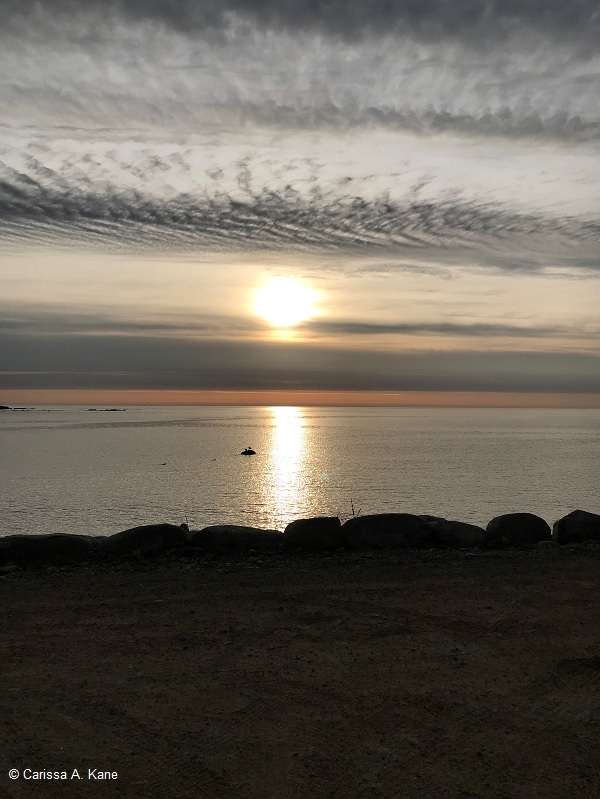
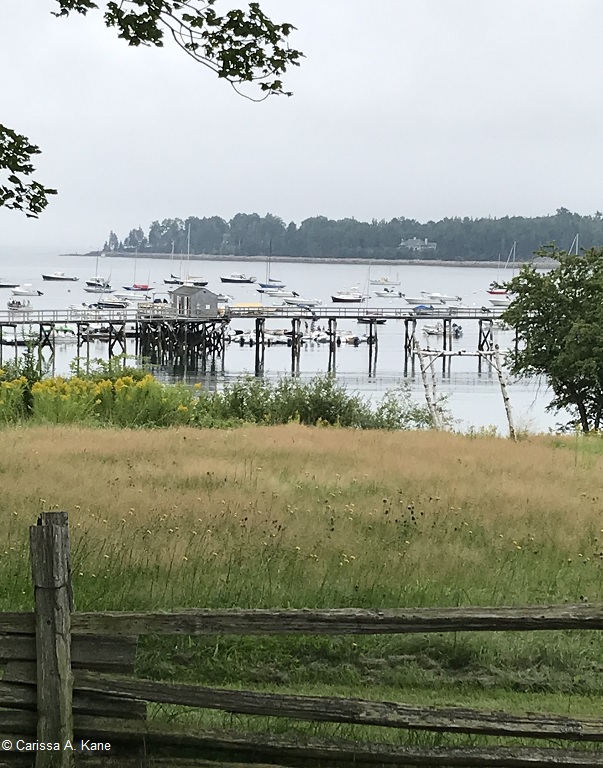
Looking out across the way, noticing the strokes with which nature paints the scene before my eyes, I am captivated. The variations of color and light both hold their own and come together. A symphony embracing one another, yet at the same time providing the contrast that makes it fully come alive. Ripples in the sky, and ripples down below. With all that is going on, it’s interesting how all these differences join to form a work of beauty, instead of tearing at each other, or falling all apart.
For in one Spirit we were all baptized into one body, whether Jews or Greeks, slaves or free persons, and we were all given to drink of one Spirit. – 1 Cor 12:13
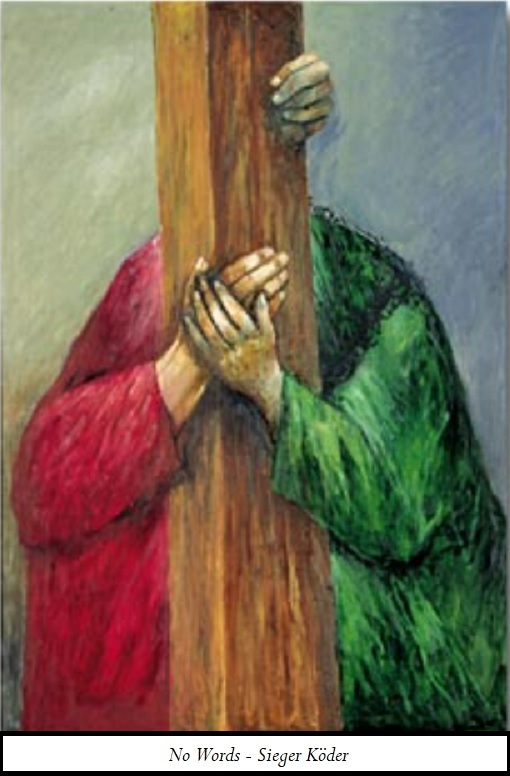
Reading the responsorial psalm for Palm Sunday and the response, “My God, my God, why have you abandoned me?” (Psalm 22:2) my mind is immediately filled with thoughts of the dear, innocent people of Ukraine whose lives have been taken, trampled upon, and upended, most recently over the course of the past several weeks, as well as for the dear, innocent people throughout the world who each day suffer such cruel and unjust treatment at the hands of others. It’s hard to comprehend how, with all the advances humankind has made in the past 2,000 years, the same hatred that slithered its way into the hearts and minds of those who sought to crucify Jesus, still exists, and that acts of such cruelty and utter disregard for humanity are still carried out.
It’s hard to understand, but perhaps that’s the point. It’s not understandable. What we are witnessing is the devastation that comes in situations where the heart of the matter—we are One—is lost; overruled by greed, hatred, lust for power, and indifference. Yet, at the same time, we are witnessing the heart of the matter—we are One—rising up, calling out… alive and well in the spirit of unity seen in those who stand up, reach out, sacrifice, and stand together.
The Passion of the Lord is about reclamation and answering that call.
Reflecting on the Passion of the Lord in the Gospel according to Luke (chapters 22-23), how do you bring your thoughts and feelings about all that is happening in the world today to God? Where do you meet Jesus? In what ways do you accompany Jesus in his Passion? And how do you draw inspiration and strength from the journey?
Sitting with the readings for the second Sunday of Lent, like an old friend, the word “Trust” enters the room with a warm smile and as if to say, “Remember me… remember when…” So much of life is about trust and so often, it seems to come down to whom or what one trusts, to what degree, how that trust is received, and the impact or consequences of its handling.
As human beings, we share in a perfectly, imperfect nature, as we navigate life in, and surrounded by, a competitive, material world. It can be tempting to think or feel, even if subconsciously, that there is something we can do about anything happening around us at any time; that a level of control is always within our grasp. We may even look to capture the things that we, as human beings, think will help us to have that control. Yet, the only control we ever really have, and the only victory ever really won, is in choices that we make to trust in God’s ways and to let go, or shed the impulse or notion that any one interest outranks everyone’s interest.
In the ninth chapter of the Gospel according to Luke, Peter, John, and James ascend the mountain with Jesus and share in the experience of his transfiguration. In the passage prior to this one, while explaining what it means to be a disciple, Jesus says, “What profit is there for one to gain the whole world yet lose or forfeit himself?” (Lk 9:25). Looking at the circumstances in the world today, one can clearly see that there is no profit in profiteering, only loss for everyone.
Think about what it must have been like for Peter, John, and James to hear Jesus’ words about discipleship and then to witness his transfiguration seeing him stand alongside the prophets, Moses and Elijah.
Looking to today’s world, when it seems there is nothing to do, or there is no good way to stop what is already in motion, perhaps the best place to start is to forget control, then pause to go back and remember the beginning. Jesus took Peter, James, and John up the mountain to pray. One can only wonder, what was in their hearts as they placed their trust in Jesus and followed him up that mountain. One can only wonder how they received what happened and what they carried in their hearts on the way down, and thereafter.
How does your trust in Jesus shape your choices, create unity, express love, and spread goodwill? Connecting with Jesus as an old friend greeting you with a warm smile, how would you proceed from the phrase, “Remember me… remember when…?”
Share with Jesus what you carry in your heart as you reflect on the world we live in, and the journey you are on within it.
Jesus took Peter, John, and James and went up the mountain to pray. While he was praying his face changed in appearance and his clothing became dazzling white. And behold, two men were conversing with him, Moses and Elijah, who appeared in glory and spoke of his exodus that he was going to accomplish in Jerusalem. Peter and his companions had been overcome by sleep, but becoming fully awake, they saw his glory and the two men standing with him. As they were about to part from him, Peter said to Jesus, “Master, it is good that we are here; let us make three tents, one for you, one for Moses, and one for Elijah.” But he did not know what he was saying. While he was still speaking, a cloud came and cast a shadow over them, and they became frightened when they entered the cloud. Then from the cloud came a voice that said, “This is my chosen Son; listen to him.” After the voice had spoken, Jesus was found alone. They fell silent and did not at that time tell anyone what they had seen. – Lk 9:28b-36
World’s breakneck pace, Stop that race. Put on the brakes. Hungry, greedy sharks, Stop the noise. Stop the thunder. Stop breeding misplaced hunger. We are broken, and run down. Lord, turn us around.
Step off that ladder. Come down from that pedestal. Look up from your work. Sister, help your brother, One and all, help each other. Stand up now, and be fed. Be true, and be led. Lord, bring us around.
Wisdom, seeking Wisdom? The time is right, as always. Be moved to higher ground. Turn it over, and then again. For although we are many, We are not. We are one. So, why not come together? Even better, be united. Lay down sides, Take up faith, not fate, And cry out loud, Lord, turn it around.
But as it is, there are many parts, yet one body. – 1 Cor 12:20
While the outside world has so much to offer, sometimes it can feel like too much, making the idea of hiding away in the seclusion of a hermitage or something similar of greater appeal than it might be otherwise. Today, January 15th, is the feast of St. Paul the Hermit who was born and lived in Egypt until he died around the age of 112. Referred to as the “First Hermit,” little information is known of him.
However, what seems of most importance is known. That is, how St. Paul the Hermit became a hermit and how humankind came to know about him. Originally, at the age of 15 and an orphan, he went into a cave seeking refuge during the persecution of Christians, in the year 250 A.D., by Roman Emperor Decius. His intention was to come out of hiding and return home once the persecutions ended.
But, over the course of his time away from humankind, St. Paul found peace as well as a calling to remain in the desert living a solitary life of prayer as a hermit. So how did this information about St. Paul the Hermit come to be known? St. Anthony of Egypt is said to have come across St. Paul along his own journey toward Truth and self-discovery.
It’s interesting how St. Paul the Hermit was called to a life of seclusion, yet still, God called another, St. Anthony, to give witness to his life and death as holy. It’s also intriguing that St. Anthony was led to St. Paul the Hermit in the process of entertaining thoughts of himself as the most enduring hermit in existence… until he met St. Paul.
In the First Letter of St. Paul to the Corinthians, chapter 12, verses 4-11, St. Paul the Apostle writes about different kinds of spiritual gifts, different forms of service, and different workings that are dispersed to all, individually, but by the same God who creates them, and the same Spirit who brings them to fruition. With God, no one gift, or creation, is above the other, differentiation is by design, all are loved into existence, all are created for unity, and all are equally important.
So, while St. Paul the Hermit and St. Anthony of Egypt had similar callings and different paths, like us, humility is what leads them to a better place.
In everything, it is only through the grace of God that we can lay down human notions; truly understand, appreciate, take care of, and celebrate one another; and thus, partake in the unity—the heart of God– that is Creation.
For many Christians the crescendo of what it means to be Christian is celebrated with great veracity around Christmas, and then again around Easter. Preparing to celebrate Christmas, we read and listen to Gospel passages, finding inspiration, hope, solace, and more, as we envision the journey of Mary and Joseph, and the birth of Jesus. Yet, with every liturgy or service throughout the year, we celebrate and are reminded of God’s love for us, the example of Jesus, and the call to discipleship. And all year long, we profess our belief that throughout the ages, from the beginning of time, there is one Word, one God, one Way, and one People.
At Christmastime, may the heightened awareness of Love (God) in our hearts bring us together to a place where we become blind to all that separates and pulls us apart. Instead, may we see one Light, one Truth, one Story as we celebrate the birth of our Lord. And, as God’s generosity comes alive for us, may we welcome it to the inn, allowing it to abound within and all around, melting the ties that otherwise bind us to “other,” away from God and one another.
In those days a decree went out from Caesar Augustus that the whole world should be enrolled. This was the first enrollment, when Quirinius was governor of Syria. And Joseph too went up from Galilee from the town of Nazareth to Judea, to the city of David that is called Bethlehem, because he was of the house and family of David, to be enrolled with Mary, his betrothed, who was with child. While they were there, the time came for her to have her child, and she gave birth to her firstborn son. She wrapped him in swaddling clothes and laid him in a manger, because there was no room for them in the inn.
Now there were shepherds in that region living in the fields and keeping the night watch over their flock. The angel of the Lord appeared to them and the glory of the Lord shone around them, and they were struck with great fear. The angel said to them, “Do not be afraid; for behold, I proclaim to you good news of great joy that will be for all the people. For today in the city of David a savior has been born for you who is Christ and Lord. And this will be a sign for you: you will find an infant wrapped in swaddling clothes and lying in a manger.” And suddenly there was a multitude of the heavenly host with the angel, praising God and saying: “Glory to God in the highest and on earth peace to those on whom his favor rests.” – Luke 2:1-14
I remember as a young student feeling fascinated as I learned all about the human heart, its functions and their importance. I was most amazed by the strength of the heart and its capacity, pumping 2,000 gallons of blood each day throughout the body. It wouldn’t be until years later that my amazement would become even greater in coming to understand the heart’s greatest asset—the rhythm, steady and strong, seeking to draw one closer, revealing God, and yearning not only to keep the connection of love, peace, and healing going, but also to help it to thrive without bounds. As the 13th century Persian poet, Rumi, wrote, “Love is the bridge between you and everything.”
In chapter 7 of the Gospel according to Mark, Jesus says to the Pharisees,
“Well did Isaiah prophesy about you hypocrites, as it is written:
This people honors me with their lips,
but their hearts are far from me;
in vain do they worship me,
teaching as doctrines human precepts.
You disregard God’s commandment but cling to human tradition.” (Mk 7:6-8)
Jesus is calling on them to be honest… to look more closely and to see that their hearts are not leading them in union with God. Their love has become misplaced. It is self-serving and focused on what is earthly rather than what is truly, right and just. Their words and actions do not come together to reflect the beauty of God’s goodness—the law that is placed in every heart—dignity, care, and love of all who are placed alongside us whether in location, heart, or mind.
This same love is what the author of the Letter of James is calling people to when he writes,
“Know this, my dear brothers: everyone should be quick to hear, slow to speak, slow to wrath,
for the wrath of a man does not accomplish the righteousness of God.
Therefore, put away all filth and evil excess and humbly welcome the word that has been planted in you and is able to save your souls.
Be doers of the word and not hearers only, deluding yourselves.” – Jas 1:19-22
No matter where one might be, or the circumstances that exist, Love is the only true hope there is. And while there may be many things that seem beyond reach, or out of control, Love is the anchor that holds us altogether, moves us into action, and brings peace, or peace of mind, strength, truth and justice, never growing cold.
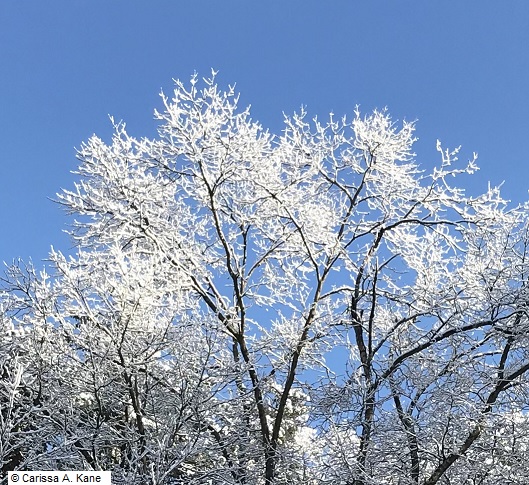
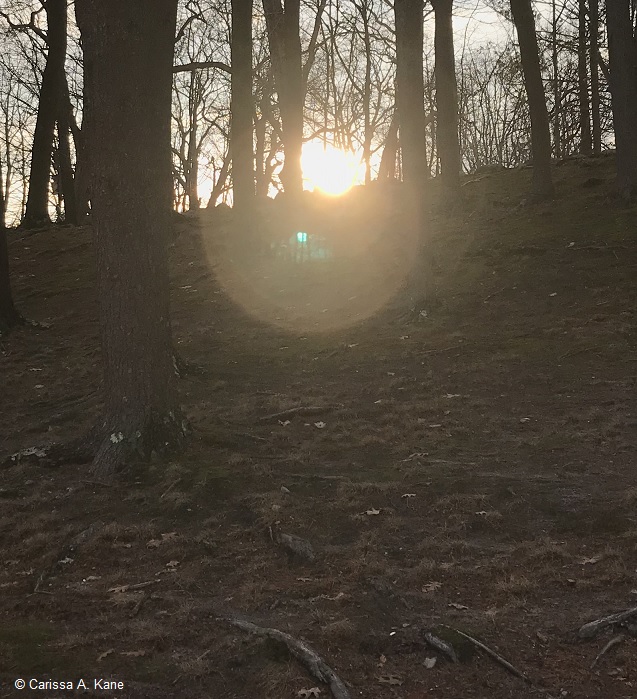
Looking into the world of nature, it can be very easy to come across what makes for a beautiful picture. Whether one’s eye is caught by a single object or multiple ones combining to create a scene that captivates and captures attention, it all starts with posture.
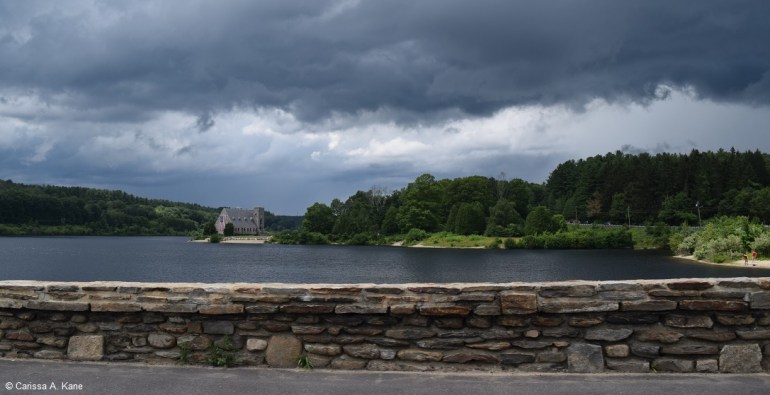
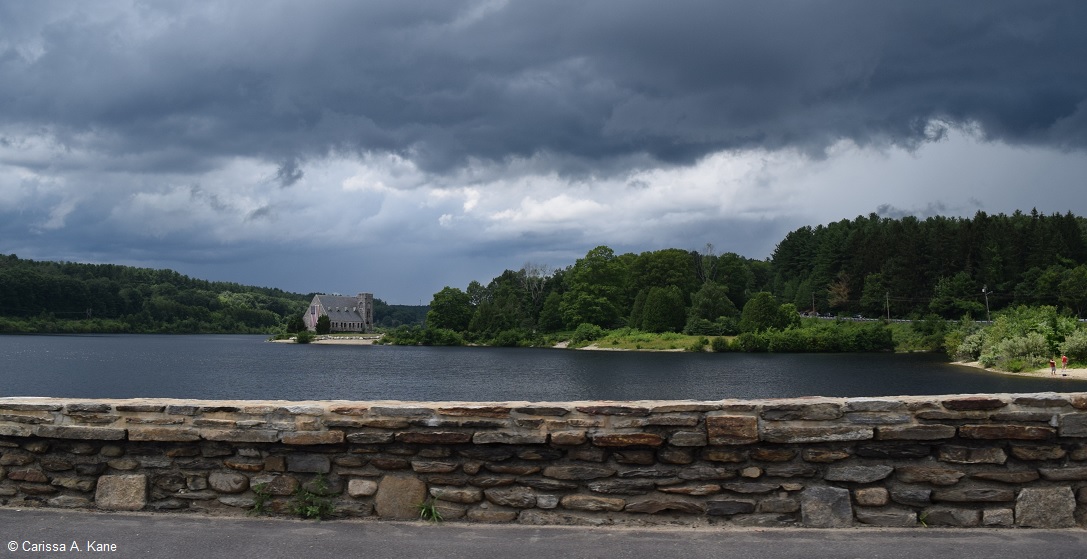
The picture below was taken at the base of a road on the way back down, after having traveled it to the top of a mountain. The way that everything came together and seemed to fall into place in the moments we happened upon it, was rather striking. As we were returning from the summit on a sunny, gorgeous day, the sun was quickly overtaken by fast moving clouds, and as we drove, we moved in and out of brief periods of rain. However, once we reached the base, things looked much brighter. Then, not much further along, we entered the scene. It was like stepping into a painted landscape.
Again, everything—road, rock wall, water, building, sand, trees, and sky—seemed to come together, bringing out the best of what that day and time could offer, and it was perfect. Unity and peace within rising above and beyond turbulence. Not only a pretty sight or precious thought, but also at the heart of faith and faithfulness—the way in which one works, lives, and cooperates with the grace of God, who resides within us, and in whose image, we are all created.
What one carries or holds onto as they journey, quite literally, impacts everything—reception, perception, reaction, response, etc.
Brothers and sisters: I, a prisoner for the Lord, urge you to live in a manner worthy of the call you have received, with all humility and gentleness, with patience, bearing with one another through love, striving to preserve the unity of the spirit through the bond of peace: one body and one Spirit, as you were also called to the one hope of your call; one Lord, one faith, one baptism; one God and Father of all, who is over all and through all and in all. – Eph 4:1-6
In a few weeks, my oldest child will be turning the page toward a new chapter in his life, as he graduates. So many years have passed and so much has transpired since his birth, yet it’s still hard to believe that this milestone is already here. As I think about the journey as a parent, I recall moments of feeling joy and pride as well as moments of feeling fear and uncertainty. What an awesome responsibility… what an awesome privilege. But then, isn’t that what love is all about? Being present, holding on, lifting up, letting go, and along the way, being drawn toward the balance that lies between?
In the Gospel according to John, Jesus says:
“As the Father loves me, so I also love you. Remain in my love.” (15:9)
How do we do that?
We remain in love, by choosing to live in Love. When we choose to be present to each other and creation, we are also choosing to be present to God, and God’s love for us. This is the source of joy, and it can only be complete when it is shared and flowing freely among us. So often though, things get in the way, distracting us, and pulling us apart from each other, as well as from God.
When we remain in God’s love though, we can see things for what they are more readily, and withhold the judgment that seeks to lead us against one another rather than bring us together. What an awesome responsibility… what an awesome privilege. But then, isn’t that what love is all about? Being present, holding on, lifting up, letting go, and along the way, being drawn toward the balance that lies between?
Be a lamp, or a lifeboat, or a ladder. Help someone’s soul heal. Walk out of your house like a shepherd.” — Rumi







 HopeThatFloats
You must be logged in to post a comment.