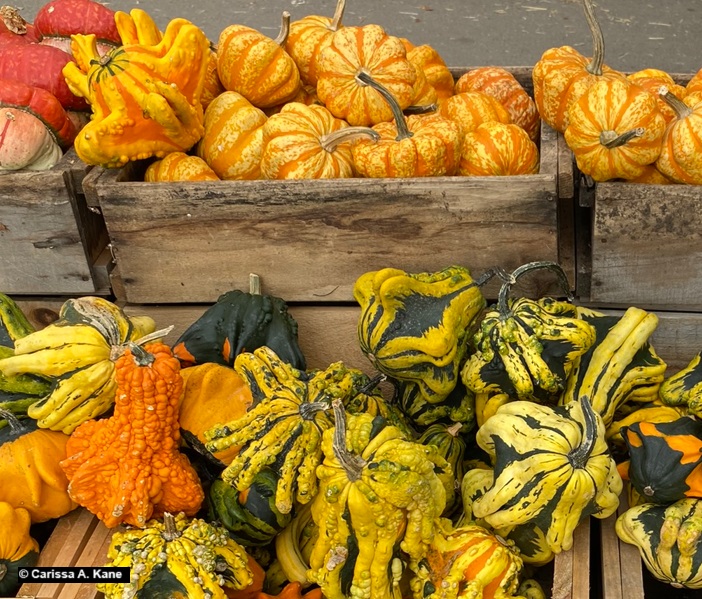
Walking past crates of pumpkins and gourds at a local farm, the different colors and shapes are stunning. It’s interesting to think that such variety can grow out of the seemingly blah ground. Yet, when examined more closely, the soil, although drab compared to its yield, is actually quite diverse and multidimensional, holding various nutrients necessary to growth.
Turning to the readings for the Twenty-eighth Sunday in Ordinary Time, we are provided with an invitation to contemplate the relationship and impact of prayer, openness to Wisdom, and placing hope in God on environment and yield.
First, in the Book of Wisdom, we are encouraged to seek Wisdom above all else. It is written:
I prayed, and prudence was given me; I pleaded, and the spirit of wisdom came to me. I preferred her to scepter and throne, and deemed riches nothing in comparison with her, nor did I liken any priceless gem to her; because all gold, in view of her, is a little sand, and before her, silver is to be accounted mire. Beyond health and comeliness I loved her, and I chose to have her rather than the light, because the splendor of her never yields to sleep. Yet all good things together came to me in her company, and countless riches at her hands. – Wisdom (7:7-11
Notice how the passage begins with praying and pleading, or in other words a humble posture. Not only that, but there is also the choice to seek Wisdom as well as to abide by it; this is further described throughout the passage. However, to be open to Wisdom, one must be open to the possibility that things are not what they seem or that there might be a better way. In addition, one must also be willing to loosen the grip, or let go of other notions, even if just temporarily, so as to allow Wisdom to shine the Light and make things clear.
In Psalm 90, the Psalmist also writes of Wisdom, reminding us of its source—God’s kindness (love)—and characteristics as well as its impact—prosperity through God’s grace.
Teach us to number our days aright, that we may gain wisdom of heart. Return, O Lord! How long? Have pity on your servants! Fill us at daybreak with your kindness, that we may shout for joy and gladness all our days. Make us glad, for the days when you afflicted us, for the years when we saw evil. Let your work be seen by your servants and your glory by their children; and may the gracious care of the Lord our God be ours; prosper the work of our hands for us! Prosper the work of our hands! – Psalm 90:12-17
Although we cannot control the timing and placement of Wisdom, we can pray and plead for it, be aware of its characteristics, and open ourselves to it, and the graces it holds. In the Letter of St. Paul to the Hebrews, we are reminded of the power of God’s word.
Brothers and sisters: Indeed the word of God is living and effective, sharper than any two-edged sword, penetrating even between soul and spirit, joints and marrow, and able to discern reflections and thoughts of the heart. No creature is concealed from him, but everything is naked and exposed to the eyes of him to whom we must render an account. – Hebrews 4:12-13
As human beings, our natural tendency is to fall into wanting to possess (control) or to fall into being possessed (controlled) by or too attached to things. However, God is not subject to this Achilles heel of ours. God, and God’s word, is “living and effective” because God is not bound, tied up, or confused, like we can be. Rather, God is all-knowing and constantly evolving, adjusting, and adapting to meet us where we are. This is not to inflict punishment or take away freedom, but to lift us up and fill us with an abundance of love and mercy, making the way for Wisdom to help us see clearly, and to use our free will to operate and navigate this world with love and mercy.
Looking at the Gospel passage for this week, we are reminded that faith and faithfulness to God not only extends beyond oneself, but that they also require flexibility and an openness to change, which is hindered when attachments to people, places, or things, outside of God exist.
As Jesus was setting out on a journey, a man ran up, knelt down before him, and asked him, “Good teacher, what must I do to inherit eternal life?” Jesus answered him, “Why do you call me good? No one is good but God alone. You know the commandments: You shall not kill; you shall not commit adultery; you shall not steal; you shall not bear false witness; you shall not defraud; honor your father and your mother.” He replied and said to him, “Teacher, all of these I have observed from my youth.” Jesus, looking at him, loved him and said to him, “You are lacking in one thing. Go, sell what you have, and give to the poor and you will have treasure in heaven; then come, follow me.” At that statement his face fell, and he went away sad, for he had many possessions.
Jesus looked around and said to his disciples, “How hard it is for those who have wealth to enter the kingdom of God!” The disciples were amazed at his words. So Jesus again said to them in reply, “Children, how hard it is to enter the kingdom of God! It is easier for a camel to pass through the eye of a needle than for one who is rich to enter the kingdom of God.” They were exceedingly astonished and said among themselves, “Then who can be saved?” Jesus looked at them and said, “For human beings it is impossible, but not for God. All things are possible for God.” – Mark 10:17-27
In the passage above, the man who approaches Jesus likely finds a great deal of security and comfort through his possessions, so much so that he walks away. In what ways can you understand how the man’s attachment prevents him from talking more with Jesus, or even asking Jesus for help? Notice how Jesus acknowledges that what he asked the man to do is not easy. Take some time to share with Jesus any challenges you may be facing with sharing the wealth—whether it is in the form of making a sacrifice to actively show care and concern for those in need, sharing something that you’re carrying all on your own and is weighing you down, or something else you’ve refrained from bringing to Jesus. Envision yourself as the man who walked away, and then, turn back around and bring yourself and your concerns back to Jesus.
We all have struggles, challenges, and hardships, yet at the same time, life and prosperity, and so many signs of it, also occur. It’s not an all or nothing, one way or the other, too late kind of world, but rather, it’s a world created by a God who is broadminded, far-reaching, for whom nothing is impossible, showing care and concern for everything and everyone, who tells us, place your hope in me, because, with me, anything is possible.
From one thing to another A shade, or some truth survives. Perhaps hidden from plain view, But nonetheless existing, If only to be seen, picked, From underneath the rubble, Intertwined and wrapped around, Trying to conceal or blur, The hard lines and soft edges, Leading one to discovery. Aiming, always aiming high, To the place where feelings go To wash away thoughts unkind. Resting in the heart of One, Meeting up, then stepping out, Similar but not the same. Grateful for Your peace and love, Amazing, so amazing, What can happen thru Your eyes. Though the winds may shift and change, The soul carries on its way, Steady in One who remains.
The Lord is my shepherd; I shall not want. – Psalm 23:1
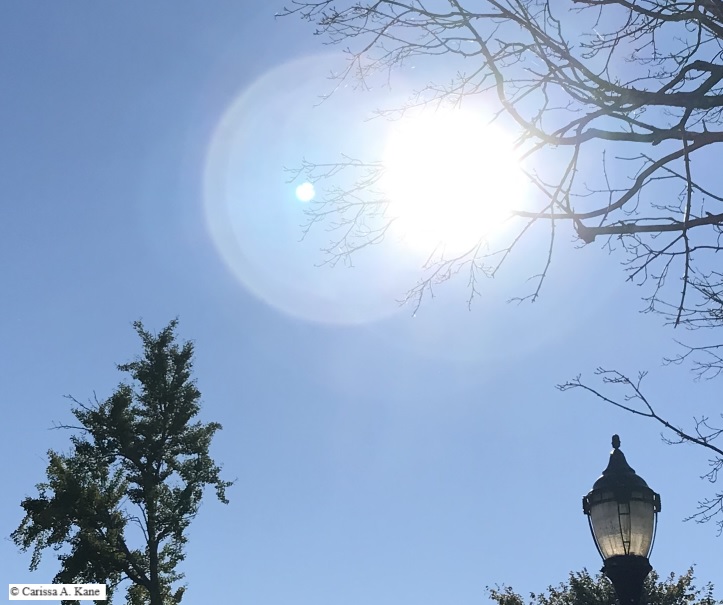
It’s said that only 10% of the energy received from the sun by a plant or tree (a.k.a. a producer) is transferred to the consumer of that plant or tree, and as one moves up the chain, although 10% keeps getting passed along to the next level, the amount of energy becomes less. This means that the further away from the original source one is, more consumption or effort is necessary to achieve or capture the same amount of energy that the plant or tree receives as a producer. As for the 90% of the energy that is retained by producers, it is used for growth and reproduction as well as some of it simply escaping as heat into the atmosphere.
It’s intriguing to think about only 1/10th of the energy received from the original source, the sun, as being passed along from the 1st level to the next, and only 1/10th of that lesser amount going to the next level, and so on. Yet, despite this comparatively small portion shrinking at each level, life not only goes on, but also evolves. It calls to mind last Sunday’s Gospel when in response to the disciples asking for an increase in faith Jesus said, “If you have faith the size of a mustard seed, you would say to [this] mulberry tree, ‘Be uprooted and planted in the sea,’ and it would obey you.” (Lk 17:5-6). It also leads to this Sunday’s readings and a key component of faith.
Although the way of the world might urge one and all to seek what is big, bold, or grand, and to make it known, the readings for the Twenty-eighth Sunday in Ordinary Time (shown below) offer an opportunity to contemplate humility. In the first reading (2 Kgs 5:14-17), Naaman, a successful and celebrated commander of King Aram’s army, is cured of leprosy by submerging himself in the Jordan seven times at the direction of the prophet Elisha. Yet, it is only by taking time to go back and look behind the scenes at the prior verses of this passage, that one can see or be reminded that it was at the urging of servants that Naaman made his way to Elisha, eventually overcame his notions and resistance to listening to the prophet, entered the waters of the Jordan, and was healed. Had Naaman dismissed his servants’ perspectives without consideration and continued to be bound up by his judgments, preferences, and ideas about the unexpected and less than grand actions Elisha instructed him to take, the healing would not have been possible. It’s important to consider humility as requiring an openness to considerations that originate and/or extend beyond oneself.
Turning to the second reading (2 Tim 2:8-13), St. Paul continues to exhort and encourage Timothy, to draw strength from the truth, keeping and carrying on the faith. While St. Paul is recognized for the tendency to be long on words, his point is always focused on the glory of God and eternal life. In this passage he writes, “Remember Jesus Christ, raised from the dead, a descendant of David: such is my gospel, for which I am suffering, even to the point of chains, like a criminal. But the word of God is not chained.” (v. 8-9). What’s it like to reflect on this vision or belief that, even though forces that seek to hold back, limit, or impose restraints on God-given freedom exist, the word of God, and therefore God, remains unchained and is not held back. How do you invite or allow the ever-unchained God into your times of challenge to comfort, sustain, and empower you? What’s it like to embrace or re-embrace, “I can’t, but God can,” and experience humility in this way?
Now, moving on to the Gospel According to Luke (Lk 17:11-19), we come back to a passage involving not 1, but 10 lepers. Jesus meets them as he is making his way to Jerusalem. They all call out to Jesus, asking for pity and they all listen when he tells them, “Go show yourselves to the priests.” (v. 14). However, only one of them becomes aware that he has been healed and goes back to Jesus to express gratitude. Jesus asks where the other 9 who were cleansed are, and goes on to tell the leper who returned, and whom he identifies as a foreigner, that his faith has saved him.” As you think about this passage, what is your first thought or feeling? What strikes you most?
It can be effortless to jump to a place of judgment either toward the one who returned or the 9 who did not. What happens though when you look again and shift your attention in this passage solely to Jesus? As you continue to reflect on this week’s readings, notice where you tend to look for or to celebrate examples of humility in your life? Share your observations with Jesus?
Humility beckons us away from focusing too much on thinking about who or where we are and draws us toward truth and unity. We are called not to shrink, but to open our hearts to all, to seek God (the Source) in all things, remembering to strive to embrace what is eternal while living within the limited reality of this world. Humility is not only letting God be God, but also asking for the grace to relinquish what we can, trust that we are more than what’s measurable, and that what’s left is and will be enough.
First Reading: Naaman went down and plunged into the Jordan seven times at the word of Elisha, the man of God. His flesh became again like the flesh of a little child, and he was clean of his leprosy.
Naaman returned with his whole retinue to the man of God. On his arrival he stood before Elisha and said, “Now I know that there is no God in all the earth, except in Israel. Please accept a gift from your servant.”
Elisha replied, “As the Lord lives whom I serve, I will not take it;” and despite Naaman’s urging, he still refused. Naaman said: “If you will not accept, please let me, your servant, have two mule-loads of earth, for I will no longer offer holocaust or sacrifice to any other god except to the Lord.” – 2 Kgs 5:14-17
Second Reading: Beloved: Remember Jesus Christ, raised from the dead, a descendant of David: such is my gospel, for which I am suffering, even to the point of chains, like a criminal. But the word of God is not chained. Therefore, I bear with everything for the sake of those who are chosen, so that they too may obtain the salvation that is in Christ Jesus, together with eternal glory. This saying is trustworthy: If we have died with him we shall also live with him; if we persevere we shall also reign with him. But if we deny him he will deny us. If we are unfaithful he remains faithful, for he cannot deny himself. – 2 Tm 2:8-13
Gospel Reading: As Jesus continued his journey to Jerusalem, he traveled through Samaria and Galilee. As he was entering a village, ten lepers met him. They stood at a distance from him and raised their voices, saying, “Jesus, Master! Have pity on us!” And when he saw them, he said, “Go show yourselves to the priests.” As they were going they were cleansed. And one of them, realizing he had been healed, returned, glorifying God in a loud voice; and he fell at the feet of Jesus and thanked him. He was a Samaritan. Jesus said in reply, “Ten were cleansed, were they not? Where are the other nine? Has none but this foreigner returned to give thanks to God?” Then he said to him, “Stand up and go; your faith has saved you.” – Lk 17:11-19






 HopeThatFloats
You must be logged in to post a comment.