Pink Carnation

Revisit…

For a time, many things are only for a time.
Some things forever gone, others, on hiatus.
Sometimes returning, welcome on arrival,
Sometimes returning, unwanted and in dread,
Sometimes slithering, seeping in, seeping out,
Creating a stir, unease or great unrest.
But Light, the Great Protector, shines thru,
Revealing all, shedding lies in time,
And casting out, what Time ordains as passed.

The Gospel passage for the First Sunday of Lent (Luke 4:1-13) is referred to as the Temptation of Jesus. After his baptism, Jesus is led into the desert by the Holy Spirit for forty days. And after these days of fasting, he is tempted by the devil in three ways:

First, to use his status as the Son of God to relieve himself of his situation of hunger.

“If you are the Son of God, command this stone to become bread.” (verse 3)

Second, to exalt himself by paying homage, or worshipping, the devil to receive earthly power and glory.

“I shall give to you all this power and their glory; for it has been handed over to me, and I may give it to whomever I wish. All this will be yours, if you worship me.” (verses 6-7)

And third, to show doubt in God, by throwing himself from the parapet of the temple, and thereby testing Scripture:

“If you are the Son of God, throw yourself down from here, for it is written: ‘He will command his angels concerning you, to guard you, and: ‘With their hands they will support you, lest you dash your foot against a stone.’” (verses 9-11)

Jesus responds to these temptations as follows:

“It is written, ‘One does not live on bread alone.’” (verse 4)

“It is written ‘You shall worship the Lord, your God, and him alone shall you serve.’” (verse 8)

And lastly, when the devil tries to zero in on and twist Scripture verses to tempt Jesus away from the truth of who God is calling him to be, Jesus, again focuses on God—a higher purpose—responding:

“It also says, ‘You shall not put the Lord, your God, to the test.’” (verse 12)

The “Temptation of Jesus” Gospel passage ends with, “When the devil had finished every temptation, he departed from him for a time.” (verse 13)

Oftentimes, after going through a challenging situation or event, it is common to be grateful for that time to be over. It can also be tempting to walk away with a notion of achievement or learning from it in a way that we see as being complete. Yet, whether good or bad, there are times when the same, or a similar challenge returns, offering an opportunity to draw even closer to God, and to see or learn even more.

Take some time to consider how open you are to remembering what you’ve learned as well as to learning something new when repeat or similar situations of challenge occur?

Reflecting on Jesus’s words in response to each of the temptations he faced in the desert, what invitation(s) are there for you and Jesus to explore? Allow your prayer to extend into these areas. Express your wants, needs, fears, etc. to Jesus, and allow Jesus to express His thoughts and wisdom to you.

Pink Carnation

You who dwell in the shelter of the Most High, who abide in the shadow of the Almighty, say to the Lord, “My refuge and fortress, my God in whom I trust.” – Psalm 91:1-2


What Are Words For…

According to the Oxford English Dictionary there are around 170,000 words currently used in the English language. In addition, there are around 47,000 words that are now considered outdated or obsolete. In preparing for, and during Lent, there is often a great focus on actions and what one will do or perhaps not do over the course of these forty days. However, Lent is also a great time to consider the importance and weight or impact of words, and how they are used.

The Gospel Acclamation for the First Sunday of Lent is “One does not live on bread alone, but on every word that comes forth from the mouth of God.” (Matthew 4:4b).

Consider things you have heard over the past week or so. How did you receive them? What words impacted you most? Now consider things you have said over the past week or so. What effects do you imagine your words have had? Invite the Lord into this process of remembering and discerning.

Whether in words heard or spoken over the past week, how did you experience God or characteristics of God’s word through the exchanges you had, words involved. and/or information received or given out?

In the Gospel for the First Sunday of Lent, it is written:

The Spirit drove Jesus out into the desert,
and he remained in the desert for forty days,
tempted by Satan.
He was among wild beasts,
and the angels ministered to him.

After John had been arrested,
Jesus came to Galilee proclaiming the gospel of God:
“This is the time of fulfillment.
The kingdom of God is at hand.
Repent, and believe in the gospel.”
– Mark 1:12-15

In what ways would you like the Lord to help you when it comes to the word of God as you go about each day?

Your ways, O Lord, are love and truth to those who keep your covenant. – cf. Psalm 25:10

Conversion…

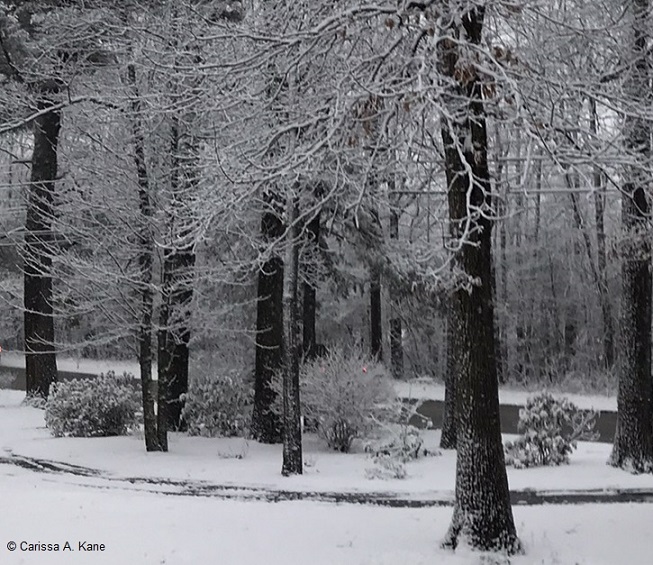
Covered with snow, the landscape so quiet, so still, so beautiful. The branches and shrubs become as if carefully wrapped, insulated from the elements, as well as by the elements. Becoming part of what’s on the outside pushing inward? Or, perhaps, it’s the outside becoming part of what’s inside and underneath, pushing outward? How will they lean, where will they fall, maybe, just maybe, they will stand upright, if anything at all.

A clean heart create for me, God; renew within me a steadfast spirit. – Ps 51:12

The Gospel for the First Sunday of Lent (Mt 4:1-11), is an account of the temptation of Jesus. We all experience variations of temptation throughout our lives. We all have weaknesses or tendencies that can lead us astray or take us away from being at or near our best, most genuine selves.

Looking to the example of Jesus, we can see his response to temptation, is first and foremost, to be aware and recognize it. Then second, to respond by remembering, and not only naming, but also reclaiming God as the source of all wellbeing. Jesus keeps God at the center throughout, and God’s grace enables him to overcome each temptation.

How can one apply this to real life experience in today’s world?

We can start by being aware and recognizing that temptation works in different ways. Sometimes it tries to move us toward “absolute” or limited views and the choices that flow from them, while at other times, temptation seeks to blur the lines between choices so that the best choice is left behind for the choice that seems good enough. Temptation tries, and keeps trying to find whatever hook will sink, to snag and pull one toward a more self-centered space and making a choice from there, instead of making it from a God-centered space where the choice is generative and beneficial beyond what one can surmise.

In the Gospel passage of the temptation of Jesus, Jesus shows us how to lean on the grace of God, and how to patiently endure to overcome temptation by living with God at the center—always in our hearts and minds. He reminds us that what has been written, holds true now, as well as forever.

One does not live on bread alone,
but on every word that comes forth
from the mouth of God. – Dt 8:3

He will command his angels concerning you
and with their hands they will support you,
lest you dash your foot against a stone. – Ps 91:11-12

You shall not put the Lord, your God, to the test. – Dt 6:16

The Lord, your God, shall you worship
and him alone shall you serve. – Dt 6:13

Reflecting on each of Jesus’s responses above, what comes to mind in terms of your own experience of God’s grace in the face of a struggle or challenge you faced? Recall how God was present to you, and how you were, or became present to God? Share with God what that experience was like, and what it means to you today. What inspiration or insight might God want that experience to reveal to you today?

Consequently…

Yes, every coin has two sides, and two sides only. Unlike coins, although people, stories, and situations also have more than one side, this does not mean that there are only two sides to matters regarding them. There are often more sides than there is the time that is taken to try to see them.

In the Gospel according to Matthew, the master of temptation seeks opportunities to blur the lines, create confusion, and make it more difficult to see clearly the choice that is, in fact, best for the time at hand.

At that time Jesus was led by the Spirit into the desert
to be tempted by the devil.
He fasted for forty days and forty nights,
and afterwards he was hungry.
The tempter approached and said to him,
“If you are the Son of God,
command that these stones become loaves of bread.”
He said in reply,
“It is written:
One does not live on bread alone,
but on every word that comes forth
from the mouth of God.”

Then the devil took him to the holy city,
and made him stand on the parapet of the temple,
and said to him, “If you are the Son of God, throw yourself down.
For it is written:
He will command his angels concerning you
and with their hands they will support you,
lest you dash your foot against a stone.”
Jesus answered him,
“Again it is written,
You shall not put the Lord, your God, to the test.”

Then the devil took him up to a very high mountain,
and showed him all the kingdoms of the world in their magnificence,
and he said to him, “All these I shall give to you,
if you will prostrate yourself and worship me.”
At this, Jesus said to him,
“Get away, Satan!
It is written:
The Lord, your God, shall you worship
and him alone shall you serve.”

Then the devil left him and, behold,
angels came and ministered to him. – Matthew 4:1-11

The trick that Jesus so masterfully avoids is the temptation to see what the devil presents to him in a two-dimensional way and thus respond or react based on that, rather than on a view or understanding that is multi-dimensional. That is, Jesus does not allow his view to be constricted by the fact that he is tired or hungry, or anything else. If he did, he would be lead to fall for the devil’s ploys, and then move toward making a choice(s) that at the root would solely benefit or be centered on himself, and meeting his personal needs at the expense of the greater good.

This passage provides a great example of the ways that are not of God, and that can go undetected and create interference. Temptation seeks to entice and distract us into living in a “going through the motions” kind of way or to distract us from being mindful and intentional. The more we partake of something, whatever it might be, the more likely it is to become rote, possibly lose meaning, and gradually remove us from the goodness of the original purpose and motivation. The devil counts on this, waiting for weakness to arrive. Notice how Jesus is pressed and tempted after being in the desert for 40 days, not right from the start of his stay or even mid-way through, but when he was physically at his weakest and likely to be less aware… when there was a potential opening for temptation to seep in.

During the season of Lent, as well as all year through, temptation seeks to draw us into seeing any, and all things as two-dimensional. Remember, though, as the saying goes, “The road to hell is paved with good intentions.” And, just because something is good, it does not mean it is always the best choice, for everyone, all the time. Only God can be the judge of that.

Coin

In the Desert…

I remember as a child spelling d-e-s-e-r-t, desert, the treat following dinner. I also remember receiving my paper back from the teacher with a red “x” and a second “s” added in the word. A common error for a young child, I am sure. It is funny how some things make a lasting impression and how over time it can be much easier to laugh at things that perhaps once did not seem so funny or amusing. This is one of the gifts that comes with perspective though.

When Jesus was led into the desert, he faced temptation. However, despite his weakened state, he did not lose perspective. He remained focused on who he was and what he knew to be true. He was able to see temptation for what it was and to say, “Get away, Satan!” We are called to do the same.

In today’s world one could say that the desert of temptation has grown exponentially. Oftentimes where one might expect to find solace or solidarity and goodwill, there is none. Despite this, one must carry on and, like Jesus, hold fast to God, the One in whose image all are created. In seeking and striving to do so with all one’s mind, heart and soul, there is comfort and strength, knowledge and wisdom, and yes, even in the desert of temptation, there is peace.

At that time Jesus was led by the Spirit into the desert
to be tempted by the devil.
He fasted for forty days and forty nights,
and afterwards he was hungry.
The tempter approached and said to him,
“If you are the Son of God,
command that these stones become loaves of bread.”
He said in reply,
“It is written:
One does not live on bread alone,
but on every word that comes forth
from the mouth of God. (Deuteronomy 8:3)”

Then the devil took him to the holy city,
and made him stand on the parapet of the temple,
and said to him, “If you are the Son of God, throw yourself down.
For it is written:
He will command his angels concerning you
and with their hands they will support you,
lest you dash your foot against a stone. (Psalm 91:11-12)”
Jesus answered him,
“Again it is written,
You shall not put the Lord, your God, to the test. (Deuteronomy 6:16)”
Then the devil took him up to a very high mountain,
and showed him all the kingdoms of the world in their magnificence,
and he said to him, “All these I shall give to you,
if you will prostrate yourself and worship me.”
At this, Jesus said to him,
“Get away, Satan!
It is written:
The Lord, your God, shall you worship
and him alone shall you serve. (Deuteronomy 6:13)

Then the devil left him and, behold,
angels came and ministered to him.

Matthew 4:1-11