The moon shining bright and full through the trees

The Light of One…

The second reading for the Second Sunday of Lent (Philippians 3:17-4:1) closes with the phrase, “stand firm in the Lord” (Phil 4:1). These words follow verses in which St. Paul encourages the Philippians, and us, “be imitators of me,” and reminds all, “our citizenship is in heaven, and from it we also await a savior, the Lord Jesus Christ. He will change our lowly body to conform with his glorified body by the power that enables him also to bring all things into subjection to himself.” (Phil 3:20-21).

Take a few moments to contemplate the characteristics of the Lord based on Scripture and your experience through prayer and faith. Visualize yourself standing firm in the Lord. What comes to mind or stirs in your heart?

This Sunday’s Gospel passage (Luke 9:28b-36) is about the Transfiguration of Jesus. Just prior to its verses, as part of his teaching on what it means to be a disciple, Jesus says, “What profit is there for one to gain the whole world yet lose or forfeit himself?” (Luke 9:25).

In seeking to respond to the call to conversion and deepening one’s faith, envision yourself with Jesus, Peter, John, and James, going up the mountain to pray. As you walk, consider an area in which you desire to increase trust in the Lord. Bring the things you notice to prayer. Ask Jesus for the grace to receive his insights, and the wisdom to parse the various facets that are involved.

Reaching the top of the mountain, there is a pause for greater solitude—a change or shift in appearance, dazzling white, Moses and Elijah joining Jesus. It is as if time has stopped. You watch and notice, becoming more fully aware of everything around you.

Then, as Moses and Elijah depart and Peter is saying something to Jesus, you hear, “This is my chosen Son; listen to him.” (Luke 9:35). You turn to Jesus, your light and salvation, and he tells you what you need to know. You receive his wisdom as the loving guidance that it is.

Preparing to rejoin Peter, James, and John for your journey back down the mountain, you express a sentiment to Jesus, and he to you, as this intimate moment winds down.

Walking down the mountain, you continue to hold onto and savor what has transpired. When you arrive at the base of the mountain, you look back up to the top, remembering this Scripture verse:

The Lord God took Abram outside and said,
“Look up at the sky and count the stars, if you can.
Just so,” he added, “shall your descendants be.”
Abram put his faith in the Lord,
who credited it to him as an act of righteousness.–
Genesis 15:5-6

The moon shining bright and full through the trees

The Lord is my light and my salvation; whom should I fear? – Psalm 27:1

Be Dazzled…

The readings for the Second Sunday of Lent take us on a journey from sacrifice or letting go to service, embracing identity, and finally becoming one with it. In the first reading, Abraham shows a willingness to sacrifice or let go of whatever his ideas or plans might have been to listen to God and do as God asks (Genesis 22:1-18). Remember, Sarah and Abraham, in their more senior years and against all odds, had their son Isaac after having been barren. Imagine what it must have been like for Abraham to then be asked to sacrifice or let go of his and Sarah’s long-awaited arrival. Yet, Abraham exemplifies a faith that places trust in God (and God alone) above all. He proceeds to take steps toward what God has asked of him. As they left the servants behind and walked along, Isaac asks his father where the sheep is for their offering. Abraham replies, “God will provide the sheep for the burnt offering.” Once they finish building an altar and placing the wood, Abraham moves toward sacrificing his and Sarah’s only child. However, the angel stops him as Isaac’s demise is not what God wills. As Abraham said, God does provide the sheep for sacrifice: “Abraham looked up and saw a single ram caught by its horns in the thicket. So Abraham went and took the ram and offered it up as a burnt offering in place of his son.” And the wisdom of his response to God’s requests and promptings shows that being faithful is to nurture a will that is open to and guided by God. For it is this kind of will that does not lead to demise or destruction.

Continuing to look to what it is to be faithful to God, the response for the Psalm is “I will walk before the Lord, in the land of the living” (Psalm 116:9). How do you feel motivated by Abraham’s example of striving to serve God with a united heart and mind? Try to envision or embody the spirit of walking before God in all that you say and do this week.

Turning to the second reading (Romans 8:31b-34), St. Paul encourages us to remember and embrace our identity when he writes: “If God is for us, who can be against us?” When one is operating with a desire to do God’s will and in the scope of being part of creation in God’s image, there is a sense of inner strength, awareness, and reverence for what is good and just while at the same time a sense of lightness and freedom or free will. It is important to pause every so often to examine what’s going on internally and from where one’s words and actions are flowing. Invite Jesus to the conversation and ask the Lord for the grace to be aligned compatibly with God in each situation you face.

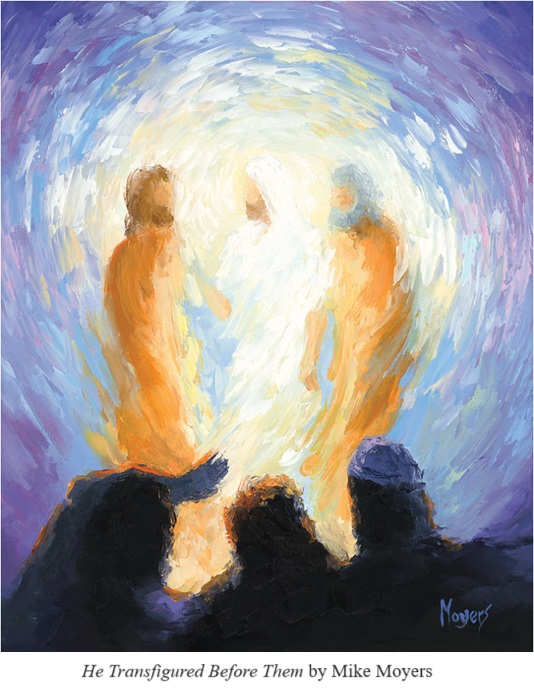
In this week’s Gospel, we read about the Transfiguration of Jesus (Mark 9:2-10), the ultimate image of embracing one’s identity and becoming one with it for the greater good.

Jesus took Peter, James, and John
and led them up a high mountain apart by themselves.
And he was transfigured before them,
and his clothes became dazzling white,
such as no fuller on earth could bleach them.
Then Elijah appeared to them along with Moses,
and they were conversing with Jesus.
Then Peter said to Jesus in reply,
“Rabbi, it is good that we are here!
Let us make three tents:
one for you, one for Moses, and one for Elijah.”
He hardly knew what to say, they were so terrified.
Then a cloud came, casting a shadow over them;
from the cloud came a voice,
“This is my beloved Son. Listen to him.”
Suddenly, looking around, they no longer saw anyone
but Jesus alone with them.

As they were coming down from the mountain,
he charged them not to relate what they had seen to anyone,
except when the Son of Man had risen from the dead.
So they kept the matter to themselves,
questioning what rising from the dead meant.
– Mark 9:2-10

Recall a time where you felt affirmed or reaffirmed and had a sense of confidence in who you are as God’s beloved, leading to spiritual growth or renewal. Ask the Lord for the grace of that experience to extend to today, offering you wisdom, insight, and openness to whatever you may need.

It Is Good…

Walking alongside a beach, the sand is smooth and the waves gentle, like ripples in a lake, pond, or puddle. The path is peaceful and seemingly continuous, until the disruption up ahead; a trench created by water draining back toward the ocean. The chasm is too large to jump across, and there’s no way around it. Or at least no way to get to the other side without having to come off the beach and onto the cracked, uneven sidewalk, stepping through the cold water, or trudging down into and through the muddy-like sand. Pausing to ponder… how best to make it through what seems like the great divide?

In looking to the Gospel passage for the Second Sunday of Lent, Peter says, “Lord, it is good we are here.” This is because he recognizes the moment as a sacred one; something greater is happening here, and we need to take heed and behold it. As he continues speaking, the bright cloud appears, a shadow is cast by it, and a voice says, “This is my beloved Son, with whom I am well pleased; listen to him.” With this, the environment shifts for Peter, James, and John, and their posture changes, but they still recognize the moment as sacred, “they fell prostrate.”

As we try to navigate this world, it can be tempting to shy away, to want to hide, circumvent, or look the other way, and to carry on insulated from the chaos and division that swirls around us. Yet, faith calls us to face the shifting environment by placing our hope and trust in Jesus. Rather than losing heart, we are called to take on the heart of Jesus. And in doing so, even when the reality in front of us may be unpleasant or seem bleak, we are able to face it through the Light of God who helps us to know when and how to rise, and to recognize each moment in these turbulent times as being sacred; holding hope and promise. This is simply because, God is with us, making the dark clouds become bright and spreading light in the midst of darkness, even when, like Peter, James and John, we don’t see it coming.

Jesus took Peter, James, and John his brother,
and led them up a high mountain by themselves.
And he was transfigured before them;
his face shone like the sun
and his clothes became white as light.
And behold, Moses and Elijah appeared to them,
conversing with him.
Then Peter said to Jesus in reply,
“Lord, it is good that we are here.
If you wish, I will make three tents here,
one for you, one for Moses, and one for Elijah.”
While he was still speaking, behold,
a bright cloud cast a shadow over them,
then from the cloud came a voice that said,
“This is my beloved Son, with whom I am well pleased;
listen to him.”
When the disciples heard this, they fell prostrate
and were very much afraid.
But Jesus came and touched them, saying,
“Rise, and do not be afraid.”
And when the disciples raised their eyes,
they saw no one else but Jesus alone.

As they were coming down from the mountain,
Jesus charged them,
“Do not tell the vision to anyone
until the Son of Man has been raised from the dead.” – Mt 17:1-9

Trust in Remembering…

Sitting with the readings for the second Sunday of Lent, like an old friend, the word “Trust” enters the room with a warm smile and as if to say, “Remember me… remember when…” So much of life is about trust and so often, it seems to come down to whom or what one trusts, to what degree, how that trust is received, and the impact or consequences of its handling.

As human beings, we share in a perfectly, imperfect nature, as we navigate life in, and surrounded by, a competitive, material world. It can be tempting to think or feel, even if subconsciously, that there is something we can do about anything happening around us at any time; that a level of control is always within our grasp. We may even look to capture the things that we, as human beings, think will help us to have that control. Yet, the only control we ever really have, and the only victory ever really won, is in choices that we make to trust in God’s ways and to let go, or shed the impulse or notion that any one interest outranks everyone’s interest.

In the ninth chapter of the Gospel according to Luke, Peter, John, and James ascend the mountain with Jesus and share in the experience of his transfiguration. In the passage prior to this one, while explaining what it means to be a disciple, Jesus says, “What profit is there for one to gain the whole world yet lose or forfeit himself?” (Lk 9:25). Looking at the circumstances in the world today, one can clearly see that there is no profit in profiteering, only loss for everyone.

Think about what it must have been like for Peter, John, and James to hear Jesus’ words about discipleship and then to witness his transfiguration seeing him stand alongside the prophets, Moses and Elijah.

Looking to today’s world, when it seems there is nothing to do, or there is no good way to stop what is already in motion, perhaps the best place to start is to forget control, then pause to go back and remember the beginning. Jesus took Peter, James, and John up the mountain to pray. One can only wonder, what was in their hearts as they placed their trust in Jesus and followed him up that mountain. One can only wonder how they received what happened and what they carried in their hearts on the way down, and thereafter.

How does your trust in Jesus shape your choices, create unity, express love, and spread goodwill? Connecting with Jesus as an old friend greeting you with a warm smile, how would you proceed from the phrase, “Remember me… remember when…?”

Share with Jesus what you carry in your heart as you reflect on the world we live in, and the journey you are on within it.

Jesus took Peter, John, and James
and went up the mountain to pray.
While he was praying his face changed in appearance
and his clothing became dazzling white.
And behold, two men were conversing with him, Moses and Elijah,
who appeared in glory and spoke of his exodus
that he was going to accomplish in Jerusalem.
Peter and his companions had been overcome by sleep,
but becoming fully awake,
they saw his glory and the two men standing with him.
As they were about to part from him, Peter said to Jesus,
“Master, it is good that we are here;
let us make three tents,
one for you, one for Moses, and one for Elijah.”
But he did not know what he was saying.
While he was still speaking,
a cloud came and cast a shadow over them,
and they became frightened when they entered the cloud.
Then from the cloud came a voice that said,
“This is my chosen Son; listen to him.”
After the voice had spoken, Jesus was found alone.
They fell silent and did not at that time
tell anyone what they had seen. – Lk 9:28b-36