Recently, I took a trip to roam. Yet, I found myself surrounded by lots of moving pieces and it was hard not to get caught up in the pace around me. In a crowded space, quick not being quick enough, too many I’s to dot, too many T’s to cross, and seemingly no time or place for pause. But then, oftentimes there isn’t, until the room for it is made.
“The inspiration you seek is already within you. Be silent and listen.” – Rumi
How tempting it can be sometimes to fall into place and do as others do, or conversely, step out of line and walk away. However, what often gets lost is the balance that allows for the ground that is known as middle. It is the place where things are less extreme, grips and grasps are loosened, and real freedom is experienced. Not beholden to what is less than, the middle is the place that gives permission for mind and heart to meet, and for the soul to connect. And only then, in action there is peace.
“…it is something very near to you, already in your mouths and in your hearts; you have only to carry it out.” – Dt 30:14
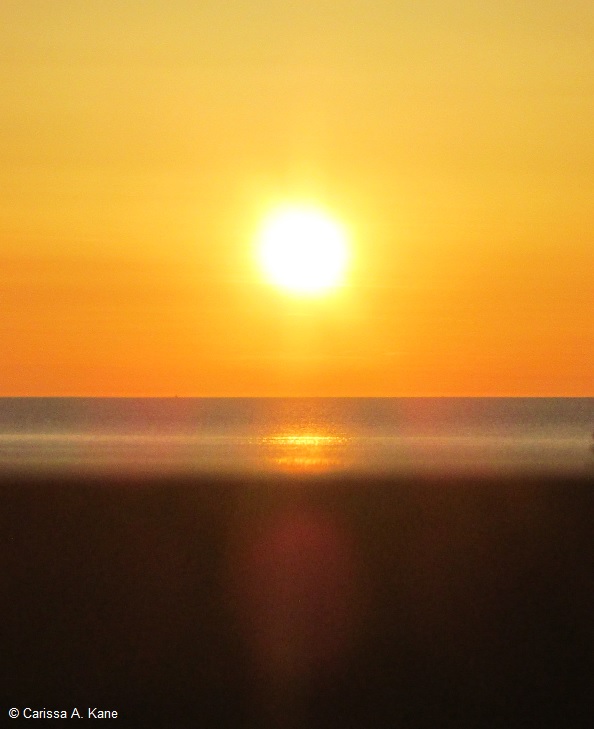
As daylight breaks, The Sun gently makes its way across the room. A brightness calling out, But without sound, That which is truly out of sight.
A beacon as it beckons, Come closer, Look to see. Rising up and drawing near, A clearer view awaits.
Darker shades turn to blue, Then lighter still, Altogether moving up, Orange, yellow, gold, So bold, so pure, so true.
It echoes all around, A promise made as well as kept, From One heart to another, Meet me here, meet me there, No matter what, you can meet me anywhere.
Give thanks to the Lord for he is good, his love is everlasting. – Psalm 118:1
Mind over matter, What difference does it make? The set of one’s mind, May toggle or break, Or yet even worse, Get stuck in one place.
Heart in the matter, What difference does it make? The set of one’s heart, When inspired by God, Finds purpose, builds faith, Sings praises, gives faith.
One cried out to the other: “Holy, holy, holy is the Lord of hosts! All the earth is filled with God’s glory!” – Isaiah 6:3
“Blessed are you who believed that what was spoken to you by the Lord would be fulfilled.” – Luke 1:45
As the minutes of daylight continue to decline and the shortest day of the year in the Northern Hemisphere approaches, life in December 2021 does not seem anywhere close to normal. However, it is at these times that opportunity abounds, if only we can meet the challenge of seeking the wisdom of balance and the choices of Light that reside between the stark contrast of opposites. And, while at times, it can seem bigger than life, and the odds improbable, looking to Mary, the Queen of Peace, one can trust it’s not impossible to experience the quiet strength of peace in troubling times.
Mary chooses to embrace the spirit of God, surrender her will and be led by God (Luke 1:26-38). Joseph, her betrothed, makes a similar choice (Matthew 1:18-24). In the eyes of the world, these choices can seem unimaginable. Why would anyone say yes to a choice that is bound to bring such harsh scrutiny, create gossip and skepticism, possible death in those times, and disgrace? Perhaps that’s why it’s never wise to judge a book by its cover. Only God can ever really know the truth of all that’s happening, and only God can ever truly influence choices that are genuinely for the greater good, even when others cannot understand them.
Mary’s “yes” and Joseph’s “yes” are certainly pivotal moments. What led them to being able to discern such choices? How did they know what to do? Sitting with their “yes’s,” the inspiration that can be drawn from them is tremendous, but it is also just the beginning.
In reflecting on what happened in those moments and in all the ones that followed, what is it like to imagine that even though the road did not get any easier, Mary and Joseph made it through not because of their own determination, but because God was with them, and they were led by the light of God?
Many years ago, before GPS, I was on my way to a meeting, when I encountered road construction and a detour from the route I was supposed to take. Following the detour signs, I began an unexpected adventure through long and winding back roads, farmland, and forestry. However, along the way, I lost my way.
Suddenly there were no signs, and I was in utterly unfamiliar territory. Initially, it was as if my surroundings were closing in on me and I was shrinking in comparison. I started to feel anxious and stressed about being late or potentially missing the meeting. Then, slowing down, I stopped and began to take more notice. Surveying the landscape and elements in the sky more intently, I was able to find new signs and my bearings were restored, leading me more peacefully to the place I needed to be. I ended up being a little late, but it was okay; as always “better late than never.”
In current day times, it can seem as if society is in a construction zone that is in disarray. So many detours, roads without signs, confusion, violence, and chaos swirling all around. Yet, among it all, continuing to seek, searching within, and then looking back out, there are always signs pointing to the promise and hope of a better way.
The readings for the First Sunday of Advent (Jer 33:14-16; Ps 25:1b,4-5,8-9,10,14; 1 Thes 3:12-4:2, Lk 21:25-28,34-36) are a call to remember the promise, open oneself to God, to pay attention, and place hope in God as the way to restoration and redemption. Take time to reflect on what promise and hope in God means to you.
Who is this God?
How and where is God welcomed into the landscape of your life?
What do you desire as you look to journey with God this Advent? What might God desire for you?
Show us, Lord, your mercy; grant us your salvation. – Psalm 85:8
Jesus tells his disciples, “Learn a lesson from the fig tree. When its branch becomes tender and sprouts leaves, you know that summer is near” (Mark 13:28). Yet, just two chapters earlier, Jesus cursed a fig tree causing it to wither:
“Seeing from a distance a fig tree, he went over to see if he could find anything on it. When he reached it he found nothing but leaves; it was not the time for figs. And he said to it in reply, ‘May no one ever eat of your fruit again!’ And his disciples heard it. … Early in the morning, as they were walking along, they saw the fig tree withered to its roots. Peter remembered and said to him, ‘Rabbi, look! The fig tree that you cursed has withered.’ Jesus said to them in reply, ‘Have faith in God.’” (Mark 11:13-14, 20-22).
Looking at these two passages and particularly at the fig tree, it may seem like Jesus is contradicting himself. However, looking at the whole picture, notice how Jesus shifts the focus from the tangible fig tree to looking beyond it and pointing to faith.
Maybe the real lesson that Jesus wants us to learn is that there are no hard and fast rules other than loving God, yourself, and your neighbor, and that this occurs best when we are not so entrenched in one way or another. That is, when we are able to be present to the moment, openminded, and willing to be guided by God, even when the direction in which we might feel compelled may not make sense in the world’s eyes and may not be fully understood by ourselves or others.
Perhaps the season is neither here nor there, but never-ending, the invitation ever-present, and more than anything, the task always at hand, is to focus on Jesus and ask for the grace to be “tender and sprout leaves.”
Jesus said to his disciples: “In those days after that tribulation the sun will be darkened, and the moon will not give its light, and the stars will be falling from the sky, and the powers in the heavens will be shaken.
“And then they will see ‘the Son of Man coming in the clouds’ with great power and glory, and then he will send out the angels and gather his elect from the four winds, from the end of the earth to the end of the sky.
“Learn a lesson from the fig tree. When its branch becomes tender and sprouts leaves, you know that summer is near. In the same way, when you see these things happening, know that he is near, at the gates. Amen, I say to you, this generation will not pass away until all these things have taken place. Heaven and earth will pass away, but my words will not pass away.
“But of that day or hour, no one knows, neither the angels in heaven, nor the Son, but only the Father.” – Mark 13:24-32
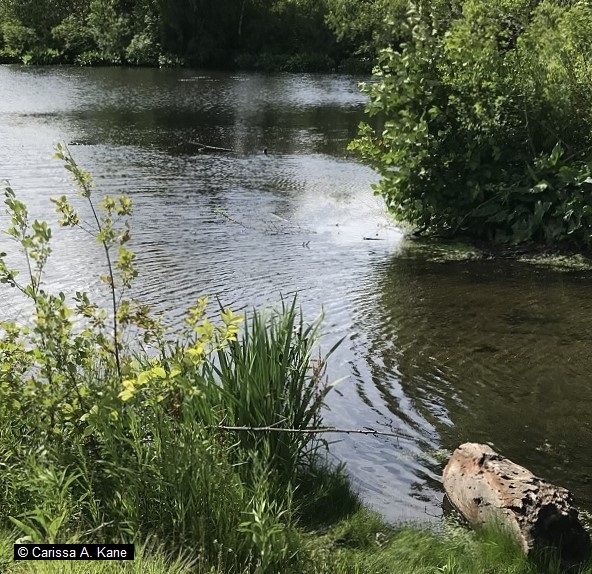
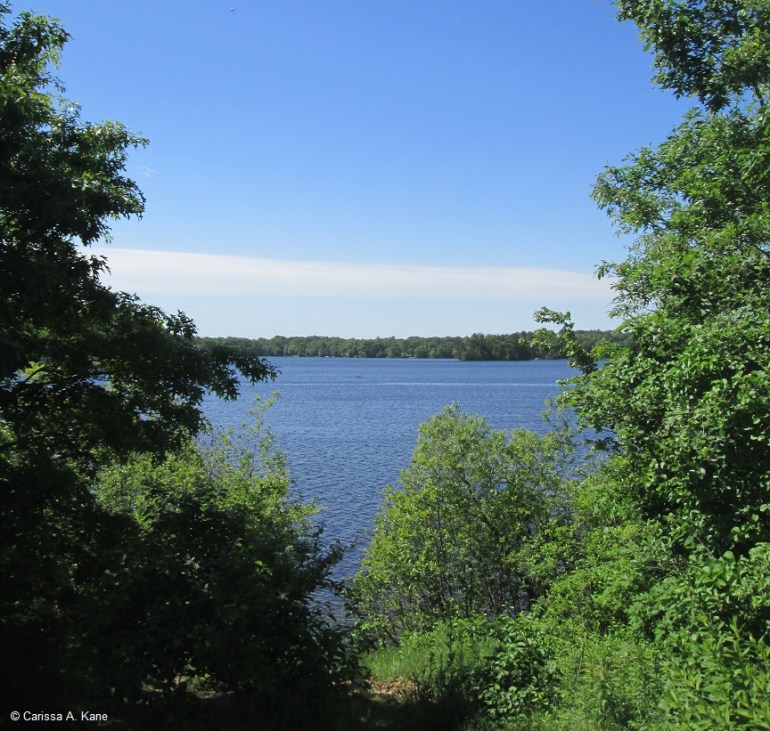
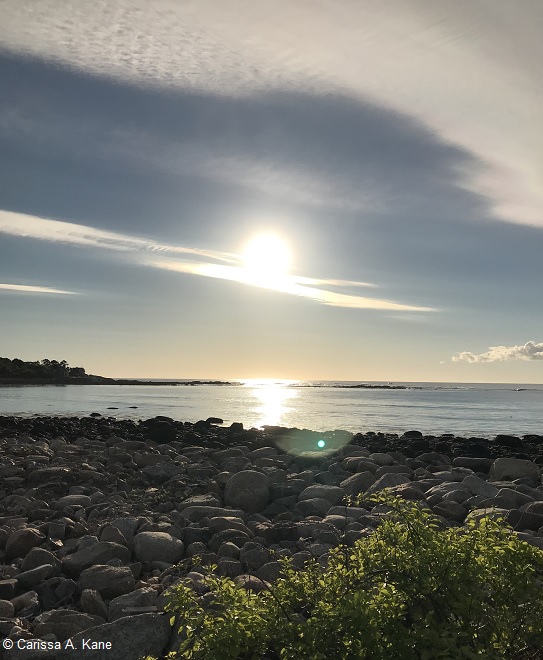
Pulling into an open lot along a scenic road, initially it seemed as though there was no place from which to view the water. Bushes and trees were all around, as if a fortress blocking the way to the water gently waving behind it. However, stepping out into the fresh air, with each movement closer, possibilities arose, until at last, nearer still and despite any preconceived notions, a path, narrow as could be, but still present, a way through appeared.
Oftentimes, there is much more than one might see or think there to be, yet it can be tempting to refrain from asking, disregard the invitation, and instead turn back, embrace presumptions from afar, and choose a side, rather than trusting that call, choosing to discover (ask and receive), allowing paths to appear and Truth to become known.
In the passage below, what resonates most with you at this moment? Which person(s) do you identify with and in what ways? How do you desire to be, and to live? Where is God in that desire?
The whole Israelite community grumbled against Moses and Aaron. The Israelites said to them, “Would that we had died at the Lord’s hand in the land of Egypt, as we sat by our fleshpots and ate our fill of bread! But you had to lead us into this desert to make the whole community die of famine!”
Then the Lord said to Moses, “I will now rain down bread from heaven for you. Each day the people are to go out and gather their daily portion; thus will I test them, to see whether they follow my instructions or not.
On the sixth day, however, when they prepare what they bring in, let it be twice as much as they gather on the other days. So Moses and Aaron told all the Israelites, “At evening you will know that it was the Lord who brought you out of the land of Egypt; and in the morning you will see the glory of the Lord, when he hears your grumbling against him. But who are we that you should grumble against us?”
And Moses said, “When the Lord gives you meat to eat in the evening and in the morning your fill of bread, and hears the grumbling you utter against him, who then are we? Your grumbling is not against us, but against the Lord.”
Then Moses said to Aaron, “Tell the whole Israelite community: Approach the Lord, for he has heard your grumbling.” But while Aaron was speaking to the whole Israelite community, they turned in the direction of the wilderness, and there the glory of the Lord appeared in the cloud!
The Lord said to Moses: “I have heard the grumbling of the Israelites. Tell them: In the evening twilight you shall eat flesh, and in the morning you shall have your fill of bread, so that you may know that I, the Lord, am your God.”
In the evening quail came up and covered the camp. In the morning a dew lay all about the camp, and when the dew evaporated, there on the surface of the desert were fine flakes like hoarfrost on the ground. On seeing it, the Israelites asked one another, “What is this?” for they did not know what it was. But Moses told them, “This is the bread that the Lord has given you to eat.” – Exodus 16:2-15
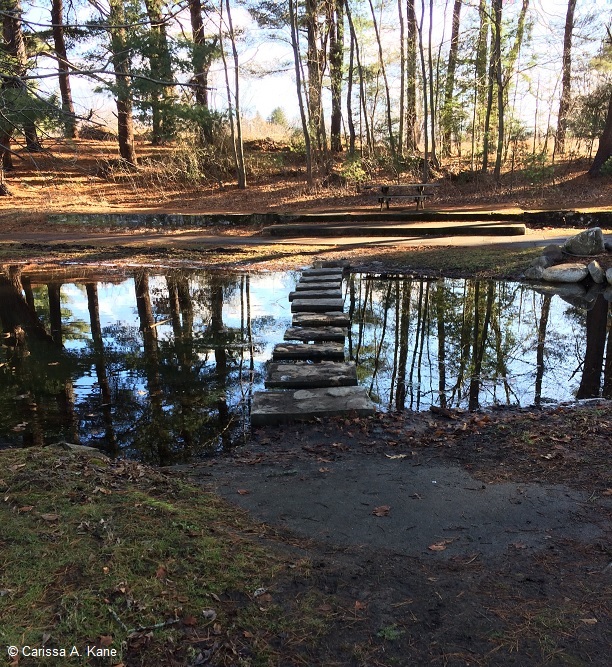
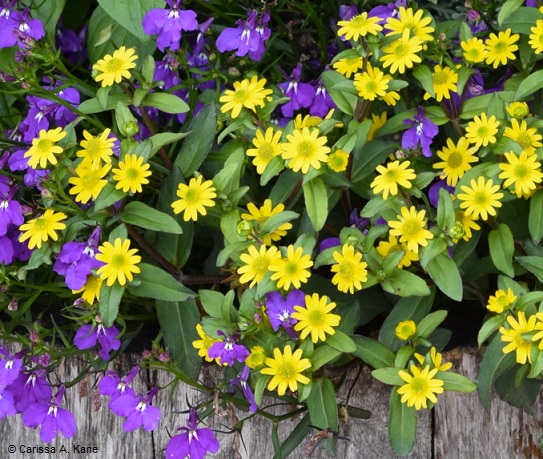
After what seemed like quite a lot of time walking and winding our way, up, down, around, and through the wooded area embracing the large pond, we arrived at what appeared to be the center of our journey—the resting place. As we moved closer to the main building, designed for respite and a bite to eat, we were greeted by a wooden barrel holding purple and yellow flowers beckoning us to keep the journey going. Bright and beautiful flowers, they drew us—tired, hungry, weary travelers—in and lifted us up, raising the smile in our hearts to our lips and bringing the twinkle back to our eyes.
No matter the circumstances, the conditions along the way, or how far one travels, Peace is always reaching out, working from within, and waiting upon us.
Faith is the road, but communion with Jesus is the well from which the pilgrim drinks. ― Charles Haddon Spurgeon
Anima Christi
Soul of Christ, sanctify me. Body of Christ, save me. Blood of Christ, inebriate me. Water from the side of Christ, wash me. Passion of Christ, strengthen me. O good Jesus, hear me. Within Thy wounds hide me. Separated from Thee let me never be. From the malignant enemy, defend me. At the hour of death, call me. And close to Thee bid me. That with Thy saints I may be Praising Thee, forever and ever. Amen.
Some days seem to arrive so suddenly, despite all the moments along the way building and leading up to them. Occasions can seem so far away, distant, or perhaps remote in possibility, but then in a blink of an eye, there they are, upon us.
Looking back, quite often we can see that there was a gradual unfolding. Bit by bit, being led, pushing back, falling into, twisting and turning, moving toward, and perhaps eventually all out embracing the process in the making. And, almost always, right before our very eyes, like the rising and setting of the sun, or the movement of the wind and drifting of the clouds.
Purpose and meaning, and yes, a point, even in the midst, or lack, of human understanding.
In the Gospel according to Mark, after the preparation and celebration of the Passover, on the day that would become known as the Lord’s supper, we read:
“Then, after singing a hymn, they went out to the Mount of Olives” (Mk 14:26).
To sing a song of thanksgiving to God would have been a very normal and traditional thing to do in bringing the Passover meal to a close. Yet what was revealed during the Lord’s supper and what was about to transpire, was not so traditional. Here is a look at it:
Jesus tells the disciples, “…one of you will betray me…” (14:18) leading to angst within each of them as they take turns asking, “Surely it is not I?” (14:19), he introduces and enters a new covenant where he, the Savior, is the sacrificial lamb (14:22-24), and then Jesus tells them, “I shall not drink again the fruit of the vine until the day when I drink it new in the kingdom of God” (14:25).
Imagine what it must have been like for the disciples as they experienced this, then sang a hymn of thanksgiving and praise, and prepared to go out to the Mount of Olives. They probably did not understand, or fully grasp, what had happened during the Passover meal.
Imagine also being told by Jesus, “All of you will have your faith shaken, for it is written: ‘I will strike the shepherd, and the sheep will be dispersed.’ But after I have been raised up, I shall go before you to Galilee.” (14:27-28). Yes, they were foretold the things that would happen, but still, they did not know the circumstances they were about to step into—the Agony in the Garden.
However, the disciples did know that they were with the Lord, and that the Lord was with them. They also had the experience of being in Jesus’ presence and a tradition of faith that had carried them throughout their lives, led them to the Lord’s supper, and would lead them through the moments that were ahead. Overall, one might say, all these things combined is what enabled them to trust, perhaps without even knowing that was what they were doing, as they left the Passover meal and stepped out, heading toward the Mount of Olives, and landing in the garden, and all that awaited them.
“I will take the cup of salvation, and call on the name of the Lord.” – Psalm 116:13
The Self-revealing of the Word is in every dimension – above, in creation; below, in the Incarnation; in the depth, in Hades; in the breadth, throughout the world. All things have been filled with the knowledge of God. – Athanasius of Alexandria
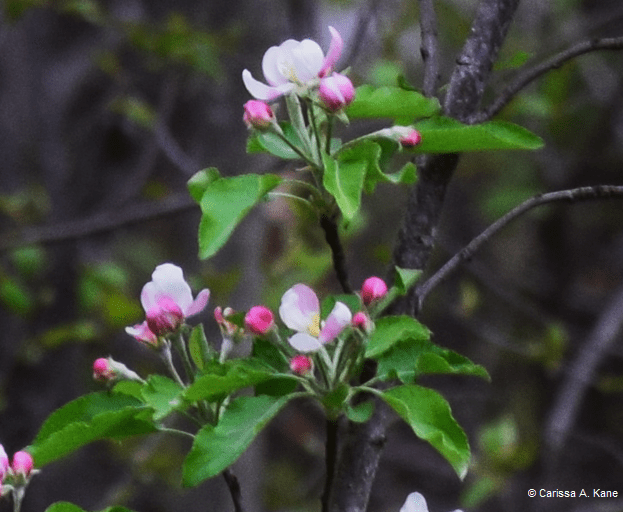
Looking out the kitchen window, a splash of pink amidst the green catches my eye. I turn back to what I am doing for a moment before realizing what that color is. As I look out again, more intently this time, I feel amazed at the way these blossoms have come into existence.
A few years ago, we planted a sapling. For the most part, since then, it looked more like a twig in the ground than a tree. Along the way, it seemed that it was not going to take. Often, we thought maybe it was on its way out. Still, we watered, fertilized, and staked it for support and so it would grow straight. It grew, and eventually produced some leaves, but largely retained the appearance of a twig in the ground, only taller and now with a little green.
Seeing the blossoms leads me to re-visit the journey. It is interesting how the little signs along the way, at the time they occurred, did not seem big enough. For example, there was growth and there were some leaves here and there, yet the recurring theme seemed to be “not what’s expected.” Looking at the blossoms now, I feel grateful that we gave it more time, kept trying, and did not give up.
Thinking about the world today and the circumstances that abound, maybe, deep down, and all around, at a level that we do not even know, we are learning to trust what we cannot see, or cannot yet understand. The question remains, do we desire truth, and do we have the patience and perseverance to receive it?
Jesus said to his disciples: “I am the true vine, and my Father is the vine grower. He takes away every branch in me that does not bear fruit, and every one that does he prunes so that it bears more fruit. You are already pruned because of the word that I spoke to you. Remain in me, as I remain in you. Just as a branch cannot bear fruit on its own unless it remains on the vine, so neither can you unless you remain in me. I am the vine, you are the branches. Whoever remains in me and I in him will bear much fruit, because without me you can do nothing. Anyone who does not remain in me will be thrown out like a branch and wither; people will gather them and throw them into a fire and they will be burned. If you remain in me and my words remain in you, ask for whatever you want and it will be done for you. By this is my Father glorified, that you bear much fruit and become my disciples.” – John 15:1-8




 HopeThatFloats
You must be logged in to post a comment.