Please join in prayer for the people of Ukraine. May they experience a non-stop, abundant outpouring of love from the rest of the world. May God continue to give them the strength, the means, and the courage to keep standing up to those who are perpetrating violence and seeking to overthrow their country and its leadership. May God turn the hearts and minds of all those in positions to affect what’s happening in Ukraine to whatever is the greatest good possible in this situation, and give those people the wherewithal to choose it.
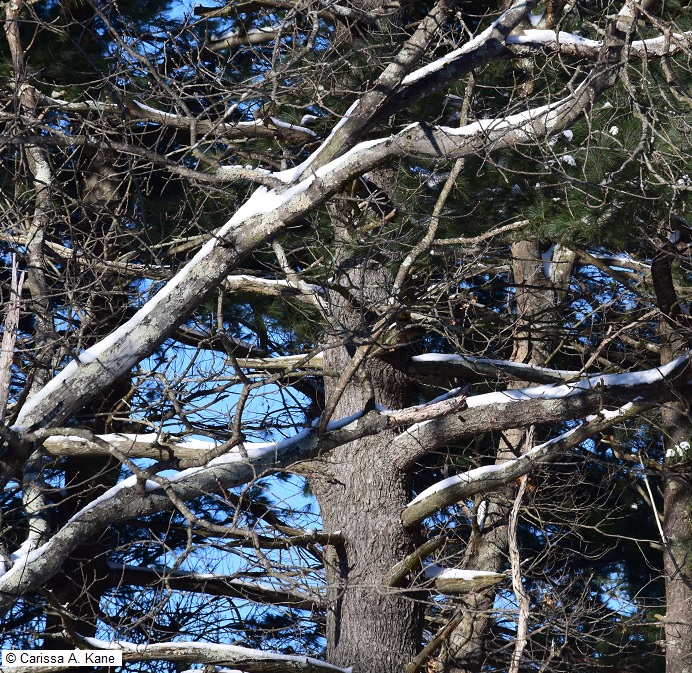
Looking out the window, branches all around. Open arms holding up the snow, or the snow resting on open arms? Both clinging to each other, or one melting into the other? Does it really matter? Still, looking out the window. Still, branches upon branches. Some sturdier than others, some swaying more than others. Does it really matter? More looking out the window, at those branches and that snow. Through it all, they just keep gently staying. Perhaps, that’s all that really matters.
Shine like lights in the world as you hold on to the word of life. – Phil 2:15d,16a
In chapter 13, verse 34 of the Gospel according to John, Jesus says, “I give you a new commandment: love one another. As I have loved you, so you also should love one another.” And, throughout the Gospels, there are many examples of Jesus’ love shown through his words, actions, reactions, and responses. Yet, to love as Jesus loved, can be very challenging, and maybe even feel impossible at times.
However, in the First Letter to the Corinthians (15:45-49), St. Paul really puts the focus on the keys to unlocking the ability to love as Jesus did. In comparing the first Adam to the last Adam (Jesus), St. Paul puts a reminder out there to not get caught up in the things of the world. The things that are material or mainly have to do with personal gain, in the end, will be immaterial. Furthermore, like with Adam and Eve, these things have a way of distorting our vision and pulling us away from the spirit of God.
So, too, it is written, the first man, Adam, became a living being, the last Adam a life-giving spirit. But the spiritual was not first; rather the natural and then the spiritual. The first man was from the earth, earthly; the second man, from heaven. As was the earthly one, so also are the earthly, and as is the heavenly one, so also are the heavenly. Just as we have borne the image of the earthly one, we shall also bear the image of the heavenly one. – 1 Corinthians 15:45-49
St. Paul is saying, remember the truth of who you are, and stay connected to it. There is no loving as Jesus did, without being able to embrace the grace of God in whose image we are created. There is no loving as Jesus did, without the spirit of God helping us to strip away the human inclination toward the world’s view of any situation or thing. It is only through the grace of God, that we can be authentic, operating in the image of God that we are, seeing beyond the haze to what really matters, and then proceeding to receive and respond to the world around us from the place that is eternal.
“To be yourself in a world that is constantly trying to make you something else is the greatest accomplishment.” – Ralph Waldo Emerson
As the minutes pass and the hours turn toward Valentine’s Day, flowers, cards, candies, and more are scooped up and distributed as gifts from one heart to another. So many thoughts and sentiments, varying degrees of affection and dedication expressed through things symbolizing love and care. What a great time to think about relationships, objects reflecting one’s dedication, and how, underneath it all, perhaps sometimes lost, is the Divine. After all, how else might one consider, or be reminded, that there’s more than me, myself, and I, and my concerns?
Broadening the scope, throughout the history of humankind, it would be fair to say that lasting relationships are built upon the ability to be present, a movement of the heart, and a sense of connection and trust. The capacity for each, placed in every being from inception and created to be held as well as extended—a full circle, inclusive kind of thing between and among the Creator and the created. Beautiful, and rightly so, when rightly exercised. However, when those elements disintegrate, for whatever reasons, relationships crack and crumble. And frequently it seems, sides are formed, heels are dug in, and maybe even enemies declared. What for? And, what’s the source of that?
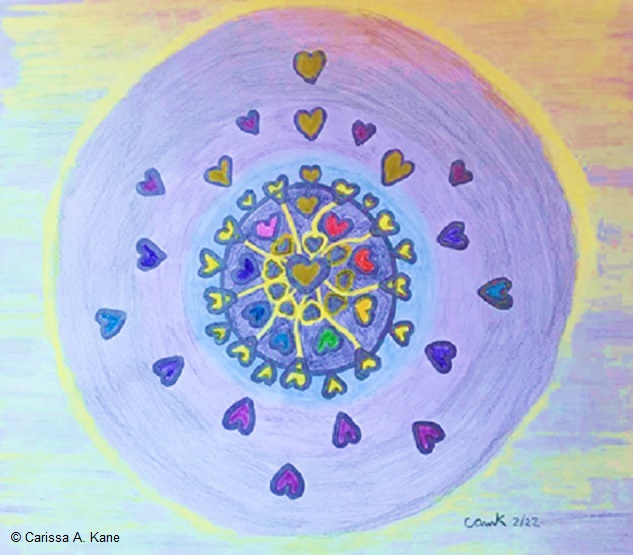
Still though, despite any disturbances or folly along the way, there is always what is Divine. It is the place where faith resides, truth is revealed, and all is known. The place where H is for Hope in God, the One and Only, where love is what truly matters and is nurtured, and where everything else can be put aside, and laid to rest.
As the minutes pass and the hours turn toward Valentine’s Day, take time to remember and to be inspired by the hope and love of God, and the ways in which it is extended not only in and through you, but also to you. How can you nurture it, and be nurtured by it?
We are all meant to be mothers of God. What good is it to me if this eternal birth of the divine Son takes place unceasingly, but does not take place within myself? And, what good is it to me if Mary is full of grace if I am not also full of grace? What good is it to me for the Creator to give birth to his Son if I do not also give birth to him in my time and my culture? This, then, is the fullness of time: When the Son of Man is begotten in us. – Meister Eckhart
Mind over matter, What difference does it make? The set of one’s mind, May toggle or break, Or yet even worse, Get stuck in one place.
Heart in the matter, What difference does it make? The set of one’s heart, When inspired by God, Finds purpose, builds faith, Sings praises, gives faith.
One cried out to the other: “Holy, holy, holy is the Lord of hosts! All the earth is filled with God’s glory!” – Isaiah 6:3
According to the ancient Greek philosopher Plato, “No one is more hated than he who speaks the truth.” This certainly seems the case for Jesus in chapter 4, verses 21-30 of the Gospel according to Luke. In fact, Jesus expands upon this observation. Not only does the truth and those who speak it, tend to garner disdain or be less than popular, but this is kicked up a notch, often occurring with greater intensity and less receptivity, the closer to home one is.
In this passage, Jesus gives two examples for his fellow Nazoreans to ponder. First, there is the widow in Sidon. What is it that led Elijah to her and her son, saving them from a sure death during the great famine? Second, there is Naaman the Syrian, who was cleansed of leprosy. How is it that Elisha was sent to Naaman rather than one of his own people suffering from leprosy?
After taking great offense at Jesus’ words (“No prophet is accepted in his native place”) and examples, the crowd seeks to extinguish him. One can only wonder if anyone in the crowd was able to step back and further consider the situation and what had transpired. Were they able to remove themselves from the sting of the truth long enough to recognize that their anger was misdirected, and to move toward healing and greater peace?
In today’s volatile and often chaotic world, it can be easy to choose a side or make a judgment and cling to it. However, oftentimes, in doing so, it can also be easy to become rigid, and to lose sight and insight into what really matters. Not only that, but also to possibly overlook Grace, which is always revealing itself in ever-changing and evolving ways.
In chapter 4 of the Gospel according to Luke, Jesus was inviting the people of Nazareth toward greater faith and into a new way of being. He is calling us in the same way today, reminding us that we cannot receive God, who made the earth and all that inhabits it, if we are not willing to change and receive the grace of a still greater way.
For true life does not occur where the air is stale and stagnant, and where all cannot breathe, but rather where it is new, fresh, and flowing free.
Jesus began speaking in the synagogue, saying: “Today this Scripture passage is fulfilled in your hearing.” And all spoke highly of him and were amazed at the gracious words that came from his mouth. They also asked, “Isn’t this the son of Joseph?” He said to them, “Surely you will quote me this proverb, ‘Physician, cure yourself,’ and say, ‘Do here in your native place the things that we heard were done in Capernaum.’” And he said, “Amen, I say to you, no prophet is accepted in his own native place. Indeed, I tell you, there were many widows in Israel in the days of Elijah when the sky was closed for three and a half years and a severe famine spread over the entire land. It was to none of these that Elijah was sent, but only to a widow in Zarephath in the land of Sidon. Again, there were many lepers in Israel during the time of Elisha the prophet; yet not one of them was cleansed, but only Naaman the Syrian.” When the people in the synagogue heard this, they were all filled with fury. They rose up, drove him out of the town, and led him to the brow of the hill on which their town had been built, to hurl him down headlong. But Jesus passed through the midst of them and went away. – Luke 4:21-30
World’s breakneck pace, Stop that race. Put on the brakes. Hungry, greedy sharks, Stop the noise. Stop the thunder. Stop breeding misplaced hunger. We are broken, and run down. Lord, turn us around.
Step off that ladder. Come down from that pedestal. Look up from your work. Sister, help your brother, One and all, help each other. Stand up now, and be fed. Be true, and be led. Lord, bring us around.
Wisdom, seeking Wisdom? The time is right, as always. Be moved to higher ground. Turn it over, and then again. For although we are many, We are not. We are one. So, why not come together? Even better, be united. Lay down sides, Take up faith, not fate, And cry out loud, Lord, turn it around.
But as it is, there are many parts, yet one body. – 1 Cor 12:20
While the outside world has so much to offer, sometimes it can feel like too much, making the idea of hiding away in the seclusion of a hermitage or something similar of greater appeal than it might be otherwise. Today, January 15th, is the feast of St. Paul the Hermit who was born and lived in Egypt until he died around the age of 112. Referred to as the “First Hermit,” little information is known of him.
However, what seems of most importance is known. That is, how St. Paul the Hermit became a hermit and how humankind came to know about him. Originally, at the age of 15 and an orphan, he went into a cave seeking refuge during the persecution of Christians, in the year 250 A.D., by Roman Emperor Decius. His intention was to come out of hiding and return home once the persecutions ended.
But, over the course of his time away from humankind, St. Paul found peace as well as a calling to remain in the desert living a solitary life of prayer as a hermit. So how did this information about St. Paul the Hermit come to be known? St. Anthony of Egypt is said to have come across St. Paul along his own journey toward Truth and self-discovery.
It’s interesting how St. Paul the Hermit was called to a life of seclusion, yet still, God called another, St. Anthony, to give witness to his life and death as holy. It’s also intriguing that St. Anthony was led to St. Paul the Hermit in the process of entertaining thoughts of himself as the most enduring hermit in existence… until he met St. Paul.
In the First Letter of St. Paul to the Corinthians, chapter 12, verses 4-11, St. Paul the Apostle writes about different kinds of spiritual gifts, different forms of service, and different workings that are dispersed to all, individually, but by the same God who creates them, and the same Spirit who brings them to fruition. With God, no one gift, or creation, is above the other, differentiation is by design, all are loved into existence, all are created for unity, and all are equally important.
So, while St. Paul the Hermit and St. Anthony of Egypt had similar callings and different paths, like us, humility is what leads them to a better place.
In everything, it is only through the grace of God that we can lay down human notions; truly understand, appreciate, take care of, and celebrate one another; and thus, partake in the unity—the heart of God– that is Creation.
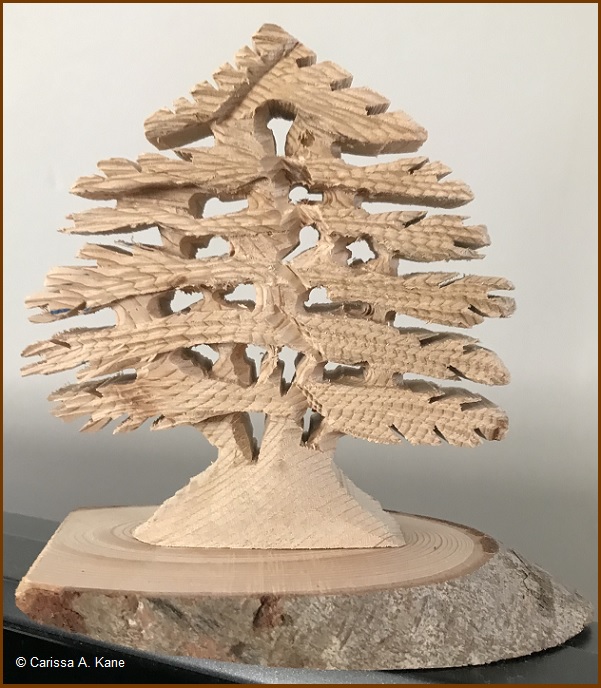
“The heart’s affections are divided like the branches of the cedar tree; if the tree loses one strong branch, it will suffer but it does not die. It will pour all its vitality into the next branch so that it will grow and fill the empty place.” – Khalil Gibran
The cedar trees of Lebanon are known for characteristics such as their strength, beauty, and fragrance. They are also named in various Bible passages. In Psalm 29, they are referred to amid verses that describe the voice of God. However, in these verses, they are not described in terms of their beauty, fragrance, or formidable strength, but rather in terms that focus on and describe the strength of God’s voice.
The voice of the Lord is over the waters; the God of glory thunders, the Lord, over the mighty waters. The voice of the Lord is power; the voice of the Lord is splendor. The voice of the Lord cracks the cedars; the Lord splinters the cedars of Lebanon… – Psalm 29:3-5
What’s striking here though, is that the nature of God’s voice, or God’s will, is much more than the power to crack and splinter the magnificent cedar tree. Not only does God break through and penetrate the tree, or whatever it may be, but as described in the verse that follows,
Makes Lebanon leap like a calf, and Sirion like a young bull. – Psalm 29:6
God opens and escorts the way to joy and newness (or fullness) of life, making it possible for something greater and more meaningful to come to the surface. And in this process, although there may be suffering, there is not death, for what is born of God is eternal.
In this new year, on the Feast of the Baptism of the Lord, as God’s beloved, striving to listen to the voice of God in turbulent times, let us pray for the wisdom and strength to follow the example of Jesus, with a desire to be led by the grace of God, and to learn how to rise from the splinters of all that is broken.
When the kindness and generous love of God our savior appeared, not because of any righteous deeds we had done but because of his mercy, He saved us through the bath of rebirth and renewal by the Holy Spirit, whom he richly poured out on us through Jesus Christ our savior, so that we might be justified by his grace and become heirs in hope of eternal life. – Titus 3:4-7
Looking up into the darkness, preparing for the show that is about to begin, and “knowing” what is to come. Fireworks on New Year’s Eve or Day is a longstanding tradition around the world. Their origin is as a part of practices meant to ward off evil spirits, driving them away with loud booms and flashes of light. In our times, fireworks can be startling, but most often they bring a sense of both awe and knowing.
Passing from one year to the next, it seems so natural to think in terms of progression. Where have I been? Where am I going? And while human nature tends to lean toward the notion of being in control, it also often leans toward a kind of mapping and planning that can take one away from the heart and light of creation, and life’s true meaning.
Life like fireworks, our expectations so great. Hearing booms followed by colors and rays of light. Looking for a magnificent display each time, each year, bigger and better than before, A man-made quest.
In the process, we stretch and strive. All caught up, are we really rising above, going beyond, settling down, or drifting into the air, as trails of smoke?
While soaring and shining, what do we leave behind in the dust, are we led, or are we leading, and what do we carry with us?
Be humble for you are made of earth. Be noble for you are made of stars. – Serbian proverb
When Jesus was born in Bethlehem of Judea, in the days of King Herod, behold, magi from the east arrived in Jerusalem, saying, “Where is the newborn king of the Jews? We saw his star at its rising and have come to do him homage.” When King Herod heard this, he was greatly troubled, and all Jerusalem with him. Assembling all the chief priests and the scribes of the people, He inquired of them where the Christ was to be born. They said to him, “In Bethlehem of Judea, for thus it has been written through the prophet: And you, Bethlehem, land of Judah, are by no means least among the rulers of Judah; since from you shall come a ruler, who is to shepherd my people Israel.” Then Herod called the magi secretly and ascertained from them the time of the star’s appearance. He sent them to Bethlehem and said, “Go and search diligently for the child. When you have found him, bring me word, that I too may go and do him homage.” After their audience with the king they set out. And behold, the star that they had seen at its rising preceded them, until it came and stopped over the place where the child was. They were overjoyed at seeing the star, and on entering the house they saw the child with Mary his mother. They prostrated themselves and did him homage. Then they opened their treasures and offered him gifts of gold, frankincense, and myrrh. And having been warned in a dream not to return to Herod, they departed for their country by another way. – Matthew 2:1-12








 HopeThatFloats
You must be logged in to post a comment.