The Prophet Isaiah foretold of John the Baptist, the voice crying out in the desert, urging people to make themselves ready to receive the Lord. And while it is true that earthly life can be viewed as a process of preparing for eternal life, it is so much more than a checklist based upon human understanding. So, while it may be tempting to repeat the sounding joy by clinging to what one knows during the season of Advent, no preparation would be complete without moving beyond our own ideas about it and allowing ourselves some time to steep in the love of God more deeply, and then to be led by it.
The way of the Lord has already been prepared. Not just for the Lord, but also for all those who wish to claim and proclaim their inheritance as God’s people. We must remember that we’re not called to be like John the Baptist. We’re called to be like Jesus. How does, and how can, God help our individual ways to greater reflect the beauty and goodness of the Way? And are we willing to go there?
In the fifteenth year of the reign of Tiberius Caesar, when Pontius Pilate was governor of Judea, and Herod was tetrarch of Galilee, and his brother Philip tetrarch of the region of Ituraea and Trachonitis, and Lysanias was tetrarch of Abilene, during the high priesthood of Annas and Caiaphas, the word of God came to John the son of Zechariah in the desert. John went throughout the whole region of the Jordan, proclaiming a baptism of repentance for the forgiveness of sins, as it is written in the book of the words of the prophet Isaiah: A voice of one crying out in the desert: “Prepare the way of the Lord, make straight his paths. Every valley shall be filled and every mountain and hill shall be made low. The winding roads shall be made straight, and the rough ways made smooth, and all flesh shall see the salvation of God.” – Luke 3:1-6
Many years ago, before GPS, I was on my way to a meeting, when I encountered road construction and a detour from the route I was supposed to take. Following the detour signs, I began an unexpected adventure through long and winding back roads, farmland, and forestry. However, along the way, I lost my way.
Suddenly there were no signs, and I was in utterly unfamiliar territory. Initially, it was as if my surroundings were closing in on me and I was shrinking in comparison. I started to feel anxious and stressed about being late or potentially missing the meeting. Then, slowing down, I stopped and began to take more notice. Surveying the landscape and elements in the sky more intently, I was able to find new signs and my bearings were restored, leading me more peacefully to the place I needed to be. I ended up being a little late, but it was okay; as always “better late than never.”
In current day times, it can seem as if society is in a construction zone that is in disarray. So many detours, roads without signs, confusion, violence, and chaos swirling all around. Yet, among it all, continuing to seek, searching within, and then looking back out, there are always signs pointing to the promise and hope of a better way.
The readings for the First Sunday of Advent (Jer 33:14-16; Ps 25:1b,4-5,8-9,10,14; 1 Thes 3:12-4:2, Lk 21:25-28,34-36) are a call to remember the promise, open oneself to God, to pay attention, and place hope in God as the way to restoration and redemption. Take time to reflect on what promise and hope in God means to you.
Who is this God?
How and where is God welcomed into the landscape of your life?
What do you desire as you look to journey with God this Advent? What might God desire for you?
Show us, Lord, your mercy; grant us your salvation. – Psalm 85:8
In chapter 18 (verses 33-37) of the Gospel according to John, Pilate asks Jesus who he is and what has done, and Jesus’ answer, as always, is all about truth. And that’s what faith is really all about—Truth and learning not only to recognize it, but also to listen to, and be led by it. In the verses that follow this passage, Pilate knows the Truth—Jesus has done no wrong, but he does not choose to listen and allow himself to be led by it.
On the Feast of Christ the King, this passage presents a great opportunity for prayer and reflection on who we are and what we do as followers of our Lord Jesus Christ. Both collectively and individually, as we approach the season of Advent and the Nativity of Christ our Lord, in what ways do the things we do and the presence of heart and mind with which we do them, reflect the goodness of God? And to what extent are they the result of truly listening and being led by Grace?
Amid one’s hopes and dreams and into the flow of reality, how do the choices of yesterday, infused with faith and the grace of God, inform and shape those of tomorrow?
So Pilate went back into the praetorium and summoned Jesus and said to him, “Are you the King of the Jews?” Jesus answered, “Do you say this on your own or have others told you about me?” Pilate answered, “I am not a Jew, am I? Your own nation and the chief priests handed you over to me. What have you done?” Jesus answered, “My kingdom does not belong to this world. If my kingdom did belong to this world, my attendants would be fighting to keep me from being handed over to the Jews. But as it is, my kingdom is not here.” So Pilate said to him, “Then you are a king?” Jesus answered, “You say I am a king. For this I was born and for this I came into the world, to testify to the truth. Everyone who belongs to the truth listens to my voice.” – John 18:33-37
Jesus tells his disciples, “Learn a lesson from the fig tree. When its branch becomes tender and sprouts leaves, you know that summer is near” (Mark 13:28). Yet, just two chapters earlier, Jesus cursed a fig tree causing it to wither:
“Seeing from a distance a fig tree, he went over to see if he could find anything on it. When he reached it he found nothing but leaves; it was not the time for figs. And he said to it in reply, ‘May no one ever eat of your fruit again!’ And his disciples heard it. … Early in the morning, as they were walking along, they saw the fig tree withered to its roots. Peter remembered and said to him, ‘Rabbi, look! The fig tree that you cursed has withered.’ Jesus said to them in reply, ‘Have faith in God.’” (Mark 11:13-14, 20-22).
Looking at these two passages and particularly at the fig tree, it may seem like Jesus is contradicting himself. However, looking at the whole picture, notice how Jesus shifts the focus from the tangible fig tree to looking beyond it and pointing to faith.
Maybe the real lesson that Jesus wants us to learn is that there are no hard and fast rules other than loving God, yourself, and your neighbor, and that this occurs best when we are not so entrenched in one way or another. That is, when we are able to be present to the moment, openminded, and willing to be guided by God, even when the direction in which we might feel compelled may not make sense in the world’s eyes and may not be fully understood by ourselves or others.
Perhaps the season is neither here nor there, but never-ending, the invitation ever-present, and more than anything, the task always at hand, is to focus on Jesus and ask for the grace to be “tender and sprout leaves.”
Jesus said to his disciples: “In those days after that tribulation the sun will be darkened, and the moon will not give its light, and the stars will be falling from the sky, and the powers in the heavens will be shaken.
“And then they will see ‘the Son of Man coming in the clouds’ with great power and glory, and then he will send out the angels and gather his elect from the four winds, from the end of the earth to the end of the sky.
“Learn a lesson from the fig tree. When its branch becomes tender and sprouts leaves, you know that summer is near. In the same way, when you see these things happening, know that he is near, at the gates. Amen, I say to you, this generation will not pass away until all these things have taken place. Heaven and earth will pass away, but my words will not pass away.
“But of that day or hour, no one knows, neither the angels in heaven, nor the Son, but only the Father.” – Mark 13:24-32
It can be easy to envision the poor widow putting her coins into the treasury, knowing the value to be considered far less than others had contributed. One might even draw a picture that perhaps includes elements representing shame, grief, loss, loneliness, and so on, overcome by giving all she had (“her whole livelihood”) and Jesus celebrating her for that. Then, from that picture, one might possibly be drawn toward a singular conclusion about verses 41-44 of chapter 12 in the Gospel according to Mark as a call to examine one’s level of charity.
It’s interesting though to reflect further on this passage. There are no words attributed to the widow, and no mention of a personal encounter between her and Jesus. The passage starts with an observation by Jesus that turns into a teaching directly to his disciples, not the poor widow, or anyone else who was putting money into the treasury. It is about more than coins and goes beyond levels of giving, extending to something greater.
Going back to the beginning of the Poor Widow’s Contribution, in verse 41, it is written, “Jesus sat down opposite the treasury and observed how the crowd put money into the treasury.” There are no interactions with those who are giving. Rather, Jesus takes in what is transpiring.
He sees the difference between the way the poor widow and the crowd, especially those with greater possessions (“Many rich people put in large sums.”), are carrying themselves. He then draws his disciples close, reveals what he sees, and tries to help them to see it as well. Jesus’s teaching, as always, is about showing the Way and helping those who follow him to become more aware, see more clearly, make better choices, and live more authentically.
Jesus wants the disciples, and us, to see that what the poor widow has given, she has given from “her whole livelihood”—her heart. This is the source of the widow’s might and is where our strength comes from as well. It is where the Lord resides.
I will place my law within them, and write it upon their hearts; I will be their God, and they shall be my people. – Jeremiah 31:33
By giving the two coins, the widow is giving her heart to the Lord, not allowing herself to be defined by her possessions, the opinions of others, or worldly cares, but instead sacrificing and letting them go, and listening to the law within her—placing trust for her well-being, first and foremost, in the Lord.
How can we look past the coins, and do the same?
In the course of his teaching Jesus said to the crowds, “Beware of the scribes, who like to go around in long robes and accept greetings in the marketplaces, seats of honor in synagogues, and places of honor at banquets. They devour the houses of widows and, as a pretext recite lengthy prayers. They will receive a very severe condemnation.”
Jesus sat down opposite the treasury and observed how the crowd put money into the treasury. Many rich people put in large sums. A poor widow also came and put in two small coins worth a few cents. Calling his disciples to himself, he said to them, “Amen, I say to you, this poor widow put in more than all the other contributors to the treasury. For they have all contributed from their surplus wealth, but she, from her poverty, has contributed all she had, her whole livelihood.” – Mark 12:38-44
Henri Nouwen wrote, “Self-knowledge and self-love are the fruit of knowing and loving God. You can see better then what is intended by the great commandment to “love the Lord your God with all your heart, with all your soul, and with all your mind, and to love your neighbor as yourself.” Laying our hearts totally open to God leads to a love of ourselves that enables us to give wholehearted love to our fellow human beings. In the seclusion of our hearts we learn to know the hidden presence of God; and with that spiritual knowledge we can lead a loving life.”
In other words, authentic love starts within, builds and grows through self-discovery and conscious connection to God. It is by this process that hearts are moved toward love in the way they exist and what they exude to the outside world.
In chapter 12 of the Gospel according to Mark, we see an example of interactions similar to those that are so prevalent these days. It is very clear that there are two sides with two very different objectives. What’s going on in the hearts and minds of each side? What’s the priority?
The chapter starts with Jesus telling the Parable of the Tenants—tenant farmers who refuse to pay the owner of the vineyard and beat and/or kill the people sent to collect the owner’s due. They even kill the vineyard owner’s son—they do not recognize him. Knowing that Jesus is calling them out in the telling of this parable, the Pharisees, scribes, and elders want to arrest him.
What makes them so quick to become so defensive? Did they stop to look inside and invite God into the process before labeling Jesus as the enemy and beginning to determine a course of action? What makes them so offended by Jesus’ words and actions?
As the chapter continues, Pharisees and Herodians, and then Sadducees are sent to question Jesus about taxes (should they pay Caesar or not? – verses 13-17) and about resurrection (how is the law of marriage applied for the widower of seven brothers and with no descendants? – verses 18-27). And Jesus’ nature continues to shine through as he continues to speak truth, conveying and citing the Word of God in his replies. He does not get rattled or fall for the attempts to manipulate him.
“Repay to Caesar what belongs to Caesar and to God what belongs to God” (verse 17).
“When they rise from the dead, they neither marry nor are given in marriage, but they are like the angels in heaven. As for the dead being raised, have you not read in the Book of Moses, in the passage about the bush, how God told him, ‘I am the God of Abraham, [the] God of Isaac, and [the] God of Jacob’? He is not God of the dead but of the living. You are greatly misled” (verses 25-27).
Despite knowing, not speculating, but actually knowing what they are trying to do, Jesus does not become defensive or aggressive, or try to avoid them and their questions—he has nothing to hide. He simply answers the questions truthfully, shedding light and putting focus on the real issue—the motives behind behavior. This leads to the question always worth asking, “In all honesty, who or what is being served, and how?” In this case, and in any day and age, lack of integrity and inability to recognize, and live in, truth is not of service to God, or anyone for that matter.
This brings us to the verses of chapter 12 referred to as “The Greatest Commandment”:
One of the scribes came to Jesus and asked him, “Which is the first of all the commandments?” Jesus replied, “The first is this: Hear, O Israel! The Lord our God is Lord alone! You shall love the Lord your God with all your heart, with all your soul, with all your mind, and with all your strength. The second is this: You shall love your neighbor as yourself. There is no other commandment greater than these.” The scribe said to him, “Well said, teacher. You are right in saying, ‘He is One and there is no other than he.’ And ‘to love him with all your heart, with all your understanding, with all your strength, and to love your neighbor as yourself’ is worth more than all burnt offerings and sacrifices.” And when Jesus saw that he answered with understanding, he said to him, “You are not far from the kingdom of God.” And no one dared to ask him any more questions. – Mark 12:28-34
Loving God with all of one’s being followed by loving one’s neighbor as oneself is to be the object of one’s striving day in and day out. As any human being can attest, this can be challenging and sometimes a downright struggle, and when left to our own devices it’s impossible. However, when we look at chapter 12 of the Gospel according to Mark, we can see in Jesus’ example of facing adversity with peace, honesty, and integrity, how a close relationship with God broadens the horizon, opening hearts and minds to the true meaning of Scripture, influencing speech and action, and revealing truth to all who are willing to embrace and engage in it over everything else (ambitions, possessions, self-interest, etc.).
With Jesus, the invitation is always open, and it doesn’t matter what you bring to the table, so much as a desire for what is true, what you are willing to let go of in order to learn, and the spirit with which you carry it out into the world.
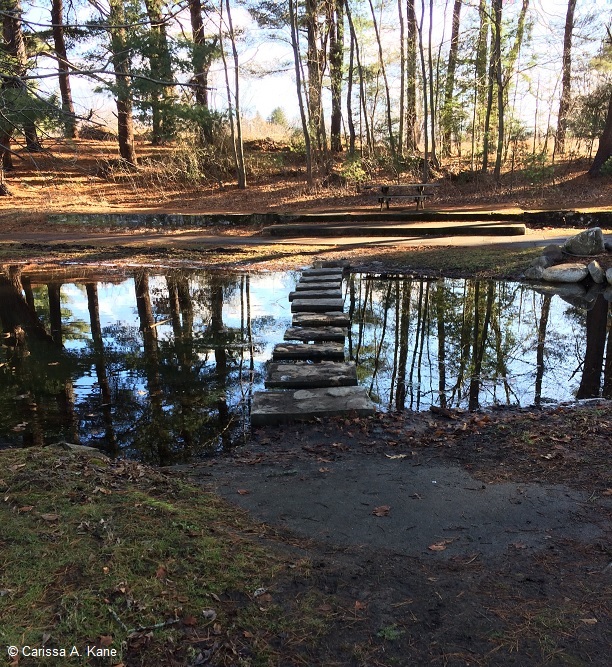
The path began at a clearing, steps molded into the landscape, a way ahead with little unknown. It was easy to proceed. However, once those steps reached their end, the terrain gradually became less friendly… less inviting. Continuing deeper in, the area overcome with overgrowth, the air overcome with temptation. Push ahead with determination or turn back in trepidation. Perhaps, another way, take stock, retreat into the moment, and explore. Look inside and ponder, “What are you looking for?”
In the Gospel according to Mark, chapter 10, verse 51, Jesus asks Bartimaeus, “What do you want me to do for you?” He doesn’t presume what Bartimaeus, the blind man, wants from him, even though it may seem obvious. He gives Bartimaeus the opportunity to engage with him and to give voice to his desire.
In the moments leading up to this encounter, Bartimaeus is in the midst of a crowd and cannot see who or what is around him, so he doesn’t know where Jesus is. Despite this, he has heard that Jesus is there, and he begins calling out to him, “Jesus, son of David, have pity on me” (verse 47). The people around him are trying to get him to stop calling out to Jesus, but Bartimaeus is not distracted by them. He stays focused on what he is looking for—his vision, and he knows that only Jesus can heal and restore it.
In today’s hazy world, overcome with overgrowth, temptation in the air, and distractions all around, Jesus is present, wanting to heal and restore vision, and not only to make the path clear for all, but also to be the path for all. Jesus is waiting, even in less friendly, less inviting spaces, wanting us to tell him about it, and wanting to hear the response to, “What do you want me to do for you?”
As Jesus was leaving Jericho with his disciples and a sizable crowd, Bartimaeus, a blind man, the son of Timaeus, sat by the roadside begging. On hearing that it was Jesus of Nazareth, he began to cry out and say, “Jesus, son of David, have pity on me.” And many rebuked him, telling him to be silent. But he kept calling out all the more, “Son of David, have pity on me.” Jesus stopped and said, “Call him.” So they called the blind man, saying to him, “Take courage; get up, Jesus is calling you.” He threw aside his cloak, sprang up, and came to Jesus. Jesus said to him in reply, “What do you want me to do for you?” The blind man replied to him, “Master, I want to see.” Jesus told him, “Go your way; your faith has saved you.” Immediately he received his sight and followed him on the way. – Mark 10:46-52
On a breezy autumn day, the sun shimmers across the water and the clouds steadily make their way from one side of the sky to the other. The trees, they stand their ground, their leaves have yet to fall. I guess it’s not their time.
Yet, ripples on the pond and clouds up in the sky, both quietly passing by. Always in time. Always in time.
The wind, it moves the clouds and water all around, and yes, even those leaves clinging to trees. Always in time. Always in time.
Some willing more than others. Taking direction, or making a stand. Always in time. Always in time.
Likewise, the Spirit in its stirring, its moving of hearts and souls, here and there along the way. Always in time. Always in time.
Always in Time… May your mercy, Lord, be upon us; as we put our hope in you. – Psalm 33:22
It’s said that the owl’s wisdom lies in its waiting, watching, and listening. In its patient, persistent process, its senses are fine-tuned, making it easier to recognize and distinguish between and among things. The owl’s very own nature leads and nurtures the animal, teaching it to tap more deeply into what it genuinely needs to survive and thrive.
This in-born nature that helps the owl to be at its best, also resides within all living things. And when tuned into, exercised, and held onto, it helps all living things to operate at their best, most authentic self. For human beings especially, the task at hand is to sort through and root out all that interferes with this natural, God-given ability.
In the Book of Wisdom, King Solomon shares:
“I prayed, and prudence was given me; I pleaded, and the spirit of wisdom came to me” – Wisdom 7:7.
While this is a great example of “ask and you shall receive,” it is also an example of the gift of humility. Oftentimes, it is humility that opens the door to wisdom. King Solomon humbled himself, he “prayed” and “pleaded” for wisdom, a gift that no amount of money in the world could buy. Throughout the Bible, and throughout history, there is no wisdom, without humility. For it is a gift that can only be received at the time and place where an open, willing, and humble heart meets the humility of God—unconditional love.
So how does one move toward this place? For starters, perhaps by praying for the grace to become more aware. Kahlil Gibran wrote, “Wisdom stands at the turn in the road and calls upon us publicly, but we consider it false and despise its adherents.”
Thinking about current day events, where do you see wisdom? In what places do you meet unconditional love… truth and peace together?
Looking back to history, Psalm 90 begins:
“A prayer of Moses, the man of God. Lord, you have been our refuge through all generations. Before the mountains were born, the earth and the world brought forth, from eternity to eternity you are God” (verses 1-2).
Wisdom draws Moses’ heart to give voice to God’s faithfulness, and seek God’s help, “Teach us to count our days aright, that we may gain wisdom of heart,” (verse 12), mercy, “Make us glad as many days as you humbled us, for as many years as we have seen trouble,” (verse 15), and grace, “May the favor of the Lord our God be ours. Prosper the work of our hands! Prosper the work of our hands!” (verse 17).
When you reflect on the work of your hands, what aspects of God (loving, patient, gentle, kind, honest, peaceful, faithful, life-giving, etc.) resonate in them? When you look at the world around you and the things in which you choose to participate, which ones bring you closer to the image of God, Love, in which you were created? In what ways do you feel inspired by the humility and generative nature of God, for whom all things are possible?
If You don’t build it, we labor in vain, Without Your Spirit, we stand with no strength. I know my life is passing away, but the works of Your hands are what will remain. Let the favor of the Lord rest upon us…
O Lord, establish the work of our hands! O Lord, establish the work of our hands!
Teach us to number the length of our days, Pour out Your power, we’ll pour out Your praise. Teach us to run, to finish the race, for only what’s done in love will remain. Let the favor of the Lord rest upon us…
O Lord, establish the work of our hands! O Lord, establish the work of our hands!
Al – le – lu – ia, al – le – luia, al – le – luia Al – le – lu – ia, al – le – luia, al – le – luia
In the First Letter of John, chapter 4, verse 12, it is written:
No one has ever seen God. Yet, if we love one another, God remains in us, and his love is brought to perfection in us. – 1 John 4:12
While it may be true that no one has ever seen God, Love and the goodness of God can be experienced daily, in any number of ways and through an unlimited number of people, places, and things. Think about a situation that recently brought peace, joy, laughter, gratitude, etc. into your heart. In what direction did you feel motivated as a result?
Think about who and what you love, in both the past and now. In what ways do you feel inspired as you reflect on this?
Tomorrow, October 4, is the feast day of St. Francis of Assisi. He was born Giovanni di Pietro di Bernardone and is perhaps most widely known for the Prayer of Saint Francis (and inspirational song) – “Make me a channel of your peace/Where there is hatred, let me bring your love…” as well as for being a lover of animals and the inspiration behind the practice of the blessing of animals.
Being born into a wealthy family, St. Francis’ life began in financial and material security. However, rather than a life focused on increasing or holding onto the guarantees that would come with money (status, power, and influence), he chose a journey far more challenging, but one that would lead toward the riches and rewards of a spiritual life—peace.
St. Francis wrote, “It was easy to love God in all that was beautiful. The lessons of deeper knowledge, though, instructed me to embrace God in all things.”
As you imagine embracing God (Love) in all things, what situations come to mind? Where are the places that are easy to carry and exude the love of God that resides within you? Where are the places that present a challenge, causing the light of God within you to diminish, and love to be held back or rebuked?
In the Gospel according to Mark, it is written:
And people were bringing children to him that he might touch them, but the disciples rebuked them. When Jesus saw this he became indignant and said to them, “Let the children come to me; do not prevent them, for the kingdom of God belongs to such as these. Amen, I say to you, whoever does not accept the kingdom of God like a child will not enter it.” Then he embraced them and blessed them, placing his hands on them. – Mark 10:13-16
Jesus’s example is one of embracing the moment, and all that it holds, with love despite the responses, reactions, or expectations of his disciples and others. With Jesus, everyone is invited… there is room in his heart for everyone.
Now imagine the situations that are easy for you to embrace with love and those that are not, as both belonging to the kingdom of God. What is that like?
Continuing to reflect on these situations, what is most important to you, and how or where does that fit in with your faith as you strive to live by it? Share your thoughts and feelings on this with Jesus. What invitation might Jesus be extending to you?
Above all the grace and the gifts that Christ gives to his beloved is that of overcoming self. – St. Francis of Assisi








 HopeThatFloats
You must be logged in to post a comment.