There was darkness all around. Not a sound, but that of waves gently breaking, making their way across the sand and rocks, back and forth, to and from. Not a sight, until the sun began its approach, gradually awakening the sky, before peeking up over the horizon.
Then what a sight. Silhouette or shadow? May be solo, but not alone. Freely flying, but in a line, parallel, heart of purpose and direction. Gliding, steady, peaceful, true in its presence… in its likeness… Silhouette.
“I saw no temple in the city, for its temple is the Lord God almighty and the Lamb. The city had no need of sun or moon to shine on it, for the glory of God gave it light, and its lamp was the Lamb.” – Rev 21:22-23
As daylight breaks, The Sun gently makes its way across the room. A brightness calling out, But without sound, That which is truly out of sight.
A beacon as it beckons, Come closer, Look to see. Rising up and drawing near, A clearer view awaits.
Darker shades turn to blue, Then lighter still, Altogether moving up, Orange, yellow, gold, So bold, so pure, so true.
It echoes all around, A promise made as well as kept, From One heart to another, Meet me here, meet me there, No matter what, you can meet me anywhere.
Give thanks to the Lord for he is good, his love is everlasting. – Psalm 118:1
If you had to describe Easter in one word, what word would you use? While there is a plethora of words that could be chosen, what words speak more profoundly to you today, and what one word would be most fitting to encapsulate the life, death, and resurrection of Jesus?
Reflecting on the Triduum, with all the words, images, and actions that take place from Holy Thursday thru the Easter Vigil, the word authenticity seems apropos. Jesus taught by example and told his disciples what was going to happen, and then it did happen. His words and actions were true from start to finish. However, Jesus was not alone in his authenticity (be who you are, do as you are).
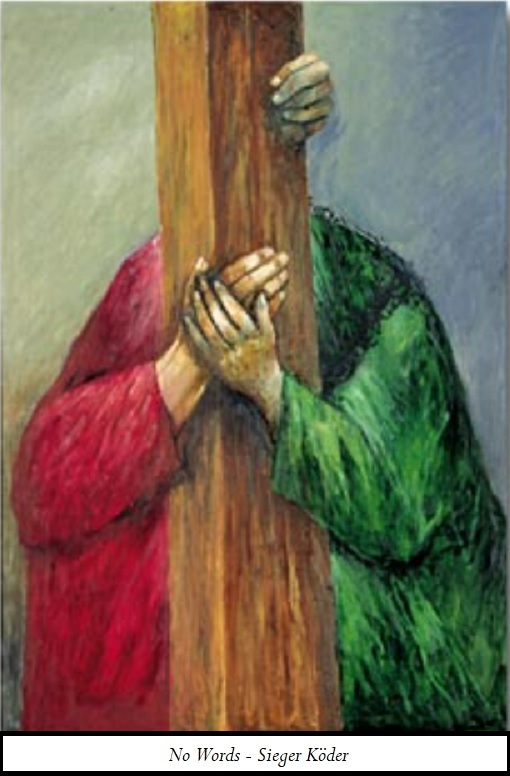
Looking more intently at the words and actions of some of the other individuals closest to Jesus, one might come to see that they were also being themselves during those moments. For example, Judas succumbed to betraying Jesus through his real-life weakness, identifying more strongly with money and power than anything else at that time. Then there’s Peter denying Jesus three times. This is not a reflection of his sincerity and desire to follow Jesus, but rather just part of where he was and what he was capable of at that time. Many of the other disciples, ran and hid after Jesus was arrested. Some did not. For example, the many women who followed Jesus, and John who witnessed the crucifixion by Mary’s side.
Think about these individuals as fellow human beings who were at the same time and place in history, while having different experiences, internal dispositions, and outward responses to the same events. In what ways do you see the beauty of God’s mercy and love shine through loud and clear? What’s it like to know that regardless of shortcomings or strengths, Jesus loved and accepted them all, seeing their value as beloved and part of creation?
Oftentimes, we can look to label words, decisions, or actions as right or wrong. However, in the process, we neglect to see what we are forfeiting. Jesus, by seeing us for who we are, accepting us where we are, and loving us as we are, not only touches our hearts and enlightens our minds, but also moves us toward resurrection, turning authenticity into Alleluia.
Going about each day, there are many words that we speak and things that we do. What are the things said or done with purpose, and what kind? What do our words and actions mean to us, what inspires them, and how do they reflect eternal life to the world around us?
Give thanks to the LORD, for he is good, his mercy endures forever. – Psalm 118:1
Reading the responsorial psalm for Palm Sunday and the response, “My God, my God, why have you abandoned me?” (Psalm 22:2) my mind is immediately filled with thoughts of the dear, innocent people of Ukraine whose lives have been taken, trampled upon, and upended, most recently over the course of the past several weeks, as well as for the dear, innocent people throughout the world who each day suffer such cruel and unjust treatment at the hands of others. It’s hard to comprehend how, with all the advances humankind has made in the past 2,000 years, the same hatred that slithered its way into the hearts and minds of those who sought to crucify Jesus, still exists, and that acts of such cruelty and utter disregard for humanity are still carried out.
It’s hard to understand, but perhaps that’s the point. It’s not understandable. What we are witnessing is the devastation that comes in situations where the heart of the matter—we are One—is lost; overruled by greed, hatred, lust for power, and indifference. Yet, at the same time, we are witnessing the heart of the matter—we are One—rising up, calling out… alive and well in the spirit of unity seen in those who stand up, reach out, sacrifice, and stand together.
The Passion of the Lord is about reclamation and answering that call.
Reflecting on the Passion of the Lord in the Gospel according to Luke (chapters 22-23), how do you bring your thoughts and feelings about all that is happening in the world today to God? Where do you meet Jesus? In what ways do you accompany Jesus in his Passion? And how do you draw inspiration and strength from the journey?
Waking up to the sounds of birds singing to each other, Calling back and forth, Noise bouncing here and there—echoes, Do they realize how far their voices reach? What is their intention? What’s that now? What do they say? Something familiar, something new, They whistle in possibilities, And the newness of the day. What is my intention? How does it travel? What do I say? Do I realize the blessing that comes with this new day?
The Lord has done great things for us; we are filled with joy. – Psalm 126:3
In chapter 13, verse 34 of the Gospel according to John, Jesus says, “I give you a new commandment: love one another. As I have loved you, so you also should love one another.” And, throughout the Gospels, there are many examples of Jesus’ love shown through his words, actions, reactions, and responses. Yet, to love as Jesus loved, can be very challenging, and maybe even feel impossible at times.
However, in the First Letter to the Corinthians (15:45-49), St. Paul really puts the focus on the keys to unlocking the ability to love as Jesus did. In comparing the first Adam to the last Adam (Jesus), St. Paul puts a reminder out there to not get caught up in the things of the world. The things that are material or mainly have to do with personal gain, in the end, will be immaterial. Furthermore, like with Adam and Eve, these things have a way of distorting our vision and pulling us away from the spirit of God.
So, too, it is written, the first man, Adam, became a living being, the last Adam a life-giving spirit. But the spiritual was not first; rather the natural and then the spiritual. The first man was from the earth, earthly; the second man, from heaven. As was the earthly one, so also are the earthly, and as is the heavenly one, so also are the heavenly. Just as we have borne the image of the earthly one, we shall also bear the image of the heavenly one. – 1 Corinthians 15:45-49
St. Paul is saying, remember the truth of who you are, and stay connected to it. There is no loving as Jesus did, without being able to embrace the grace of God in whose image we are created. There is no loving as Jesus did, without the spirit of God helping us to strip away the human inclination toward the world’s view of any situation or thing. It is only through the grace of God, that we can be authentic, operating in the image of God that we are, seeing beyond the haze to what really matters, and then proceeding to receive and respond to the world around us from the place that is eternal.
“To be yourself in a world that is constantly trying to make you something else is the greatest accomplishment.” – Ralph Waldo Emerson
As the minutes pass and the hours turn toward Valentine’s Day, flowers, cards, candies, and more are scooped up and distributed as gifts from one heart to another. So many thoughts and sentiments, varying degrees of affection and dedication expressed through things symbolizing love and care. What a great time to think about relationships, objects reflecting one’s dedication, and how, underneath it all, perhaps sometimes lost, is the Divine. After all, how else might one consider, or be reminded, that there’s more than me, myself, and I, and my concerns?
Broadening the scope, throughout the history of humankind, it would be fair to say that lasting relationships are built upon the ability to be present, a movement of the heart, and a sense of connection and trust. The capacity for each, placed in every being from inception and created to be held as well as extended—a full circle, inclusive kind of thing between and among the Creator and the created. Beautiful, and rightly so, when rightly exercised. However, when those elements disintegrate, for whatever reasons, relationships crack and crumble. And frequently it seems, sides are formed, heels are dug in, and maybe even enemies declared. What for? And, what’s the source of that?
Still though, despite any disturbances or folly along the way, there is always what is Divine. It is the place where faith resides, truth is revealed, and all is known. The place where H is for Hope in God, the One and Only, where love is what truly matters and is nurtured, and where everything else can be put aside, and laid to rest.
As the minutes pass and the hours turn toward Valentine’s Day, take time to remember and to be inspired by the hope and love of God, and the ways in which it is extended not only in and through you, but also to you. How can you nurture it, and be nurtured by it?
We are all meant to be mothers of God. What good is it to me if this eternal birth of the divine Son takes place unceasingly, but does not take place within myself? And, what good is it to me if Mary is full of grace if I am not also full of grace? What good is it to me for the Creator to give birth to his Son if I do not also give birth to him in my time and my culture? This, then, is the fullness of time: When the Son of Man is begotten in us. – Meister Eckhart
Mind over matter, What difference does it make? The set of one’s mind, May toggle or break, Or yet even worse, Get stuck in one place.
Heart in the matter, What difference does it make? The set of one’s heart, When inspired by God, Finds purpose, builds faith, Sings praises, gives faith.
One cried out to the other: “Holy, holy, holy is the Lord of hosts! All the earth is filled with God’s glory!” – Isaiah 6:3
“The heart’s affections are divided like the branches of the cedar tree; if the tree loses one strong branch, it will suffer but it does not die. It will pour all its vitality into the next branch so that it will grow and fill the empty place.” – Khalil Gibran
The cedar trees of Lebanon are known for characteristics such as their strength, beauty, and fragrance. They are also named in various Bible passages. In Psalm 29, they are referred to amid verses that describe the voice of God. However, in these verses, they are not described in terms of their beauty, fragrance, or formidable strength, but rather in terms that focus on and describe the strength of God’s voice.
The voice of the Lord is over the waters; the God of glory thunders, the Lord, over the mighty waters. The voice of the Lord is power; the voice of the Lord is splendor. The voice of the Lord cracks the cedars; the Lord splinters the cedars of Lebanon… – Psalm 29:3-5
What’s striking here though, is that the nature of God’s voice, or God’s will, is much more than the power to crack and splinter the magnificent cedar tree. Not only does God break through and penetrate the tree, or whatever it may be, but as described in the verse that follows,
Makes Lebanon leap like a calf, and Sirion like a young bull. – Psalm 29:6
God opens and escorts the way to joy and newness (or fullness) of life, making it possible for something greater and more meaningful to come to the surface. And in this process, although there may be suffering, there is not death, for what is born of God is eternal.
In this new year, on the Feast of the Baptism of the Lord, as God’s beloved, striving to listen to the voice of God in turbulent times, let us pray for the wisdom and strength to follow the example of Jesus, with a desire to be led by the grace of God, and to learn how to rise from the splinters of all that is broken.
When the kindness and generous love of God our savior appeared, not because of any righteous deeds we had done but because of his mercy, He saved us through the bath of rebirth and renewal by the Holy Spirit, whom he richly poured out on us through Jesus Christ our savior, so that we might be justified by his grace and become heirs in hope of eternal life. – Titus 3:4-7
“Blessed are you who believed that what was spoken to you by the Lord would be fulfilled.” – Luke 1:45
As the minutes of daylight continue to decline and the shortest day of the year in the Northern Hemisphere approaches, life in December 2021 does not seem anywhere close to normal. However, it is at these times that opportunity abounds, if only we can meet the challenge of seeking the wisdom of balance and the choices of Light that reside between the stark contrast of opposites. And, while at times, it can seem bigger than life, and the odds improbable, looking to Mary, the Queen of Peace, one can trust it’s not impossible to experience the quiet strength of peace in troubling times.
Mary chooses to embrace the spirit of God, surrender her will and be led by God (Luke 1:26-38). Joseph, her betrothed, makes a similar choice (Matthew 1:18-24). In the eyes of the world, these choices can seem unimaginable. Why would anyone say yes to a choice that is bound to bring such harsh scrutiny, create gossip and skepticism, possible death in those times, and disgrace? Perhaps that’s why it’s never wise to judge a book by its cover. Only God can ever really know the truth of all that’s happening, and only God can ever truly influence choices that are genuinely for the greater good, even when others cannot understand them.
Mary’s “yes” and Joseph’s “yes” are certainly pivotal moments. What led them to being able to discern such choices? How did they know what to do? Sitting with their “yes’s,” the inspiration that can be drawn from them is tremendous, but it is also just the beginning.
In reflecting on what happened in those moments and in all the ones that followed, what is it like to imagine that even though the road did not get any easier, Mary and Joseph made it through not because of their own determination, but because God was with them, and they were led by the light of God?
You must be logged in to post a comment.