From the warmth of Christmas, Hearts brighten and faces glow; Generosity abounds.
The origin of one and all Drawing out our spirits; His Spirit placed within.
Let the peace of Christ control your hearts; Let the word of Christ dwell in you richly. – Colossians 3:15a, 16a
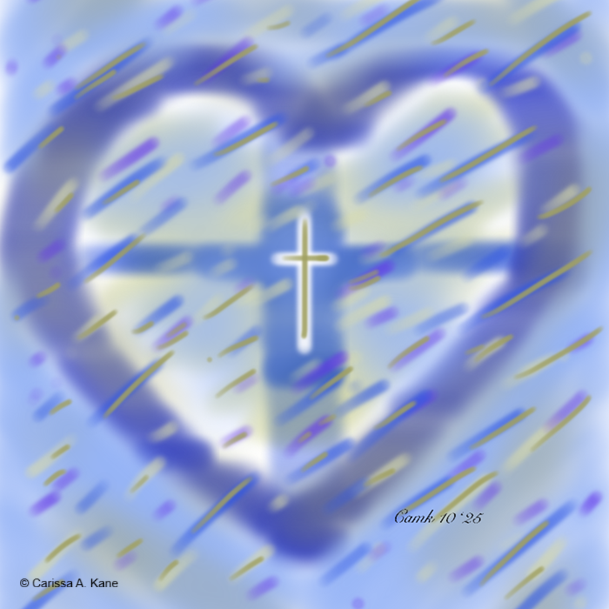
Reflecting on this Christmas and the days surrounding it, envision your heart resting within the heart of the Lord. What feelings and experiences come to mind? How was your heart moved?
The following is the Gospel passage for the Feast of the Holy Family of Jesus, Mary and Joseph:
When the magi had departed, behold, the angel of the Lord appeared to Joseph in a dream and said, “Rise, take the child and his mother, flee to Egypt, and stay there until I tell you. Herod is going to search for the child to destroy him.” Joseph rose and took the child and his mother by night and departed for Egypt. He stayed there until the death of Herod, that what the Lord had said through the prophet might be fulfilled, Out of Egypt I called my son.
When Herod had died, behold, the angel of the Lord appeared in a dream to Joseph in Egypt and said, “Rise, take the child and his mother and go to the land of Israel, for those who sought the child’s life are dead.” He rose, took the child and his mother, and went to the land of Israel. But when he heard that Archelaus was ruling over Judea in place of his father Herod, he was afraid to go back there. And because he had been warned in a dream, he departed for the region of Galilee. He went and dwelt in a town called Nazareth, so that what had been spoken through the prophets might be fulfilled, He shall be called a Nazorean. – Matthew 2:13-15, 19-23
What speaks to your heart most from the above passage? What quality or characteristic would you assign to it?
Again, thinking of Christmas, the birth of our Lord, and the days surrounding it, what do you desire to carry forward? What does the Lord desire for you?
Although the colder air that accompanies this time of year in the Northeast can be quite refreshing, after some time, it can leave one wanting for the warmth of shelter, a soft blanket, or hot beverage to offset the chill.
In the Gospel passage for the Fourth Sunday of Advent (Matthew 1:18-24), we learn about the warmth of St. Joseph’s response to his betrothed, with whom he had not yet lived or had relations with, being pregnant. Imagine the response, gossip, or chill in the air, created by those around Mary and Joseph. Yet, even before his dream in which the Lord appeared, reassuring him of Mary’s faithfulness, Joseph had decided to respond in a way that was filled with warmth, gentleness, and mercy:
This is how the birth of Jesus Christ came about. When his mother Mary was betrothed to Joseph, but before they lived together, she was found with child through the Holy Spirit. Joseph her husband, since he was a righteous man, yet unwilling to expose her to shame, decided to divorce her quietly. – v. 18-19
Envision yourself in Joseph’s shoes. He is described here as being righteous. What do you make of his initial decision to quietly divorce?
Reflecting on situations that are on your mind and in your heart, how do you seek righteousness? What does it look like? And what qualities does it manifest?
As the Gospel passage continues, Joseph has a dream in which the Lord visits him.
“Joseph, son of David, do not be afraid to take Mary your wife into your home. For it is through the Holy Spirit that this child has been conceived in her. She will bear a son and you are to name him Jesus, because he will save his people from their sins.” – v. 20-21
Recall a time when you had made a decision and then something occurred that reaffirmed your decision or created a new sense of the situation. What happened? What were you praying for, and how did things turn out? How were you saved or blessed? What was the warmth of God like?
Invite the Lord to revisit this with you. What grace from this experience awaits you today?
Spend some time contemplating the verses below and noticing what word, phrase, or image speaks to your heart most:
All this took place to fulfill what the Lord had said through the prophet: Behold, the virgin shall conceive and bear a son, and they shall name him Emmanuel, which means “God is with us.” – v. 22-23
Continuing to pray with what caught your attention, ask the Lord to grant you insight so that you may see, or have a greater sense of, “God is with us.”
Before ending this prayer time, return to the image of St. Joseph.
When Joseph awoke, he did as the angel of the Lord had commanded him and took his wife into his home. – v. 24
As you strive to be faithful to God, what inspires you? What do you need from the Lord to draw comfort and strength from Him, as you journey through your days, while also reflecting the warmth of His presence.
Let the Lord enter; he is king of glory. – Psalm 24:7c,10b
With the news of yet another mass shooting in the United States along with violence and conflict around the world, on top of any personal challenges, from which no one is spared, a sense of doom or a feeling of imprisonment can hang in the air and weigh on one’s heart and mind. Yet, as we enter the Third Week of Advent, Gaudete (Rejoice) Sunday, our faith encourages us to remain a people of hope, holding firm to the Lord, and continuing to strive to be living testaments to the Way, knowing that there is something greater, and that God is with us.
In today’s Gospel (Matthew 11:2-11), it is written:
“Are you the one who is to come, or should we look for another?” – v. 3
This is the question that an imprisoned John the Baptist, having heard about “the works of the Christ,” (v.2) had his disciples ask Jesus.
With the events occurring around you, and in the world today, what are you looking for?
Taking a step back, in the First Reading (Isaiah 35:1-6a, 10), it is written:
Strengthen the hands that are feeble, make firm the knees that are weak, say to those whose hearts are frightened: Be strong, fear not! Here is your God, he comes with vindication; with divine recompense he comes to save you. – Isaiah 35:3-4
Spend some time recalling some of the ways that you have been strengthened by the Lord. What happens as you allow yourself to remember?
Read aloud today’s Psalm (146:6-10):
The Lord God keeps faith forever, secures justice for the oppressed, gives food to the hungry. The Lord sets captives free. The Lord gives sight to the blind; the Lord raises up those who were bowed down. The Lord loves the just; the Lord protects strangers. The fatherless and the widow he sustains, but the way of the wicked he thwarts. The Lord shall reign forever; your God, O Zion, through all generations.
Reflecting on the qualities of God expressed in the Psalm, bring forth your own petitions, praying for the cares and concerns that are pulling at your heart at this time. Following each one, say the response, “Lord, come and save us.”
In the Letter of Saint James, from today’s Second Reading, it is written:
Be patient, brothers and sisters, until the coming of the Lord. See how the farmer waits for the precious fruit of the earth, being patient with it until it receives the early and the late rains. You too must be patient. Make your hearts firm, because the coming of the Lord is at hand. Do not complain, brothers and sisters, about one another, that you may not be judged. Behold, the Judge is standing before the gates. Take as an example of hardship and patience, brothers and sisters, the prophets who spoke in the name of the Lord. – James 5:7-10
Share with Jesus, the ways or situations in which you are feeling challenged when it comes to patience, complaining/criticizing, and/or a heart firm in the Lord. Allow Jesus to impart his wisdom regarding this.
When you are ready for this prayer period to come to a close, offer an expression of gratitude, and ask the Lord to help you to draw inspiration from the experiences recalled and the insights gained during your prayer.
Lord, help me to discern what’s important as I face the moments before me today, and in the days to come. Help my choices to reflect your goodness, and my prayers to reflect your heart.
The readings for the First Sunday of Advent begin with the prophet Isaiah’s vision:
This is what Isaiah, son of Amoz, saw concerning Judah and Jerusalem. In days to come, the mountain of the Lord’s house shall be established as the highest mountain and raised above the hills. All nations shall stream toward it; many peoples shall come and say: “Come, let us climb the Lord’s mountain, to the house of the God of Jacob, that he may instruct us in his ways, and we may walk in his paths.” For from Zion shall go forth instruction, and the word of the Lord from Jerusalem. He shall judge between the nations, and impose terms on many peoples. They shall beat their swords into plowshares and their spears into pruning hooks; one nation shall not raise the sword against another, nor shall they train for war again. O house of Jacob, come, let us walk in the light of the Lord!” – Isaiah 2:1-5
What does your vision of walking in the light of the Lord look like?
Picture yourself ascending the mountain to receive instruction from the Lord. Be attuned to the stirrings of your heart as you do so. Thinking about your ways (words, actions, and general way of being), ask the Lord to join.
Letting the Lord be the judge, what adjustments might help you to greater reflect the image of God?
The Responsorial Psalm is from Psalm 122 (verses 1-9):
R. Let us go rejoicing to the house of the Lord.
I rejoiced because they said to me, “We will go up to the house of the Lord.” And now we have set foot within your gates, O Jerusalem.
R. Let us go rejoicing to the house of the Lord.
Jerusalem, built as a city with compact unity. To it the tribes go up, the tribes of the Lord.
R. Let us go rejoicing to the house of the Lord.
According to the decree for Israel, to give thanks to the name of the Lord. In it are set up judgment seats, seats for the house of David.
R. Let us go rejoicing to the house of the Lord.
Pray for the peace of Jerusalem! May those who love you prosper! May peace be within your walls, prosperity in your buildings.
R. Let us go rejoicing to the house of the Lord.
Because of my brothers and friends I will say, “Peace be within you!” Because of the house of the Lord, our God, I will pray for your good.
R. Let us go rejoicing to the house of the Lord.
What phrase(s) draws your attention most? In what way does it strike a chord with you? Spend some time praying with this verse(s). How are you inspired? Share the thoughts and feelings that arise with the Lord. Ask the Lord to deepen your understanding and the grace to embody the wisdom of this psalm.
In the Second Reading (Romans 13:11-14), St. Paul writes that time is of the essence as he urges the Christians in Rome to embrace that which is eternal, the Light of Christ, over “works of darkness” (verse 12). Knowing that works of darkness can enter through the disguise of light and that the Light of Christ is not stagnant, in what ways do you invite the Lord to be with you as you make decisions, and how do you keep the Lord in your heart and on your mind, as you proceed through the tasks of each day? Ask the Lord to help you in areas you find challenging and to awaken you to areas of potential growth.
The Gospel for the First Sunday of Advent is from Matthew, chapter 24, verses 37-44:
Jesus said to his disciples: “As it was in the days of Noah, so it will be at the coming of the Son of Man. In those days before the flood, they were eating and drinking, marrying and giving in marriage, up to the day that Noah entered the ark. They did not know until the flood came and carried them all away. So will it be also at the coming of the Son of Man. Two men will be out in the field; one will be taken, and one will be left. Two women will be grinding at the mill; one will be taken, and one will be left. Therefore, stay awake! For you do not know on which day your Lord will come. Be sure of this: if the master of the house had known the hour of night when the thief was coming, he would have stayed awake and not let his house be broken into. So too, you also must be prepared, for at an hour you do not expect, the Son of Man will come.”
“Stay awake!”, “be prepared,” the time is unknown to you. It could happen in the next breath, far into the future, or somewhere in between. What is your initial reaction to this Gospel passage? And, in what ways does it move you?
Part of awareness and preparation involves thinking about when something will be coming or how long it might last. However, no matter how much one might plan, things can change. And while there are things that one can do regularly to be ready, faithfulness to God is about holding fast to the Lord with an openness or flexibility that allows one to cooperate with His grace. In this way, impediments to staying awake and being prepared are cast out, rather than interfering with discernment and a greater sense of God’s will.
What gets in the way of your openness to change, or things being different than what you thought, hoped for, or planned? Think of a situation where you were open to change. What was that like? And what role did prayer play in it?
Now think of a situation where you were resistant or hesitant to change because what you saw was different than your way of thinking, your approach, or what you pictured. What were you clinging to that removed the choice of being flexible? Ask the Lord to step through this situation with you and for the willingness to accept His point of view, whether it includes reaffirmation, further instruction, or gentle correction.
Continue to reflect on and pray with the insights revealed to you throughout the week. Ask for the grace to be inspired and guided by the will of God, and the desire to draw closer to God this Advent.
Show us, Lord, your mercy; grant us your salvation. – Psalm 85:8
The Gospel for The Solemnity of Our Lord Jesus Christ, King of the Universe (Luke 23:35-43) gives witness to how honesty, and owning up to the truth, leads to the path of healing and salvation. And, as the days in the week ahead lead to the First Sunday of Advent, it can also be seen as an invitation for personal reflection and contemplation on areas of growth as well as places or spots that could benefit from greater attention through prayer and other practices throughout the journey toward Christmas. While the Gospel for this week has us at the crucifixion, as always, the focus is ultimately on salvation—Resurrection.
Turning to the Gospel for this Sunday, of the men on either side of Jesus at the crucifixion, one cast shade at him, while the other set the record straight, and then said, “Jesus, remember me when you come into your kingdom.” The first man seems unable to look beyond himself, and only lashes out at Jesus, and doubts him. It is written:
“Now one of the criminals hanging there reviled Jesus, saying, “Are you not the Christ? Save yourself and us.”
The man on the opposite side of Jesus, responds differently. He seems better able to look at the situation he is in with greater clarity. He recognizes and accepts (or owns up to) the truth. Not only that, but he also speaks it. Furthermore, he expresses to Jesus, his desire to be remembered by Him. The second man’s response is, in effect, an act of repentance. It is written:
The other, however, rebuking him, said in reply, “Have you no fear of God, for you are subject to the same condemnation? And indeed, we have been condemned justly, for the sentence we received corresponds to our crimes, but this man has done nothing criminal.” Then he said, “Jesus, remember me when you come into your kingdom.”
Take some time to re-read and consider this Gospel passage more deeply.
What do you imagine is at the heart of each man’s response? How does your heart respond to them? Given your experience of Jesus, how do imagine his heart responds to each man?
During our lifetimes, there are various challenges of varying degrees that we all face. We all have ups and downs, and days that are better than others in terms of how we respond and react. However, our faith tells us we are not alone and encourages us to do our best, and to remember Jesus, and His example.
Think about honesty, healing, and salvation and what your experience has been. Bring whatever comes to mind and heart into conversation with Jesus, trusting that it will be received with sincerity, love, compassion, and mercy.
Acknowledge areas of improvement and growth and how that came about. How are your practices (words, actions, prayer, etc.) an example of honesty, healing, and salvation?
Invite Jesus to share insight on areas where you know you can do better and to reveal ones in which perhaps, you may not be aware.
When your prayer time is coming to its completion, envision yourself asking Jesus for whatever you feel you need at this moment, and then saying to Jesus, “Jesus, remember me when you come into your kingdom.” Close your eyes, take comfort, and trust that Jesus, who said to the criminal asking to be remembered, “Amen, I say to you, today you will be with me in Paradise.”, remembers you always.
He is before all things, and in him all things hold together. – Corinthians 1:17
September 21 is the feast day of St. Matthew, the tax collector turned disciple. It is Matthew’s home at which Jesus and his disciples are having dinner, among, “many tax collectors and sinners” (Mt 9:10), when the following exchange occurs:
The Pharisees saw this and said to his disciples, “Why does your teacher eat with tax collectors and sinners?” He heard this and said, “Those who are well do not need a physician, but the sick do. Go and learn the meaning of the words, ‘I desire mercy, not sacrifice.’ I did not come to call the righteous but sinners.” – Matthew 9:11-13
If you were Matthew or a dinner guest at his house and witnessed this exchange between Jesus and the Pharisees, how would you feel, and what would you make of Jesus’s words? How about if you were a Pharisee? A disciple? Envision yourself in the shoes of the different people present or groups represented.
While there can be a wide range of perspectives and experiences in earthly regards, looking beyond that, what do you see or sense as a common bond or thread between them all?
Next, take some time to remember and pray with some of your experiences of compassion, forgiveness, and kindness. What’s it like to reflect on instances in which you received mercy, as well as the ones where you exhibited mercy toward another, as originating from the heart of God, for whom nothing is impossible? Not only that, but also to consider that these instances involved your cooperation with God, through whom anything is possible?
Share with the Lord what’s on your mind and in your heart as you contemplate his words.
In the Gospel for the Twenty-fifth Sunday in Ordinary Time, St. Luke writes:
Jesus said to his disciples: “The person who is trustworthy in very small matters is also trustworthy in great ones; and the person who is dishonest in very small matters is also dishonest in great ones. If, therefore, you are not trustworthy with dishonest wealth, who will trust you with true wealth? If you are not trustworthy with what belongs to another, who will give you what is yours? No servant can serve two masters. He will either hate one and love the other, or be devoted to one and despise the other. You cannot serve both God and mammon.” – Luke 16:10-13
Continuing to pray with your experiences of mercy, reflect on God’s grace and the extent to which honesty, trust, and trustworthiness, have helped or aided you toward receiving and extending compassion, kindness, and the benefit of the doubt to yourself and others. Ask the Lord to help you to see clearly your areas of growth, and to gently acknowledge, and commit to cooperation with Grace in, areas in need of conversion.
What wisdom is waiting on you today?
Closing prayer: Hallelujah! Praise, you servants of the Lord, praise the name of the Lord. Blessed be the name of the Lord both now and forever. From the rising of the sun to its setting let the name of the Lord be praised. High above all nations is the Lord; above the heavens his glory. Who is like the Lord our God, enthroned on high, looking down on heaven and earth? He raises the needy from the dust, lifts the poor from the ash heap, Seats them with princes, the princes of the people, Gives the childless wife a home, the joyful mother of children. Hallelujah! – Psalm 113:1-9











 HopeThatFloats
You must be logged in to post a comment.