The Thing To Do…

The Gospel passage for the Third Sunday of Advent (Luke 3:10-18) begins with the question, “What then should we do?” What to do is a question that is asked of John the Baptist three times in this passage. And through his replies, John essentially instructs those who have what we might call an upper hand or an edge over others—a crowd, the tax collectors, and the soldiers who are seemingly among the first to make their way to the desert to be baptized—to share with those who are without, to refrain from over taxing others, and to stop abusing their position by using it to take advantage of others.

How do John’s instructions strike you?

It’s interesting that just prior to this passage, John had said to the first group of people mentioned (the crowd),

“You brood of vipers! Who warned you to flee from the coming wrath? Produce good fruits as evidence of your repentance; and do not begin to say to yourselves, ‘We have Abraham as our father,’ for I tell you, God can raise up children to Abraham from these stones. Even now the ax lies at the root of the trees. Therefore every tree that does not produce good fruit will be cut down and thrown into the fire.” – Luke 3:8-9.

What do you think caused the crowd to respond with, “What then should we do?”

Envisioning yourself in this crowd, and labeled by John the Baptist as “a brood of vipers,” are you surprised or shocked? What would you do at these words? What response or question would you have?

When presented with a situation that is unexpected, how do you decide what to do? What does your prayer process look like in terms of manner, taking time and a step back, desire and/or openness to new or different ways forward? How about when it comes to situations that are expected? How does your prayer process stay the same or fluctuate?

Spend some time in prayer, sharing with Jesus that which arises into your awareness, and seeking wisdom, guidance, and whatever else you feel you need at this moment. As your prayer comes to a close, express your desire as you go forward, and ask for the grace to receive, whole-heartedly, God’s love for you, and the desire Jesus has for you at this moment.

Then, on this Gaudete Sunday, rejoice in the Lord!

You do not need to know precisely what is happening, or exactly where it is all going. What you need is to recognize the possibilities and challenges offered by the present moment, and to embrace them with courage, faith and hope. – Thomas Merton

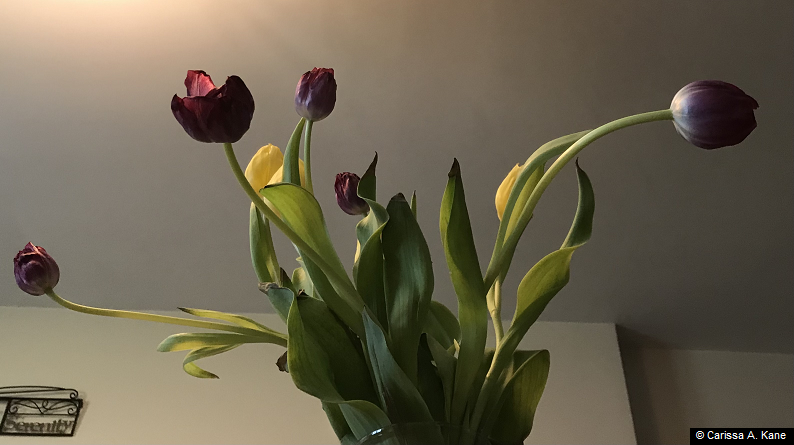
Reach…

They started out a neatly organized bouquet of tulips, bulbs closed and standing upright in a vase, but with time, each came into its own. Still tulips though, and called by name, no matter the style or type of display. Some still upright. Some bending, turning, twisting, as if being called toward something else altogether, but again, all still called by name—side by side—together.

More than humane… a compelling lesson for humanity. Nothing new… it is as it has always been. In opening up, reaching out, and stretching toward another… letting go of “other,” change is made. What is true and meaningful, is more than comprehension. When the peace within one’s heart, reaches out, it permeates from soul to soul, and only then, is it about becoming.

Just as he said to the disciples who met him on the road to Emmaus, Jesus says to us, “You are witnesses of these things.” (Luke 24:48). As followers of Jesus, what did they do with that?

Fast forward to today… As disciples of Jesus, what do we do with all to which we have become witnesses? How do we stand with both the crucified and risen Jesus?

When he saw the crowds, he went up the mountain, and after he had sat down, his disciples came to him.
He began to teach them, saying:

“Blessed are the poor in spirit,
for theirs is the kingdom of heaven.

Blessed are they who mourn,
for they will be comforted.

Blessed are the meek,
for they will inherit the land.

Blessed are they who hunger and thirst for righteousness,
for they will be satisfied.

Blessed are the merciful,
for they will be shown mercy.

Blessed are the clean of heart,
for they will see God.

Blessed are the peacemakers,
for they will be called children of God.

Blessed are they who are persecuted for the sake of righteousness,
for theirs is the kingdom of heaven.

Blessed are you when they insult you and persecute you and utter every kind of evil against you [falsely] because of me.

Rejoice and be glad, for your reward will be great in heaven.
Thus they persecuted the prophets who were before you.

– Matthew 5:1-12

To the Limit…

Under the best of circumstances there are moments that can stretch one to what feels like the end of the line or heading into an abyss. Over the past several months enduring all that has come with the COVID-19 pandemic, on top of the more typical challenges of life, has added entirely new layers to our existence. In many ways, one might say that we are often being pushed to our limits.

When the prophet, Elijah, stepped out from the safety of the cave, he did so trusting the voice of God that called upon him to do so. Prior to reaching Horeb and the cave within it, Elijah, his life in danger for being a vessel of Truth, had fled Samaria and was “on the run” for 40 days and nights. In the First Book of Kings, chapter 19, verse 4, when he says, “Enough, Lord! Take my life, for I am no better than my ancestors.” it certainly seems he has reached his breaking point or been pushed to the brink of what he can tolerate.

However, it is exactly at this point, that Elijah finds respite, laying down, or taking a break. What looks like the end, as is often the case, becomes a new or different beginning, a new leg of the journey. After some sleep, a messenger of the Lord wakes Elijah up and prompts him to eat and drink, and then keep moving on. Under the direction of God, eventually, he arrives at the place, another place, where he meets God once again.

This many thousands of years later, trying as well as unimaginable days still exist, and they are experienced by one and all, in various ways, across the world…across the universe. Yet, at the very same time, there is God, in the urgent fleeing of Elijah, the messenger along the way, in each and every step toward the mountain and into the cave. There is God, constant… continuing presence, through great winds, the quaking of the earth, and in the burning of the fire.

And, also, there is God in the whisperings of the day, beckoning to all who might listen… endless opportunities to recognize, and face, the limits of our patience or understanding. There are so many ways to discover the essence of who we are called to be, and to seek the courage to stand up, come forward to the entrance of the cave, and be true to the Vision.

ToTheLimit

At the mountain of God, Horeb,
Elijah came to a cave where he took shelter.
Then the LORD said to him,
“Go outside and stand on the mountain before the LORD;
the LORD will be passing by.”
A strong and heavy wind was rending the mountains
and crushing rocks before the LORD—
but the LORD was not in the wind.
After the wind there was an earthquake—
but the LORD was not in the earthquake.
After the earthquake there was fire—
but the LORD was not in the fire.
After the fire there was a tiny whispering sound.
When he heard this,
Elijah hid his face in his cloak
and went and stood at the entrance of the cave. – 1 Kings 19:9A, 11-13A

OMG…

Challenged to see beyond this dreadful thing, the ups and downs around it, and the many other “less than” that exist, as we attempt to rise to the occasion, buds continue to bloom and trees begin to fill in as leaves start to grow. Eggs hatch, and first steps, or first swims, carry on.  And as babies become toddlers, the continuum of childhood through adulthood is undisturbed… not deterred, as we all grow, in ways that may differ, or sometimes be the same.

In the face of COVID-19, the precious and the chosen remain, both in this life, and in eternal life. Amid days, leading to months of uncertainty at the hands of this pandemic, lie the new and the renewed at the hands of the Almighty, through the hearts of humanity… and all things living.

“As it was in the beginning, is now, and ever shall be, world without end. Amen.”  Glory be to God.

OLife

O Me! O Life! – by Walt Whitman

Oh me! Oh life! of the questions of these recurring,
Of the endless trains of the faithless, of cities fill’d with the foolish,
Of myself forever reproaching myself, (for who more foolish than I, and who more faithless?)
Of eyes that vainly crave the light, of the objects mean, of the struggle ever renew’d,
Of the poor results of all, of the plodding and sordid crowds I see around me,
Of the empty and useless years of the rest, with the rest me intertwined,
The question, O me! so sad, recurring—What good amid these, O me, O life?

Answer.
That you are here—that life exists and identity,
That the powerful play goes on, and you may contribute a verse.

More Than These…

In a recent discussion involving various “hot” topics, it was refreshing to listen as well as to share and receive the thoughts, facts, opinions, and understandings of all who were present. It was also enlightening and thought provoking, when the youngest one in the group, a teenager, spoke, so mild mannered, with such honesty and so lovingly. “Well, I look at it this way. Imagine…,” she continued on, explaining her thoughts and feelings on the situation, taking into serious consideration what it might be like to be in the midst of a situation, or a life, shrouded in controversy created or inflamed by the judgment of others.

In a world run by various governments and organizations with all kinds of man-made rules and regulations, there are often many hoops to jump through, complexity, dualism, complicity all around. Despite best efforts, through all the fog, it can be easy to become bound to these entities and their impositions, rather than remaining bound to God.

In Psalm 119, verses 32 through 34, it is written:

I will run the way of your commandments,
for you will broaden my heart.
Lord, teach me the way of your statutes;
I shall keep them with care.
Give me understanding to keep your law,
to observe it with all my heart.

The psalmist’s prayer is a reminder that, more important than the law, is The Way. It promises eternal life to all who are faithful to God, but what does that really mean? The Way cannot be contained or encapsulated solely in a list or in practices put into place. It is greater than rules created or handed down by human beings. More than these, it challenges each of us to be broader… having a bold heart for truth and justice for all, to take great care in how we live, and to strive to honor God’s ways and God’s voice wholeheartedly.

MoreThanThese

Your Words

Your Words
Let me hear Your words
Above all other voices
Above all the distractions in this world

Let me hear Your words
Above all of the voices
Above all the distractions in this world

For Your words bring life
And Your voice speaks promises
Lord, Your love offers more
Than anything else in this world

Your words give us life that’s never ending
Your words bring us love that never fails
Everything else will fade away
But what will remain
Are Your words

Let us speak Your words
More than ours, more than ever
Let us share Your love with all the world

The grass will wither and the flowers will fall
But the word of our God will last forever
The grass will wither and the flowers will fall
But the word of our God will last forever

Music by Third Day performing Your Words (Official Music Video). (C)2015 Provident Label Group LLC, a division of Sony Music Entertainment


Be the spirit that is willing to be true…

To one side of the landscape there was mostly a wall of green, and then what seemed like a path of orange with some red extending upward and to the right, as if to say, come along this way.

In the second letter to Timothy, Paul writes, “I remind you, stir into flame the gift of God…” (2 Timothy 1:6). Paul is in prison, and Timothy, to whom he has been a mentor, must proceed in the work he has been called to do, namely evangelizing. However, rather than just telling Timothy what he needs to do, Paul first calls on him to remember the truth.

“For God did not give us a spirit of cowardice but rather of power and love and self-control…” – v. 7

This is a call to action that encourages Timothy, and encourages us, to carry on with integrity, and in a manner that is befitting one created in the image of God. If Timothy were to look around to see what others were doing, or to focus on the fact that Paul has been imprisoned for his Spirit driven efforts (which go against the grain of the majority and popular opinion) perhaps he would stop and turn the other way. In fact, it would be likely that he would move away from taking an approach that is first and foremost, faithful to God, and instead be lead toward fulfilling earthly ambitions or needs, thus compromising, or at the expense of, the fulfillment of his heavenly call.

This would be sad… tragic and a monumental loss. However, with God there is always more than one chance to do the right thing. More than one chance to make truly life giving choices and to live the life that God dreams for us. The life that we see as having ups and downs through trials and tribulations, but that becomes even keeled when we face them, inspired and moved into action by the Spirit of God, bringing a sense of peace in each and every thing.

For the vision is a witness for the appointed time,
a testimony to the end; it will not disappoint.
If it delays, wait for it,
it will surely come, it will not be late. – Habakkuk 2:3

With a willing spirit, and through the grace of God, each leaf turns in time, regardless of its surroundings.

If today you hear his voice, harden not your hearts. – Psalm 95

StirIntoFlame

Beloved:
I remind you, to stir into flame
the gift of God that you have through the imposition of my hands.
For God did not give us a spirit of cowardice
but rather of power and love and self-control.
So do not be ashamed of your testimony to our Lord,
nor of me, a prisoner for his sake;
but bear your share of hardship for the gospel
with the strength that comes from God.

Take as your norm the sound words that you heard from me,
in the faith and love that are in Christ Jesus.
Guard this rich trust with the help of the Holy Spirit
that dwells within us. – 2 Timothy 1:6-8, 13-14

Something to Chew on…

These days so much in life can be rather easily accomplished “on the go,” or with a simple click, press, or swipe. Convenience and moving from one thing to the next without skipping a beat, at times almost mindlessly, or without taking a breath, is more commonplace than not. One can only wonder, how much is missed or falls through the cracks along this way? Or, perhaps an even better question, how is the time saved by all that serves to make life convenient being spent? Which path am I following? And society?

We have been blessed into creation with the capacity to decipher that which is of true benefit… that which is authentic. Not only that, but we have also been graced with a deep-seated desire to be connected to and guided by Wisdom… Love… Justice as we navigate our environment. Sometimes, with convenience, we somehow become busier—having less time to breathe properly when by all accounts it seems there should be more time. It can be easy to slip away from taking the time not only to discover and recognize what we are really consuming, but also to be filled by God with all that we need to speak up, making clear what is unacceptable, refusing to look or walk the other way… refusing to support or consume garbage.

Jesus tells us to know what we are eating. In order to take and eat of the goodness of God, we must take the time to chew before we swallow. It is in the chewing, that we come to see the Truth, and through the Truth that we find the courage and wherewithal to remain firm, resolved to being faithful to God, standing up in the face of all that would serve to strike down that which is good and honorable in and through each other.

Whoever eats my flesh and drinks my blood
remains in me and I in him, says the Lord. – John 6:56

Cloaked in Courage…

A long time ago, there was a woman with an illness for which there seemed to be no cure. She tried everything she could possibly try within the realm of conventional or traditional practices. However, the only changes were negative as both the condition of her health, and her wealth, continued to suffer.

After being through so much over the course of many years, the woman was moved to try something not only different, but also bold and new. It would take courage, especially given the times in which she lived and her status in society. It would also require a great leap of faith. However, as nervous or afraid as she might have felt, when she considered all things, deep down she knew that trying more of the same, would only lead to further suffering. She came to see that she needed to do something different, so she did, and it made all the difference.

Oftentimes, steadfastness can be confused with, or perhaps too tightly associated with, choices that are “conventional” or “traditional.” Yet, when looking through the eyes of faith and one’s experience along with tradition, and Scripture, God’s steadfastness is not stagnant, nor is it ever tied to the “rules” of the time, space, or place in which one might find themselves.

In many ways, and as seen through all of Scripture, including the life and ministry of Jesus, God is always present as well as constantly evolving. At the same time, God calls each of us to evolve, too.

The woman who suffered with hemorrhages for twelve years certainly had faith. We can also surmise that she had been praying all that time too in addition to seeking medical help. However, her healing only came when she listened deep within, took courage, did the unconventional, and touched the cloak of Jesus.

There was a woman afflicted with hemorrhages for twelve years.
She had suffered greatly at the hands of many doctors
and had spent all that she had.
Yet she was not helped but only grew worse.
She had heard about Jesus and came up behind him in the crowd
and touched his cloak.
She said, “If I but touch his clothes, I shall be cured.”
Immediately her flow of blood dried up.
She felt in her body that she was healed of her affliction.
Jesus, aware at once that power had gone out from him,
turned around in the crowd and asked, “Who has touched my clothes?”
But his disciples said to Jesus,
“You see how the crowd is pressing upon you,
and yet you ask, ‘Who touched me?'”
And he looked around to see who had done it.
The woman, realizing what had happened to her,
approached in fear and trembling.
She fell down before Jesus and told him the whole truth.
He said to her, “Daughter, your faith has saved you.
Go in peace and be cured of your affliction.” – Mark 5: 25-34,

Throwing Stones…

Stones

“Let the one among you who is without sin,
be the first to throw a stone at her.” – John 8:7

In the world in which we live, the above Bible verse has come to mean, to many people, it is not Christ-like to criticize wrongdoing. Is that interpretation accurate though? Is that really how Christ lived and taught? Is it true?

It is interesting how the truth is often twisted and how, throughout history, the truth, and speakers of the truth, have often been frowned upon. In the Gospel passage of the woman caught in adultery (John 8:1-11), Jesus, champion of truth, honesty and integrity, is put in a position where the authorities (the scribes and Pharisees) are looking for a reason to “take him down” so to speak. They see Jesus as a threat. If the truth becomes known…if their manipulation and ways of holding down and misleading the faithful become known, the faithful will no longer support them and their authority will fade away. This possibility makes them focus even more on trying to suppress or manipulate the truth. They are not open to anything other than efforts to hold onto their kingdom, no matter how that might affect the faithful.

While the scribes and Pharisees are trying to trap Jesus into going against Mosaic law, so that they can arrest him and eventually do away with him, Jesus turns the tables on them. Jesus knows that their motivation is self-serving; they are not concerned about the spiritual well-being of the woman they have brought before Jesus. They are using her, and Mosaic law, to try to get what they want. They are not pointing to the law for the purpose of which the law was made and certainly not for the well-being of the woman or the larger community.

So how does Jesus respond? He calls the scribes and Pharisees attention to the fact that they are not without sin; their hearts are not pure, and they slither away. The woman is left standing alone with Jesus.

While Jesus does not condemn the woman, he does hold her accountable and tells her not to sin any more.

Oftentimes, we can confuse holding someone accountable or to the truth as being judgmental. However, we need to be able to judge situations and, at times, we are called to speak the truth, even if that means it may be in conflict with another or requires holding another accountable.

In a scripture passage prior to the passage about the woman caught in adultery, Jesus says, “Whoever speaks on his own seeks his own glory, but whoever seeks the glory of the one who sent him is truthful, and there is no wrong in him. Did not Moses give you the law? Yet none of you keeps the law. Why are you trying to kill me?” The crowd answered, “You are possessed! Who is trying to kill you?” Jesus answered and said to them, “I performed one work and all of you are amazed because of it. Moses gave you circumcision—not that it came from Moses but rather from the patriarchs—and you circumcise a man on the Sabbath. If a man can receive circumcision on a Sabbath so that the law of Moses may not be broken, are you angry with me because I made a whole person well on a Sabbath? Stop judging by appearances, but judge justly.” (John 7:18-24)

If we come back to the woman caught in adultery, we see that Jesus doesn’t condemn her to death, but he does make a judgment. He tells her to sin no more. He tells her to stop.

When we look at our own lives, like with everything else, we need to follow Jesus’ example. We shouldn’t throw stones, but we should judge justly. When we see people doing wrong, we are called to speak the truth and to stand up for what is just. That is a big part of carrying one’s own cross…of being Christian.


Jesus went to the Mount of Olives.
But early in the morning he arrived again in the temple area,
and all the people started coming to him,
and he sat down and taught them.
Then the scribes and the Pharisees brought a woman
who had been caught in adultery
and made her stand in the middle.
They said to him,
“Teacher, this woman was caught
in the very act of committing adultery.
Now in the law, Moses commanded us to stone such women.
So what do you say?”
They said this to test him,
so that they could have some charge to bring against him.
Jesus bent down and began to write on the ground with his finger.
But when they continued asking him,
he straightened up and said to them,
“Let the one among you who is without sin
be the first to throw a stone at her.”
Again he bent down and wrote on the ground.
And in response, they went away one by one,
beginning with the elders.
So he was left alone with the woman before him.
Then Jesus straightened up and said to her,
“Woman, where are they?
Has no one condemned you?”
She replied, “No one, sir.”
Then Jesus said, “Neither do I condemn you.
Go, and from now on do not sin anymore.” – John 8:1-11

Polished Stones…

PLUM2G

I woke up this morning with a U2 song in my head. I was particularly struck by the line, “The sea throws rocks together but time, leaves us polished stones.” As I look at stones collected from a local beach over the past number of years, I love how all the stones, of different shapes, sizes and colors, share a smooth texture. Sometimes I wonder from where each stone may have originated. How far did each one travel along its journey from out in the deep ocean to the sands of the beach? The stones, no matter where they came from or how they started out, all came to be smooth by being tossed about in the sea.

It is interesting how in the same way that the friction caused by water against stone and stone against stone has smoothed the edges over time, adversity can smooth our edges. Adversity can lead to growth.

It seems human nature to prefer the moments of smooth sailing, keeping quiet and avoiding potential conflict. However, as I reflect, it seems like so much more growth comes from moments of standing in the ocean and moving with the waves as they ebb and flow, as they rise and fall with the tide, and crash around during storm surges. Carrying hope in my heart and a desire to be all that I can be (and all that I was created to be) deep within my soul, I am able to own who I am. With each wave, through God’s grace and with openness and acceptance, the jagged edges are smoothed away. I am made new.

“Then we will no longer be infants, tossed back and forth by the waves, and blown here and there by every wind of teaching…” – Ephesians 4:14

Ordinary Love by U2

The sea wants to kiss the golden shore.
The sunlight warms your skin.
All the beauty that’s been lost before, wants to find us again.
I can’t fight you anymore; it’s you I’m fighting for.
The sea throws rocks together but time, leaves us polished stones.

We can’t fall any further if, we can’t feel ordinary love.
And we cannot reach any higher, if we can’t deal with ordinary love.

Birds fly high in the summer sky and rest on the breeze.
The same wind will take care of you and I, we’ll build our house in the trees.
Your heart is on my sleeve, did you put it there with a magic marker.
For years I would believe, that the world, couldn’t wash it away.

Cause we can’t fall any further if, we can’t feel ordinary love.
And we cannot reach any higher, if we can’t deal with ordinary love.

Are we tough enough, for ordinary love?

We can’t fall any further if, we can’t feel ordinary love.
And we cannot reach any higher, if we can’t deal with ordinary love.

Are we tough enough, for ordinary love?