Learning from the Fig Tree…

In the Gospel passage for the Thirty-third Sunday in Ordinary Time (Mark 13:24-32), Jesus says, “Learn a lesson from the fig tree. When its branch becomes tender and sprouts leaves, you know that summer is near.” (v. 24). These words are part of his response to a question asked of him by the disciples, Peter, James, John, and Andrew.

Away from the others, and just after Jesus commented to his disciples on the destruction of the temple, they had asked him, “Tell us, when will this happen, and what sign will there be when all these things are about to come to an end?” (Mark 13:4). The first thing that Jesus says to them is, “See that no one deceives you.” (Mk 13:5). As he continues to tell them the signs and what will happen (trials and tribulations such as war, persecutions, etc.), he also continues to give them instructions as to how to handle themselves and the situations they will face. He says:

“… do not be alarmed” (v. 7)

“Watch out for yourselves.” or be aware (v. 9)

“… do not worry beforehand about what you are to say. But say whatever will be given to you at that hour. For it will not be you who are speaking but the holy Spirit.” (v. 11)

“Be watchful!” (v. 23)

Then he says these words that are part of the Gospel for today, “Learn a lesson from the fig tree. When its branch becomes tender and sprouts leaves, you know that summer is near.” (v. 28). And although Jesus says this as he continues to tell Peter, James, John, and Andrew about the signs that will occur at the end times, the gospel passage ends with Jesus saying, “But of that day or hour, no one knows, neither the angels in heaven, nor the Son, but only the Father.” (v. 32). In other words, perhaps Jesus is reminding us not to focus on the signs, but rather to focus on his instructions.

His last instruction, “Learn a lesson from the fig tree,” is intriguing. In chapter 11 of Mark’s Gospel, Jesus curses a fig tree for being fruitless:

“The next day as they were leaving Bethany he was hungry. Seeing from a distance a fig tree in leaf, he went over to see if he could find anything on it. When he reached it he found nothing but leaves; it was not the time for figs. And he said to it in reply, ‘May no one ever eat of your fruit again!’ And his disciples heard it.” (Mark 11:12-14).

In this earlier passage, there is a mention of time, “… it was not the time for figs.” And now, when Jesus is telling some of his disciples about the signs of the end times and instructing them on how to be prepared, he again, refers to figs and time (and not knowing the exact time of the end).

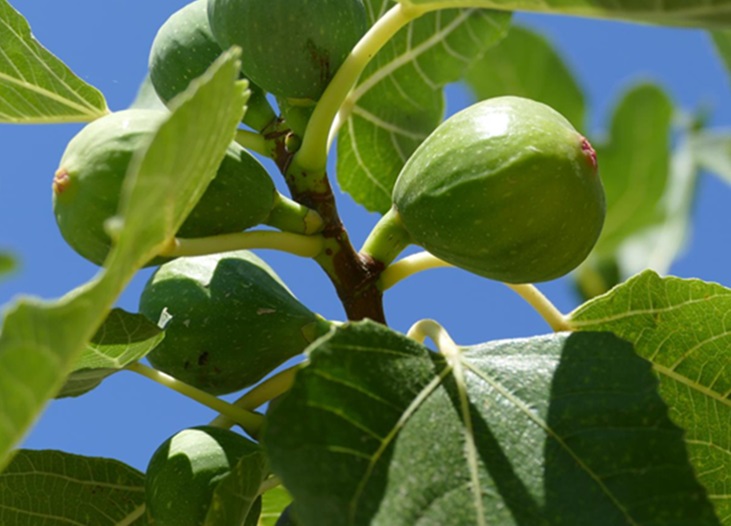
A few interesting things about figs and time… Fig trees, like other fruit trees, have leaves, but unlike other fruit trees, their fruit flowers internally. Also, each fig contains a collection of many flowers and seeds. And while one may think of a fig as a piece of fruit, they are actually an infructescence—a multiple fruit—that in a sense, is always in the process of blooming.

So, in both times of uncertainty and times of comfort, see that no one deceives you, do not worry, and learn from the fig tree, continuing to grow from within, knowing that the fruit will come at the time that is appointed.  

“Lord, my allotted portion and my cup, you have made my destiny secure.” – Psalm 16:5

A Time to Reflect…

The Gospel acclamation for the Twenty-Seventh Sunday in Ordinary Time is, “If we love one another, God remains in us and his love is brought to perfection in us.” (1 John 4:12). Take some time to consider this verse.

What are the things that you heard and saw this past week that caught your attention? What values, notions, and ideas did they express?

It can be tempting to rush toward opinions and judgments based on listening to and watching what others are doing, what they have to say about situations, and about what’s happening in society and throughout the world. Not only that, but also to not really take time to honestly consider, reflect on, and discern the values being represented.

It can also be easy to be drawn in by a thing or two that may seem of the utmost importance, only to be swept up and moved along without recognizing movement away from values, expressed notions, and ideas that truly align with and promote the sentiments of Love.

In the coming days try to notice the words and actions to which not only your ears and eyes are exposed or drawn, but also your heart. What is stirred inside of you? and how are these things a reflection of Love?

Continuing to take these things to prayer, seek to see them as God sees them.

No one has ever seen God. Yet, if we love one another, God remains in us, and his love is brought to perfection in us. – 1 John 4:12

Fulfillment…

On the Solemnity of the Most Holy Body and Blood of Christ also known as Corpus Christi, the Collect (opening prayer) is: “O God, who in this wonderful Sacrament have left us a memorial of your Passion, grant us, we pray, so to revere the sacred mysteries of your Body and Blood that we may always experience in ourselves the fruits of your redemption.”

Spend some time reflecting on this prayer and on the Sacrament of the Eucharist. What does it mean to you and how has it impacted you? Remember how you have experienced the fruits of the Lord’s redemption. What wonders has the Lord worked in your life? Take a few moments to express gratitude for these experiences and the awareness of them.

In the hymn One Bread, One Body, the lyrics direct us to mindfulness of our call, one and all, to unity as God’s people (the church):

One bread, one body, one Lord of all
One cup of blessing which we bless
And we, though many, throughout the Earth
We are one body in this one Lord
– John Foley, SJ (excerpt from One Bread, One Body)

Recall a time(s) when you have experienced unity and the fruits of the Lord’s redemption with others? In what ways have you witnessed the hand of the Lord? Give thanks for these times of common ground and the remembrance of them.

What hopes and desires do you have at this moment for awareness and unity in your life? your community? your country? and the world? Share these with the Lord. Ask the Lord for the grace to further appreciate and be inspired by experiences of the outpouring of His love.

Pray for one and all to have an open heart and mind to the well-being of all creation, and above all, to draw closer to God so as to embody (to speak and act in accord with) God’s desires as expressed through the example of Jesus.

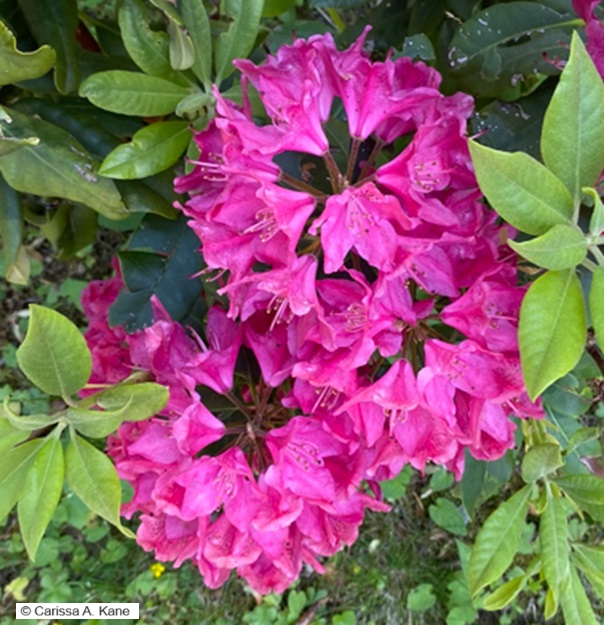
Rhododendron Flowers

How shall I make a return to the Lord
for all the good he has done for me?
The cup of salvation I will take up,
and I will call upon the name of the Lord. – Psalm 116:12-13

Alpha to Omega Design on a Communion Pix

United from Beginning to End…

In the First Reading for the Solemnity of the Holy Trinity (Deuteronomy 4:32-34, 39-40), Moses reminds the people of how God has been present to them in Egypt and the magnitude of what God has done for them. He then implores them to use these experiences to remain focused on God as well as God’s ways thru adherence to God’s statutes and commandments. There can be a tendency to think of statutes and commandments as confining, but when taken into consideration along with the bigger picture of God’s dedication and love for all of creation, they can be seen as providing concrete ways to create unity and exercise respect and dignity with a goal of freedom and protection for one and all.

With God there is always more than one side. The relationship is mutual and considers all parties. There are statutes and commandments, but there are also God’s actions, not just telling humanity how to be, but also leading the way and showing us by example. The verses in the Psalm (Ps 33:4-5, 6, 9, 18-19, 20, 22) describe the Lord’s words, actions, and persona as: upright, trustworthy, just, right, kind, effective, protective, and helpful. These attributes are also infused in the statutes and commandments. They are extended to us by God and in turn we are to extend them to each other.

In the Second Reading (Romans 8:14-17), St. Paul reminds us of our part in the Trinity. As “children of God” and “Joint heirs with Christ” we are not to be enslaved by fear, but rather to live in and be led by the Spirit of God. The passage begins with a salutation of “Brothers and Sisters.” This is not an uncommon greeting. Readings from the letters of St. Paul often begin with a salutation of “Brothers and Sisters,” perhaps to continually express the overall desire and focus on the goal of unity with the Lord and one and another. Imagine starting all your communications with “Brothers and Sisters” or adding “Brothers and Sisters” to communications you receive. How might that shape what you write/say and how you receive what is written/said to you?

Moving on to the Gospel passage known as the Commissioning of the Disciples (Matthew 28:16-20), the disciples, who have gone to Galilee as instructed by Jesus, encounter the risen Jesus. It is written, “they worshipped, but they doubted.” (verse 17). What’s it like to think that despite the existence of doubt, they were still seen as worthy, encountered Jesus, and were given the opportunity to serve as Jesus’ disciples? When situations arise, it can be tempting to give rise to doubt or to fall into a one thing or another, or all or nothing mindset. However, with the Lord, all are worthy, there are often many ways and different degrees to serve, and faith always triumphs over doubt.      

Overall, the Solemnity of the Most Holy Trinity presents an opportunity to acknowledge, contemplate, and celebrate how one experiences the Father and the Son and the Holy Spirit. When you consider each aspect of the Trinity, what characteristics or attributes come to mind? How have you experienced these in your life and how has your prayer been influenced by them? In what ways are you inspired by the Holy Trinity individually and in your relationships? How might the Trinity influence you to overcome uncertainty or division and work toward unity, to better communicate or deepen relationships, or in any related discernment?

“I am the Alpha and the Omega,” says the Lord God, “the one who is and who was and who is to come, the almighty.” – Revelation 1:8

Being Productive…

What does it mean to be productive? And how does that definition differ based upon the task or subject matter involved?

Oftentimes, productivity is judged based on things that can be measured or compared. However, the most impactful or most productive things in life are not necessarily widely valued by society, nor can they always be measured or necessarily seen.   

In the Gospel for the fifth Sunday of Easter (John 15:1-8), Jesus says, “I am the vine, you are the branches. Whoever remains in me and I in him will bear much fruit, because without me you can do nothing.” (verse 5). Jesus is providing an image that can be used to reflect on both the tangible and the non-tangible.

Think about personal interactions you have had over time and how they have impacted you. We all have experiences where what someone says or does, or doesn’t say or do, has affected us in one way or another. Where or what is the fruit of these experiences? What was in your heart at the time, and what’s happening now as you recall them?

Jesus says, “If you remain in me and my words remain in you, ask for whatever you want and it will be done for you. By this is my Father glorified, that you bear much fruit and become my disciples.” (John 15:7-8).

Consider Jesus’s words in this Gospel as an invitation to contemplate how we, as human beings, treat, engage, and communicate with each other, and what comes of it. What fruit is being nurtured and growing out of the way we are with each other? How is love reflected? And what tweaks or changes might be appropriate so that the Way does not get lost along our way?

Moving forward, how might Jesus’s words better inform your thoughts, actions, and decisions? What is it that you desire? Spend some time praying with this and whatever insights are revealed.

The human heart is always drawn by love. – St. Catherine of Siena

The Sun Rising

Relating to and thru One…

The readings for the Third Sunday of Lent can be seen as a call to pay attention to the nature of relationships and what they lead or point to. In the First Reading (Exodus 20:1-17), God delivers the commandments, which are seemingly clear instructions, and by adhering to them, the people will prosper. Notice how God’s mercy far outweighs any punishment.

For I, the Lord, your God, am a jealous God, inflicting punishment for their ancestors’ wickedness on the children of those who hate me, down to the third and fourth generation; but showing love down to the thousandth generation of those who love me and keep my commandments. (Ex 20:5-6)

Also, notice that punishment is reserved for “those who hate me,” and their children. Hate is a pretty strong word and one can imagine some sort of pattern or learned behavior to reach that point or designation. In that light, perhaps this passage can be viewed as a Lenten invitation to be mindful of one’s actions, the sentiments from which they come, and what they might teach.

Looking at the Responsorial Psalm (Psalm 19:8-11), the response is “Lord, you have the words of everlasting life.” (Jn 6:68c). Again, drawing us to God’s words as priceless and wrapping up by trying to convey just how valuable they are: They are more precious than gold, than a heap of purest gold; sweeter also than syrup or honey from the comb. (Ps 19:11).

As for verses 8-10 of the Psalm, the first part of each line refers to the Lord’s “rules”—laws, decrees, precepts, commands, reverence, and ordinances. The second part of each phrase or sentence provides guidance by giving indicators that one can use to try to determine if they are obeying and honoring the Lord. How? By evaluating the situation and answering the question: Do I experience or have a sense of a refreshed soul/peace, wisdom, a rejoicing heart, enlightenment, endurance/inner strength, truth, or justice?

The law of the Lord is perfect,
    refreshing the soul;
The decree of the Lord is trustworthy,
    giving wisdom to the simple.

The precepts of the Lord are right,
    rejoicing the heart;
the command of the Lord is clear,
    enlightening the eye.

The fear of the Lord is pure,
    enduring forever;
the ordinances of the Lord are true,
    all of them just.

In the Second Reading (1 Corinthians 1:22-25), St. Paul is encouraging the Corinthians, and us, to be careful about the way we go about seeking signs and wisdom. God certainly uses people, situations, and things to accomplish tasks and impart wisdom, however, as St. Paul says, “we proclaim Christ crucified.”  That means, there is no substituting human thoughts, ideas, goals, etc. for God’s will and wisdom as the source or root that one allows to resonate with and guide their soul. Ultimately, things come down to what happens between each person and God, and one is not to blindly follow others thus giving what belongs to or originates with God (one’s soul and will) to another human being and/or their agenda.

In what ways do you take each situation to prayer with an openness to the fact that what is right and just in one situation may not be right and just or the best way in another situation? What’s it like to consider that the “rules” and their application are shaped by God’s love and mercy, and that this is by God’s design? In what ways do you leave room for love and mercy in situations and decisions?

Turning to the Gospel passage referred to as the Cleansing of the Temple (John 2:13-25), we can see Jesus’ disavowal of the perversion of the Temple and the rules and practices around and within it. The focus has become all about transactions and status. Jesus drives everyone out, saying to those profiting at the expense of the poor—those selling doves, “Take these out of here, and stop making my Father’s house a marketplace.” (Jn 2:16). In the verses that follow, Jesus refers to his body as the temple and foreshadows his crucifixion and resurrection. The passage ends with:

But Jesus would not trust himself to them because he knew them all,
and did not need anyone to testify about human nature.
He himself understood it well.
(Jn 2:24-25)

Envision Jesus, who is the source of salvation and redemption, entering the temple area of your life—your heart. Imagine yourself receiving the peace, inner strength, and wisdom of Jesus as you sit together. What would you share? And, what would He who understands human nature well, impart to you in terms of what to drive out and what to keep?

Emmaus…

Today, April 22, 2023, as we head into the 3rd Sunday of Easter, we celebrate Earth Day. The earth has been around for over 4.5 billion years, and Earth day? It has been celebrated for 53 years—since 1970.

Despite the comparatively young age of Earth Day, an appreciation for, and the call to honor and preserve the beauty of our planet, nature, and all creation has been ongoing for a far greater time than has been documented. In fact, it’s part of the plan, and path of life. Yet, as with many things, it can become a battle ground… a place for sides to be formed, to rise up against each other, to hold firm, to lose sight, and to stall any attempts at dialogue and resolution, never mind love and mercy.

In the readings for the 3rd Sunday of Easter (Acts 2:14, 22-23; Ps 16:1-2,5, 7-8, 9-10, 11; 1 Pt 1:17-21, and Lk 24:13-35), there lies an invitation to connect more strongly with the path of life as being bigger, and sweeping more broadly, than the circle in which any one individual, or group, travels. So often when we think we know, we don’t. The issues at hand are always more than what we can see, and the way that any one individual may or may not be affected, cannot be used to color the experience of all of humankind. How, after all, is it possible to be open to Divinity, without being open to possibilities?

Turning to Scripture, it seems that those who sought to crucify Jesus, were so sure that he was a threat. It’s clear that His ways were not in line enough with theirs and one can imagine how that might jeopardize their sense of identity, authority, power, and control. We can see how their ability to move in ways that embraced and imbued love, truth, justice, and mercy was hindered by their inability to recognize that they were seeing and acting through their own, limited understanding. There was no room for God on the path to which they were so deeply committed, and this led to them receiving and reacting in fear and seeking even greater control, rather than responding with love.

On the other hand, Jesus, who reacted with love and was inspired by God, could not be held down, even by death.

This man, delivered up by the set plan and foreknowledge of God,
you killed, using lawless men to crucify him.
But God raised him up, releasing him from the throes of death,
because it was impossible for him to be held by it.
For David says of him:
I saw the Lord ever before me,
with him at my right hand I shall not be disturbed.
Therefore my heart has been glad and my tongue has exulted;
my flesh, too, will dwell in hope,
because you will not abandon my soul to the netherworld,
nor will you suffer your holy one to see corruption.
You have made known to me the paths of life;
you will fill me with joy in your presence. – Acts 2:23-28

This is the message of our faith, and the model that we are to follow. Our faith and hope is to be placed in God, and doing so, our words and actions will reflect the Way of God. The Way where our eyes are opened and our hearts burn with desire to be in the service of Love, wherever it leads.

On the road to Emmaus, the two disciples requested of Jesus, “Stay with us” (Lk 24:29).

In our striving, we must do the same, and like the disciples, we must also leave room for the breaking of bread and having hearts that are open to receive, with the love of Jesus, whatever may be revealed.

“You cannot get through a single day without having an impact on the world around you. What you do makes a difference, and you have to decide what kind of difference you want to make.” – Jane Goodall

Like a Lady…

Behold God beholding you… and smiling. – Anthony de Mello, SJ

Pausing to take a deep breath and take in a beautiful day, as I survey my surroundings, I take joy in a ladybug who comes into view, also exploring. Interested, I move closer to get a better view. There it is. Moving along, wings closed, orange with spots of black, yellow head, eyes, antennae, and legs; many parts, one body.

As I watch, I am amused by its way—steady… patient… gentle, but also driven—purposeful. Different, yet underneath it all, the same. A reminder to remember, everyone… everything, is heading somewhere, here and now, and eventually, as well as ultimately.

In the Gospel acclamation for the 14th Sunday in Ordinary Time, it is written, “The Spirit of the Lord is upon me, because he has anointed me to bring glad tidings to the poor” (Lk 4:18). If you had to re-write this sentence, applying it to yourself, what is it that the Lord has anointed or wants to anoint you for?

Moving on to the Gospel according to Mark, in chapter 6, verses 1-6, we read about Jesus essentially being shut out in his hometown area. It appears he is seen through a very narrow lens and because of this he is not welcome, encouraged, or accepted for who he truly is in the present. There is a lack of openness to the value he brings to the table, and he is limited in what he can accomplish.

It is important to remember that Jesus’s inability to be effective has nothing to do with Jesus. It is the result of the closed-minded, closed-hearted resistance he meets. A meaningful encounter cannot happen in the conditions that exist, and so, he must move on.

Perhaps one of the things Jesus is asking us in this passage is to examine the conditions that exist within our own hearts and minds. If, for example, we had to take our words and actions throughout the course of the day and insert them, one by one, at the end of the phrase, “The Spirit of the Lord is upon me, because he has anointed me to,” how would they fit in with Christianity?

In praying with this passage, as you hold dear the desire to honor the Lord whose Spirit is upon you, and who not only anoints you, but also delights in you, what invitation(s) is awaiting?

Jesus departed from there and came to his native place, accompanied by his disciples.
When the sabbath came he began to teach in the synagogue,
and many who heard him were astonished.
They said, “Where did this man get all this?
What kind of wisdom has been given him?
What mighty deeds are wrought by his hands!
Is he not the carpenter, the son of Mary,
and the brother of James and Joses and Judas and Simon?
And are not his sisters here with us?”
And they took offense at him.
Jesus said to them,
“A prophet is not without honor except in his native place
and among his own kin and in his own house.”
So he was not able to perform any mighty deed there,
apart from curing a few sick people by laying his hands on them.
He was amazed at their lack of faith. – Mark 6:1-6

Remain…

In a few weeks, my oldest child will be turning the page toward a new chapter in his life, as he graduates. So many years have passed and so much has transpired since his birth, yet it’s still hard to believe that this milestone is already here. As I think about the journey as a parent, I recall moments of feeling joy and pride as well as moments of feeling fear and uncertainty. What an awesome responsibility… what an awesome privilege. But then, isn’t that what love is all about? Being present, holding on, lifting up, letting go, and along the way, being drawn toward the balance that lies between?   

In the Gospel according to John, Jesus says:

“As the Father loves me, so I also love you. Remain in my love.” (15:9)

How do we do that?

We remain in love, by choosing to live in Love. When we choose to be present to each other and creation, we are also choosing to be present to God, and God’s love for us. This is the source of joy, and it can only be complete when it is shared and flowing freely among us. So often though, things get in the way, distracting us, and pulling us apart from each other, as well as from God.

When we remain in God’s love though, we can see things for what they are more readily, and withhold the judgment that seeks to lead us against one another rather than bring us together. What an awesome responsibility… what an awesome privilege. But then, isn’t that what love is all about? Being present, holding on, lifting up, letting go, and along the way, being drawn toward the balance that lies between?

Be a lamp, or a lifeboat, or a ladder. Help someone’s soul heal. Walk out of your house like a shepherd.” — Rumi