Oh no! Not again, again. Utter outrage is not enough. The bottom line if not obvious, is this, There are no excuses, There are no good reasons, There is no lower we can go, Beyond bottom is where we already are.
Over and over, we say no more, But here we are, again, and again, More than once more, By many more. As if it’s never enough.
Too much! More than enough already. Violence begets violence, But I’m not violent, One might say, But if we’re being honest, Aren’t we all, In some way?
Thinking carefully, Competition here and there, Competition everywhere. Through the years, Things get turned upside down, Words get mixed, Intentions sway, Power plays, Hands shake, All as if nobody is the wiser.
Enough already! Place the value in what’s valuable! Get over self-inflation, Turn right side up, and Come back down to earth. Look reality in the face, And address it wholeheartedly. Join each other as One nation.
Stop the violence, Stop it now. No more loss. None! Not any! It ought to be common sense. That’s what ought to be automatic.
Consider communicating (and re-communicating) to elected officials concerns and wishes regarding gun control and reform to laws, and exercise the right to vote to put people in office who will work to address gun violence more effectively. Pray, because prayer never hurts, and can only help. In addition, the following is a short list of organizations working to increase awareness and stop gun violence.
There was darkness all around. Not a sound, but that of waves gently breaking, making their way across the sand and rocks, back and forth, to and from. Not a sight, until the sun began its approach, gradually awakening the sky, before peeking up over the horizon.
Then what a sight. Silhouette or shadow? May be solo, but not alone. Freely flying, but in a line, parallel, heart of purpose and direction. Gliding, steady, peaceful, true in its presence… in its likeness… Silhouette.
“I saw no temple in the city, for its temple is the Lord God almighty and the Lamb. The city had no need of sun or moon to shine on it, for the glory of God gave it light, and its lamp was the Lamb.” – Rev 21:22-23
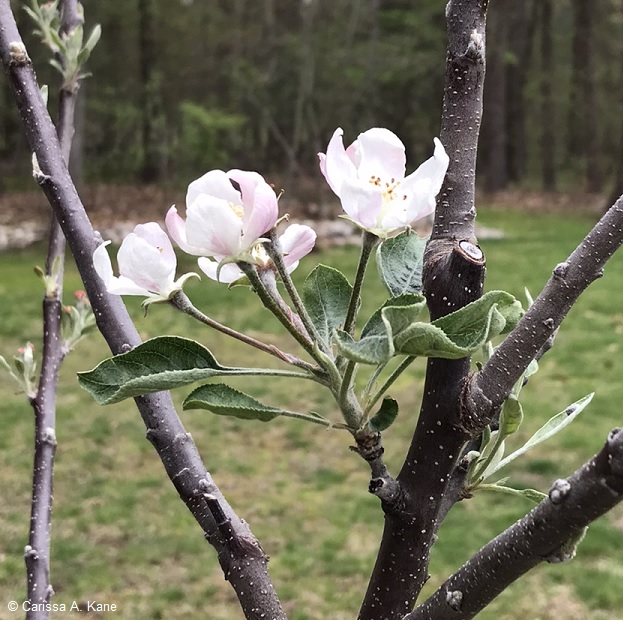
Watching as the branches fill in, flowers blossom, pollen wafts through the air, and Spring burgeons and unfolds, there is a sense of awe. In the Book of Revelation, it is written, “The One who sat on the throne said, ‘Behold, I make all things new.’” (Rev 21:5a). Not some things, or only certain things, but all things. Thinking about this, I cannot help but consider this concept further and ask, “Am I open to all things being made new by God?”
The flowers grow and open, pretty much wherever they are planted. And certainly, there are some conditions necessary for their maturity and well-being—light, water, nutrients, and some level of protection from harsher elements and realities. However, the things vital to their growth can be found or seep in even in unexpected places, and overall, flowers grow where they will.
In chapter 14, verses 21-27, of the Acts of the Apostles, we continue to learn of the experiences of Paul and Barnabas as they travel on, inspired by their discipleship desire. Their journey leads them back to Antioch, the place of resistance from where they were expelled in chapter 13.
It is written:
“From there they sailed to Antioch, where they had been commended to the grace of God for the work they had now accomplished. And when they arrived, they called the church together and reported what God had done with them and how he had opened the door of faith to the Gentiles.” – (verses 26-27)
Imagine. God called them to something more, launching something new from the very place that was not open to receiving them at the time. It turns out God had somewhere else in mind for them. How did they react or respond?
Paul and Barnabas were willing to let go of their notions and allow themselves to be led to other territories where they not only experienced what God had in mind, but also deepened their faith. Eventually, they were led back to Antioch, where, because of God who makes all things new, they were able to meet resistance with something more, something stronger, faithful witness to the Glory of God.
So just as flowers grow where they will, so too Paul and Barnabas… so too us. If we are open to it.
On the Fourth Sunday of Easter, we read about the experience of Paul and Barnabas touching the hearts of the Gentiles (perhaps seen as the outsiders) while enraging those considering themselves more as chosen, but of a different persuasion. Things seem to get off to a good start, but then the atmosphere changes. However, despite the change to an overwhelmingly inhospitable environment, the disciples hold firm to the Way even as they are being thrown out of Antioch. We read, “So they shook the dust from their feet in protest against them, and went to Iconium” (Acts 13:51).
It’s interesting that Paul and Barnabas left Antioch, a city whose name means, “resistant, holding out against” and went on to Iconium, which means “City of the Image,” where they were more well-received, at least for a little while, before being led on to other territories. As with Jesus, with the disciples, there is always room for choice; they do not practice coercion.
We also read in this section of Scripture, “The disciples were filled with joy and the Holy Spirit” (Acts 13:51-52). What a combination! What’s it like to consider this disposition on the heels of them being expelled from Antioch? In what ways do you see the influence of Jesus, the Good Shepherd, in the reactions and responses of Paul and Barnabas, and their willingness to be led by the will of God, which is not rigid, and they cannot, and do not, know ahead of time?
In the Gospel according to John, Jesus says:
“My sheep hear my voice; I know them, and they follow me. I give them eternal life, and they shall never perish. No one can take them out of my hand. My Father, who has given them to me, is greater than all, and no one can take them out of the Father’s hand. The Father and I are one.” – Jn 10:27-30
Contemplating the Gospel as the living Word of God, if someone told you a story about an inhospitable experience, perhaps one that caused them to pick up and leave, how would you receive what they shared? What if their experience occurred in a place where your experience was more, or only, positive? How open would you be to giving an honest look to the situation? And what would you be most interested in learning about their experience?
Keeping in mind, we are all created in God’s image, and we all belong to the sheepfold, how do you accept the invitation to trust that the same God who loves you, loves them, and that the same God who guides you, guides them, even if their choices and experiences may not be the same as yours?
In what ways, are your responses to people and situations a reflection of the Good Shepherd, and a heart that is filled with joy and the Holy Spirit?
Paul and Barnabas continued on from Perga and reached Antioch in Pisidia. On the sabbath they entered the synagogue and took their seats. Many Jews and worshipers who were converts to Judaism followed Paul and Barnabas, who spoke to them and urged them to remain faithful to the grace of God.
On the following sabbath almost the whole city gathered to hear the word of the Lord. When the Jews saw the crowds, they were filled with jealousy and with violent abuse contradicted what Paul said. Both Paul and Barnabas spoke out boldly and said, “It was necessary that the word of God be spoken to you first, but since you reject it and condemn yourselves as unworthy of eternal life, we now turn to the Gentiles. For so the Lord has commanded us, I have made you a light to the Gentiles, that you may be an instrument of salvation to the ends of the earth.”
The Gentiles were delighted when they heard this and glorified the word of the Lord. All who were destined for eternal life came to believe, and the word of the Lord continued to spread through the whole region. The Jews, however, incited the women of prominence who were worshipers and the leading men of the city, stirred up a persecution against Paul and Barnabas, and expelled them from their territory. So they shook the dust from their feet in protest against them, and went to Iconium. The disciples were filled with joy and the Holy Spirit. – Acts 13:14, 43-52
Recall an experience of bumping into someone that you know, in a place and at a time that you normally wouldn’t expect to see them? Initially, you might be surprised for good or less, or perhaps it might take a few moments to fully recognize the person. Maybe some memories of them come to mind.
Next, imagine that you kept encountering that same person over the course of several weeks. What would you think? What would you feel?
Now envision being one of Jesus’ disciples and having the experience of Jesus’ appearing to you, here and there, in the time between his Resurrection and Ascension. How would you react or respond after the profound experience of his crucifixion, his Resurrection, and being in the environment of belief and disbelief created by it all?
Would you be devoted to trying to see a pattern to Jesus’ appearances to try to predict when you might see him next? Would you commit yourself to trying to figure out the reasons why he was appearing? How hard would you work to come to some sort of knowledge about these occurrences? In what ways would you characterize your approach?
Focusing more closely on Jesus and his third appearance at the Sea of Tiberias (John 21), how determined would your mind be, and how open would your heart be, to the presence of Jesus who is in the form of the person on the shore, unknown and at a distance? How about to yourself or the person on the shore, thought of as being known? Would you cast the net again? What would you discover?
Simon Peter said to them, “I am going fishing.” They said to him, “We also will come with you.” So they went out and got into the boat, but that night they caught nothing. When it was already dawn, Jesus was standing on the shore; but the disciples did not realize that it was Jesus. Jesus said to them, “Children, have you caught anything to eat?” They answered him, “No.” So he said to them, “Cast the net over the right side of the boat and you will find something.” So they cast it, and were not able to pull it in because of the number of fish. So the disciple whom Jesus loved said to Peter, “It is the Lord.” When Simon Peter heard that it was the Lord, he tucked in his garment, for he was lightly clad, and jumped into the sea. – Jn 21:3-7
In what ways do you allow Jesus to be present to you in the unexpected? In what ways do you invite Jesus to help you to be present, to hold situations up to the light, to receive God’s wisdom so that you can embody the thoughts and feelings needed not only to embrace the moment, but also to receive and recognize the grace it holds, and how to share it?
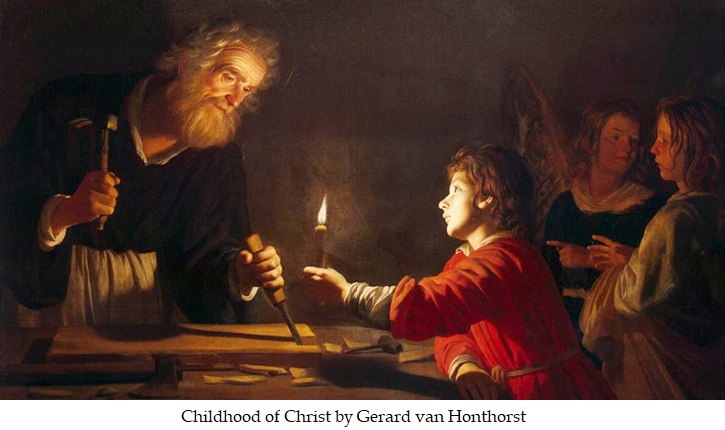
Sometimes, there are so many questions, and it can seem like so much work. Yet, as April turns to May and the Feast of St. Joseph The Worker arrives, so also does the opportunity to experience not only the light of longer days, but also renewal through the touch of Grace—peace, light, hope, and inspiration—that continues to blossom with the Easter season, and beyond.
How does grace touch and move your heart? And how is it reflected in your work?
If you had to describe Easter in one word, what word would you use? While there is a plethora of words that could be chosen, what words speak more profoundly to you today, and what one word would be most fitting to encapsulate the life, death, and resurrection of Jesus?
Reflecting on the Triduum, with all the words, images, and actions that take place from Holy Thursday thru the Easter Vigil, the word authenticity seems apropos. Jesus taught by example and told his disciples what was going to happen, and then it did happen. His words and actions were true from start to finish. However, Jesus was not alone in his authenticity (be who you are, do as you are).
Looking more intently at the words and actions of some of the other individuals closest to Jesus, one might come to see that they were also being themselves during those moments. For example, Judas succumbed to betraying Jesus through his real-life weakness, identifying more strongly with money and power than anything else at that time. Then there’s Peter denying Jesus three times. This is not a reflection of his sincerity and desire to follow Jesus, but rather just part of where he was and what he was capable of at that time. Many of the other disciples, ran and hid after Jesus was arrested. Some did not. For example, the many women who followed Jesus, and John who witnessed the crucifixion by Mary’s side.
Think about these individuals as fellow human beings who were at the same time and place in history, while having different experiences, internal dispositions, and outward responses to the same events. In what ways do you see the beauty of God’s mercy and love shine through loud and clear? What’s it like to know that regardless of shortcomings or strengths, Jesus loved and accepted them all, seeing their value as beloved and part of creation?
Oftentimes, we can look to label words, decisions, or actions as right or wrong. However, in the process, we neglect to see what we are forfeiting. Jesus, by seeing us for who we are, accepting us where we are, and loving us as we are, not only touches our hearts and enlightens our minds, but also moves us toward resurrection, turning authenticity into Alleluia.
Going about each day, there are many words that we speak and things that we do. What are the things said or done with purpose, and what kind? What do our words and actions mean to us, what inspires them, and how do they reflect eternal life to the world around us?
Give thanks to the LORD, for he is good, his mercy endures forever. – Psalm 118:1
Reading the responsorial psalm for Palm Sunday and the response, “My God, my God, why have you abandoned me?” (Psalm 22:2) my mind is immediately filled with thoughts of the dear, innocent people of Ukraine whose lives have been taken, trampled upon, and upended, most recently over the course of the past several weeks, as well as for the dear, innocent people throughout the world who each day suffer such cruel and unjust treatment at the hands of others. It’s hard to comprehend how, with all the advances humankind has made in the past 2,000 years, the same hatred that slithered its way into the hearts and minds of those who sought to crucify Jesus, still exists, and that acts of such cruelty and utter disregard for humanity are still carried out.
It’s hard to understand, but perhaps that’s the point. It’s not understandable. What we are witnessing is the devastation that comes in situations where the heart of the matter—we are One—is lost; overruled by greed, hatred, lust for power, and indifference. Yet, at the same time, we are witnessing the heart of the matter—we are One—rising up, calling out… alive and well in the spirit of unity seen in those who stand up, reach out, sacrifice, and stand together.
The Passion of the Lord is about reclamation and answering that call.
Reflecting on the Passion of the Lord in the Gospel according to Luke (chapters 22-23), how do you bring your thoughts and feelings about all that is happening in the world today to God? Where do you meet Jesus? In what ways do you accompany Jesus in his Passion? And how do you draw inspiration and strength from the journey?
Waking up to the sounds of birds singing to each other, Calling back and forth, Noise bouncing here and there—echoes, Do they realize how far their voices reach? What is their intention? What’s that now? What do they say? Something familiar, something new, They whistle in possibilities, And the newness of the day. What is my intention? How does it travel? What do I say? Do I realize the blessing that comes with this new day?
The Lord has done great things for us; we are filled with joy. – Psalm 126:3
In Greek mythology, keeping the gods and goddesses happy was central to life. So, temples were built, activities were held, sacrifices were made, all to please the gods and goddesses so that the people in turn might be helped along or rewarded rather than punished. Having recently seen a show that involved Greek mythology and the challenge of relationships, reading “…be reconciled to God,” in chapter 5, verse 20 of the Second Letter to the Corinthians, strikes a chord. And then there is the Gospel reading for the Fourth Sunday of Lent which includes the parable of the Prodigal Son (Luke 15:11-32), which really leads one to think about relationships. Combining the two, it can be intriguing to look more closely at the differences and similarities between one’s relationship with God and one’s relationships with others (family, friends, acquaintances, etc.). And perhaps consider further, the impact of both the things we can see and those we think we can see but cannot.
Looking to St. Paul and to the Prodigal Son, it’s all about stripping away the extraneous, drawing closer to what lies within, and trusting one’s experience. However, not one’s experience of self or others, but looking for, remembering and trusting one’s experience of God within the interactions and dealings we have with one another.
Imagine riding along from start to finish with Saul of Tarsus, soldier… warrior, active persecutor of early Christians who was literally knocked off his horse, called to conversion, and way down the road, became St. Paul.
Envision travelling with the Prodigal Son. The son who took his inheritance while his father was still living and turned his back on everyone and everything that he had previously known. He had to take his own path and have his own way; it was just something he needed to do. However, on that path, he lost everything, but then gained so much more than he could have ever dreamed of, by owning the truth and returning home, where he was immediately welcomed and embraced.
For St. Paul and the Prodigal Son, it turned out that the things that drove them… the things that sucked them in as being so important or so necessary, weren’t. And while it may have seemed to them as though they lost everything in the process of their falling, they did not. Both experienced the kindness and love of God both directly and through others—the grace that led them to pivot—and it is through that, that they came to know their true worth as God’s beloved, and that what really matters can never be taken away, only shared and magnified.
Sitting with the readings for the second Sunday of Lent, like an old friend, the word “Trust” enters the room with a warm smile and as if to say, “Remember me… remember when…” So much of life is about trust and so often, it seems to come down to whom or what one trusts, to what degree, how that trust is received, and the impact or consequences of its handling.
As human beings, we share in a perfectly, imperfect nature, as we navigate life in, and surrounded by, a competitive, material world. It can be tempting to think or feel, even if subconsciously, that there is something we can do about anything happening around us at any time; that a level of control is always within our grasp. We may even look to capture the things that we, as human beings, think will help us to have that control. Yet, the only control we ever really have, and the only victory ever really won, is in choices that we make to trust in God’s ways and to let go, or shed the impulse or notion that any one interest outranks everyone’s interest.
In the ninth chapter of the Gospel according to Luke, Peter, John, and James ascend the mountain with Jesus and share in the experience of his transfiguration. In the passage prior to this one, while explaining what it means to be a disciple, Jesus says, “What profit is there for one to gain the whole world yet lose or forfeit himself?” (Lk 9:25). Looking at the circumstances in the world today, one can clearly see that there is no profit in profiteering, only loss for everyone.
Think about what it must have been like for Peter, John, and James to hear Jesus’ words about discipleship and then to witness his transfiguration seeing him stand alongside the prophets, Moses and Elijah.
Looking to today’s world, when it seems there is nothing to do, or there is no good way to stop what is already in motion, perhaps the best place to start is to forget control, then pause to go back and remember the beginning. Jesus took Peter, James, and John up the mountain to pray. One can only wonder, what was in their hearts as they placed their trust in Jesus and followed him up that mountain. One can only wonder how they received what happened and what they carried in their hearts on the way down, and thereafter.
How does your trust in Jesus shape your choices, create unity, express love, and spread goodwill? Connecting with Jesus as an old friend greeting you with a warm smile, how would you proceed from the phrase, “Remember me… remember when…?”
Share with Jesus what you carry in your heart as you reflect on the world we live in, and the journey you are on within it.
Jesus took Peter, John, and James and went up the mountain to pray. While he was praying his face changed in appearance and his clothing became dazzling white. And behold, two men were conversing with him, Moses and Elijah, who appeared in glory and spoke of his exodus that he was going to accomplish in Jerusalem. Peter and his companions had been overcome by sleep, but becoming fully awake, they saw his glory and the two men standing with him. As they were about to part from him, Peter said to Jesus, “Master, it is good that we are here; let us make three tents, one for you, one for Moses, and one for Elijah.” But he did not know what he was saying. While he was still speaking, a cloud came and cast a shadow over them, and they became frightened when they entered the cloud. Then from the cloud came a voice that said, “This is my chosen Son; listen to him.” After the voice had spoken, Jesus was found alone. They fell silent and did not at that time tell anyone what they had seen. – Lk 9:28b-36
















You must be logged in to post a comment.