The Cross in Reflection…

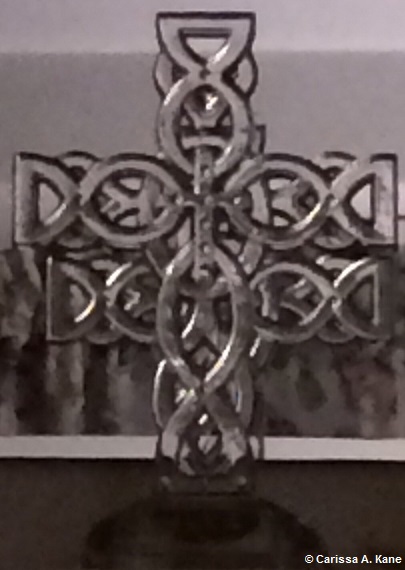
The intricate pattern of the cross and its reflection in the mirror called out, as if to say, there are many sides, some smooth… some sharp… some in between, to each and everything under the sun. Also, there are many directions. However, at the center, there is always Truth. The question is whether or not there is a desire to see it. Is there a desire to acknowledge and dwell with it in the presence of all that surrounds it? Is time and space allowed for coming to the place of knowledge from which life truly springs regardless of circumstances?

Cross

On the evening of that first day of the week,
when the doors were locked, where the disciples were,
for fear of the Jews,
Jesus came and stood in their midst
and said to them, “Peace be with you.”
When he had said this, he showed them his hands and his side.
The disciples rejoiced when they saw the Lord.
Jesus said to them again, “Peace be with you.
As the Father has sent me, so I send you.”
And when he had said this, he breathed on them and said to them,
“Receive the Holy Spirit.
Whose sins you forgive are forgiven them,
and whose sins you retain are retained.”

Thomas, called Didymus, one of the Twelve,
was not with them when Jesus came.
So the other disciples said to him, “We have seen the Lord.”
But he said to them,
“Unless I see the mark of the nails in his hands
and put my finger into the nailmarks
and put my hand into his side, I will not believe.”

Now a week later his disciples were again inside
and Thomas was with them.
Jesus came, although the doors were locked,
and stood in their midst and said, “Peace be with you.”
Then he said to Thomas, “Put your finger here and see my hands,
and bring your hand and put it into my side,
and do not be unbelieving, but believe.”
Thomas answered and said to him, “My Lord and my God!”
Jesus said to him, “Have you come to believe because you have seen me?
Blessed are those who have not seen and have believed.”

Now Jesus did many other signs in the presence of his disciples
that are not written in this book.
But these are written that you may come to believe
that Jesus is the Christ, the Son of God,
and that through this belief you may have life in his name. – John 20:19-31

At the Water’s Edge…

From time to time, there is a place my family likes to go where we sit, talk, and take in the scenery. Sometimes, we go together and other times one or two of us may go alone.  Whichever the case, and as familiar as the place has become, the experience is seldom the same. Instead, it is common that something new or different happens among the interactions, whether in the surroundings or in the conversation.

The other day, the flow of the water was moving in a different direction than usual. Normally, the water flows toward the land on the other side. On this day, it was flowing toward the side where I was, calling attention to the edge of the water in front of me.

At the edge of the water, lay remnants of leaves fallen from days of old. At the edge of the grass, lay remnants of leaves fallen from days of old. The image was intriguing.

While days of old, are a thing of the past, it is often from days of old, that the water flows and the grass grows. It is often from something known, that something new, different, or previously unknown comes into being. It is rarely, if at all, one or the other (old or new) exclusively, for that which stands the test of time.

Jesus walked on both land and sea. He bridged the old to the new, remaining faithful, or perhaps in modern day terms, remaining loyal to God. True to God to the very end… and from that end, a new beginning arose.

We are called to do the same, and through the grace of God and the guidance of the Holy Spirit, we can.

Glory be to the Father,
and to the Son,
and to the Holy Spirit,
as it was in the beginning,
is now,
and ever shall be,
world without end.
Amen.

AtTheWatersEdge

The Glass Across the Way…

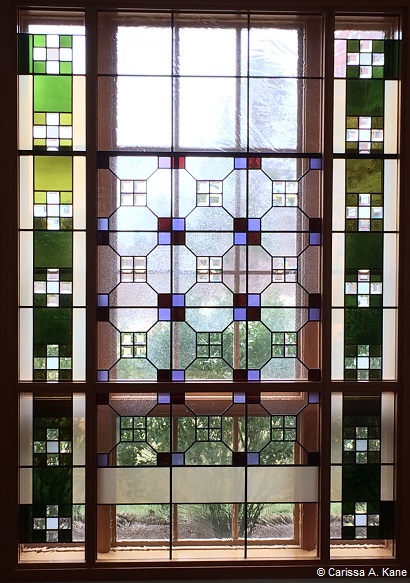
As I looked at the stained glass window across the hall, at first I took in its pattern and the colors in it. Then, it was interesting to notice the way the light came through it, and the way the different sections of glass distorted or hid what was on the other side. It was only at the base of the window that one could see pretty clearly, what was outside; and, I imagine, one who was outside could see in, too.

Oftentimes, situations, relationships, and interactions can be like looking through glass. They can range from those where the glass may seem impenetrable to those where the glass is transparent, with nothing to hide. Yet, even in those cases where the glass is very dark, light is still able to shine through it.

Look at Pilate, Herod, one of the criminals alongside Jesus, and the centurion (Luke 23:1-49). In the midst of all that was happening through the trial and crucifixion of Jesus, light was shed and truth was revealed to them. What did they do with it? What do we do with it?

This is what the Passion of our Lord and Savior Jesus Christ is all about. In all moments, even in the moments when life seems darkest or situations seem impossible, there is still light with and within us, and where there is light, there is always a way… the Way.

The more we can allow ourselves to be transparent in our relationship with God, the more we shine, and the more we shine, the better we are able to see, and live, the Way.    
EPWindow

The elders of the people, chief priests and scribes,
arose and brought Jesus before Pilate.
They brought charges against him, saying,
“We found this man misleading our people;
he opposes the payment of taxes to Caesar
and maintains that he is the Christ, a king.”
Pilate asked him, “Are you the king of the Jews?”
He said to him in reply, “You say so.”
Pilate then addressed the chief priests and the crowds,
“I find this man not guilty.”
But they were adamant and said,
“He is inciting the people with his teaching throughout all Judea,
from Galilee where he began even to here.”

On hearing this Pilate asked if the man was a Galilean;
and upon learning that he was under Herod’s jurisdiction,
he sent him to Herod who was in Jerusalem at that time.
Herod was very glad to see Jesus;
he had been wanting to see him for a long time,
for he had heard about him
and had been hoping to see him perform some sign.
He questioned him at length,
but he gave him no answer.
The chief priests and scribes, meanwhile,
stood by accusing him harshly.
Herod and his soldiers treated him contemptuously and mocked him,
and after clothing him in resplendent garb,
he sent him back to Pilate.
Herod and Pilate became friends that very day,
even though they had been enemies formerly.
Pilate then summoned the chief priests, the rulers, and the people
and said to them, “You brought this man to me
and accused him of inciting the people to revolt.
I have conducted my investigation in your presence
and have not found this man guilty
of the charges you have brought against him,
nor did Herod, for he sent him back to us.
So no capital crime has been committed by him.
Therefore I shall have him flogged and then release him.”

But all together they shouted out,
“Away with this man!
Release Barabbas to us.”
— Now Barabbas had been imprisoned for a rebellion
that had taken place in the city and for murder. —
Again Pilate addressed them, still wishing to release Jesus,
but they continued their shouting,
“Crucify him!  Crucify him!”
Pilate addressed them a third time,
“What evil has this man done?
I found him guilty of no capital crime.
Therefore I shall have him flogged and then release him.”
With loud shouts, however,
they persisted in calling for his crucifixion,
and their voices prevailed.
The verdict of Pilate was that their demand should be granted.
So he released the man who had been imprisoned
for rebellion and murder, for whom they asked,
and he handed Jesus over to them to deal with as they wished.

As they led him away
they took hold of a certain Simon, a Cyrenian,
who was coming in from the country;
and after laying the cross on him,
they made him carry it behind Jesus.
A large crowd of people followed Jesus,
including many women who mourned and lamented him.
Jesus turned to them and said,
“Daughters of Jerusalem, do not weep for me;
weep instead for yourselves and for your children
for indeed, the days are coming when people will say,
‘Blessed are the barren,
the wombs that never bore
and the breasts that never nursed.’
At that time people will say to the mountains,
‘Fall upon us!’
and to the hills, ‘Cover us!’
for if these things are done when the wood is green
what will happen when it is dry?”
Now two others, both criminals,
were led away with him to be executed.

When they came to the place called the Skull,
they crucified him and the criminals there,
one on his right, the other on his left.
Then Jesus said,
“Father, forgive them, they know not what they do.”
They divided his garments by casting lots.
The people stood by and watched;
the rulers, meanwhile, sneered at him and said,
“He saved others, let him save himself
if he is the chosen one, the Christ of God.”
Even the soldiers jeered at him.
As they approached to offer him wine they called out,
“If you are King of the Jews, save yourself.”
Above him there was an inscription that read,
“This is the King of the Jews.”

Now one of the criminals hanging there reviled Jesus, saying,
“Are you not the Christ?
Save yourself and us.”
The other, however, rebuking him, said in reply,
“Have you no fear of God,
for you are subject to the same condemnation?
And indeed, we have been condemned justly,
for the sentence we received corresponds to our crimes,
but this man has done nothing criminal.”
Then he said,
“Jesus, remember me when you come into your kingdom.”
He replied to him,
“Amen, I say to you,
today you will be with me in Paradise.”

It was now about noon and darkness came over the whole land
until three in the afternoon
because of an eclipse of the sun.
Then the veil of the temple was torn down the middle.
Jesus cried out in a loud voice,
“Father, into your hands I commend my spirit”;
and when he had said this he breathed his last.

The centurion who witnessed what had happened glorified God and said,
“This man was innocent beyond doubt.”
When all the people who had gathered for this spectacle
saw what had happened,
they returned home beating their breasts;
but all his acquaintances stood at a distance,
including the women who had followed him from Galilee
and saw these events. – Luke 23:1-49


The Hospitality of Love…

Without question, the story of the Prodigal Son shows the mercy of God and the challenge of forgiving trespasses, both our own and those of others. In addition, this parable also offers insight into the importance of a hospitable heart—a heart that is welcoming and gracious to all. This is what caused all those who drew near or reached out to Jesus, to do so. Likewise, this is what led the son who was lost to come back home.

“Coming to his senses he thought, ‘How many of my father’s hired workers have more than enough food to eat…” (Luke 15:17). Having lost everything that he thought was going to make him happy and experiencing a very inhospitable environment, the lost son recalls the truth of what the environment was like at his father’s house. He humbles himself and sets out to return home, owning the ways in which he has failed and letting go of all that might lead him to stay away.

When he does so, he encounters neither judgment nor criticism. In addition, his status as son and birthright as heir await him. He encounters open arms running to embrace and welcome him home—a heart overjoyed by his presence. Once again, he experiences true hospitality, which draws him right back into the fold.

Whether there is one or one million and one… or more, God is all in, and for all, always. Cause for rejoicing! What a great example!

May love be the gardener of your years
bringing forth from your grounding in God
a harvest of wholeness and peace,
a bounty of courage and compassion.

May your soul tower with the strength of cedars;
your heart pound with the power of the sea.
May joy rise in you like the mountains
and may it be a blessing you share with those you love,
who this day make merry
then in you, the great love of God
has found a home on earth.

– A Lebanese Blessing by Jeannette Abi-Bader, HM

ProdigalSon_Field


Tax collectors and sinners were all drawing near to listen to Jesus,
but the Pharisees and scribes began to complain, saying,
“This man welcomes sinners and eats with them.”
So to them Jesus addressed this parable:
“A man had two sons, and the younger son said to his father,
‘Father give me the share of your estate that should come to me.’

So the father divided the property between them.
After a few days, the younger son collected all his belongings
and set off to a distant country
where he squandered his inheritance on a life of dissipation.
When he had freely spent everything,
a severe famine struck that country,
and he found himself in dire need.
So he hired himself out to one of the local citizens
who sent him to his farm to tend the swine.
And he longed to eat his fill of the pods on which the swine fed,
but nobody gave him any.
Coming to his senses he thought,
‘How many of my father’s hired workers
have more than enough food to eat,
but here am I, dying from hunger.
I shall get up and go to my father and I shall say to him,
“Father, I have sinned against heaven and against you.
I no longer deserve to be called your son;
treat me as you would treat one of your hired workers.”’
So he got up and went back to his father.
While he was still a long way off,
his father caught sight of him, and was filled with compassion.
He ran to his son, embraced him and kissed him.
His son said to him,
‘Father, I have sinned against heaven and against you;
I no longer deserve to be called your son.’
But his father ordered his servants,
‘Quickly bring the finest robe and put it on him;
put a ring on his finger and sandals on his feet.
Take the fattened calf and slaughter it.
Then let us celebrate with a feast,
because this son of mine was dead, and has come to life again;
he was lost, and has been found.’
Then the celebration began.
Now the older son had been out in the field
and, on his way back, as he neared the house,
he heard the sound of music and dancing.
He called one of the servants and asked what this might mean.
The servant said to him,
‘Your brother has returned
and your father has slaughtered the fattened calf
because he has him back safe and sound.’
He became angry,
and when he refused to enter the house,
his father came out and pleaded with him.
He said to his father in reply,
‘Look, all these years I served you
and not once did I disobey your orders;
yet you never gave me even a young goat to feast on with my friends.
But when your son returns
who swallowed up your property with prostitutes,
for him you slaughter the fattened calf.’
He said to him,
‘My son, you are here with me always;
everything I have is yours.
But now we must celebrate and rejoice,
because your brother was dead and has come to life again;
he was lost and has been found.’” – Luke 15:1-3, 11-32

Awaken to the Light…

A few nights ago I had fallen asleep while other household members were still up and about. Suddenly though, I was awake again. Someone had turned on the hallway light, which extended its reach into the room where I was sleeping. And while the light was rather intrusive that night, more often than not, the light is exactly what we need.

According to the Gospel of Luke, Peter, John, and James accompanied Jesus up the mountain to pray, but at some point, the three disciples were “overcome by sleep” (Luke 9:32). During their sleep, Jesus is not only joined by the prophets Moses and Elijah, engaging in discussion with them, but also becomes transfigured, his appearance changing and his clothing giving off great light.

Peter, John and James, awoken seemingly by the intense light, witness Jesus’ transfiguration and the presence of the prophets alongside him. This is shortly followed by a cloud that envelops them, creating both darkness and fear. Yet it was in this cloud and undoubtedly their confusion about what was going on, that God speaks to them, shedding light by revealing the truth as well as providing instruction—“This is my chosen Son; listen to him” (Luke 9:35).   

While the disciples cannot account for what happened while they were sleeping, now that they are awake they do have a responsibility with regards to what they had witnessed. At the time appointed by Jesus (Matthew 17:9; Mark 9:9), they will give voice to what they saw and experienced that day on the mountain.

As we go through life, we all have moments where we experience or witness the glory of God. We also have moments where we witness the opposite of that. Whichever it may be, we are always called to testify and give witness to the truth.

The Light always wakes us up, but it is up to us how we respond.

ThePath_Akiane
In order to choose the right path we do not have to figure out the wrong one— we just need to follow the light. – The Path by Akiane Kramarik

Jesus took Peter, John, and James
and went up the mountain to pray.
While he was praying his face changed in appearance
and his clothing became dazzling white.
And behold, two men were conversing with him, Moses and Elijah,
who appeared in glory and spoke of his exodus
that he was going to accomplish in Jerusalem.
Peter and his companions had been overcome by sleep,
but becoming fully awake,
they saw his glory and the two men standing with him.
As they were about to part from him, Peter said to Jesus,
“Master, it is good that we are here;
let us make three tents,
one for you, one for Moses, and one for Elijah.”
But he did not know what he was saying.
While he was still speaking,
a cloud came and cast a shadow over them,
and they became frightened when they entered the cloud.
Then from the cloud came a voice that said,
“This is my chosen Son; listen to him.”
After the voice had spoken, Jesus was found alone.
They fell silent and did not at that time
tell anyone what they had seen.  – Luke 9:28B-36

Waiting to Arrive…

Looking out at the thin ice in the quiet stillness of early morning, I think, “How fragile life is.” As I sit and watch, I feel tired… stretched thin. Until this moment, it has been so busy… too busy.

I survey the area. It seems motionless. I think, “The time is now.” Everyone…everything must wait.

While time continues to tick, I linger, allowing more than just a chance to be still and listen. With each minute that passes, I feel a calm and steady strength growing from deep within. How resilient Life is.

ThinIce

My eyes are ever upon the LORD, who frees my feet from the snare. – Psalm 25:15

Lady Luck…

As I proceeded toward the steps and the front door, I could see something… a bug, moving on the frame around the door. With each step, I could see it more clearly. I was thinking, “It couldn’t be, it’s too cold,” but as I got closer to the front door, I saw that in fact it was a ladybug. What a pleasant surprise, in stark contrast to the spotting of the brown stink bugs that are common this time of year.

As I watched the ladybug crawling around for a few moments, I could not help but smile. Although it was a small thing, on a rather chilly day, this friendlier, more palpable kind of bug brought a sense of wonder and joy to me as the weather progresses toward winter where I live.

What a great way to prepare to enter the house. What a great way to prepare to enter any place for that matter. To go forth thinking… feeling… remembering the truth of what it means to be begotten by God. That is blessed!

Gifts and blessings come in packages of all types and sizes. Look for and welcome the unexpected. Receive all that each moment brings. Strive to remain faithful regardless of circumstances. Trust that what God has in store is always the best.

You will show me the path to life,
fullness of joys in your presence,
the delights at your right hand forever. – Psalm 16:11

LadyBug

The Point of Letting Go…

“The jar of flour did not go empty, nor the jug of oil run dry…” (1 Kings 17:16). Why? Because the Lord ordained it to be so.

In those days, Elijah the prophet went to Zarephath.
As he arrived at the entrance of the city,
a widow was gathering sticks there; he called out to her,
“Please bring me a small cupful of water to drink.”
She left to get it, and he called out after her,
“Please bring along a bit of bread.”
She answered, “As the LORD, your God, lives,
I have nothing baked; there is only a handful of flour in my jar
and a little oil in my jug.
Just now I was collecting a couple of sticks,
to go in and prepare something for myself and my son;
when we have eaten it, we shall die.”
Elijah said to her, “Do not be afraid.
Go and do as you propose.
But first make me a little cake and bring it to me.
Then you can prepare something for yourself and your son.
For the LORD, the God of Israel, says,
‘The jar of flour shall not go empty,
nor the jug of oil run dry,
until the day when the LORD sends rain upon the earth.'”
She left and did as Elijah had said.
She was able to eat for a year, and he and her son as well;
the jar of flour did not go empty,
nor the jug of oil run dry,
as the LORD had foretold through Elijah.

– 1 Kings 17:10-16

God sent Elijah to the widow and her son during a period of famine. God’s plan, always, is to provide sustenance for those who are receptive to it. Oftentimes in order to receive the grace that God has in store, one must let go of something that is “other.” More often than not, it involves changing; adjusting, fine-tuning, or altogether shedding that which we may have resigned ourselves to holding onto.

Certainly, it would have been easy as well as justifiable for the widow at Zarephath to hold onto the last of her flour and oil rather than to share any portion of it with Elijah, the stranger in her midst. At first, it seems to be her intention to do just that. However, she listens to the prophet’s words and trusts the way in which they resonate with her.

Although the prophet, and the widow and her son are different, the same God leads each of them. It is in cooperation with God that they recognize this in each other, and in doing so, become one with the grace waiting to be bestowed upon them.

God calls and sends Elijah to a new place. The same God helps the widow to let go of what little she has, instead of clinging to it, and to trust that it will be enough for all… and it is.

YellowFall2

Tapestry…

Just a few months ago it would have been hard to imagine such a pattern or striking array of color replacing the multitude of green leaves that seemed to be all around. And while the scene seemed so rich back then, it seems even more so now. Though the leaves will be falling soon, with the addition of greater diversity, they paint a splendid picture that brings a sense of joy along with hope and promise.

It is amazing how it can be so easy to appreciate the contrast, depth, and value provided by the many differences found in and among nature. That same beauty exists in a wide array through the variety found in humanity, yet oftentimes it is not seen as such. Whether it be difference in appearance, opinion, or fact, there is always a pearl to be discovered, something of great value to be learned.

Sometimes we can work together and other times we need to work apart, going in different directions. What we end up becoming or what we feel moved to do may look very different. When it is all said and done though, like the leaves on the trees, our uniqueness brought together creates the picture that is priceless, but only when we remain rooted in the Source.

Love the LORD, your God,
with all your heart,
and with all your soul,
and with all your strength. – Deuteronomy 6:5

AutumnLeaves

In the Way…

In the end, it is usually only one thing that gets in the way, time, and time again.

Throughout chapter ten of the Gospel according to Mark, one thing after another seems to be in the way. There are the Pharisees who see Jesus as being in the way and the disciples who see the people trying to bring the children to Jesus as being in the way. Then, the rich man’s possessions are in the way and the status of the disciples is in the way (when James and John ask to sit at the right and left of Jesus). Finally, there is Bartimaeus, the blind man, seen as being in the way by many in the crowd.

So what is the one thing that in the end is really in the way?

The answer starts, like many things, back at the beginning. In the first section of chapter ten, Jesus speaks about hardness of heart. To varying degrees, whether or not we are able to see and acknowledge it, none of us has a heart that is exempt from hardness. We all have moments, where our words, actions, or inclinations can be rigid and cold rather than pliable and warm.

Throughout the Bible, there are countless times when hardness of a heart(s) in one way or another prevents choices that are in union with God and one another. It can be difficult to recognize when hardness of heart is present or starts to build. However, like Bartimaeus, whether or not we may be in the way of others, we need not be afraid to set our hearts on the Lord, and let our guard down to cry out and say, “Master, I want to see.”

Mercy

As Jesus was leaving Jericho with his disciples and a sizable crowd,
Bartimaeus, a blind man, the son of Timaeus,
sat by the roadside begging.
On hearing that it was Jesus of Nazareth,
he began to cry out and say,
“Jesus, son of David, have pity on me.”
And many rebuked him, telling him to be silent.
But he kept calling out all the more,
“Son of David, have pity on me.”
Jesus stopped and said, “Call him.”
So they called the blind man, saying to him,
“Take courage; get up, Jesus is calling you.”
He threw aside his cloak, sprang up, and came to Jesus.
Jesus said to him in reply, “What do you want me to do for you?”
The blind man replied to him, “Master, I want to see.”
Jesus told him, “Go your way; your faith has saved you.”
Immediately he received his sight
and followed him on the way.

– Mark 10:46-52