The Place of Choice…

In the last chapter of the Book of Joshua (Jos 24), Joshua, who succeeded Moses, is nearing death when he gathers the tribes of Israel and speaks the words of the Lord. First, the Lord helps the people to remember the truth of their journey together and God’s presence throughout. Then, the ageless choice, just as poignant today as back in Joshua’s times and prior, is offered: “…choose today whom you will serve…” (Jos 24:15).

Oftentimes the way of society tends toward reaching heights higher than, obtaining more than, and being waited upon or served as if elevated in position. And in that striving and the push to achieve, there are all sorts of temptations moving in and out, and throughout, trying to slide into place without notice, shifting motivation away from what might truly be good. Then, there is also the voice of reason—Truth, seeking balance, calling for heart and soul to live and breathe in all that drives the choices being made, actions being taken, and the spirit in which they are carried out.

So how does one proceed with so many competing interests? More simply, slowing down with prayerful moments that lead to the choosing in each, and every, day.

This past Wednesday was the feast day of Alberto Hurtado Cruchaga, S.J. He was born in 1901 and lived in Chile, becoming a Jesuit priest who served the poor and worked for social justice until his death in 1952. The following prayer is his prayer. It seeks integrity, hope, and faith in God and reminds one of Truth—all things are possible with God.

Prayer of St. Alberto Hurtado Cruchaga, S.J.

Lord, help me to speak the truth in front of the strong
and not say lies to gain the applause of the weak.

If you give me fortune, don’t take happiness away from me.
If you give me strength, don’t take reason away from me.
If you give me success, don’t take humility away from me.
If you give me humility, don’t take dignity away from me.

Help me always see the other side of the medal.
Do not let me blame others of treason
for not thinking like me.
Teach me to love people as myself
and to judge myself as others.

Do not let me fall into pride if I triumph
nor in despair if I fail.
Rather, remind me that failure
is the experience which precedes triumph.

Teach me that forgiving is the grandest for the strong
and that revenge is the primitive sign of the weak.

If you take away my fortune, leave me with hope.
If you take away success, leave me with the strength
to triumph from the defeat.

If I fail people, give me the courage to ask pardon.
If the people fail me, give me the courage to forgive.
Lord, if I forget You, don’t forget me.


The Ups and Downs of Our Terrain…

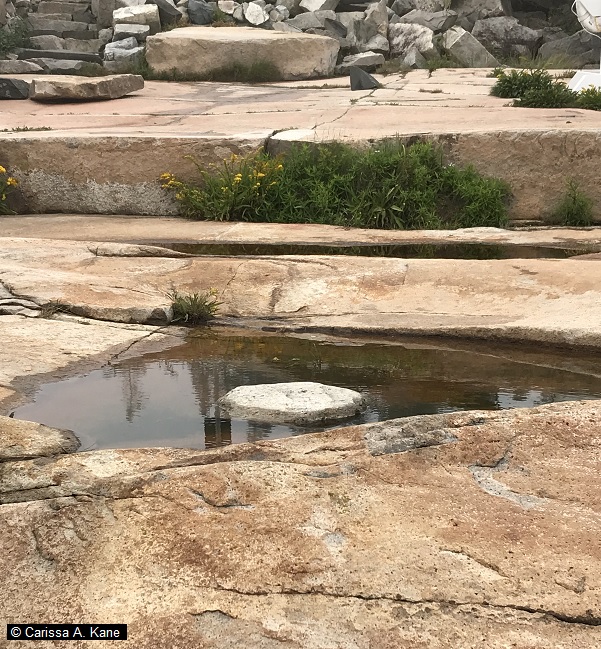
With the starting point blanketed in fog, one couldn’t help but wonder whether it would be worthwhile to venture out any further on this day. Yet, despite the limited visibility we carried on, coming across pockets that offered clearer vision—spots and places once hidden, where we could pause and gather our bearings. And as for the silence encompassing the mist all around, while at first eerie, with time becoming rather comforting, inspiring a sense of adventure and greater insight as we moved along the contours, crossed plateaus, and entered the ups and downs of our terrain.

Always a spot to rest, or safely step, provided when needed most.

Always a way around, over, or simply through, provided when needed most.

Always at the right time, in the right place, and in the right way, provided when needed most.

Interesting how most needs are met, in trusting, while moving toward, and searching for, what is truly needed.

He replied, “Rather, blessed are those who hear the word of God and observe it.” – Luke 11:28

Quieting the Murmur…

Depending upon one’s experiences, certain words can bring to mind a particular image or situation. Hearing or seeing the word, “murmur,” many people might think of the human heart and the condition of a heart murmur, speaking in a low volume as in under one’s breath, or perhaps a hushed conversation between a number of people within a larger setting. Interestingly, in any of these cases, the murmur, or anything else that may be transpiring, can be of no significance, or the opposite. And, as always, the only way to know more certainly is by tuning in more closely.

While searching to discover what’s going on may seem pretty basic or obvious, human nature often leads us toward conjecture, murmuring amongst ourselves rather than seeking the source directly and looking for the answers or understanding there.

In the Gospel according to John, chapter 6, verses 41-51, the people are in disbelief, and maybe confused about Jesus’s statement that he is the bread of life that has come down to earth from heaven. Filled with questions, and likely doubt, with a limited knowledge of who Jesus really is, they are quietly speaking amongst themselves. They are looking for answers from each other, even though none of them understand what was said or what Jesus meant by it. What might this passage, and what follows from it, look like if instead of asking each other, the people asked Jesus directly about his statements, and took careful notice of his response together with his actions?

Moving forward to the way that Jesus responds to the hushed voices going on around him, regarding him, it is as if Jesus is simply saying, “Stop,” to the gossip and speculation. He does not enter into the grumbling. He does not succumb to it, and the questions the people were asking each other instead of engaging directly with Jesus, go unanswered, while Jesus continues to focus on Truth, and giving voice to it. After all, the fact of the matter is that more often than not, it really is as simple as continually asking Jesus for help in seeing something for what it is, saying, “Stop,” to nonsense, understanding and embracing what is of genuine importance, and listening, so as to recognize when and how to be moved.

The Jews murmured about Jesus because he said,
“I am the bread that came down from heaven,”
and they said,
“Is this not Jesus, the son of Joseph?
Do we not know his father and mother?
Then how can he say,
‘I have come down from heaven’?”
Jesus answered and said to them,
“Stop murmuring among yourselves.
No one can come to me unless the Father who sent me draw him,
and I will raise him on the last day.
It is written in the prophets:
They shall all be taught by God.
Everyone who listens to my Father and learns from him comes to me.
Not that anyone has seen the Father
except the one who is from God;
he has seen the Father.
Amen, amen, I say to you,
whoever believes has eternal life.
I am the bread of life.
Your ancestors ate the manna in the desert, but they died;
this is the bread that comes down from heaven
so that one may eat it and not die.
I am the living bread that came down from heaven;
whoever eats this bread will live forever;
and the bread that I will give is my flesh for the life of the world.”

– John 6:41-51

The Sum of Kind and Wonderful…

With lots of rain this past week and existing conditions around the globe, it certainly seems like stormy times continue to be the pattern. Not only that, but it’s like they are holding as if super glue. So why not embrace them?

We know that the perfect storm forms out of what can be predicted or seen combined with what is unforeseen or unplanned. That is why such a storm often catches us off guard; there is an opening. Similarly, anything in life that is mutually beneficial, or truly divine, comes to fruition. And, even in the times when we cannot perceive or name it, there is always something more than what meets the eye, seeking to bear fruit. Always something more working through whatever failings or inadequacies there may be, to spread light and love, and ultimately, to break through, bringing what is good into the world.

During all this storminess, sometimes it can be tempting to look at life through a smaller lens, as if a mathematical equation to be solved. As if you get out of it what you put in, and the sum of all our human efforts creates a whole or complete picture of the end sought from the beginning. Yet, although these philosophies may be true to some extent, there is a lot more that comes into play for any given situation.

Often, in times like these, there is an invitation to see more clearly, and a reminder that while the surface may seem clear cut, Truth is encompassed in the depths and cannot be erased. It draws for us a complete picture, and what is Whole, never lies.

Lord, let us see your kindness, and grant us your salvation. – Psalm 85:8

Like a Lady…

Behold God beholding you… and smiling. – Anthony de Mello, SJ

Pausing to take a deep breath and take in a beautiful day, as I survey my surroundings, I take joy in a ladybug who comes into view, also exploring. Interested, I move closer to get a better view. There it is. Moving along, wings closed, orange with spots of black, yellow head, eyes, antennae, and legs; many parts, one body.

As I watch, I am amused by its way—steady… patient… gentle, but also driven—purposeful. Different, yet underneath it all, the same. A reminder to remember, everyone… everything, is heading somewhere, here and now, and eventually, as well as ultimately.

In the Gospel acclamation for the 14th Sunday in Ordinary Time, it is written, “The Spirit of the Lord is upon me, because he has anointed me to bring glad tidings to the poor” (Lk 4:18). If you had to re-write this sentence, applying it to yourself, what is it that the Lord has anointed or wants to anoint you for?

Moving on to the Gospel according to Mark, in chapter 6, verses 1-6, we read about Jesus essentially being shut out in his hometown area. It appears he is seen through a very narrow lens and because of this he is not welcome, encouraged, or accepted for who he truly is in the present. There is a lack of openness to the value he brings to the table, and he is limited in what he can accomplish.

It is important to remember that Jesus’s inability to be effective has nothing to do with Jesus. It is the result of the closed-minded, closed-hearted resistance he meets. A meaningful encounter cannot happen in the conditions that exist, and so, he must move on.

Perhaps one of the things Jesus is asking us in this passage is to examine the conditions that exist within our own hearts and minds. If, for example, we had to take our words and actions throughout the course of the day and insert them, one by one, at the end of the phrase, “The Spirit of the Lord is upon me, because he has anointed me to,” how would they fit in with Christianity?

In praying with this passage, as you hold dear the desire to honor the Lord whose Spirit is upon you, and who not only anoints you, but also delights in you, what invitation(s) is awaiting?

Jesus departed from there and came to his native place, accompanied by his disciples.
When the sabbath came he began to teach in the synagogue,
and many who heard him were astonished.
They said, “Where did this man get all this?
What kind of wisdom has been given him?
What mighty deeds are wrought by his hands!
Is he not the carpenter, the son of Mary,
and the brother of James and Joses and Judas and Simon?
And are not his sisters here with us?”
And they took offense at him.
Jesus said to them,
“A prophet is not without honor except in his native place
and among his own kin and in his own house.”
So he was not able to perform any mighty deed there,
apart from curing a few sick people by laying his hands on them.
He was amazed at their lack of faith. – Mark 6:1-6

What The World Needs Now…

In chapter 5 of the Gospel according to Mark, the saving power of Jesus is revealed in the healing of the man with unclean spirits (the Gerasene demoniac), the woman who had been hemorrhaging for 12 years, and the daughter of Jairus, a synagogue official. In all three cases, Jesus acts differently than what is expected, in that he is not afraid to meet and embrace those who have met misfortune, and are viewed as less than, and he does not treat anyone or anything as a lost cause or beyond repair. Because of this, even though what he has to offer is beneficial, to those who are married to one way of being he is seen as someone to be weary of and who is dangerous.

When Jesus heals the demoniac, sending the unclean spirits into a herd of swine who then head over the bank and into the sea where they meet their demise, folks become afraid. They cannot see the miracle in the healing that has taken place and ask him to leave. He does get in the boat and depart back to the other side. However, he also remains. The man he healed takes heed in Jesus’s instructions to him. In staying behind, Jesus is with him, and the man gives witness to what the Lord has done for him.

When the hemorrhaging woman touches his cloak, Jesus, who is on the way to heal the synagogue official’s daughter, stops, and takes time not only to seek and find the woman he has just healed, but also to engage with her. Despite fear, the woman comes forward to own, or to claim, the truth. In doing so, she is met, not with a critical, harsh, or condescending response, but rather with affirmation. She believed in Jesus and was willing to take a leap and trust in the healing that she sensed he could bring, when she dared to reached out to touch his garment as he passed by. With Jesus, there is no such thing as too little, too late, not worthwhile, or not enough time.

When it is announced that the synagogue official’s daughter is dead, and that he is no longer needed, Jesus does not turn away. He tells the girl’s father, “Do not be afraid. Just have faith.” (v. 36). Despite the news and being ridiculed by others, Jesus proceeds to their house and wakes the girl up. With Jesus, nothing is impossible.

As a Christian, one is called to follow Jesus, embracing the Way, and striving, through the grace of God, to live it. As challenging, uncomfortable, or unpopular as it may be, oftentimes, this requires change and evolution. Sometimes it may mean the opposite or a variation of the new ways and examples happening in the world, and at other times, it may mean the opposite or a variation of the old ways. Either way, the constant is Love, and the question is whether we trust God enough to let Love be the author.

It’s an incredible mystery of God’s love that the more you know how deeply you are loved, the more you will see how deeply your sisters and your brothers in the human family are loved. – Henri Nouwen

The True Vine…

The Self-revealing of the Word is in every dimension – above, in creation; below, in the Incarnation; in the depth, in Hades; in the breadth, throughout the world. All things have been filled with the knowledge of God. – Athanasius of Alexandria

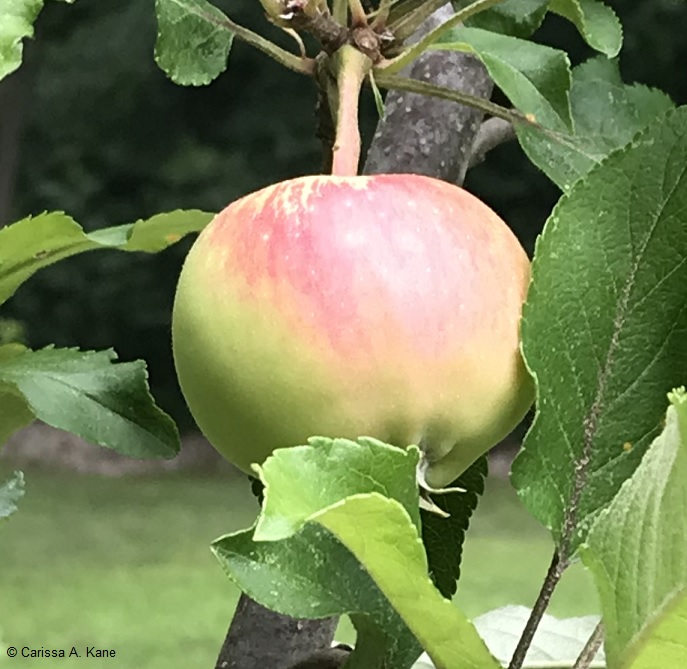
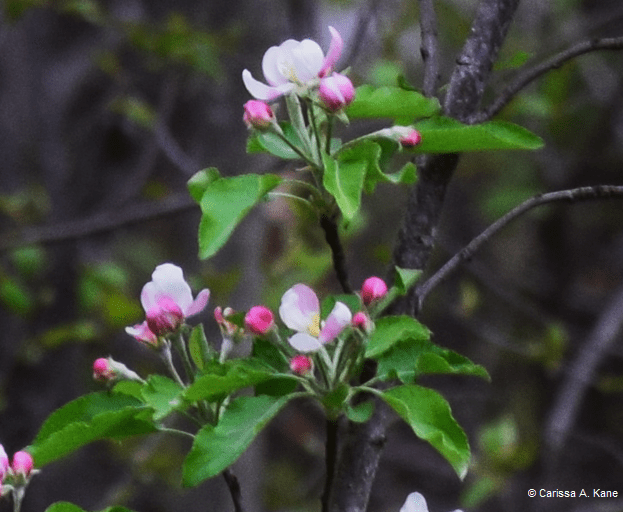
Looking out the kitchen window, a splash of pink amidst the green catches my eye. I turn back to what I am doing for a moment before realizing what that color is. As I look out again, more intently this time, I feel amazed at the way these blossoms have come into existence.

A few years ago, we planted a sapling. For the most part, since then, it looked more like a twig in the ground than a tree. Along the way, it seemed that it was not going to take. Often, we thought maybe it was on its way out. Still, we watered, fertilized, and staked it for support and so it would grow straight. It grew, and eventually produced some leaves, but largely retained the appearance of a twig in the ground, only taller and now with a little green.

Seeing the blossoms leads me to re-visit the journey. It is interesting how the little signs along the way, at the time they occurred, did not seem big enough. For example, there was growth and there were some leaves here and there, yet the recurring theme seemed to be “not what’s expected.” Looking at the blossoms now, I feel grateful that we gave it more time, kept trying, and did not give up.

Thinking about the world today and the circumstances that abound, maybe, deep down, and all around, at a level that we do not even know, we are learning to trust what we cannot see, or cannot yet understand. The question remains, do we desire truth, and do we have the patience and perseverance to receive it?

Jesus said to his disciples:
“I am the true vine, and my Father is the vine grower.
He takes away every branch in me that does not bear fruit,
and every one that does he prunes so that it bears more fruit.
You are already pruned because of the word that I spoke to you.
Remain in me, as I remain in you.
Just as a branch cannot bear fruit on its own
unless it remains on the vine,
so neither can you unless you remain in me.
I am the vine, you are the branches.
Whoever remains in me and I in him will bear much fruit,
because without me you can do nothing.
Anyone who does not remain in me
will be thrown out like a branch and wither;
people will gather them and throw them into a fire
and they will be burned.
If you remain in me and my words remain in you,
ask for whatever you want and it will be done for you.
By this is my Father glorified,
that you bear much fruit and become my disciples.” – John 15:1-8

Connected, Again and Again…

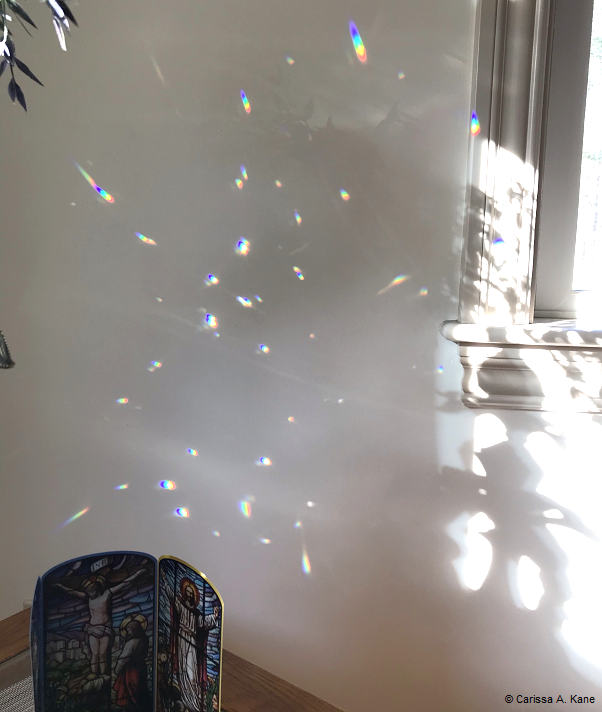
Upon entering the room, the display of rainbow-like bursts on one of the walls, captured my attention. Looking back now though, I see more clearly. Connections all around. The shadow once shed, takes on a new face. Taking up and letting go. To shed and re-shed from beginning to end. Tied together throughout by the image of God, and all eternally beloved. It’s in the air. Life and breath, width and depth. With God, it’s Universal.

The veil of the sanctuary was torn in two from top to bottom. – Mark 15:38

Waves of Light…

Over the past few weeks, as my son has worked on a film project, I have had the opportunity to follow the process of shooting and reshooting scenes, as well as making adjustments for both acoustics and lighting. Most noticeably, the lighting and the impact that it has on the ability to capture scenes in a way that is focused, crisp, and clear has been interesting. On one particular shoot, the light in the room was intermittently “shifting” as the sunlight shining in from a window and a breeze, moving branches outside the window, affected it.

It was striking to see what seemed like waves of light, here and there, moving across the room. While initially, it seemed that the light was doing nothing but interfering, in a different part of the room and from another angle, the lighting was just right and the footage was crystal clear.

In the Gospel according to John, chapter 9, verses 1 through 41, Jesus is the Light that makes things clear to those who desire to see with an open heart. Yet, some receive the Presence as something to be embraced and to lead the way, while others reject the Presence as something that is an interruption or nuisance.

So a second time the Pharisees called the man who had been blind and said to him, “Give God the praise! We know that this man, Jesus, is a sinner.” (For Jesus had healed the man on the Sabbath).

He replied, “If he is a sinner, I do not know. One thing I do know is that I was blind and now I see.”

So they said to him, “What did he do to you? How did he open your eyes?”

He answered them, “I told you already and you did not listen. Why do you want to hear it again? Do you want to become his disciples, too?”

They ridiculed him and said, “You are that man’s disciple; we are disciples of Moses! We know that God spoke to Moses, but we do not know where this one is from.”

The man answered and said to them, “This is what is so amazing, that you do not know where he is from, yet he opened my eyes. We know that God does not listen to sinners, but if one is devout and does his will, he listens to him.
It is unheard of that anyone ever opened the eyes of a person born blind. If this man were not from God, he would not be able to do anything.”

They answered and said to him, “You were born totally in sin, and are you trying to teach us?” Then they threw him out.

– John 9:24-34

Preoccupied with their own ambitions… focused on their own designs, the Pharisees could not recognize the Light… the truth about Jesus and the healing of the blind man. And therefore, understanding, appreciating, finding joy in the situation, being happy for the good fortune of the man who could now see, or being receptive to Jesus, would not be possible.

There is a saying that life is what you make of it, and another that people see what they want to see. Was the blind man a sinner? Were his parents sinners being punished with a blind son (as was the thinking at the time)? Was Jesus a sinner?

How might this passage be different if the Pharisees, had been open to the Light, or even simply the idea of it?

What difference or impact, does receiving the Light of Jesus make?

How does being open to the other side of the room or trying to take a view from a different angle, allow one to see and receive the Light, and to let Jesus lead?

I am the light of the world, says the Lord;
whoever follows me will have the light of life.   

– John 8:12

Genesis bringing Light all The Way through…

If not for the memory of the Light, I could not stand the silence in the darkness of the night.

In the beginning, when God created the heavens and the earth—and the earth was without form or shape, with darkness over the abyss and a mighty wind sweeping over the waters—Then God said: Let there be light, and there was light. God saw that the light was good. God then separated the light from the darkness. God called the light “day,” and the darkness he called “night.” Evening came, and morning followed—the first day.

– Genesis 1:1-5

On the eve of Christmas, in a year, that so many are glad, is coming to an end, there is so much up in the air. At times, it seems as if the world is pending, wobbling like a coin as its spin is heading toward an end. Yet, time continues, faith remains, and still, a hearty globe—goodness here and there—Goodness, always in the air. We think we wait, but really, all of Life believes in us, and is awaiting our arrival.

In the beginning was the Word, and the Word was with God, and the Word was God. He was in the beginning with God. All things came to be through him, and without him nothing came to be. What came to be through him was life, and this life was the light of the human race; the light shines in the darkness, and the darkness has not overcome it.

– John 1:1-5
Illustration by Nicola Gregory