Quieting the Murmur…

Depending upon one’s experiences, certain words can bring to mind a particular image or situation. Hearing or seeing the word, “murmur,” many people might think of the human heart and the condition of a heart murmur, speaking in a low volume as in under one’s breath, or perhaps a hushed conversation between a number of people within a larger setting. Interestingly, in any of these cases, the murmur, or anything else that may be transpiring, can be of no significance, or the opposite. And, as always, the only way to know more certainly is by tuning in more closely.

While searching to discover what’s going on may seem pretty basic or obvious, human nature often leads us toward conjecture, murmuring amongst ourselves rather than seeking the source directly and looking for the answers or understanding there.

In the Gospel according to John, chapter 6, verses 41-51, the people are in disbelief, and maybe confused about Jesus’s statement that he is the bread of life that has come down to earth from heaven. Filled with questions, and likely doubt, with a limited knowledge of who Jesus really is, they are quietly speaking amongst themselves. They are looking for answers from each other, even though none of them understand what was said or what Jesus meant by it. What might this passage, and what follows from it, look like if instead of asking each other, the people asked Jesus directly about his statements, and took careful notice of his response together with his actions?

Moving forward to the way that Jesus responds to the hushed voices going on around him, regarding him, it is as if Jesus is simply saying, “Stop,” to the gossip and speculation. He does not enter into the grumbling. He does not succumb to it, and the questions the people were asking each other instead of engaging directly with Jesus, go unanswered, while Jesus continues to focus on Truth, and giving voice to it. After all, the fact of the matter is that more often than not, it really is as simple as continually asking Jesus for help in seeing something for what it is, saying, “Stop,” to nonsense, understanding and embracing what is of genuine importance, and listening, so as to recognize when and how to be moved.

The Jews murmured about Jesus because he said,
“I am the bread that came down from heaven,”
and they said,
“Is this not Jesus, the son of Joseph?
Do we not know his father and mother?
Then how can he say,
‘I have come down from heaven’?”
Jesus answered and said to them,
“Stop murmuring among yourselves.
No one can come to me unless the Father who sent me draw him,
and I will raise him on the last day.
It is written in the prophets:
They shall all be taught by God.
Everyone who listens to my Father and learns from him comes to me.
Not that anyone has seen the Father
except the one who is from God;
he has seen the Father.
Amen, amen, I say to you,
whoever believes has eternal life.
I am the bread of life.
Your ancestors ate the manna in the desert, but they died;
this is the bread that comes down from heaven
so that one may eat it and not die.
I am the living bread that came down from heaven;
whoever eats this bread will live forever;
and the bread that I will give is my flesh for the life of the world.”

– John 6:41-51

With Whom…

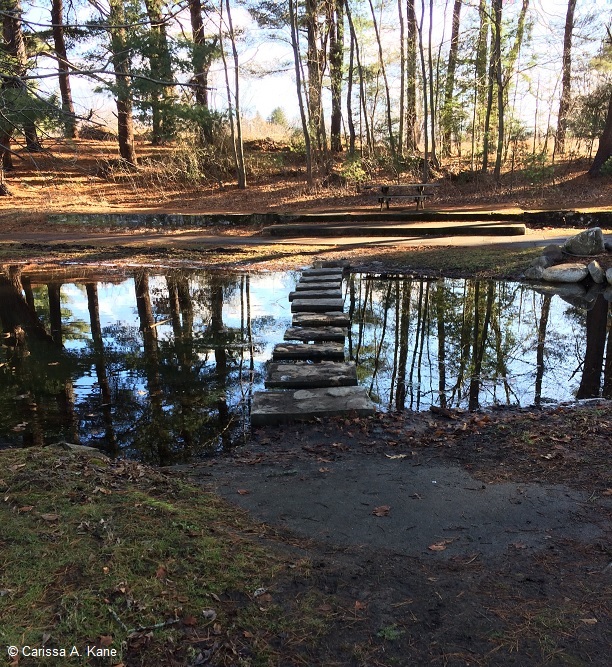
Pulling into an open lot along a scenic road, initially it seemed as though there was no place from which to view the water. Bushes and trees were all around, as if a fortress blocking the way to the water gently waving behind it. However, stepping out into the fresh air, with each movement closer, possibilities arose, until at last, nearer still and despite any preconceived notions, a path, narrow as could be, but still present, a way through appeared.

Oftentimes, there is much more than one might see or think there to be, yet it can be tempting to refrain from asking, disregard the invitation, and instead turn back, embrace presumptions from afar, and choose a side, rather than trusting that call, choosing to discover (ask and receive), allowing paths to appear and Truth to become known.

In the passage below, what resonates most with you at this moment? Which person(s) do you identify with and in what ways? How do you desire to be, and to live? Where is God in that desire?

The whole Israelite community grumbled against Moses and Aaron.
The Israelites said to them,
“Would that we had died at the Lord’s hand in the land of Egypt,
as we sat by our fleshpots and ate our fill of bread!
But you had to lead us into this desert
to make the whole community die of famine!”

Then the Lord said to Moses,
“I will now rain down bread from heaven for you.
Each day the people are to go out and gather their daily portion;
thus will I test them,
to see whether they follow my instructions or not.

On the sixth day, however, when they prepare what they bring in,
let it be twice as much as they gather on the other days.
So Moses and Aaron told all the Israelites,
“At evening you will know that it was the Lord
who brought you out of the land of Egypt;
and in the morning you will see the glory of the Lord,
when he hears your grumbling against him.
But who are we that you should grumble against us?”

And Moses said, “When the Lord gives you meat to eat in the evening
and in the morning your fill of bread,
and hears the grumbling you utter against him,
who then are we?
Your grumbling is not against us, but against the Lord.”

Then Moses said to Aaron, “Tell the whole Israelite community:
Approach the Lord, for he has heard your grumbling.”
But while Aaron was speaking to the whole Israelite community,
they turned in the direction of the wilderness,
and there the glory of the Lord appeared in the cloud!

The Lord said to Moses:
“I have heard the grumbling of the Israelites.
Tell them: In the evening twilight you shall eat flesh,
and in the morning you shall have your fill of bread,
so that you may know that I, the Lord, am your God.”

In the evening quail came up and covered the camp.
In the morning a dew lay all about the camp,
and when the dew evaporated, there on the surface of the desert
were fine flakes like hoarfrost on the ground.
On seeing it, the Israelites asked one another, “What is this?”
for they did not know what it was.
But Moses told them,
“This is the bread that the Lord has given you to eat.” – Exodus 16:2-15

Resetting the Pace…

After what seemed like quite a lot of time walking and winding our way, up, down, around, and through the wooded area embracing the large pond, we arrived at what appeared to be the center of our journey—the resting place. As we moved closer to the main building, designed for respite and a bite to eat, we were greeted by a wooden barrel holding purple and yellow flowers beckoning us to keep the journey going. Bright and beautiful flowers, they drew us—tired, hungry, weary travelers—in and lifted us up, raising the smile in our hearts to our lips and bringing the twinkle back to our eyes.

No matter the circumstances, the conditions along the way, or how far one travels, Peace is always reaching out, working from within, and waiting upon us.

Faith is the road, but communion with Jesus is the well from which the pilgrim drinks. ― Charles Haddon Spurgeon

Anima Christi

Soul of Christ, sanctify me.
Body of Christ, save me.
Blood of Christ, inebriate me.
Water from the side of Christ, wash me.
Passion of Christ, strengthen me.
O good Jesus, hear me.
Within Thy wounds hide me.
Separated from Thee let me never be.
From the malignant enemy, defend me.
At the hour of death, call me.
And close to Thee bid me.
That with Thy saints I may be Praising Thee, forever and ever.
Amen.

The Sum of Kind and Wonderful…

With lots of rain this past week and existing conditions around the globe, it certainly seems like stormy times continue to be the pattern. Not only that, but it’s like they are holding as if super glue. So why not embrace them?

We know that the perfect storm forms out of what can be predicted or seen combined with what is unforeseen or unplanned. That is why such a storm often catches us off guard; there is an opening. Similarly, anything in life that is mutually beneficial, or truly divine, comes to fruition. And, even in the times when we cannot perceive or name it, there is always something more than what meets the eye, seeking to bear fruit. Always something more working through whatever failings or inadequacies there may be, to spread light and love, and ultimately, to break through, bringing what is good into the world.

During all this storminess, sometimes it can be tempting to look at life through a smaller lens, as if a mathematical equation to be solved. As if you get out of it what you put in, and the sum of all our human efforts creates a whole or complete picture of the end sought from the beginning. Yet, although these philosophies may be true to some extent, there is a lot more that comes into play for any given situation.

Often, in times like these, there is an invitation to see more clearly, and a reminder that while the surface may seem clear cut, Truth is encompassed in the depths and cannot be erased. It draws for us a complete picture, and what is Whole, never lies.

Lord, let us see your kindness, and grant us your salvation. – Psalm 85:8

Waiting to be Found…

From childhood, the name Anthony has evoked two thoughts more prominently than others, spaghetti day and help in finding what has been lost— “St. Anthony, please come around: something is lost, and it cannot be found,” or the less formal, “Tony, Tony, look around. Something’s lost and must be found!”

Today, June 13th, is the feast day of St. Anthony of Padua whose life in words and actions is an inspiring example of participation in the Kingdom of God, here on earth, and everlasting. Anthony accepted the invitation, sought union with the Lord, and allowed himself to be led, leaving behind a path that guaranteed him earthly wealth and power. It seems so appropriate that the name Anthony means fortunate… blessed… praiseworthy… priceless. Words that create an image of abundance, and that one can also imagine applying to the Kingdom of God.

In the Book of the Prophet Ezekiel, it is written:

Thus says the Lord God:
I, too, will take from the crest of the cedar,
    from its topmost branches tear off a tender shoot,
and plant it on a high and lofty mountain;
    on the mountain heights of Israel I will plant it.
It shall put forth branches and bear fruit,
    and become a majestic cedar.
Birds of every kind shall dwell beneath it,
    every winged thing in the shade of its boughs.
And all the trees of the field shall know
    that I, the Lord,
bring low the high tree,
    lift high the lowly tree,
wither up the green tree,
    and make the withered tree bloom.
As I, the Lord, have spoken, so will I do. – Ez 17:22-24

Reading this passage, listening to the words and phrases within it, and considering the example of St. Anthony, one is reminded that just as the Lord stooped down, becoming one of, and with us, we also, are called to abandon lofty ideals, places, and practices. While the world, and all that is passing, might seek to grip and hold us down, God seeks to meet us on ground level, and elevate us to that which is eternal. In what ways, might this Divine invitation be accepted more fully?

“The creator of the heavens obeys a carpenter; the God of eternal glory listens to a poor virgin. Has anyone ever witnessed anything comparable to this? Let the philosopher no longer disdain from listening to the common laborer; the wise, to the simple; the educated, to the illiterate; a child of a prince, to a peasant.” – St. Anthony of Padua

The Gradual…

Some days seem to arrive so suddenly, despite all the moments along the way building and leading up to them. Occasions can seem so far away, distant, or perhaps remote in possibility, but then in a blink of an eye, there they are, upon us.

Looking back, quite often we can see that there was a gradual unfolding. Bit by bit, being led, pushing back, falling into, twisting and turning, moving toward, and perhaps eventually all out embracing the process in the making. And, almost always, right before our very eyes, like the rising and setting of the sun, or the movement of the wind and drifting of the clouds.

Purpose and meaning, and yes, a point, even in the midst, or lack, of human understanding.

In the Gospel according to Mark, after the preparation and celebration of the Passover, on the day that would become known as the Lord’s supper, we read:

“Then, after singing a hymn, they went out to the Mount of Olives” (Mk 14:26).

To sing a song of thanksgiving to God would have been a very normal and traditional thing to do in bringing the Passover meal to a close. Yet what was revealed during the Lord’s supper and what was about to transpire, was not so traditional. Here is a look at it:

Jesus tells the disciples, “…one of you will betray me…” (14:18) leading to angst within each of them as they take turns asking, “Surely it is not I?” (14:19), he introduces and enters a new covenant where he, the Savior, is the sacrificial lamb (14:22-24), and then Jesus tells them, “I shall not drink again the fruit of the vine until the day when I drink it new in the kingdom of God” (14:25).

Imagine what it must have been like for the disciples as they experienced this, then sang a hymn of thanksgiving and praise, and prepared to go out to the Mount of Olives. They probably did not understand, or fully grasp, what had happened during the Passover meal.

Imagine also being told by Jesus, “All of you will have your faith shaken, for it is written: ‘I will strike the shepherd, and the sheep will be dispersed.’ But after I have been raised up, I shall go before you to Galilee.” (14:27-28). Yes, they were foretold the things that would happen, but still, they did not know the circumstances they were about to step into—the Agony in the Garden.

However, the disciples did know that they were with the Lord, and that the Lord was with them. They also had the experience of being in Jesus’ presence and a tradition of faith that had carried them throughout their lives, led them to the Lord’s supper, and would lead them through the moments that were ahead. Overall, one might say, all these things combined is what enabled them to trust, perhaps without even knowing that was what they were doing, as they left the Passover meal and stepped out, heading toward the Mount of Olives, and landing in the garden, and all that awaited them.

“I will take the cup of salvation, and call on the name of the Lord.” – Psalm 116:13

Shelter in the storm, and out…

Inside seeking shelter on a very stormy day, I hear the wind howling… beckoning, come and see.

Looking out the window, great and mighty power, the surge before my eyes.

The wind, it whips and stirs. The waves, they’re in a frenzy, crashing down on all, in the way or not.

Rain, it’s driven sideways. I wonder if it minds.

Then, the birds. Something else. Just being birds, but more. Unphased by all the bother. Flying high, swooping low, drifting, diving, floating, gliding, in the winds that blow.

Beauty in the chaos. Stillness in the storm.

Trusting, not resisting.

All, it will be well.

Listening, not withdrawing, but drawing from within.

Knowing, sensing, feeling, it is—the One who is.

All, it is well.

The True Vine…

The Self-revealing of the Word is in every dimension – above, in creation; below, in the Incarnation; in the depth, in Hades; in the breadth, throughout the world. All things have been filled with the knowledge of God. – Athanasius of Alexandria

Looking out the kitchen window, a splash of pink amidst the green catches my eye. I turn back to what I am doing for a moment before realizing what that color is. As I look out again, more intently this time, I feel amazed at the way these blossoms have come into existence.

A few years ago, we planted a sapling. For the most part, since then, it looked more like a twig in the ground than a tree. Along the way, it seemed that it was not going to take. Often, we thought maybe it was on its way out. Still, we watered, fertilized, and staked it for support and so it would grow straight. It grew, and eventually produced some leaves, but largely retained the appearance of a twig in the ground, only taller and now with a little green.

Seeing the blossoms leads me to re-visit the journey. It is interesting how the little signs along the way, at the time they occurred, did not seem big enough. For example, there was growth and there were some leaves here and there, yet the recurring theme seemed to be “not what’s expected.” Looking at the blossoms now, I feel grateful that we gave it more time, kept trying, and did not give up.

Thinking about the world today and the circumstances that abound, maybe, deep down, and all around, at a level that we do not even know, we are learning to trust what we cannot see, or cannot yet understand. The question remains, do we desire truth, and do we have the patience and perseverance to receive it?

Jesus said to his disciples:
“I am the true vine, and my Father is the vine grower.
He takes away every branch in me that does not bear fruit,
and every one that does he prunes so that it bears more fruit.
You are already pruned because of the word that I spoke to you.
Remain in me, as I remain in you.
Just as a branch cannot bear fruit on its own
unless it remains on the vine,
so neither can you unless you remain in me.
I am the vine, you are the branches.
Whoever remains in me and I in him will bear much fruit,
because without me you can do nothing.
Anyone who does not remain in me
will be thrown out like a branch and wither;
people will gather them and throw them into a fire
and they will be burned.
If you remain in me and my words remain in you,
ask for whatever you want and it will be done for you.
By this is my Father glorified,
that you bear much fruit and become my disciples.” – John 15:1-8

More than a recipe…

I did not learn to make hummus, with just the “right” amount of fresh garlic, salt, and lemon juice by eating it, reading a recipe, or watching my mother make it over, and over again. Rather, I learned by taking what I saw, remembering what I had tasted, and trying to make it myself, over, and over again. After all, the most helpful way to learn is by ongoing, active observance, repetition, participation, reflection, and openness to growth.

While experience is key, it is interesting that oftentimes as experience increases, awareness to room for improvement can lessen, or even disappear. With that, it may be more than tempting to take moments and situations for granted, rote, or with a “nothing new here” spirit. However, even the process of washing, rinsing, and repeating, holds newness and opportunity with each turn.

In the Gospel according to John, a week later, when the disciples were still locked in the room, Jesus appeared again (Jn 20:26). What was it like for the disciples who had seen the risen Jesus the first time he had appeared? Was it just a been there, done that, repeat for them, or were they able to experience the second appearance in a new or deeper way?

What was the attitude in the room? Were the disciples who had previously seen Jesus able to receive this visitation as being as much for them as it was for Thomas? To whom was Jesus speaking when he said to Thomas, “Have you come to believe because you have seen me?”

In the Gospel according to Mark, chapter 16, verse 11, it is written that when Mary Magdalene told the disciples that the risen Jesus had appeared to her outside the tomb, they did not believe without seeing either. Did the disciples remember this, when Thomas said, “Unless I see the mark of the nails in his hands and put my finger into the nailmarks and put my hand into his side, I will not believe.”(Jn 20:27)?

What did Thomas think, when Jesus said to him, “Have you come to believe because you have seen me? Blessed are those who have not seen and have believed.” (John 20:29)? What did he feel? Perhaps, he felt bad that he did not believe what he had been told by the other disciples. Or, perhaps Thomas felt joy that Jesus heard his need, and responded to it, allowing him to experience the risen Jesus himself.

After all, whether making hummus , dealing with faith, or anything else for which there may be “recipes” or popular thought, there is always more than what is on the page, for “Experience is the teacher of all things” (attributed to Julius Ceasar).

In all times, but most especially in those that are challenging, we must consider experience, both our own and that of others. What has it been like? Do we remember the times and places where we have doubted, questioned, or disagreed, and, do we extend the same courtesy, patience, peace, and understanding that Jesus extends to us, to others?

On the evening of that first day of the week,
when the doors were locked, where the disciples were,
for fear of the Jews,
Jesus came and stood in their midst
and said to them, “Peace be with you.”
When he had said this, he showed them his hands and his side.
The disciples rejoiced when they saw the Lord.
Jesus said to them again, “Peace be with you.
As the Father has sent me, so I send you.”
And when he had said this, he breathed on them and said to them,
“Receive the Holy Spirit.
Whose sins you forgive are forgiven them,
and whose sins you retain are retained.”
Thomas, called Didymus, one of the Twelve,
was not with them when Jesus came.
So the other disciples said to him, “We have seen the Lord.”
But he said to them,
“Unless I see the mark of the nails in his hands
and put my finger into the nailmarks
and put my hand into his side, I will not believe.”
Now a week later his disciples were again inside
and Thomas was with them.
Jesus came, although the doors were locked,
and stood in their midst and said, “Peace be with you.”
Then he said to Thomas, “Put your finger here and see my hands,
and bring your hand and put it into my side,
and do not be unbelieving, but believe.”
Thomas answered and said to him, “My Lord and my God!”
Jesus said to him, “Have you come to believe because you have seen me?
Blessed are those who have not seen and have believed.”
Now Jesus did many other signs in the presence of his disciples
that are not written in this book.
But these are written that you may come to believe
that Jesus is the Christ, the Son of God,
and that through this belief you may have life in his name. – John 20:19-31

Underneath it All…

After Jesus’ body was laid in the tomb, a large stone was placed in front of the opening to it, and life for those seemingly left behind, although altered, carried on.

Then, the third day…

They were saying to one another, “Who will roll back the stone for us from the entrance to the tomb?” – Mark 16:3

Envisioning the stone obstructing the way, brings me back to an instance from childhood.  I recall one year in particular when there was work being done in our backyard that required excavation. Things were going along smoothly until a large boulder, seemingly immovable, was unearthed.

As a result, everything came to a halt and it stayed that way for a number of days. The contractor’s equipment was insufficient to move such a large object. Eventually, though, special equipment was brought in to move the boulder to the perimeter of the backyard. Now out of the way, the work that had been started was able to be completed.

In the days and years that followed, when playing or hanging out with siblings or friends, or just looking out across the yard, there was the boulder. Thinking back, it’s interesting that while some things that seemed so large in size during childhood, seem to have shrunken in adulthood, the boulder remained unchanged. It was huge then, and it is huge now. Still an awesome reminder that every situation, even the unexpected or seemingly impossible, can be overcome.  

As the second Easter Sunday amidst Covid-19 times approaches, many thoughts and emotions surface around all that has transpired over the course of the past year, and more. In “normal” times, the experiences one encounters can be challenging enough, never mind a pandemic. Yet, despite the challenges and struggles, there is always help. That’s the promise.

When Mary Magdalene, Mary, the mother of James, and Salome, went to the tomb to anoint Jesus’ body, they expected the stone to be in the way, and they expected that they would need help. What they didn’t know, was that the stone had already been rolled back, and all that was left, was for them to arrive.

When the sabbath was over,
Mary Magdalene, Mary, the mother of James, and Salome
bought spices so that they might go and anoint him.
Very early when the sun had risen,
on the first day of the week, they came to the tomb.
They were saying to one another,
“Who will roll back the stone for us
from the entrance to the tomb?”
When they looked up,
they saw that the stone had been rolled back;
it was very large.
On entering the tomb they saw a young man
sitting on the right side, clothed in a white robe,
and they were utterly amazed.
He said to them, “Do not be amazed!
You seek Jesus of Nazareth, the crucified.
He has been raised; he is not here.
Behold the place where they laid him.
But go and tell his disciples and Peter,
‘He is going before you to Galilee;
there you will see him, as he told you.’” – Mark 16:1-7

Savior, he can move the mountains
My God is mighty to save
He is mighty to save
Forever author of Salvation
He rose and conquered the grave

Jesus conquered the grave – Ben Fielding/Reuben Morgan – Mighty to Save