The readings for the Third Sunday of Lent can be seen as an invitation to pray and reflect on our encounters with God and others, the conversations that arise during them as well as after, and how we determine what we hold onto and listen to.
After the prophet Moses led the Israelites out of Egypt and into the wilderness, they started to become disgruntled. God provided food for them in the form of quail and manna, however, as the days passed their unhappiness grew as they still did not know what was next and where they would end up. Their existence became a grind and a growing number of the people began to feel like maybe they would have been better off not following Moses; perhaps their current situation was worse than being enslaved in Egypt.
The First Reading (Exodus 17:3-7) has Moses receiving complaints and being well aware of the growing displeasure among the people. He’s in a “What now?” moment.
So Moses cried out to the Lord,
“What shall I do with this people?
a little more and they will stone me!” – v. 4
What strikes you most from the verse above? What are your conversations with God like during your “What now?” moments?
In the following verse, the Lord responds to Moses and tells him what to do. What do you notice about the Lord’s answer?
“Go over there in front of the people,
along with some of the elders of Israel,
holding in your hand, as you go,
the staff with which you struck the river.
I will be standing there in front of you on the rock in Horeb.
Strike the rock, and the water will flow from it
for the people to drink.” – v. 5-6
In what ways do you trust God to provide for you and others during challenging times? How about during less difficult times?
Recall a time when you cried out to God, and God provided for both you and others.
The First Reading ends with:
The place was called Massah and Meribah,
because the Israelites quarreled there
and tested the Lord, saying,
“Is the Lord in our midst or not?” – v. 7
What do you make of the people quarreling? How do you imagine something like that could impact a sense of trust in the community? And in God?
The response for the Psalm is:
“If today you hear God’s voice, harden not your hearts.” – Ps 95:8.
Again, thinking about your conversations with God, what level of transparency do they reflect? Are there areas where you may be holding back, or you feel like God is? Take some prayer time to express your thoughts and feelings on this and to allow room for God’s insight to be shared with you.
The Second Reading (Romans 5:1-2, 5-8), begins with: “Brothers and sisters:”
If you were to use this greeting, who would be included as brothers and sisters?
This letter to the Romans continues:
Since we have been justified by faith,
we have peace with God through our Lord Jesus Christ,
through whom we have gained access by faith
to this grace in which we stand,
and we boast in hope of the glory of God.
Have there been times when you have felt justified by faith? What made you feel that way or what were the signs? And what was it like?
The passage is completed with the following verses:
And hope does not disappoint,
because the love of God has been poured out into our hearts
through the Holy Spirit who has been given to us.
For Christ, while we were still helpless,
died at the appointed time for the ungodly.
Indeed, only with difficulty does one die for a just person,
though perhaps for a good person one might even find courage to die.
But God proves his love for us
in that while we were still sinners Christ died for us.
How has God’s love been poured out into your heart? What has the impact been? And how do your choices reflect that love to God, yourself, and to others?
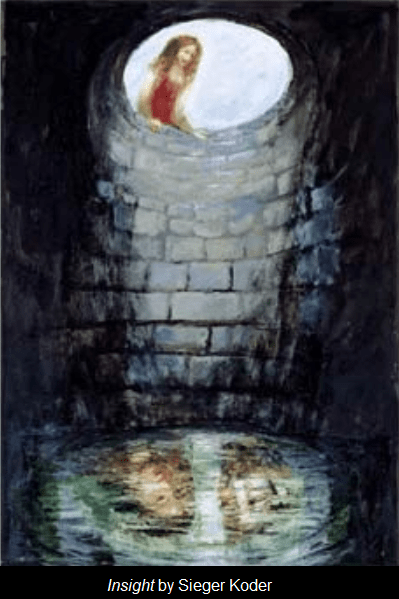
In the Gospel Reading (John 4:5-42), we read about Jesus, a Jew, and the woman at the well, a Samaritan. Each comes from a line of people who normally steer clear of each other. Thinking about this atypical exchange back then and life today, how do you desire to respond to the “atypical”?
Next, consider Jesus’s words around water and food, things that last a limited amount of time before one needs to acquire more, as an invitation to look more closely at what’s been on your plate and the concerns you are carrying. As you do so, contemplate what you are seeking and from where you are seeking it.
What does the Lord want to reveal to you?
Lord, you are truly the Savior of the world; give me living water, that I may never thirst again. – John 4:42, 15

 HopeThatFloats
You must be logged in to post a comment.