Literally, the second the light turns green, horns are honking. Sometimes, it is from cars two or three deep in line! Imagine if instead of cars on the roads, it was just people, single file, moving on foot. Stop or go to the rhythm of the traffic lights. Perhaps it would be more like the game musical chairs than the one named “Simon Says,” but in today’s world, likely more dangerous, and certainly far more intense.
While in situations like driving, signs of impatience can be much easier to spot, at other times it can be harder to see when patience is absent or slipping away. The second reading for the Third Sunday of Advent (Jas 5:7-10), begins with, “Be patient, brothers and sisters.” It seems so fitting that during one of the busiest times of the year for many people, these verses in the Letter of James contain a form of the word, and urges patience four times, once each in three out of the four verses. And, as for the one verse that doesn’t use the word, it calls us to ponder one of the ways that human beings tend to handle displeasure with one another (“Do not complain, brothers, about one another, that you may not be judged.” – v.9).
Think of a recent experience where you were on the receiving end of your own or someone else’s impatience or displeasure. What happened? And what judgments were involved?
Now, think of a recent experience where you were the one responding with impatience or displeasure. What was going on? And what opinions or beliefs were involved?
In each situation, how might an increase of your own patience have improved the situation or the aftermath of it?
When pausing to think of recent experiences where patience was lacking or displeasure arose, on someone else’s part or on your part, which experience was easier to recall? Which experience came to mind more quickly?
It can be tempting to see patience in terms of something someone has or does not have. However, like any other attribute, it’s possible for it to exist in some situations and not in others. This is important because oftentimes it can be easy to think, “I’m patient,” or “I’m…” this or that based on a small sampling of situations that one’s ego might readily serve up to “pass the test” and move us along from further introspection and possibly attaining additional growth and greater freedom; things that are impossible without honestly looking across and considering the spectrum of one’s life experiences.
An Advent Prayer: Lord, help me to allow you to direct the pace of each day. Through my stopping and going, and all that may occur between, may my actions and responses reflect grace and genuine patience and understanding that flows from you, regardless of what I may or may not receive in return. And help me to continue to look to you, that you may grant me the grace to notice and appreciate the beauty and goodness of all creation, and the heart and soul of those I encounter each day.
Be patient, brothers and sisters, until the coming of the Lord. See how the farmer waits for the precious fruit of the earth, being patient with it until it receives the early and the late rains. You too must be patient. Make your hearts firm, because the coming of the Lord is at hand. Do not complain, brothers and sisters, about one another, that you may not be judged. Behold, the Judge is standing before the gates. Take as an example of hardship and patience, brothers and sisters, the prophets who spoke in the name of the Lord. – James 5:7-10
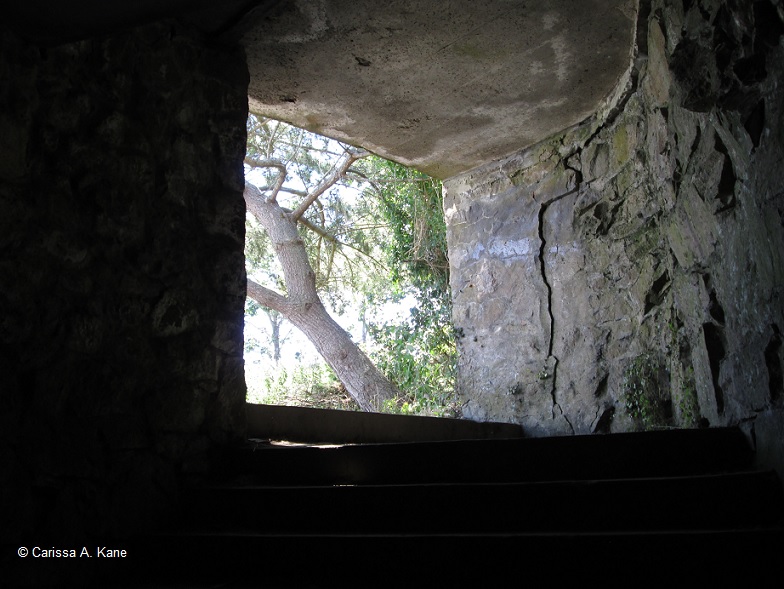
Heading out to somewhere that was new to us, we carried an excitement along the way. After quite some time on foot and feeling a little weary, we unexpectedly came to a tunnel. We had no idea how long it was or what was involved in getting through it. On top of that, all we could see was that it was pitch black inside. However, knowing it was part of the route and using one of the tools we had, a cellphone flashlight, we proceeded step by step, shining the light so we could see, and making our way through each curve until eventually we saw light coming from the opening on the other side.
However, if we didn’t have a flashlight, or a tool, to help us navigate through the darkness, I’m not sure we would have gone through that tunnel. Instead, we probably would’ve found a way around it or turned around and headed back to where we began. And, while finding a way around an obstacle or avoiding it, may be harmless in some cases, in others it is not. Sometimes the measures one may take to circumnavigate or escape a situation, may also lead to compromising, in one way or another, the well-being of oneself and/or others.
Considering the readings for the Twenty-seventh Sunday in Ordinary Time, they provide advice, wisdom, and encouragement to strive to serve God, not man, and to trust in God’s plan and in God’s ways. This is important no matter the time or place, but most especially in troubling or challenging times and environments.
If the knowledge that there is light at the end of the tunnel, and a way to make it through darkness, was enough to sustain courage, integrity, and faithfulness on its own, humankind would not fall prey to the shortcuts, traps, and tricks along the way. Faith is the tool that holds the keys and keeps one and all together; hearts, souls, and minds. It enables one “to be more than,” infused with grace, driven by truth and trust to face challenges, and find and follow the way through darkness; oftentimes leading one to discover a depth they never knew existed within them.
Take some time to read the Scripture passages from the Twenty-seventh Sunday in Ordinary Time (Hab 1:2-3; 2:2-4, Ps 95:1-2, 6-7, 8-9, 2 Tm 1:6-8, 13-14, and Lk 17:5-10 – shown below). Contemplate them in relation to today’s world. What are your concerns? What are some of the phrases or images that inspire you? Allow your heart and mind to draw together. Invite Jesus into the process and see what happens.
How long, O Lord? I cry for help but you do not listen! I cry out to you, “Violence!” but you do not intervene. Why do you let me see ruin; why must I look at misery? Destruction and violence are before me; there is strife, and clamorous discord. Then the Lord answered me and said: Write down the vision clearly upon the tablets, so that one can read it readily. For the vision still has its time, presses on to fulfillment, and will not disappoint; if it delays, wait for it, it will surely come, it will not be late. The rash one has no integrity; but the just one, because of his faith, shall live. – Hab 1:2-3; 2:2-4
R. If today you hear his voice, harden not your hearts. Come, let us sing joyfully to the Lord; let us acclaim the Rock of our salvation. Let us come into his presence with thanksgiving; let us joyfully sing psalms to him. R. If today you hear his voice, harden not your hearts. Come, let us bow down in worship; let us kneel before the Lord who made us. For he is our God, and we are the people he shepherds, the flock he guides. R. If today you hear his voice, harden not your hearts. Oh, that today you would hear his voice: “Harden not your hearts as at Meribah, as in the day of Massah in the desert, Where your fathers tempted me; they tested me though they had seen my works.” R. If today you hear his voice, harden not your hearts. – Ps 95:1-2, 6-7, 8-9
Beloved: I remind you, to stir into flame the gift of God that you have through the imposition of my hands. For God did not give us a spirit of cowardice but rather of power and love and self-control. So do not be ashamed of your testimony to our Lord, nor of me, a prisoner for his sake; but bear your share of hardship for the gospel with the strength that comes from God. Take as your norm the sound words that you heard from me, in the faith and love that are in Christ Jesus. Guard this rich trust with the help of the Holy Spirit that dwells within us. – 2 Tm 1:6-8, 13-14
The apostles said to the Lord, “Increase our faith.” The Lord replied, “If you have faith the size of a mustard seed, you would say to this mulberry tree, ‘Be uprooted and planted in the sea,’ and it would obey you. “Who among you would say to your servant who has just come in from plowing or tending sheep in the field, ‘Come here immediately and take your place at table’? Would he not rather say to him, ‘Prepare something for me to eat. Put on your apron and wait on me while I eat and drink. You may eat and drink when I am finished’? Is he grateful to that servant because he did what was commanded? So should it be with you. When you have done all you have been commanded, say, ‘We are unprofitable servants; we have done what we were obliged to do.'” – Lk 17:5-10
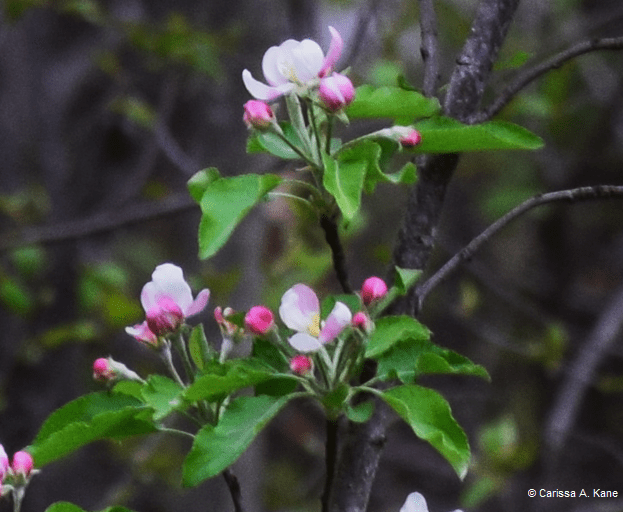
Watching as the branches fill in, flowers blossom, pollen wafts through the air, and Spring burgeons and unfolds, there is a sense of awe. In the Book of Revelation, it is written, “The One who sat on the throne said, ‘Behold, I make all things new.’” (Rev 21:5a). Not some things, or only certain things, but all things. Thinking about this, I cannot help but consider this concept further and ask, “Am I open to all things being made new by God?”
The flowers grow and open, pretty much wherever they are planted. And certainly, there are some conditions necessary for their maturity and well-being—light, water, nutrients, and some level of protection from harsher elements and realities. However, the things vital to their growth can be found or seep in even in unexpected places, and overall, flowers grow where they will.
In chapter 14, verses 21-27, of the Acts of the Apostles, we continue to learn of the experiences of Paul and Barnabas as they travel on, inspired by their discipleship desire. Their journey leads them back to Antioch, the place of resistance from where they were expelled in chapter 13.
It is written:
“From there they sailed to Antioch, where they had been commended to the grace of God for the work they had now accomplished. And when they arrived, they called the church together and reported what God had done with them and how he had opened the door of faith to the Gentiles.” – (verses 26-27)
Imagine. God called them to something more, launching something new from the very place that was not open to receiving them at the time. It turns out God had somewhere else in mind for them. How did they react or respond?
Paul and Barnabas were willing to let go of their notions and allow themselves to be led to other territories where they not only experienced what God had in mind, but also deepened their faith. Eventually, they were led back to Antioch, where, because of God who makes all things new, they were able to meet resistance with something more, something stronger, faithful witness to the Glory of God.
So just as flowers grow where they will, so too Paul and Barnabas… so too us. If we are open to it.
The Prophet Isaiah foretold of John the Baptist, the voice crying out in the desert, urging people to make themselves ready to receive the Lord. And while it is true that earthly life can be viewed as a process of preparing for eternal life, it is so much more than a checklist based upon human understanding. So, while it may be tempting to repeat the sounding joy by clinging to what one knows during the season of Advent, no preparation would be complete without moving beyond our own ideas about it and allowing ourselves some time to steep in the love of God more deeply, and then to be led by it.
The way of the Lord has already been prepared. Not just for the Lord, but also for all those who wish to claim and proclaim their inheritance as God’s people. We must remember that we’re not called to be like John the Baptist. We’re called to be like Jesus. How does, and how can, God help our individual ways to greater reflect the beauty and goodness of the Way? And are we willing to go there?
In the fifteenth year of the reign of Tiberius Caesar, when Pontius Pilate was governor of Judea, and Herod was tetrarch of Galilee, and his brother Philip tetrarch of the region of Ituraea and Trachonitis, and Lysanias was tetrarch of Abilene, during the high priesthood of Annas and Caiaphas, the word of God came to John the son of Zechariah in the desert. John went throughout the whole region of the Jordan, proclaiming a baptism of repentance for the forgiveness of sins, as it is written in the book of the words of the prophet Isaiah: A voice of one crying out in the desert: “Prepare the way of the Lord, make straight his paths. Every valley shall be filled and every mountain and hill shall be made low. The winding roads shall be made straight, and the rough ways made smooth, and all flesh shall see the salvation of God.” – Luke 3:1-6
Behold God beholding you… and smiling. – Anthony de Mello, SJ
Pausing to take a deep breath and take in a beautiful day, as I survey my surroundings, I take joy in a ladybug who comes into view, also exploring. Interested, I move closer to get a better view. There it is. Moving along, wings closed, orange with spots of black, yellow head, eyes, antennae, and legs; many parts, one body.
As I watch, I am amused by its way—steady… patient… gentle, but also driven—purposeful. Different, yet underneath it all, the same. A reminder to remember, everyone… everything, is heading somewhere, here and now, and eventually, as well as ultimately.
In the Gospel acclamation for the 14th Sunday in Ordinary Time, it is written, “The Spirit of the Lord is upon me, because he has anointed me to bring glad tidings to the poor” (Lk 4:18). If you had to re-write this sentence, applying it to yourself, what is it that the Lord has anointed or wants to anoint you for?
Moving on to the Gospel according to Mark, in chapter 6, verses 1-6, we read about Jesus essentially being shut out in his hometown area. It appears he is seen through a very narrow lens and because of this he is not welcome, encouraged, or accepted for who he truly is in the present. There is a lack of openness to the value he brings to the table, and he is limited in what he can accomplish.
It is important to remember that Jesus’s inability to be effective has nothing to do with Jesus. It is the result of the closed-minded, closed-hearted resistance he meets. A meaningful encounter cannot happen in the conditions that exist, and so, he must move on.
Perhaps one of the things Jesus is asking us in this passage is to examine the conditions that exist within our own hearts and minds. If, for example, we had to take our words and actions throughout the course of the day and insert them, one by one, at the end of the phrase, “The Spirit of the Lord is upon me, because he has anointed me to,” how would they fit in with Christianity?
In praying with this passage, as you hold dear the desire to honor the Lord whose Spirit is upon you, and who not only anoints you, but also delights in you, what invitation(s) is awaiting?
Jesus departed from there and came to his native place, accompanied by his disciples. When the sabbath came he began to teach in the synagogue, and many who heard him were astonished. They said, “Where did this man get all this? What kind of wisdom has been given him? What mighty deeds are wrought by his hands! Is he not the carpenter, the son of Mary, and the brother of James and Joses and Judas and Simon? And are not his sisters here with us?” And they took offense at him. Jesus said to them, “A prophet is not without honor except in his native place and among his own kin and in his own house.” So he was not able to perform any mighty deed there, apart from curing a few sick people by laying his hands on them. He was amazed at their lack of faith. – Mark 6:1-6
The Self-revealing of the Word is in every dimension – above, in creation; below, in the Incarnation; in the depth, in Hades; in the breadth, throughout the world. All things have been filled with the knowledge of God. – Athanasius of Alexandria
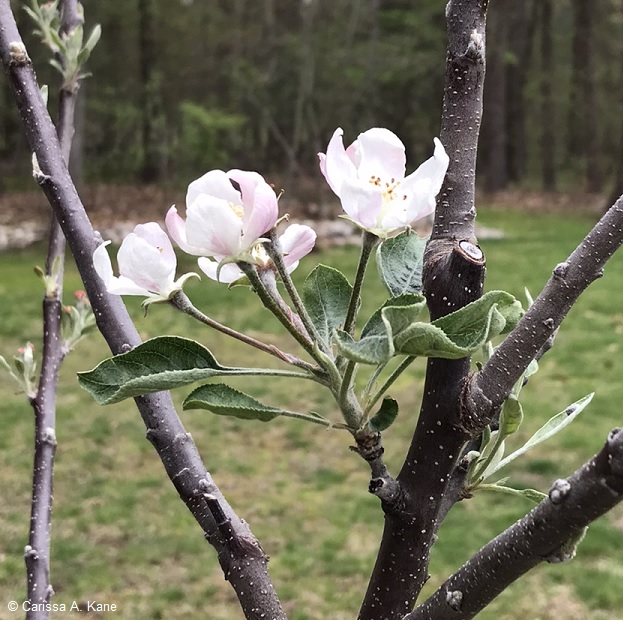
Looking out the kitchen window, a splash of pink amidst the green catches my eye. I turn back to what I am doing for a moment before realizing what that color is. As I look out again, more intently this time, I feel amazed at the way these blossoms have come into existence.
A few years ago, we planted a sapling. For the most part, since then, it looked more like a twig in the ground than a tree. Along the way, it seemed that it was not going to take. Often, we thought maybe it was on its way out. Still, we watered, fertilized, and staked it for support and so it would grow straight. It grew, and eventually produced some leaves, but largely retained the appearance of a twig in the ground, only taller and now with a little green.
Seeing the blossoms leads me to re-visit the journey. It is interesting how the little signs along the way, at the time they occurred, did not seem big enough. For example, there was growth and there were some leaves here and there, yet the recurring theme seemed to be “not what’s expected.” Looking at the blossoms now, I feel grateful that we gave it more time, kept trying, and did not give up.
Thinking about the world today and the circumstances that abound, maybe, deep down, and all around, at a level that we do not even know, we are learning to trust what we cannot see, or cannot yet understand. The question remains, do we desire truth, and do we have the patience and perseverance to receive it?
Jesus said to his disciples: “I am the true vine, and my Father is the vine grower. He takes away every branch in me that does not bear fruit, and every one that does he prunes so that it bears more fruit. You are already pruned because of the word that I spoke to you. Remain in me, as I remain in you. Just as a branch cannot bear fruit on its own unless it remains on the vine, so neither can you unless you remain in me. I am the vine, you are the branches. Whoever remains in me and I in him will bear much fruit, because without me you can do nothing. Anyone who does not remain in me will be thrown out like a branch and wither; people will gather them and throw them into a fire and they will be burned. If you remain in me and my words remain in you, ask for whatever you want and it will be done for you. By this is my Father glorified, that you bear much fruit and become my disciples.” – John 15:1-8
Over the past few weeks, as my son has worked on a film project, I have had the opportunity to follow the process of shooting and reshooting scenes, as well as making adjustments for both acoustics and lighting. Most noticeably, the lighting and the impact that it has on the ability to capture scenes in a way that is focused, crisp, and clear has been interesting. On one particular shoot, the light in the room was intermittently “shifting” as the sunlight shining in from a window and a breeze, moving branches outside the window, affected it.
It was striking to see what seemed like waves of light, here and there, moving across the room. While initially, it seemed that the light was doing nothing but interfering, in a different part of the room and from another angle, the lighting was just right and the footage was crystal clear.
In the Gospel according to John, chapter 9, verses 1 through 41, Jesus is the Light that makes things clear to those who desire to see with an open heart. Yet, some receive the Presence as something to be embraced and to lead the way, while others reject the Presence as something that is an interruption or nuisance.
So a second time the Pharisees called the man who had been blind and said to him, “Give God the praise! We know that this man, Jesus, is a sinner.” (For Jesus had healed the man on the Sabbath).
He replied, “If he is a sinner, I do not know. One thing I do know is that I was blind and now I see.”
So they said to him, “What did he do to you? How did he open your eyes?”
He answered them, “I told you already and you did not listen. Why do you want to hear it again? Do you want to become his disciples, too?”
They ridiculed him and said, “You are that man’s disciple; we are disciples of Moses! We know that God spoke to Moses, but we do not know where this one is from.”
The man answered and said to them, “This is what is so amazing, that you do not know where he is from, yet he opened my eyes. We know that God does not listen to sinners, but if one is devout and does his will, he listens to him. It is unheard of that anyone ever opened the eyes of a person born blind.If this man were not from God, he would not be able to do anything.”
They answered and said to him, “You were born totally in sin, and are you trying to teach us?” Then they threw him out.
– John 9:24-34
Preoccupied with their own ambitions… focused on their own designs, the Pharisees could not recognize the Light… the truth about Jesus and the healing of the blind man. And therefore, understanding, appreciating, finding joy in the situation, being happy for the good fortune of the man who could now see, or being receptive to Jesus, would not be possible.
There is a saying that life is what you make of it, and another that people see what they want to see. Was the blind man a sinner? Were his parents sinners being punished with a blind son (as was the thinking at the time)? Was Jesus a sinner?
How might this passage be different if the Pharisees, had been open to the Light, or even simply the idea of it?
What difference or impact, does receiving the Light of Jesus make?
How does being open to the other side of the room or trying to take a view from a different angle, allow one to see and receive the Light, and to let Jesus lead?
I am the light of the world, says the Lord; whoever follows me will have the light of life.
Under the best of circumstances there are moments that can stretch one to what feels like the end of the line or heading into an abyss. Over the past several months enduring all that has come with the COVID-19 pandemic, on top of the more typical challenges of life, has added entirely new layers to our existence. In many ways, one might say that we are often being pushed to our limits.
When the prophet, Elijah, stepped out from the safety of the cave, he did so trusting the voice of God that called upon him to do so. Prior to reaching Horeb and the cave within it, Elijah, his life in danger for being a vessel of Truth, had fled Samaria and was “on the run” for 40 days and nights. In the First Book of Kings, chapter 19, verse 4, when he says, “Enough, Lord! Take my life, for I am no better than my ancestors.” it certainly seems he has reached his breaking point or been pushed to the brink of what he can tolerate.
However, it is exactly at this point, that Elijah finds respite, laying down, or taking a break. What looks like the end, as is often the case, becomes a new or different beginning, a new leg of the journey. After some sleep, a messenger of the Lord wakes Elijah up and prompts him to eat and drink, and then keep moving on. Under the direction of God, eventually, he arrives at the place, another place, where he meets God once again.
This many thousands of years later, trying as well as unimaginable days still exist, and they are experienced by one and all, in various ways, across the world…across the universe. Yet, at the very same time, there is God, in the urgent fleeing of Elijah, the messenger along the way, in each and every step toward the mountain and into the cave. There is God, constant… continuing presence, through great winds, the quaking of the earth, and in the burning of the fire.
And, also, there is God in the whisperings of the day, beckoning to all who might listen… endless opportunities to recognize, and face, the limits of our patience or understanding. There are so many ways to discover the essence of who we are called to be, and to seek the courage to stand up, come forward to the entrance of the cave, and be true to the Vision.
At the mountain of God, Horeb, Elijah came to a cave where he took shelter. Then the LORD said to him, “Go outside and stand on the mountain before the LORD; the LORD will be passing by.” A strong and heavy wind was rending the mountains and crushing rocks before the LORD— but the LORD was not in the wind. After the wind there was an earthquake— but the LORD was not in the earthquake. After the earthquake there was fire— but the LORD was not in the fire. After the fire there was a tiny whispering sound. When he heard this, Elijah hid his face in his cloak and went and stood at the entrance of the cave. – 1 Kings 19:9A, 11-13A
“I have been a seeker and I still am, but I stopped asking the books and the stars. I started listening to the teaching of my soul.” –Rumi
Recently I attended a show where one of the scenes had a song about parents and teachers who were not listening to the voices of the children. It was as if in trying to teach and steer their children, they had become closed off to the fact that maybe there were things that they needed to learn too. The show and that scene were striking, calling to mind this Rumi quote and making me think about teaching, learning, and the role of prayer.
After having retreated to spend the night on the mountain, praying to God (Luke 6:12), Jesus returned. It was then, and only then, after prayer, that Jesus took action. Perhaps the most appealing qualities of Jesus are that his words and actions match, and that he teaches with a motivation that comes from wisdom and nourishment received through prayer.
While his disciples and countless others seek to listen to his words, to see what he is all about, and to receive healing from him, Jesus, in his ministry, never seeks to elevate, separate, or cut himself off from others, outside of retreating to pray. In the Sermon on the Plain (Luke 6:20-26), Jesus stands on level ground as he teaches… as he ministers.
Throughout Scripture, and throughout the ages, Jesus is always in the midst of those who seek him. As we strive, struggle, and overcome, Jesus is one with us. And we are to be one with each other.
However, just as in Scripture, in order for this to occur, we must be honest, having within our hearts and minds an openness to healing, a resistance to complacency, and a desire to keep learning and to grow closer to God each and every day. Doing so allows for a life that is not only just and honorable, but also faithful.
And he came down with them
and stood on a stretch of level ground.
A great crowd of his disciples
and a large number of the people
from all Judea and Jerusalem
and the coastal region of Tyre and Sidon
came to hear him
and to be healed of their diseases;
and even those who were tormented by unclean spirits were cured.
Everyone in the crowd sought to touch him
because power came forth from him and healed them all.
And raising his eyes toward his disciples he said:
“Blessed are you who are poor,
for the kingdom of God is yours.
Blessed are you who are now hungry,
for you will be satisfied.
Blessed are you who are now weeping,
for you will laugh.
Blessed are you when people hate you,
and when they exclude and insult you,
and denounce your name as evil
on account of the Son of Man.
Rejoice and leap for joy on that day! Behold, your reward will be great in heaven. For their ancestors treated the prophets in the same way.
But woe to you who are rich,
for you have received your consolation.
But woe to you who are filled now,
for you will be hungry.
Woe to you who laugh now,
for you will grieve and weep.
Woe to you when all speak well of you,
for their ancestors treated the false prophets in this way.










 HopeThatFloats
You must be logged in to post a comment.