The Glass Across the Way…

As I looked at the stained glass window across the hall, at first I took in its pattern and the colors in it. Then, it was interesting to notice the way the light came through it, and the way the different sections of glass distorted or hid what was on the other side. It was only at the base of the window that one could see pretty clearly, what was outside; and, I imagine, one who was outside could see in, too.

Oftentimes, situations, relationships, and interactions can be like looking through glass. They can range from those where the glass may seem impenetrable to those where the glass is transparent, with nothing to hide. Yet, even in those cases where the glass is very dark, light is still able to shine through it.

Look at Pilate, Herod, one of the criminals alongside Jesus, and the centurion (Luke 23:1-49). In the midst of all that was happening through the trial and crucifixion of Jesus, light was shed and truth was revealed to them. What did they do with it? What do we do with it?

This is what the Passion of our Lord and Savior Jesus Christ is all about. In all moments, even in the moments when life seems darkest or situations seem impossible, there is still light with and within us, and where there is light, there is always a way… the Way.

The more we can allow ourselves to be transparent in our relationship with God, the more we shine, and the more we shine, the better we are able to see, and live, the Way.    
EPWindow

The elders of the people, chief priests and scribes,
arose and brought Jesus before Pilate.
They brought charges against him, saying,
“We found this man misleading our people;
he opposes the payment of taxes to Caesar
and maintains that he is the Christ, a king.”
Pilate asked him, “Are you the king of the Jews?”
He said to him in reply, “You say so.”
Pilate then addressed the chief priests and the crowds,
“I find this man not guilty.”
But they were adamant and said,
“He is inciting the people with his teaching throughout all Judea,
from Galilee where he began even to here.”

On hearing this Pilate asked if the man was a Galilean;
and upon learning that he was under Herod’s jurisdiction,
he sent him to Herod who was in Jerusalem at that time.
Herod was very glad to see Jesus;
he had been wanting to see him for a long time,
for he had heard about him
and had been hoping to see him perform some sign.
He questioned him at length,
but he gave him no answer.
The chief priests and scribes, meanwhile,
stood by accusing him harshly.
Herod and his soldiers treated him contemptuously and mocked him,
and after clothing him in resplendent garb,
he sent him back to Pilate.
Herod and Pilate became friends that very day,
even though they had been enemies formerly.
Pilate then summoned the chief priests, the rulers, and the people
and said to them, “You brought this man to me
and accused him of inciting the people to revolt.
I have conducted my investigation in your presence
and have not found this man guilty
of the charges you have brought against him,
nor did Herod, for he sent him back to us.
So no capital crime has been committed by him.
Therefore I shall have him flogged and then release him.”

But all together they shouted out,
“Away with this man!
Release Barabbas to us.”
— Now Barabbas had been imprisoned for a rebellion
that had taken place in the city and for murder. —
Again Pilate addressed them, still wishing to release Jesus,
but they continued their shouting,
“Crucify him!  Crucify him!”
Pilate addressed them a third time,
“What evil has this man done?
I found him guilty of no capital crime.
Therefore I shall have him flogged and then release him.”
With loud shouts, however,
they persisted in calling for his crucifixion,
and their voices prevailed.
The verdict of Pilate was that their demand should be granted.
So he released the man who had been imprisoned
for rebellion and murder, for whom they asked,
and he handed Jesus over to them to deal with as they wished.

As they led him away
they took hold of a certain Simon, a Cyrenian,
who was coming in from the country;
and after laying the cross on him,
they made him carry it behind Jesus.
A large crowd of people followed Jesus,
including many women who mourned and lamented him.
Jesus turned to them and said,
“Daughters of Jerusalem, do not weep for me;
weep instead for yourselves and for your children
for indeed, the days are coming when people will say,
‘Blessed are the barren,
the wombs that never bore
and the breasts that never nursed.’
At that time people will say to the mountains,
‘Fall upon us!’
and to the hills, ‘Cover us!’
for if these things are done when the wood is green
what will happen when it is dry?”
Now two others, both criminals,
were led away with him to be executed.

When they came to the place called the Skull,
they crucified him and the criminals there,
one on his right, the other on his left.
Then Jesus said,
“Father, forgive them, they know not what they do.”
They divided his garments by casting lots.
The people stood by and watched;
the rulers, meanwhile, sneered at him and said,
“He saved others, let him save himself
if he is the chosen one, the Christ of God.”
Even the soldiers jeered at him.
As they approached to offer him wine they called out,
“If you are King of the Jews, save yourself.”
Above him there was an inscription that read,
“This is the King of the Jews.”

Now one of the criminals hanging there reviled Jesus, saying,
“Are you not the Christ?
Save yourself and us.”
The other, however, rebuking him, said in reply,
“Have you no fear of God,
for you are subject to the same condemnation?
And indeed, we have been condemned justly,
for the sentence we received corresponds to our crimes,
but this man has done nothing criminal.”
Then he said,
“Jesus, remember me when you come into your kingdom.”
He replied to him,
“Amen, I say to you,
today you will be with me in Paradise.”

It was now about noon and darkness came over the whole land
until three in the afternoon
because of an eclipse of the sun.
Then the veil of the temple was torn down the middle.
Jesus cried out in a loud voice,
“Father, into your hands I commend my spirit”;
and when he had said this he breathed his last.

The centurion who witnessed what had happened glorified God and said,
“This man was innocent beyond doubt.”
When all the people who had gathered for this spectacle
saw what had happened,
they returned home beating their breasts;
but all his acquaintances stood at a distance,
including the women who had followed him from Galilee
and saw these events. – Luke 23:1-49

A Good Recipe…

There is a cooking show that I watch from time to time in which chefs compete against each other until one chef is left standing. Throughout each round of the show, there is commentary from the chefs providing an inside view on their thoughts as they compete. Now, it could be that more than one chef states something like this to the camera, but oftentimes, there will be one chef who is absolutely certain that his or her dish is the best and cannot be beat. Without fail, that chef is beat.

Therefore, whoever thinks he is standing secure should take care not to fall. – St. Paul

In the first letter of St. Paul to the Corinthians (chapter 10, verse 12), St. Paul is trying to call awareness to the age old danger of allowing oneself to be lifted too high. He is cautioning the people against falling into the trap of seeing themselves, or living, as though above the need for self-examination. He is pointing to the example of the past and saying, learn from it! Do not let history repeat itself.

St. Paul goes on to state that there will be trials, but that they will not be bigger than God, who will provide for, protect, and faithfully guide the faithful through them.

No trial has come to you but what is human. God is faithful and will not let you be tried beyond your strength; but with the trial he will also provide a way out, so that you may be able to bear it. – 1 Corinthians 10:13   

It is a great time of year to take, or make, the opportunity to reflect upon faithfulness. Not loyalty to any human person, organization, or structure, but God’s faithfulness to us and ours to God. To examine what it means to oneself as an individual, as part of a family or group, as part of a community, etc. and to invite God for insight on how to better live by it.

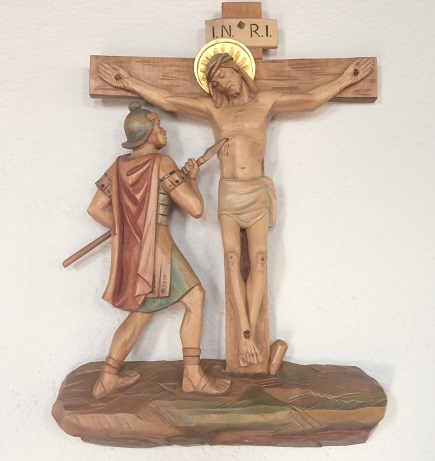
TheWoundToJesusChest

Continuing Education…

“I have been a seeker and I still am, but I stopped asking the books and the stars. I started listening to the teaching of my soul.” –Rumi

Recently I attended a show where one of the scenes had a song about parents and teachers who were not listening to the voices of the children. It was as if in trying to teach and steer their children, they had become closed off to the fact that maybe there were things that they needed to learn too. The show and that scene were striking, calling to mind this Rumi quote and making me think about teaching, learning, and the role of prayer.

After having retreated to spend the night on the mountain, praying to God (Luke 6:12), Jesus returned. It was then, and only then, after prayer, that Jesus took action. Perhaps the most appealing qualities of Jesus are that his words and actions match, and that he teaches with a motivation that comes from wisdom and nourishment received through prayer.

While his disciples and countless others seek to listen to his words, to see what he is all about, and to receive healing from him, Jesus, in his ministry, never seeks to elevate, separate, or cut himself off from others, outside of retreating to pray. In the Sermon on the Plain (Luke 6:20-26), Jesus stands on level ground as he teaches… as he ministers.

Throughout Scripture, and throughout the ages, Jesus is always in the midst of those who seek him. As we strive, struggle, and overcome, Jesus is one with us. And we are to be one with each other.

However, just as in Scripture, in order for this to occur, we must be honest, having within our hearts and minds an openness to healing, a resistance to complacency, and a desire to keep learning and to grow closer to God each and every day. Doing so allows for a life that is not only just and honorable, but also faithful.

And he came down with them
and stood on a stretch of level ground.
A great crowd of his disciples
and a large number of the people
from all Judea and Jerusalem
and the coastal region of Tyre and Sidon
came to hear him
and to be healed of their diseases;
and even those who were tormented by unclean spirits were cured.
Everyone in the crowd sought to touch him
because power came forth from him and healed them all.

And raising his eyes toward his disciples he said:

“Blessed are you who are poor,
for the kingdom of God is yours.

Blessed are you who are now hungry,
for you will be satisfied.

Blessed are you who are now weeping,
for you will laugh.

Blessed are you when people hate you,
and when they exclude and insult you,
and denounce your name as evil
on account of the Son of Man.

Rejoice and leap for joy on that day! Behold, your reward will be great in heaven. For their ancestors treated the prophets in the same way.

But woe to you who are rich,
for you have received your consolation.

But woe to you who are filled now,
for you will be hungry.

Woe to you who laugh now,
for you will grieve and weep.

Woe to you when all speak well of you,
for their ancestors treated the false prophets in this way.

– Luke 6:17-26

The Sting of Things…

One Sunday afternoon, during a childhood visit with family, I was stung by a bee. I was around 5 or 6 at the time and vividly recall being in the backyard of my aunt and uncle’s home with some of my siblings and cousins. It was a hot, sunny day. I do not remember what we were playing, but we had been running around the yard. Then at one point, we stopped playing and were standing in the shade. We were under the cover of the lowest branches of a humongous tree, when suddenly I felt an intense, sharp jab in my leg.  

I had flicked the bee away, but I could see the stinger was still there as I headed into the house where the adults were. It was very painful, but after the stinger was removed and some mud was applied to the area, the pain started to subside. I remember how cool and soothing the mud felt and how surprised I was to learn that mud was an old time “remedy” for putting an end to the sting.

As we go through life, none of us escape the sting of things that go awry. Whether through our own words or deeds or those of others—or lack thereof—there is not a single person who walks the earth without feeling stung at some points along the way. And sometimes, the sting may strike with such intensity that it can seem like there is no mud for such a sting… no remedy to be found. It is just at those moments though, that we must remember, our job is to simply fill the jars with water (that is, to be true to oneself and who God created you to be), and trust Jesus to turn the water into wine.

stainedglasscross

There was a wedding at Cana in Galilee,
and the mother of Jesus was there.
Jesus and his disciples were also invited to the wedding.
When the wine ran short,
the mother of Jesus said to him,
“They have no wine.”
And Jesus said to her,
“Woman, how does your concern affect me?
My hour has not yet come.”
His mother said to the servers,
“Do whatever he tells you.”
Now there were six stone water jars there for Jewish ceremonial washings,
each holding twenty to thirty gallons.
Jesus told the them,
“Fill the jars with water.”
So they filled them to the brim.
Then he told them,
“Draw some out now and take it to the headwaiter.”
So they took it.
And when the headwaiter tasted the water that had become wine,
without knowing where it came from
— although the servers who had drawn the water knew —,
the headwaiter called the bridegroom and said to him,
“Everyone serves good wine first,
and then when people have drunk freely, an inferior one;
but you have kept the good wine until now.”
Jesus did this as the beginning of his signs at Cana in Galilee
and so revealed his glory,
and his disciples began to believe in him. – John 2:1-11

Filled with Expectation…

The other day as I was driving in the car with my daughter, I blew a bubble and then proceeded to pop it causing the chewing gum to make a snapping noise. My daughter looked at me and smiled, then commented on how she found it interesting that some things seem impossible and then after time, if you stick with them, they become possible. Although we were speaking about the challenge of learning how to blow bubbles, how to whistle, and other seemingly trivial feats, all that we spoke about involved the same process that is incurred in bigger matters and across much of life.

Time and again, on different levels and with varying intensity, the journey within the journey begins with a desire or a hope to, or for, something new or something more. Once we not only become aware of that desire, but also begin to pay closer attention to it, excitement and expectation often rise. We feel compelled to rush ahead, launching into exploration and diving fully into it. Or, we might feel hesitant, wanting only to touch the tip of a toe into it, or to run away from it, as we test the water, so to speak. Either way, the key is the same.

It is only through persistence in striving to be in union with God that we come to the place of fruition. It is God who plants all desires that are worthy, and it is through God that we come to know not only that we are chosen, but also for what.

As we continue to move forward into this New Year, may we be filled with expectation whose source is God, joy as a child learning “the impossible” and doing it for the very first time, and peace that comes not from what we choose, but from why we choose.

truepeace

The people were filled with expectation,
and all were asking in their hearts
whether John might be the Christ.
John answered them all, saying,
“I am baptizing you with water,
but one mightier than I is coming.
I am not worthy to loosen the thongs of his sandals.
He will baptize you with the Holy Spirit and fire.”

After all the people had been baptized
and Jesus also had been baptized and was praying,
heaven was opened and the Holy Spirit descended upon him
in bodily form like a dove.
And a voice came from heaven,
“You are my beloved Son;
with you I am well pleased.” – Luke 3:15-16, 21-22

Emerging Grace…

It is a most joyous occasion for all, when the light one carries within burns brightly, emerging into an outward glow.

At the time of birth, we all shine with a radiance that is unmatched—beautiful and unblemished. Our light, new to those already in the world, is received magnanimously, often with open hearts, steadfast love, and faithful hope. In fact, the thoughts and feelings engendered by even just the announcement of impending birth often stirs hearts and minds to great anticipation and excitement. Perhaps it is because the unblemished Love within us recognizes and longs for the companionship and unblemished Love within others.

We delight in this Love and welcome it as Good News. It is unquestionable and so easy to see and to embrace. When faced with the knowledge of new life, the Spirit of connection… of Oneness and Unity that resides within each of us cries out. As we move about each day, the same Spirit is with us. A constant companion, with a desire to fill each thirst and hunger within, to help us to see the new life that is all around us, waiting to come to life, waiting to be received, with the same openness and joy that we hold at the time of birth. The Spirit abides within us and moves us toward God and one another, as in the moment the infant in Elizabeth’s womb leaped for joy (Luke 1:44). How do we respond?

O God, restore us;
light up your face and we shall be saved. – Psalm 80:4

AFK_In_Womb

The Spirit of…

Throughout the year, all around the world, people of all backgrounds prepare for various holidays, Holy days, and the festivities associated with them. There are many cultural as well as familial traditions. Among the countless possibilities, the fact remains that most people have their own ideas and preferences for what a holiday “should” be. Whether inherited and passed along as they were from their beginnings—with no change, put into practice with some variation of what came before, or created in an entirely new and different way, oftentimes we establish routines and even deadlines for the tasks that have become part of our preparation for a special day.

Yet, plan as we may, preparing the way can end up looking very different from what one may have set out to do, may have pictured, or expected from the image of years passed. Frequently though the places where there seems to be missteps, no time, no room, or where we may least expect something good, are exactly the places where we are apt encounter the gift of God’s grace. That is often the beauty and the blessing of holidays, Holy days, and the events that surround them. In our attempts to make them special and meaningful in our own ways, we often look up and around a little more, changing our ordinary routines just enough that we also, perhaps unknowingly, open ourselves and our environment up to more of the Extraordinary—the Divine.

When it is all said and done, it is not so much what we do that makes these days special, but rather what is behind our words and actions and the ways in which we are inspired to say and do them. As the holidays, Holy days, and festivities continue to arrive, embrace the “the splendor of glory from God” (Baruch 5:1). Live from it, allowing it to flow through you into the moments of each and every day, spreading peace, love, and joy wherever you may go; providing comfort, strength, restoration and healing wherever it is needed; and building and bridging relationships all around. In this Spirit, may we receive whomever and whatever may come as we are, that is blessed with the splendor of God’s glory.

Dove

Lady Luck…

As I proceeded toward the steps and the front door, I could see something… a bug, moving on the frame around the door. With each step, I could see it more clearly. I was thinking, “It couldn’t be, it’s too cold,” but as I got closer to the front door, I saw that in fact it was a ladybug. What a pleasant surprise, in stark contrast to the spotting of the brown stink bugs that are common this time of year.

As I watched the ladybug crawling around for a few moments, I could not help but smile. Although it was a small thing, on a rather chilly day, this friendlier, more palpable kind of bug brought a sense of wonder and joy to me as the weather progresses toward winter where I live.

What a great way to prepare to enter the house. What a great way to prepare to enter any place for that matter. To go forth thinking… feeling… remembering the truth of what it means to be begotten by God. That is blessed!

Gifts and blessings come in packages of all types and sizes. Look for and welcome the unexpected. Receive all that each moment brings. Strive to remain faithful regardless of circumstances. Trust that what God has in store is always the best.

You will show me the path to life,
fullness of joys in your presence,
the delights at your right hand forever. – Psalm 16:11

LadyBug

The Point of Letting Go…

“The jar of flour did not go empty, nor the jug of oil run dry…” (1 Kings 17:16). Why? Because the Lord ordained it to be so.

In those days, Elijah the prophet went to Zarephath.
As he arrived at the entrance of the city,
a widow was gathering sticks there; he called out to her,
“Please bring me a small cupful of water to drink.”
She left to get it, and he called out after her,
“Please bring along a bit of bread.”
She answered, “As the LORD, your God, lives,
I have nothing baked; there is only a handful of flour in my jar
and a little oil in my jug.
Just now I was collecting a couple of sticks,
to go in and prepare something for myself and my son;
when we have eaten it, we shall die.”
Elijah said to her, “Do not be afraid.
Go and do as you propose.
But first make me a little cake and bring it to me.
Then you can prepare something for yourself and your son.
For the LORD, the God of Israel, says,
‘The jar of flour shall not go empty,
nor the jug of oil run dry,
until the day when the LORD sends rain upon the earth.'”
She left and did as Elijah had said.
She was able to eat for a year, and he and her son as well;
the jar of flour did not go empty,
nor the jug of oil run dry,
as the LORD had foretold through Elijah.

– 1 Kings 17:10-16

God sent Elijah to the widow and her son during a period of famine. God’s plan, always, is to provide sustenance for those who are receptive to it. Oftentimes in order to receive the grace that God has in store, one must let go of something that is “other.” More often than not, it involves changing; adjusting, fine-tuning, or altogether shedding that which we may have resigned ourselves to holding onto.

Certainly, it would have been easy as well as justifiable for the widow at Zarephath to hold onto the last of her flour and oil rather than to share any portion of it with Elijah, the stranger in her midst. At first, it seems to be her intention to do just that. However, she listens to the prophet’s words and trusts the way in which they resonate with her.

Although the prophet, and the widow and her son are different, the same God leads each of them. It is in cooperation with God that they recognize this in each other, and in doing so, become one with the grace waiting to be bestowed upon them.

God calls and sends Elijah to a new place. The same God helps the widow to let go of what little she has, instead of clinging to it, and to trust that it will be enough for all… and it is.

YellowFall2

Before (and with) the Lord…

A good amount of each day is spent traveling from one spot to another. Sometimes the distance is short—a few steps here or there—and sometimes it is longer. For sure, there is a lot of physical movement by each of us as well as around us throughout any given day. Add to this the movements that occur within that are not “physical,” such as a change of heart, a new or different perspective, and so on.

In Psalm 116, the psalmist writes, “I shall walk before the LORD in the land of the living” (verse 9). Notice how the psalmist does not write, “I shall run before the Lord,” “I shall stand before the Lord,” or “I shall sit before the Lord.” The psalmist uses the word, “walk.”

“I shall walk before the Lord.” It is intentional, measured, and purposeful, as if to say, “As I go about my way in this life, I will move with meaning, ever mindful of the Lord’s presence.” A tall order, yes, but not impossible one step… one moment at a time.

The journey is meant to be something that is striven for, without succumbing to a notion or drive toward perfection. Mistakes and mishaps, trials and tribulations are par for the course, and the more one can acknowledge and look to learn from them, the less distraction they will cause while walking through them. More than anything, it is about a heart that is open and willing, filled with desire for constant contact and union with the Lord, while in the land of the “living.”

In the Gospel of Mark, chapter 8, verses 27-35, Jesus asks his disciples about who they believe him to be. Peter immediately answers, “You are the Messiah.” Peter knows and believes in Jesus as the Savior, but he, like the others, does not know what that really means. When Jesus then tells them that he will be beaten and killed, and about his resurrection, Peter responds just as fervently as he did when professing Jesus as the Messiah. However, where Peter says to the Lord, “Yes!” loud and clear, now when Jesus tells him something that is unexpected, unpleasant, and most likely the exact opposite of what he has envisioned or hoped for, Peter says to the Lord, “No!” loud and clear. While his passion may be the same, in that moment, he loses sight of the Lord and with that, his response moves away from being intentional, measured, and purposeful. Jesus recognizes this immediately and responds, “Get behind me, Satan. You are thinking not as God does, but as human beings do.”

As Peter continues striving to walk with the Lord both before and after the death and resurrection of Jesus, he learns as he moves and grows in trust, wisdom, and understanding. We, also disciples, are called to move in the same way… and we can, too.

How do I walk not only before the Lord, but also with and in the Lord as I go about each day… each moment?

We must not mind insulting men, if by respecting them we offend God. – Saint John Chrysostom

BiddefordPoolSunset

Jesus and his disciples set out
for the villages of Caesarea Philippi.
Along the way he asked his disciples,
“Who do people say that I am?”
They said in reply,
“John the Baptist, others Elijah,
still others one of the prophets.”
And he asked them,
“But who do you say that I am?”
Peter said to him in reply,
“You are the Christ.”
Then he warned them not to tell anyone about him.

He began to teach them
that the Son of Man must suffer greatly
and be rejected by the elders, the chief priests, and the scribes,
and be killed, and rise after three days.
He spoke this openly.
Then Peter took him aside and began to rebuke him.
At this he turned around and, looking at his disciples,
rebuked Peter and said, “Get behind me, Satan.
You are thinking not as God does, but as human beings do.”

He summoned the crowd with his disciples and said to them,
“Whoever wishes to come after me must deny himself,
take up his cross, and follow me.
For whoever wishes to save his life will lose it,
but whoever loses his life for my sake
and that of the gospel will save it.” – Mark 8:27-35