Perhaps one of the most beautiful and mesmerizing things about the ocean is its motion. Despite its unrelenting, constant movement, and the change and transition that it brings about for anyone or anything within it, it is found, more often than not, to be soothing or healing. Yet, in any other arena, on land, in the air, or in our lives, it seems fair to say that the movement of the ocean would be considered chaos, and be an unsettling presence.
In the Book of Revelation, it is written, “The One who was seated on the throne said: ‘Behold, I make all things new…'” (21:5). This verse is a great reminder that God is not static, but rather like the ocean, always encouraging change and seeking balance—the greater good.
In such volatile times, it is worth the exploration to see the things that are as opposed to the things that used to be. Where there is little or no true change, there is always room to do better… to do more than just look. To act, rather than to sit, stuck at the place that is only the beginning.
“Not everything that is faced can be changed, but nothing can be changed until it is faced.” – James Baldwin
The world, And its inhabitants, Who are abundantly “living,” Something else. In a shell, On a hill, Away from it all. Yet, Life, Forgotten, Trampled, and hidden. Nothing else. Something else.
Create a clean heart in me, O God; Renew within me a steadfast spirit. – Psalm 51:12
Over the past few weeks, as my son has worked on a film project, I have had the opportunity to follow the process of shooting and reshooting scenes, as well as making adjustments for both acoustics and lighting. Most noticeably, the lighting and the impact that it has on the ability to capture scenes in a way that is focused, crisp, and clear has been interesting. On one particular shoot, the light in the room was intermittently “shifting” as the sunlight shining in from a window and a breeze, moving branches outside the window, affected it.
It was striking to see what seemed like waves of light, here and there, moving across the room. While initially, it seemed that the light was doing nothing but interfering, in a different part of the room and from another angle, the lighting was just right and the footage was crystal clear.
In the Gospel according to John, chapter 9, verses 1 through 41, Jesus is the Light that makes things clear to those who desire to see with an open heart. Yet, some receive the Presence as something to be embraced and to lead the way, while others reject the Presence as something that is an interruption or nuisance.
So a second time the Pharisees called the man who had been blind and said to him, “Give God the praise! We know that this man, Jesus, is a sinner.” (For Jesus had healed the man on the Sabbath).
He replied, “If he is a sinner, I do not know. One thing I do know is that I was blind and now I see.”
So they said to him, “What did he do to you? How did he open your eyes?”
He answered them, “I told you already and you did not listen. Why do you want to hear it again? Do you want to become his disciples, too?”
They ridiculed him and said, “You are that man’s disciple; we are disciples of Moses! We know that God spoke to Moses, but we do not know where this one is from.”
The man answered and said to them, “This is what is so amazing, that you do not know where he is from, yet he opened my eyes. We know that God does not listen to sinners, but if one is devout and does his will, he listens to him. It is unheard of that anyone ever opened the eyes of a person born blind.If this man were not from God, he would not be able to do anything.”
They answered and said to him, “You were born totally in sin, and are you trying to teach us?” Then they threw him out.
– John 9:24-34
Preoccupied with their own ambitions… focused on their own designs, the Pharisees could not recognize the Light… the truth about Jesus and the healing of the blind man. And therefore, understanding, appreciating, finding joy in the situation, being happy for the good fortune of the man who could now see, or being receptive to Jesus, would not be possible.
There is a saying that life is what you make of it, and another that people see what they want to see. Was the blind man a sinner? Were his parents sinners being punished with a blind son (as was the thinking at the time)? Was Jesus a sinner?
How might this passage be different if the Pharisees, had been open to the Light, or even simply the idea of it?
What difference or impact, does receiving the Light of Jesus make?
How does being open to the other side of the room or trying to take a view from a different angle, allow one to see and receive the Light, and to let Jesus lead?
I am the light of the world, says the Lord; whoever follows me will have the light of life.
Believe it or not, it seems easier to believe that which is tangible. Thus, the saying, “I’ll believe it when I see it!” Yet, in reality, what one believes actually comes from within. Belief is born out of that which echoes the perceived experience of one’s heart and mind.
As perception changes, the things that resonate and to which one is receptive change too. As a result, internally, one is moved to also change, hopefully for the better. Thus the words of Maya Angelou, “Do the best you can until you know better. Then when you know better, do better.”
This is really what human nature is all about—we are created to continually evolve—called to conversion each and every day. It is important to remember that when it comes to love, and what is truly good, honorable, and just, there is always room for growth! How much? That’s up to the individual—again it comes back to perception.
During Lent and throughout the year, the practicing, and living out, of what one believes, can, and often does, take so many forms. After all, faith is living… breathing… active. It is not intended to be stale, or fixed in place or time, but to be celebrated with body, heart, and mind. Not to be carried along, but to carry us through and to broaden the depth with which we see God, ourselves, and other, as one.
Seek, and you will find what brings you closer. It’s not about “should” or “if,” but rather what is. The journey is yours and God’s together. Trust, and you will discover.
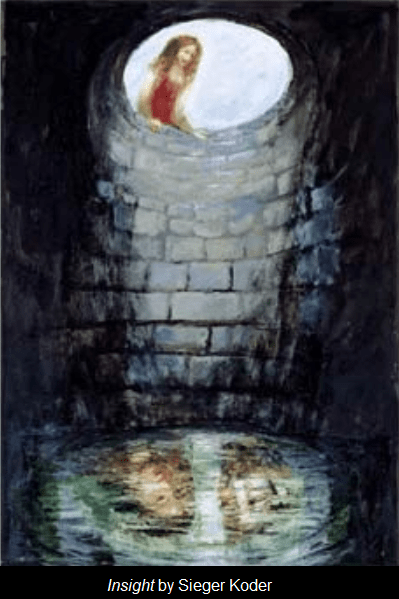
Jesus came to a town of Samaria called Sychar, near the plot of land that Jacob had given to his son Joseph. Jacob’s well was there. Jesus, tired from his journey, sat down there at the well. It was about noon.
A woman of Samaria came to draw water. Jesus said to her, “Give me a drink.” His disciples had gone into the town to buy food. The Samaritan woman said to him, “How can you, a Jew, ask me, a Samaritan woman, for a drink?” —For Jews use nothing in common with Samaritans.— Jesus answered and said to her, “If you knew the gift of God and who is saying to you, ‘Give me a drink, ‘ you would have asked him and he would have given you living water.” The woman said to him, “Sir, you do not even have a bucket and the cistern is deep; where then can you get this living water? Are you greater than our father Jacob, who gave us this cistern and drank from it himself with his children and his flocks?” Jesus answered and said to her, “Everyone who drinks this water will be thirsty again; but whoever drinks the water I shall give will never thirst; the water I shall give will become in him a spring of water welling up to eternal life.” The woman said to him, “Sir, give me this water, so that I may not be thirsty or have to keep coming here to draw water.”
Jesus said to her, “Go call your husband and come back.” The woman answered and said to him, “I do not have a husband.” Jesus answered her, “You are right in saying, ‘I do not have a husband.’ For you have had five husbands, and the one you have now is not your husband. What you have said is true.” The woman said to him, “Sir, I can see that you are a prophet. Our ancestors worshiped on this mountain; but you people say that the place to worship is in Jerusalem.” Jesus said to her, “Believe me, woman, the hour is coming when you will worship the Father neither on this mountain nor in Jerusalem. You people worship what you do not understand; we worship what we understand, because salvation is from the Jews. But the hour is coming, and is now here, when true worshipers will worship the Father in Spirit and truth; and indeed the Father seeks such people to worship him. God is Spirit, and those who worship him must worship in Spirit and truth.” The woman said to him, “I know that the Messiah is coming, the one called the Christ; when he comes, he will tell us everything.” Jesus said to her, “I am he, the one speaking with you.”
At that moment his disciples returned, and were amazed that he was talking with a woman, but still no one said, “What are you looking for?” or “Why are you talking with her?” The woman left her water jar and went into the town and said to the people, “Come see a man who told me everything I have done. Could he possibly be the Christ?” They went out of the town and came to him. Meanwhile, the disciples urged him, “Rabbi, eat.” But he said to them, “I have food to eat of which you do not know.” So the disciples said to one another, “Could someone have brought him something to eat?” Jesus said to them, “My food is to do the will of the one who sent me and to finish his work. Do you not say, ‘In four months the harvest will be here’? I tell you, look up and see the fields ripe for the harvest. The reaper is already receiving payment and gathering crops for eternal life, so that the sower and reaper can rejoice together. For here the saying is verified that ‘One sows and another reaps.’ I sent you to reap what you have not worked for; others have done the work, and you are sharing the fruits of their work.”
Many of the Samaritans of that town began to believe in him because of the word of the woman who testified, “He told me everything I have done.” When the Samaritans came to him, they invited him to stay with them; and he stayed there two days. Many more began to believe in him because of his word, and they said to the woman, “We no longer believe because of your word; for we have heard for ourselves, and we know that this is truly the savior of the world.” – John 4:5-42
So what happened to Jonah? What did he do after delivering the message to “shape up” to the Ninevites?
First, he witnessed them take heed and repent. Next, he witnessed God shower them with mercy (Jonah 3:1-10). And then, in the next chapter, chapter 4, Jonah walked away, angry at God’s forgiveness and understanding of those “wicked” people of Nineveh. Why?
Jonah’s mind had already been made up about the Ninevites. That’s why he initially tried to run away from the mission God gave him (Jonah, chapter 2). Unsuccessful, though, and after being spewed from the belly of the fish, he ended up going to Nineveh to deliver God’s message to the people. And, exactly as Jonah expects, God ends up forgiving the Ninevites.
It’s interesting how God accepts the actions of the people of Nineveh as acknowledgement of their wrong doing, while Jonah, who had already determined the Ninevites did not deserve another chance, hardened his heart toward them and could not see or receive the spirit of their actions as a desire to make amends. That’s okay though, because as the story continues, we see more about God’s ways. Despite his lack of understanding or missing desire for mercy to extend to the Ninevites, God does not abandon Jonah either. Rather, God continues the conversation and keeps seeking to reach Jonah and his heart, the same as with the Ninevites.
The Book of Jonah reveals the story of a prophet whose name means “dove” in Hebrew. In a time when a desire for peace seems so great, for so many, it is important to remember that God’s embrace, and longing for ongoing, personal relationship with all creation, extends to all. Yes, all!
God accepts those who accept and receive God, even when human beings can’t or won’t. Thank God! There are no exceptions, and only God can ever truly know what is in someone else’s heart.
But this greatly displeased Jonah, and he became angry.
He prayed to the Lord, “O Lord, is this not what I said while I was still in my own country? This is why I fled at first toward Tarshish. I knew that you are a gracious and merciful God, slow to anger, abounding in kindness, repenting of punishment.
So now, Lord, please take my life from me; for it is better for me to die than to live.”
But the Lord asked, “Are you right to be angry?”
Jonah then left the city for a place to the east of it, where he built himself a hut and waited under it in the shade, to see what would happen to the city.
Then the Lord God provided a gourd plant. And when it grew up over Jonah’s head, giving shade that relieved him of any discomfort, Jonah was greatly delighted with the plant.
But the next morning at dawn God provided a worm that attacked the plant, so that it withered.
And when the sun arose, God provided a scorching east wind; and the sun beat upon Jonah’s head till he became faint. Then he wished for death, saying, “It is better for me to die than to live.”
But God said to Jonah, “Do you have a right to be angry over the gourd plant?” Jonah answered, “I have a right to be angry—angry enough to die.”
Then the Lord said, “You are concerned over the gourd plant which cost you no effort and which you did not grow; it came up in one night and in one night it perished.
And should I not be concerned over the great city of Nineveh, in which there are more than a hundred and twenty thousand persons who cannot know their right hand from their left, not to mention all the animals?”
The snow swept its way into town yesterday. It was hanging onto leaves where it could, perhaps overwhelming branches here and there, and weighing some down—secure, and even to the ground. For others, it seemed, the flakes of snow could not take hold—still blessed though. All around, snow laden leaves… branches, and tints of orange and yellow along with evergreens remained. Some standing, some kneeling, some sitting, some laying down, all in various forms of surrender. Peace… Joy… Light… Life… Grace in every stage.
Grace, the ultimate presentation, always there for the taking, greatest help in decision making.
When Jesus saw the crowds, he went up the mountain, and after he had sat down, his disciples came to him. He began to teach them, saying: “Blessed are the poor in spirit, for theirs is the Kingdom of heaven. Blessed are they who mourn, for they will be comforted. Blessed are the meek, for they will inherit the land. Blessed are they who hunger and thirst for righteousness, for they will be satisfied. Blessed are the merciful, for they will be shown mercy. Blessed are the clean of heart, for they will see God. Blessed are the peacemakers, for they will be called children of God. Blessed are they who are persecuted for the sake of righteousness, for theirs is the Kingdom of heaven. Blessed are you when they insult you and persecute you and utter every kind of evil against you falsely because of me. Rejoice and be glad, for your reward will be great in heaven.” – Matthew 5:1-12
Each time I have had the opportunity to travel west through New York, coming across the Erie Canalway National Heritage Corridor brings me back decades to being a young student, and a favorite social studies lesson that included an explanation of how canals work. I recall listening with great interest about the way that locks and channels along the way, made it possible for canals to bridge the gap where differences of altitude were previously an obstacle.
A few days ago, I attended a virtual meeting featuring two speakers who were former governors of different political affiliations. The topic they discussed was the importance of public service. Both emphasized that in their experience, engaging on a personal level with a wide array of people was critical, and how a lack of openness to each other and ongoing dialogue leads to polarization. In other words, when you get to know people and learn about their lives, you connect in a way that lends itself to trying to work together with respect and courtesy, despite any differences of opinion. It reminded me of locks (or stops) and channels on the canal, working together to level things off, close the space between, and create a solution to overcome the difference that was otherwise impossible.
October 4th is the feast day of St. Francis of Assisi, who was born into a very well to do family in the 12th century. He lived a lavish lifestyle in his younger years, but in his early 20s, he became disillusioned with the material life and all that came with it, and walked away from it. From that point he increasingly embraced a life of prayer from which his words and actions, through the grace of God, flowed. He is quoted as saying, “It is no use walking anywhere to preach unless our walking is our preaching.”
St. Francis’s life started in a very different space, more than comfortable, and far away from the experience of most. In the end though, he had closed the gap and found the greatest of riches, in doing so.
In current day times, there is too much distance between… too much space across so many arenas, and it is wreaking havoc. It can seem that there is not a lot that one can do. However, we can always decide what kind of channel we want to be, and we can always seek inspiration that helps us to shorten, or even close, the space between, and rise above the deficits that may be.
I have chosen you from the world, says the Lord, to go and bear fruit that will remain. – John 15:16
Peace Prayer of St. Francis Lord, make me an instrument of your peace: where there is hatred, let me sow love; where there is injury, pardon; where there is doubt, faith; where there is despair, hope; where there is darkness, light; where there is sadness, joy. O divine Master, grant that I may not so much seek to be consoled as to console, to be understood as to understand, to be loved as to love. For it is in giving that we receive, it is in pardoning that we are pardoned, and it is in dying that we are born to eternal life. Amen.
As autumn makes her entrance, bursts of color begin to appear where once green was all around. Noticing an especially colorful section for so early in the season, I also see a gap within it… something missing… branches gone or somehow lost along the way.
As I look, I wonder. What could they have been? What would they have been? How the rest of the scenery is affected by their absence, also crosses my mind.
More than 204,000 people in the United States of America have died from COVID-19 thus far. That is approximately 21% of the 989,000 brothers and sisters across the world who have died from the virus. In the 196 recognized countries, almost 1 Million people have died since this pandemic began. While this is a statistic, it is far greater than a number(s).
What do we know about our brothers and sisters who have succumbed to this illness? The truth is, we know that they represented a wide range of age groups; came from various backgrounds, and political and religious affiliations; and studied or worked in all different kinds of occupations, to name just a few things. We also know, for sure, that they were not all advanced in age, nor did they all have pre-existing health conditions. Some, in fact, were closer to what would be considered the first half of life, physically fit, and/or not considered to be at a higher risk.
More important than all of that, they were fellow human beings. They were not just a number. They were living, breathing human beings, whose lives are not to be readily written off as dispensable to serve the interests of any one person or people in particular claiming to be “for” Life. Those who have died, loved, and were loved, and now, they are missed, leaving a gap… an emptiness, most especially for those who knew them best.
More than 204,000, and counting, brothers and sisters in the United States of America. More than 989,000, and counting, brothers and sisters worldwide. What could they have been? What would they have been? How is rest of the world affected by their absence?
Will we be driven further apart by lies, deception, and reckless disregard for life, or will we see what is truly going on, honor the lives of those who have died, and finally, come together?
Brothers and sisters: If there is any encouragement in Christ, any solace in love, any participation in the Spirit, any compassion and mercy, complete my joy by being of the same mind, with the same love, united in heart, thinking one thing. Do nothing out of selfishness or out of vainglory; rather, humbly regard others as more important than yourselves, each looking out not for his own interests, but also for those of others. Have in you the same attitude that is also in Christ Jesus. – Phil 2:1-5
A couple of summers ago, while visiting family, we decided to go out for ice cream. As we opened the back door of the mini-van, immediately, and with great enthusiasm, the dog jumped in, and was ready to go. Unfortunately, the dog could not come with us, and needed to be escorted back out of the vehicle. As disappointed as he seemed though, when we got back to the house, his excitement upon our reuniting was as if his disappointment or hopes dashed prior to our departure, had never occurred.
It is interesting how dogs, act and react, especially when they are excited. Perhaps, jumping and bouncing, running back and forth, and/or wagging their tails furiously at the approach of a favorite treat or as a loved one returns home. Then there are the other times, when they might plant their paws and growl, preparing to resist, attack, or defend against something non-preferred, or a threat perceived. Regardless of the situation though, what is often most striking is the capacity of dogs to love without abandon.
Moving from wagging tails to wagging fingers, there is the human frailty that causes hearts to bruise, egos to rouse, and hurt to linger. This, all the while, the silent plea, “Come now. Come down off your high horse,” echoes deep within. But, which will win?
Sometimes, it’s time to stop stopping. Stop standing still. When stubborn, yet again, the wagging, it begins. There it is. Getting in the way, determined to carry on, refusing to give in.
At what cost?
So many things, taking up space, too tightly held. How can the space between us do anything, but swell? Wider it becomes… bigger… stronger… bolder it grows. Drifting… fading… falling, tell me, what is so appalling?
One can’t help but wonder, when will this nonsense stop? When will we heed the warning that echoes deep within, “Come now. Come down off your high horse.”?
I give you a new commandment, says the Lord: love one another as I have loved you. – John 13:34
You do not have to be good. You do not have to walk on your knees for a hundred miles through the desert repenting. You only have to let the soft animal of your body love what it loves. Tell me about despair, yours, and I will tell you mine. Meanwhile the world goes on. Meanwhile the sun and the clear pebbles of the rain are moving across the landscapes, over the prairies and the deep trees, the mountains and the rivers. Meanwhile the wild geese, high in the clean blue air, are heading home again. Whoever you are, no matter how lonely, the world offers itself to your imagination, calls to you like the wild geese, harsh and exciting – over and over announcing your place in the family of things. — Mary Oliver, Wild Geese












 HopeThatFloats
You must be logged in to post a comment.