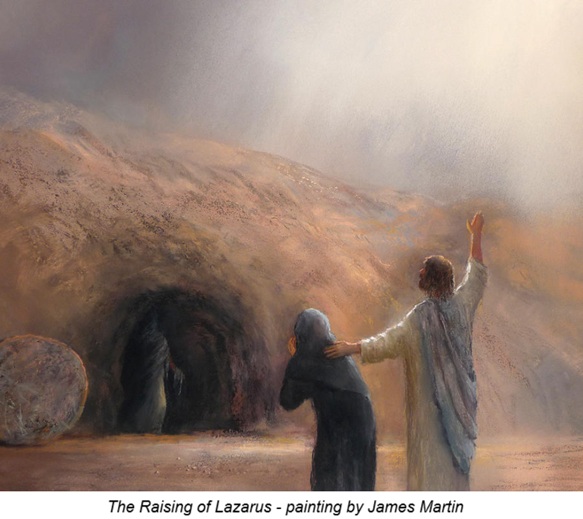
The Raising of Lazarus

The Hope that Raises and Restores…

Approaching the Fifth Sunday of Lent, take a moment to consider the past few weeks and the times you have felt closest to the Lord as well as those times you have felt distanced. Of the situations that come to mind, what jumps out the most in terms of the characteristics of the Lord that you experienced and the ones that, in hindsight, you may have been seeking without knowing it at the time? Take what you notice to prayer, trusting that although the time has passed, conversation with the Lord can still bear fruit, providing insight, wisdom, and whatever else you may need at this moment, and going forward.

As you prepare to consider the readings for this Sunday, invite the Lord to continue the conversation and time together.

In the First Reading from Ezekiel 37:12-14, we have the ending verses of a section referred to as “Vision of the Dry Bones”. The passage is a conversation between the prophet and the Lord where the dry bones are likened to the loss of hope in the Lord, and Ezekiel is instructed as to what he is to tell to the people. As Ezekiel follows each of the Lord’s directives, the vision moves toward the bones being restored to life.

The directives to the dry bones spoken by the prophet are in Word:

“Dry bones, hear the word of the Lord!” (v. 4);

and Spirit:

“Listen! I will make breath enter you so you may come to life.” (v. 5).

The dry bones come to life and the Lord says to Ezekiel: “They are saying, ‘Our bones are dried up, our hope is lost, and we are cut off.’” (v.11)

This is where the First Reading starts. The Lord further instructs Ezekiel, giving him the words to address the need for restoration/renewal, hope, and connection.

Among the words of the Lord, in these verses, to be prophesied are:

“I will put my spirit in you that you may come to life, and I will settle you in your land. Then you shall know that I am the Lord. I have spoken; I will do it” (v. 14)

How are your mind and your heart touched by the words and imagery in this passage? Share what you think and feel at this moment with the Lord. Ask the Lord for openness to receiving his insights about restoration, renewal, hope, and/or connection in your life, your community, and the world at large.

Continuing to stay with the conversation, consider the response to the Psalm, “With the Lord there is mercy and fullness of redemption.” (Psalm 130:7). What are a few ways that you have received the Lord’s mercy and a sense of redemption? How do you feel as you recall those times? In what ways might they instill greater hope in you or inspire you today?

In the Second Reading (Romans 8:8-11), part of what St. Paul writes to the Romans is:

“But you are not in the flesh; on the contrary, you are in the spirit, if only the Spirit of God dwells in you. Whoever does not have the Spirit of Christ does not belong to him. But if Christ is in you, although the body is dead because of sin, the spirit is alive because of righteousness.” – v. 9-10

How do you desire for the Spirit of God, that dwells in you, to be with you and to help you to not only hold onto and connect to, but to also be energized by and to be a reflection of the Lord’s mercy, hope, and inspiration? Share with the Lord whatever is in your heart at this time. Also, take time to allow the Lord to reveal what’s on his heart.

The following verses are an excerpt from the Gospel Reading (John 11:1-45):

Jesus said, “Take away the stone.”
Martha, the dead man’s sister, said to him,
“Lord, by now there will be a stench;
he has been dead for four days.”
Jesus said to her,
“Did I not tell you that if you believe
you will see the glory of God?”
So they took away the stone.
And Jesus raised his eyes and said,
“Father, I thank you for hearing me.
I know that you always hear me;
but because of the crowd here I have said this,
that they may believe that you sent me.”
And when he had said this,
He cried out in a loud voice,
“Lazarus, come out!”
The dead man came out,
tied hand and foot with burial bands,
and his face was wrapped in a cloth.
So Jesus said to them,
“Untie him and let him go.”
Now many of the Jews who had come to Mary
and seen what he had done began to believe in him. – John 11:39-44

Contemplating this passage in the light of your prayers, conversation with the Lord, and what you noticed from the prior readings above, what is the stone that Jesus wants to take away? In what ways might Jesus want you to “untie” and “let go”?

As you pray with this, ask for openness to the Lord’s guidance and for whatever you feel you need to hear the Word of God, to listen, and to receive the Spirit of God. What does the Lord desire for you so that the goodness that dwells within you, continues to sustain you, your hope in the Lord, and extends to others.
The Raising of Lazarus

I am the resurrection and the life; whoever believes in me, even if he dies, will live, and everyone who lives and believes in me will never die. Do you believe this? – John 11:25-26

The Reason for Hope…

Today, March 25th, is the Solemnity of the Annunciation of the Lord. The readings for this day, are a reminder, “God is with us” (Isaiah 8:10), “for nothing will be impossible for God.” (Luke 1:37), and guidance to contemplate relationship with God. An opportunity to consider how one responds to the call of the ever present God of love, mercy, and redemption. What happens at the thought of “I come to do your will.” (Psalm 40:8a, 9a; Hebrews 10:7b, 9a), or Mary’s response of “Behold, I am the handmaid of the Lord.” (Luke 1:38)?

Spending time with the road traveled by the Prophet Isaiah, the Psalmist, Mary, and St. Paul, one can draw inspiration, perhaps more easily, because we know, or we can read about the ways in which God was with them and enabled them to fulfill the path that was theirs, in the face of trials and tribulations.   

In the first reading for the Fifth Sunday of Lent, it is written, “I will put my spirit in you that you may live, and I will settle you upon your land; thus you shall know that I am the Lord. I have promised, and I will do it, says the Lord.” (Ezekiel 37:14).

The verses that follow this passage, are referred to as the joining of the two sticks. That is, God’s intention or call… God’s will for the tribes of Juda and Joseph to come together and for the people to be united.

“Thus says the Lord God: I will soon take the Israelites from among the nations to which they have gone and gather them from all around to bring them back to their land. I will make them one nation in the land, upon the mountains of Israel, and there shall be one king for them all. They shall never again be two nations, never again be divided into two kingdoms.” – Ezekiel 37:21-22

Thinking about this in terms of the division in families, communities, and the world at large today, in what ways do you see the Spirit of God shining through in your life, your community, and the world?

With the Lord there is mercy and fullness of redemption. – Psalm 130:7

Where do you experience love, mercy, and unity? And how do you desire to be an agent or a partner in not only carrying, but also sharing the essence of these attributes of God?

Looking around and sitting with personal challenges and the state of the world today can be daunting at times. There is much that is awry and issues that can seem insurmountable. With these realities it can be tempting to not look around or to not focus much attention or thought on the problems that exist. However, not ignoring what’s going on, is part of what it means to carry the cross—to live in reality, whatever it may be, praying and proceeding with hope that is eternal, and that resides in and seeks to be guided by God, for whom nothing is impossible.      

As St. Paul writes, “If the Spirit of the one who raised Jesus from the dead dwells in you, the one who raised Christ from the dead will give life to your mortal bodies also, through his Spirit dwelling in you.” (Romans 8:11). How do you desire the Spirit of the Lord to be present to you at this moment? In what areas do you desire greater light and life?  

In lots of ways, the times we are experiencing lend themselves to the deception that we are dealing with the impossible and that throwing the towel in, or walking away is the answer. Yet, faith beckons one to pause and to notice. Who or what is deeming the situation a lost cause? What is the source? Is it a human summation? From what spirit does it come?

In chapter 11 of the Gospel According to John, verses 1-45, we read about the raising of Lazarus. In order to go to the home of his good friends, Mary, Martha, and the now deceased Lazarus, Jesus must return to the town where people have tried to stone him, more than once. In addition, by the time Jesus arrives there, it has been four days since Lazarus’ lifeless body was placed in the tomb. Many would deem this situation hopeless or impossible. Why does Jesus go back to the place where he is mocked, and people are seeking his demise? Why does Jesus even attempt to raise Lazarus who is clearly beyond resuscitation?

Because Jesus is Life! He is full of love and mercy, the embodiment of God, and death, in any of its forms, cannot and will not defeat Him, or those who belong to Him. For it is through Him, that all things are possible.      

Now a man was ill, Lazarus from Bethany,
the village of Mary and her sister Martha.
Mary was the one who had anointed the Lord with perfumed oil
and dried his feet with her hair;
it was her brother Lazarus who was ill.
So the sisters sent word to him saying,
“Master, the one you love is ill.”
When Jesus heard this he said,
“This illness is not to end in death,
but is for the glory of God,
that the Son of God may be glorified through it.”
Now Jesus loved Martha and her sister and Lazarus.
So when he heard that he was ill,
he remained for two days in the place where he was.
Then after this he said to his disciples,
“Let us go back to Judea.”
The disciples said to him,
“Rabbi, the Jews were just trying to stone you,
and you want to go back there?”
Jesus answered,
“Are there not twelve hours in a day?
If one walks during the day, he does not stumble,
because he sees the light of this world.
But if one walks at night, he stumbles,
because the light is not in him.”
He said this, and then told them,
“Our friend Lazarus is asleep,
but I am going to awaken him.”
So the disciples said to him,
“Master, if he is asleep, he will be saved.”
But Jesus was talking about his death,
while they thought that he meant ordinary sleep.
So then Jesus said to them clearly,
“Lazarus has died.
And I am glad for you that I was not there,
that you may believe.
Let us go to him.”
So Thomas, called Didymus, said to his fellow disciples,
“Let us also go to die with him.”
When Jesus arrived, he found that Lazarus
had already been in the tomb for four days.
Now Bethany was near Jerusalem, only about two miles away.
And many of the Jews had come to Martha and Mary
to comfort them about their brother.
When Martha heard that Jesus was coming,
she went to meet him;
but Mary sat at home.
Martha said to Jesus,
“Lord, if you had been here,
my brother would not have died.
But even now I know that whatever you ask of God,
God will give you.”
Jesus said to her,
“Your brother will rise.”
Martha said to him,
“I know he will rise,
in the resurrection on the last day.”
Jesus told her,
“I am the resurrection and the life;
whoever believes in me, even if he dies, will live,
and everyone who lives and believes in me will never die.
Do you believe this?”
She said to him, “Yes, Lord.
I have come to believe that you are the Christ, the Son of God,
the one who is coming into the world.”
When she had said this,
she went and called her sister Mary secretly, saying,
“The teacher is here and is asking for you.”
As soon as she heard this,
she rose quickly and went to him.
For Jesus had not yet come into the village,
but was still where Martha had met him.
So when the Jews who were with her in the house comforting her
saw Mary get up quickly and go out,
they followed her,
presuming that she was going to the tomb to weep there.
When Mary came to where Jesus was and saw him,
she fell at his feet and said to him,
“Lord, if you had been here,
my brother would not have died.”
When Jesus saw her weeping and the Jews who had come with her weeping,
he became perturbed and deeply troubled, and said,
“Where have you laid him?”
They said to him, “Sir, come and see.”
And Jesus wept.
So the Jews said, “See how he loved him.”
But some of them said,
“Could not the one who opened the eyes of the blind man
have done something so that this man would not have died?”
So Jesus, perturbed again, came to the tomb.
It was a cave, and a stone lay across it.
Jesus said, “Take away the stone.”
Martha, the dead man’s sister, said to him,
“Lord, by now there will be a stench;
he has been dead for four days.”
Jesus said to her,
“Did I not tell you that if you believe
you will see the glory of God?”
So they took away the stone.
And Jesus raised his eyes and said,
“Father, I thank you for hearing me.
I know that you always hear me;
but because of the crowd here I have said this,
that they may believe that you sent me.”
And when he had said this,
He cried out in a loud voice,
“Lazarus, come out!”
The dead man came out,
tied hand and foot with burial bands,
and his face was wrapped in a cloth.
So Jesus said to them,
“Untie him and let him go.”
Now many of the Jews who had come to Mary
and seen what he had done began to believe in him. – John 11:1-45

Taking the Baton…

There I was, jogging in place, raring to go, waiting in anticipation for the race to start, the baton to be handed off, and trying to be ready to receive and hold onto it, as the moment arrived and my turn approached. Although it was well over 30 years ago, I recall that relay race very well. It was a rite of passage as one prepared to transition from one school level to the next.

Transition is so much a part of life, as is competition. While change and a drive toward accomplishment can be wonderful and life altering, depending on the mood, or the spirit, operating it may, or may not, be life giving. How to tell the difference? When life feels like a race rather than a journey, or it is more about “I” and “me” than about “we” and “us,” chances are the tide is shifting, or has changed, to that of earthly matters.

In the relay race, one can be ready and raring to go, but it is only when the baton is passed, received, and held onto, that one can run their leg of the race, helping the team to accomplish the task at hand.

When Jesus appeared to the disciples in the upper room (John 20:19-23), he extended them peace, showed them proof that it was really him, breathed on them and said, “Receive the Holy Spirit. Whose sins you forgive are forgiven them, and whose sins you retain are retained.”

In the Book of the Prophet Ezekiel, it is through the breath of God that the dry, dead bones, come to life (Ezekiel 37). “As I watched, sinews appeared on them, flesh grew over them, skin covered them on top, but there was no breath in them. Then he said to me: Prophesy to the breath, prophesy, son of man! Say to the breath: Thus says the Lord GOD: From the four winds come, O breath, and breathe into these slain that they may come to life. I prophesied as he commanded me, and the breath entered them; they came to life and stood on their feet, a vast army (verses 8-10).

In the Book of Genesis, God created the first human being, who then came alive by the breath of God (Genesis 2:7).

The breath of God—Ruah… the Spirit of God is truly life giving. By it we have been blessed into being. It is for us to take and receive over and over—ever-present and always available, to hold onto, and to be run with, or rather to be led by. When we live in and through the Spirit of God throughout our journey, life abounds, not just for ourselves, but also for those around us.

“In contrast, the fruit of the Spirit is love, joy, peace, patience, kindness, generosity, faithfulness, gentleness, self-control” (Galatians 5:22-23).

One need not run like the wind, so much as to let oneself be carried by it.

NantasketClouds2