Circumstances come and go, Like trains arriving and departing. Slowing down to a standstill, Then picking up, increasing speed. Paying homage on one hand, Indifference on the other. Sometimes creeping in, Showing up unannounced, All at once, or not at all, And everywhere in between. They slip in, they slip out, They disappear, or they don’t.
Circumstances show themselves, Morning, noon, and night, But so do signs, big and small, They come and go as well. Some noticed, some not, but… Always on time, in time, If not a step ahead. They are all around us. Then, there is Love, Binding all together In this coming and this going. Love serves us well… If we allow it.
“It was not you who chose me, but I who chose you and appointed you to go and bear fruit that will remain, so that whatever you ask the Father in my name he may give you. This I command you: love one another.” – John 15:16-17
The readings for the Second Sunday of Lent take us on a journey from sacrifice or letting go to service, embracing identity, and finally becoming one with it. In the first reading, Abraham shows a willingness to sacrifice or let go of whatever his ideas or plans might have been to listen to God and do as God asks (Genesis 22:1-18). Remember, Sarah and Abraham, in their more senior years and against all odds, had their son Isaac after having been barren. Imagine what it must have been like for Abraham to then be asked to sacrifice or let go of his and Sarah’s long-awaited arrival. Yet, Abraham exemplifies a faith that places trust in God (and God alone) above all. He proceeds to take steps toward what God has asked of him. As they left the servants behind and walked along, Isaac asks his father where the sheep is for their offering. Abraham replies, “God will provide the sheep for the burnt offering.” Once they finish building an altar and placing the wood, Abraham moves toward sacrificing his and Sarah’s only child. However, the angel stops him as Isaac’s demise is not what God wills. As Abraham said, God does provide the sheep for sacrifice: “Abraham looked up and saw a single ram caught by its horns in the thicket. So Abraham went and took the ram and offered it up as a burnt offering in place of his son.” And the wisdom of his response to God’s requests and promptings shows that being faithful is to nurture a will that is open to and guided by God. For it is this kind of will that does not lead to demise or destruction.
Continuing to look to what it is to be faithful to God, the response for the Psalm is “I will walk before the Lord, in the land of the living” (Psalm 116:9). How do you feel motivated by Abraham’s example of striving to serve God with a united heart and mind? Try to envision or embody the spirit of walking before God in all that you say and do this week.
Turning to the second reading (Romans 8:31b-34), St. Paul encourages us to remember and embrace our identity when he writes: “If God is for us, who can be against us?” When one is operating with a desire to do God’s will and in the scope of being part of creation in God’s image, there is a sense of inner strength, awareness, and reverence for what is good and just while at the same time a sense of lightness and freedom or free will. It is important to pause every so often to examine what’s going on internally and from where one’s words and actions are flowing. Invite Jesus to the conversation and ask the Lord for the grace to be aligned compatibly with God in each situation you face.
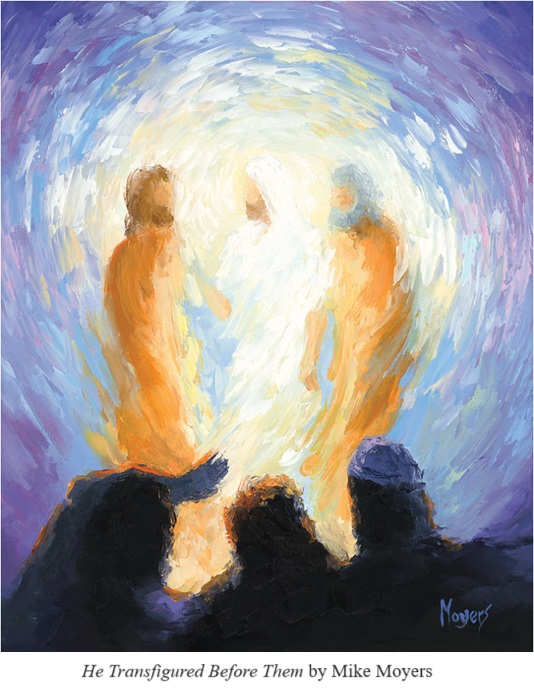
In this week’s Gospel, we read about the Transfiguration of Jesus (Mark 9:2-10), the ultimate image of embracing one’s identity and becoming one with it for the greater good.
Jesus took Peter, James, and John and led them up a high mountain apart by themselves. And he was transfigured before them, and his clothes became dazzling white, such as no fuller on earth could bleach them. Then Elijah appeared to them along with Moses, and they were conversing with Jesus. Then Peter said to Jesus in reply, “Rabbi, it is good that we are here! Let us make three tents: one for you, one for Moses, and one for Elijah.” He hardly knew what to say, they were so terrified. Then a cloud came, casting a shadow over them; from the cloud came a voice, “This is my beloved Son. Listen to him.” Suddenly, looking around, they no longer saw anyone but Jesus alone with them.
As they were coming down from the mountain, he charged them not to relate what they had seen to anyone, except when the Son of Man had risen from the dead. So they kept the matter to themselves, questioning what rising from the dead meant. – Mark 9:2-10
Recall a time where you felt affirmed or reaffirmed and had a sense of confidence in who you are as God’s beloved, leading to spiritual growth or renewal. Ask the Lord for the grace of that experience to extend to today, offering you wisdom, insight, and openness to whatever you may need.
In Greek mythology, keeping the gods and goddesses happy was central to life. So, temples were built, activities were held, sacrifices were made, all to please the gods and goddesses so that the people in turn might be helped along or rewarded rather than punished. Having recently seen a show that involved Greek mythology and the challenge of relationships, reading “…be reconciled to God,” in chapter 5, verse 20 of the Second Letter to the Corinthians, strikes a chord. And then there is the Gospel reading for the Fourth Sunday of Lent which includes the parable of the Prodigal Son (Luke 15:11-32), which really leads one to think about relationships. Combining the two, it can be intriguing to look more closely at the differences and similarities between one’s relationship with God and one’s relationships with others (family, friends, acquaintances, etc.). And perhaps consider further, the impact of both the things we can see and those we think we can see but cannot.
Looking to St. Paul and to the Prodigal Son, it’s all about stripping away the extraneous, drawing closer to what lies within, and trusting one’s experience. However, not one’s experience of self or others, but looking for, remembering and trusting one’s experience of God within the interactions and dealings we have with one another.
Imagine riding along from start to finish with Saul of Tarsus, soldier… warrior, active persecutor of early Christians who was literally knocked off his horse, called to conversion, and way down the road, became St. Paul.
Envision travelling with the Prodigal Son. The son who took his inheritance while his father was still living and turned his back on everyone and everything that he had previously known. He had to take his own path and have his own way; it was just something he needed to do. However, on that path, he lost everything, but then gained so much more than he could have ever dreamed of, by owning the truth and returning home, where he was immediately welcomed and embraced.
For St. Paul and the Prodigal Son, it turned out that the things that drove them… the things that sucked them in as being so important or so necessary, weren’t. And while it may have seemed to them as though they lost everything in the process of their falling, they did not. Both experienced the kindness and love of God both directly and through others—the grace that led them to pivot—and it is through that, that they came to know their true worth as God’s beloved, and that what really matters can never be taken away, only shared and magnified.



 HopeThatFloats
You must be logged in to post a comment.