Be Dazzled…

The readings for the Second Sunday of Lent take us on a journey from sacrifice or letting go to service, embracing identity, and finally becoming one with it. In the first reading, Abraham shows a willingness to sacrifice or let go of whatever his ideas or plans might have been to listen to God and do as God asks (Genesis 22:1-18). Remember, Sarah and Abraham, in their more senior years and against all odds, had their son Isaac after having been barren. Imagine what it must have been like for Abraham to then be asked to sacrifice or let go of his and Sarah’s long-awaited arrival. Yet, Abraham exemplifies a faith that places trust in God (and God alone) above all. He proceeds to take steps toward what God has asked of him. As they left the servants behind and walked along, Isaac asks his father where the sheep is for their offering. Abraham replies, “God will provide the sheep for the burnt offering.” Once they finish building an altar and placing the wood, Abraham moves toward sacrificing his and Sarah’s only child. However, the angel stops him as Isaac’s demise is not what God wills. As Abraham said, God does provide the sheep for sacrifice: “Abraham looked up and saw a single ram caught by its horns in the thicket. So Abraham went and took the ram and offered it up as a burnt offering in place of his son.” And the wisdom of his response to God’s requests and promptings shows that being faithful is to nurture a will that is open to and guided by God. For it is this kind of will that does not lead to demise or destruction.

Continuing to look to what it is to be faithful to God, the response for the Psalm is “I will walk before the Lord, in the land of the living” (Psalm 116:9). How do you feel motivated by Abraham’s example of striving to serve God with a united heart and mind? Try to envision or embody the spirit of walking before God in all that you say and do this week.

Turning to the second reading (Romans 8:31b-34), St. Paul encourages us to remember and embrace our identity when he writes: “If God is for us, who can be against us?” When one is operating with a desire to do God’s will and in the scope of being part of creation in God’s image, there is a sense of inner strength, awareness, and reverence for what is good and just while at the same time a sense of lightness and freedom or free will. It is important to pause every so often to examine what’s going on internally and from where one’s words and actions are flowing. Invite Jesus to the conversation and ask the Lord for the grace to be aligned compatibly with God in each situation you face.

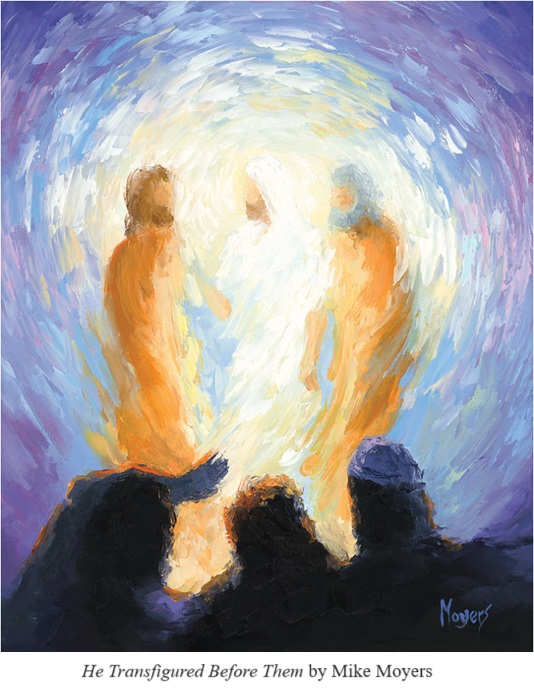
In this week’s Gospel, we read about the Transfiguration of Jesus (Mark 9:2-10), the ultimate image of embracing one’s identity and becoming one with it for the greater good.

Jesus took Peter, James, and John
and led them up a high mountain apart by themselves.
And he was transfigured before them,
and his clothes became dazzling white,
such as no fuller on earth could bleach them.
Then Elijah appeared to them along with Moses,
and they were conversing with Jesus.
Then Peter said to Jesus in reply,
“Rabbi, it is good that we are here!
Let us make three tents:
one for you, one for Moses, and one for Elijah.”
He hardly knew what to say, they were so terrified.
Then a cloud came, casting a shadow over them;
from the cloud came a voice,
“This is my beloved Son. Listen to him.”
Suddenly, looking around, they no longer saw anyone
but Jesus alone with them.

As they were coming down from the mountain,
he charged them not to relate what they had seen to anyone,
except when the Son of Man had risen from the dead.
So they kept the matter to themselves,
questioning what rising from the dead meant.
– Mark 9:2-10
Recall a time where you felt affirmed or reaffirmed and had a sense of confidence in who you are as God’s beloved, leading to spiritual growth or renewal. Ask the Lord for the grace of that experience to extend to today, offering you wisdom, insight, and openness to whatever you may need.

Blow the Horn…

I remember being instructed throughout childhood, “Do not be afraid to ask questions or to ask for help.” In addition, I also recall a teacher I had in elementary school who would often encourage students to ask any question they might have, saying, “The only stupid questions are the ones not asked.” She would then go on to explain that typically, for every student that asks a question, there is at least one other student, if not more, who whether or not they have the same question, somehow stand to benefit from hearing the answer.

Chapter 18, verse 23 of the Book of Genesis reads:

Then Abraham drew nearer (to the Lord) and said:
“Will you sweep away the innocent with the guilty? 

Knowing the Lord intends to address the depravity and numerous wrongs being committed in Sodom and Gomorrah, Abraham (having in mind his nephew, Lot, who resides in Sodom) asks this question and then follows it up with a couple more.

Suppose there were fifty righteous people in the city; would you really sweep away and not spare the place for the sake of the fifty righteous people within it?

Far be it from you to do such a thing, to kill the righteous with the wicked, so that the righteous and the wicked are treated alike! Far be it from you! Should not the judge of all the world do what is just?” – Genesis 18:24-25

Despite being encouraged in my early years to ask away when questions would arise, Abraham’s questions to the Lord, and the manner in which he asks them, used to seem so bold, and almost out of line or disrespectful to me. Questions were to be asked, but not ones like these, and certainly not of God, or those ordained as chosen to serve God’s people.

Now older, such a notion seems so archaic to me as well as one of detriment. It is especially curious, given the fact that Scripture provides many examples of the faithful asking God similar types of questions, sometimes even telling God, “Here is what (or how) I need You to be in this situation.” Not only that, but God’s response is always one of compassion, love, and mercy, not one that is punitive or that takes offense.

The honesty with which Abraham, and others after him, communicate and relate
to God—their prayer—is answered.

Faithfulness begets faithfulness.

The Answer to Prayer – Luke 11:9-13

“And I tell you, ask and you will receive; seek and you will find; knock and the door will be opened to you.

For everyone who asks, receives; and the one who seeks, finds; and to the one who knocks, the door will be opened.

What father among you would hand his son a snake when he asks for a fish?

Or hand him a scorpion when he asks for an egg?

If you then, who are wicked, know how to give good gifts to your children, how much more will the Father in heaven give the holy Spirit to those who ask him?”

Horn1

I will give thanks to you, O LORD, with all my heart,
for you have heard the words of my mouth;
in the presence of the angels I will sing your praise;
I will worship at your holy temple
and give thanks to your name.

Because of your kindness and your truth;
for you have made great above all things
your name and your promise.
When I called you answered me;
you built up strength within me.

The LORD is exalted, yet the lowly he sees,
and the proud he knows from afar.
Though I walk amid distress, you preserve me;
against the anger of my enemies you raise your hand.

Your right hand saves me.
The LORD will complete what he has done for me;
your kindness, O LORD, endures forever;
forsake not the work of your hands.

Lord, on the day I called for help, you answered me. – Psalm 138:1-3,6-8

Written in the Sky…

Diversity is a gift that can open one’s eyes to varying perspectives and bring to light the beauty of creation in all its different forms. When coupled with a sense of unity; a desire to be united and recognition that we are one, as Love calls us to be, diversity can bring out the best of the human race.

St. Albert the Great wrote, “It is by the path of love, which is charity, that God draws near to man, and man to God. But where charity is not found, God cannot dwell. If, then, we possess charity, we possess God, for ‘God is Charity’ (1 John 4:8).” One of his students, Italian Dominican friar St. Thomas Aquinas, by influence of the Greek philosopher, Aristotle, wrote, “To love is to will the good of the other.” Whether Italian or Greek, it’s all the same. We, all humans, are created and called to love, to live in light (not darkness) and to bear witness to both. So then, what is one to do when confronted with or by those who don’t operate this way?

First and foremost, remember the truth. Who am I before God? Then, calling this to mind, stay focused and be faithful, trusting in the goodness of God.

“Faith is the realization of what is hoped for
and evidence of things not seen.
Because of it the ancients were well attested.” – Hebrews 11:1-2

It can be hard to trust and to stay focused when we do not see what we hope to see. All the same though, faith calls me to persevere and persist. And, in turn, if I cooperate, God enables me to do so. It is in this way, that faith beckons me to receive grace upon grace, to be strengthened and filled with hope, allowing me to trust, even when there may not be any physical signs for me to see.

“By faith Abraham obeyed when he was called to go out to a place
that he was to receive as an inheritance;
he went out, not knowing where he was to go.
By faith he sojourned in the Promised Land as in a foreign country,
dwelling in tents with Isaac and Jacob, heirs of the same promise;
for he was looking forward to the city with foundations,
whose architect and maker is God.
By faith he received power to generate,
even though he was past the normal age
and Sarah herself was sterile,
for he thought that the one who had made the promise was trustworthy.
So it was that there came forth from one man,
himself as good as dead,
descendants as numerous as the stars in the sky
and as countless as the sands on the seashore.” – Hebrews 11:8-12

Abraham focused on being faithful to God. God took care of and provided for Abraham and his descendants. Everything else fell into place…eventually.

writteninthesky

To Have Faith Like Abraham…

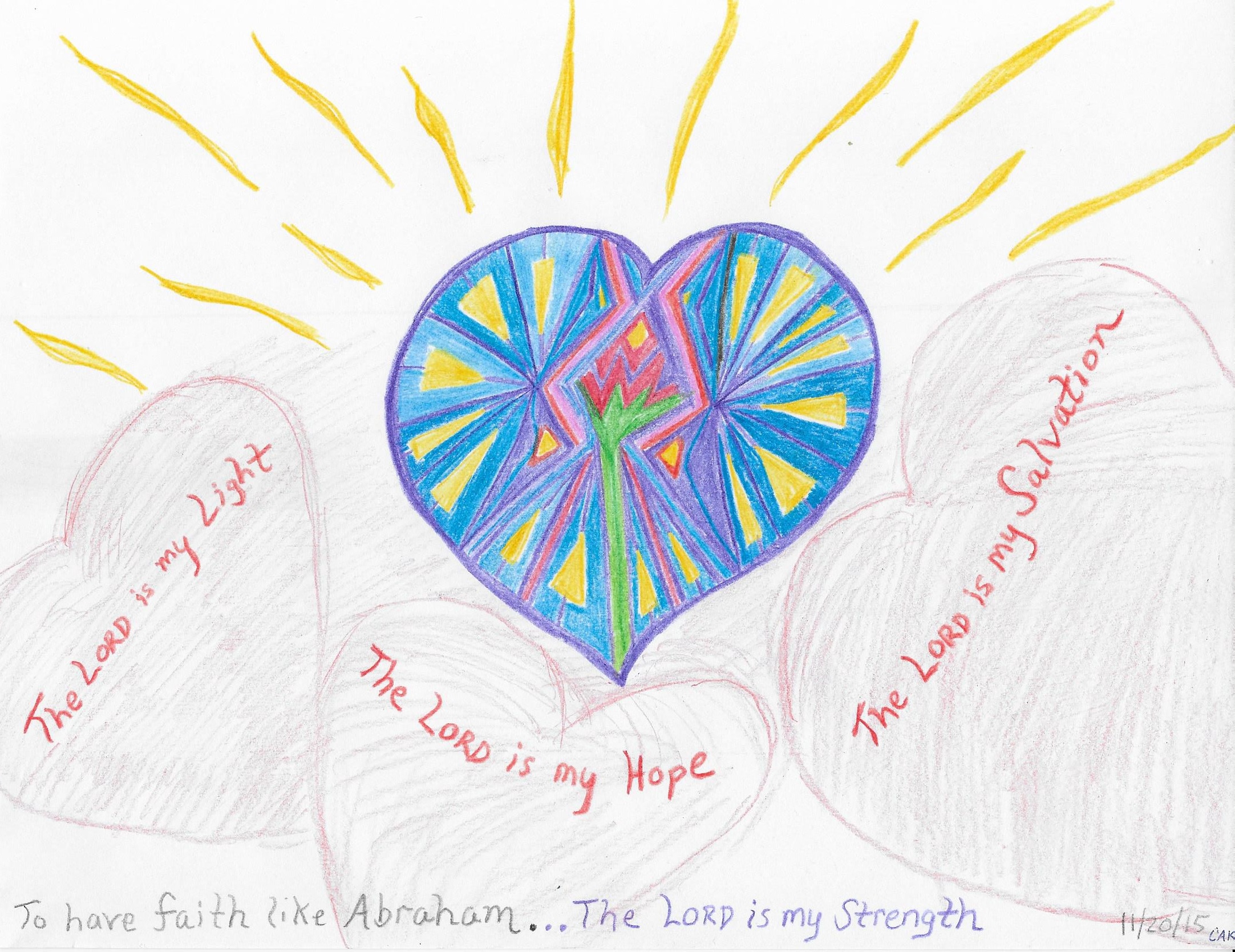
It’s interesting to start out in one direction only to end up in another. The drawing below started out as a broken heart, as I pondered and sat with the sadness I felt over situations around me. However, the more I sat and drew, the more at peace I felt. And when I was done, and it came time for a title, as I looked at the drawing, all I could think was “Abraham.”

The Book of Genesis reveals many trials and tribulations as well as triumphs. Within its pages is the story of the man who started out as Abram, but ended up as Abraham. And while he, like any human being, was not perfect, his life and relationship with God serves as a great example; both are marked by perseverance, faithfulness, and trust. Abraham sought to do the Lord’s will…to do right by God.

Despite the circumstances around him, Abraham was able to see what God had done for him, how God had provided for him, and how God had been with him. To look at Abraham’s life is to see the light of God shining in, shining through, and filling up the holes created by human experience.

Even in his own failings, or perceived failings, Abraham chose God…chose life, time after time. With Abraham, there was always room for God, for the desire for God and to do right by God. There was a confidence, hope and trust that was constant; there was also a sense of freedom. Abraham knew who he was before God and allowed God to help him as he strove to embrace and live out his part of salvation history.

“Abraham” – “The father of many.” To have faith like Abraham…to allow God to shine in us, through us, and beyond us, wherever we go.

FaithLikeAbraham