Throwing Stones…

Stones

“Let the one among you who is without sin,
be the first to throw a stone at her.” – John 8:7

In the world in which we live, the above Bible verse has come to mean, to many people, it is not Christ-like to criticize wrongdoing. Is that interpretation accurate though? Is that really how Christ lived and taught? Is it true?

It is interesting how the truth is often twisted and how, throughout history, the truth, and speakers of the truth, have often been frowned upon. In the Gospel passage of the woman caught in adultery (John 8:1-11), Jesus, champion of truth, honesty and integrity, is put in a position where the authorities (the scribes and Pharisees) are looking for a reason to “take him down” so to speak. They see Jesus as a threat. If the truth becomes known…if their manipulation and ways of holding down and misleading the faithful become known, the faithful will no longer support them and their authority will fade away. This possibility makes them focus even more on trying to suppress or manipulate the truth. They are not open to anything other than efforts to hold onto their kingdom, no matter how that might affect the faithful.

While the scribes and Pharisees are trying to trap Jesus into going against Mosaic law, so that they can arrest him and eventually do away with him, Jesus turns the tables on them. Jesus knows that their motivation is self-serving; they are not concerned about the spiritual well-being of the woman they have brought before Jesus. They are using her, and Mosaic law, to try to get what they want. They are not pointing to the law for the purpose of which the law was made and certainly not for the well-being of the woman or the larger community.

So how does Jesus respond? He calls the scribes and Pharisees attention to the fact that they are not without sin; their hearts are not pure, and they slither away. The woman is left standing alone with Jesus.

While Jesus does not condemn the woman, he does hold her accountable and tells her not to sin any more.

Oftentimes, we can confuse holding someone accountable or to the truth as being judgmental. However, we need to be able to judge situations and, at times, we are called to speak the truth, even if that means it may be in conflict with another or requires holding another accountable.

In a scripture passage prior to the passage about the woman caught in adultery, Jesus says, “Whoever speaks on his own seeks his own glory, but whoever seeks the glory of the one who sent him is truthful, and there is no wrong in him. Did not Moses give you the law? Yet none of you keeps the law. Why are you trying to kill me?” The crowd answered, “You are possessed! Who is trying to kill you?” Jesus answered and said to them, “I performed one work and all of you are amazed because of it. Moses gave you circumcision—not that it came from Moses but rather from the patriarchs—and you circumcise a man on the Sabbath. If a man can receive circumcision on a Sabbath so that the law of Moses may not be broken, are you angry with me because I made a whole person well on a Sabbath? Stop judging by appearances, but judge justly.” (John 7:18-24)

If we come back to the woman caught in adultery, we see that Jesus doesn’t condemn her to death, but he does make a judgment. He tells her to sin no more. He tells her to stop.

When we look at our own lives, like with everything else, we need to follow Jesus’ example. We shouldn’t throw stones, but we should judge justly. When we see people doing wrong, we are called to speak the truth and to stand up for what is just. That is a big part of carrying one’s own cross…of being Christian.


Jesus went to the Mount of Olives.
But early in the morning he arrived again in the temple area,
and all the people started coming to him,
and he sat down and taught them.
Then the scribes and the Pharisees brought a woman
who had been caught in adultery
and made her stand in the middle.
They said to him,
“Teacher, this woman was caught
in the very act of committing adultery.
Now in the law, Moses commanded us to stone such women.
So what do you say?”
They said this to test him,
so that they could have some charge to bring against him.
Jesus bent down and began to write on the ground with his finger.
But when they continued asking him,
he straightened up and said to them,
“Let the one among you who is without sin
be the first to throw a stone at her.”
Again he bent down and wrote on the ground.
And in response, they went away one by one,
beginning with the elders.
So he was left alone with the woman before him.
Then Jesus straightened up and said to her,
“Woman, where are they?
Has no one condemned you?”
She replied, “No one, sir.”
Then Jesus said, “Neither do I condemn you.
Go, and from now on do not sin anymore.” – John 8:1-11
Taking Paul’s Advice…

I saw this quote from Frederick Buechner, an American writer and theologian, the other day. I was contemplating what to do about a particular situation and all of a sudden, there was the answer, this quote, “Go where your best prayers take you.”

As I read the words, a smile came across my face. A reminder just at the right moment, and while the words may seem so simple or even obvious, I felt so grateful to see them and to be reminded of what I know through experience to be so true. I think most of us start out with the best of intentions and then along the way, we can get sidetracked or pulled away from the very place to which we started out.

It seems like it has been human nature, since the beginning of time, to want to be in charge, whether consciously or sub-consciously. Yet, I and many people I know, and know of, seem to agree, that being in a place of seeing oneself as being in charge, or the ultimate authority, can be a most dangerous place to be. Putting oneself at the top, in head and heart, seems to be a place that leads to chaos of one kind or another, more often than not. We can all probably point to many examples of such chaos in our lives and throughout the world.

“One of the most arduous spiritual tasks is that of giving up control and allowing the Spirit of God to lead our lives.” – Henri Nouwen

We can all probably also point to moments of joy and triumph that we’ve experienced ourselves or seen around us where the decision(s) seemed to be so guided by prayer rather than motivated by self-determination or self-preservation. This is not to say that decisions led by prayer do not also come with difficulty or challenge. Sometimes they do. However, when I turn my will over to God, putting prayer and listening at the top of the list, and asking God to help me to choose light and hope over fear, I find without fail, peace, calm and blessings in the midst of smooth sailing as well as in the midst of a storm.

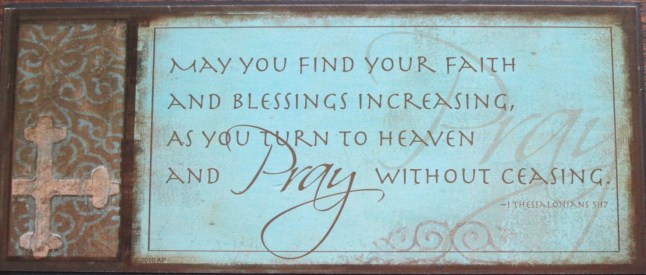
PrayWithoutCeasing

St. Paul’s advice to the Thessalonians, “Pray without ceasing…”

Polished Stones…

PLUM2G

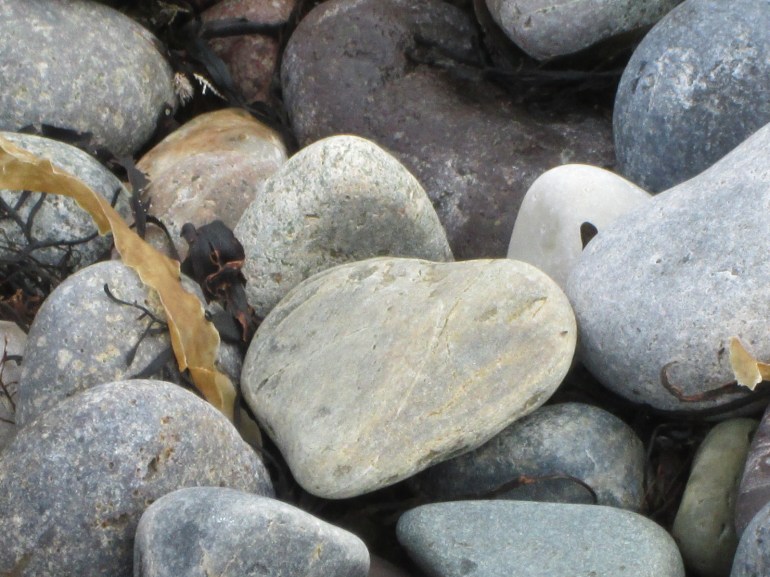
I woke up this morning with a U2 song in my head. I was particularly struck by the line, “The sea throws rocks together but time, leaves us polished stones.” As I look at stones collected from a local beach over the past number of years, I love how all the stones, of different shapes, sizes and colors, share a smooth texture. Sometimes I wonder from where each stone may have originated. How far did each one travel along its journey from out in the deep ocean to the sands of the beach? The stones, no matter where they came from or how they started out, all came to be smooth by being tossed about in the sea.

It is interesting how in the same way that the friction caused by water against stone and stone against stone has smoothed the edges over time, adversity can smooth our edges. Adversity can lead to growth.

It seems human nature to prefer the moments of smooth sailing, keeping quiet and avoiding potential conflict. However, as I reflect, it seems like so much more growth comes from moments of standing in the ocean and moving with the waves as they ebb and flow, as they rise and fall with the tide, and crash around during storm surges. Carrying hope in my heart and a desire to be all that I can be (and all that I was created to be) deep within my soul, I am able to own who I am. With each wave, through God’s grace and with openness and acceptance, the jagged edges are smoothed away. I am made new.

“Then we will no longer be infants, tossed back and forth by the waves, and blown here and there by every wind of teaching…” – Ephesians 4:14

Ordinary Love by U2

The sea wants to kiss the golden shore.
The sunlight warms your skin.
All the beauty that’s been lost before, wants to find us again.
I can’t fight you anymore; it’s you I’m fighting for.
The sea throws rocks together but time, leaves us polished stones.

We can’t fall any further if, we can’t feel ordinary love.
And we cannot reach any higher, if we can’t deal with ordinary love.

Birds fly high in the summer sky and rest on the breeze.
The same wind will take care of you and I, we’ll build our house in the trees.
Your heart is on my sleeve, did you put it there with a magic marker.
For years I would believe, that the world, couldn’t wash it away.

Cause we can’t fall any further if, we can’t feel ordinary love.
And we cannot reach any higher, if we can’t deal with ordinary love.

Are we tough enough, for ordinary love?

We can’t fall any further if, we can’t feel ordinary love.
And we cannot reach any higher, if we can’t deal with ordinary love.

Are we tough enough, for ordinary love?

Blossoming Day by Day…

“Where flowers bloom, so does hope” – Lady Bird Johnson

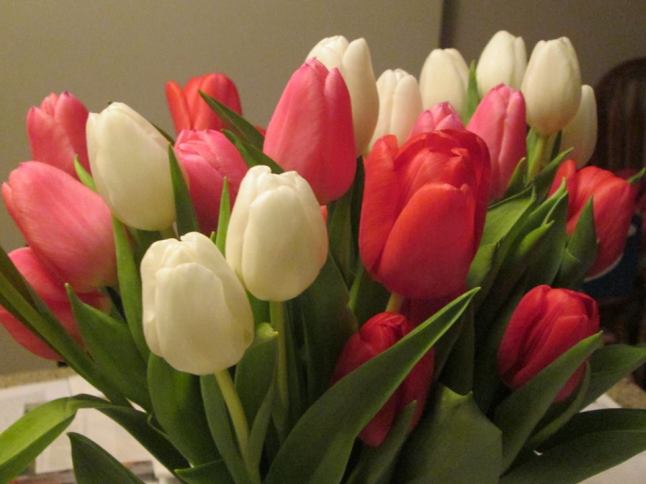
About a week ago, I received a gift of flowers—pink, red and white tulips. When I first opened the box in which they were delivered, the tulips were cold and the petals closed like a clenched fist, but still beautiful. After cutting the end of each stem at an angle, I placed the tulips in a glass vase with plant food and some water. I continued to add water as needed and in the warmth of my home, the petals loosened over the course of the week. Each flower transitioned from being fully closed to being in a state of full bloom; different then when they first arrived…even more beautiful.

Thinking back over the course of the past week, it strikes me that the tulips needed much more water in the first day or two than they did in the days beyond that. I remember at times looking at the flowers and the vase, and feeling surprised that more water was needed again. In fact, I think I added water 2-3 times in those first couple of days.

As I sit facing what are now fully opened tulips, I think about the work required to get to this point. I needed to continue to add water to the vase while the flowers needed to continue to take the water in. There was collaboration. Both things needed to occur in order for the tulips to fully open.

Overall, one might say that the environment needed to be conducive to growth. That is, there needed to be give and take, and room for change…inside (the vase) as well as outside. It is not really all that much different from human relationships. When the environment is conducive, it is much easier to work together, to give and take, and to allow room for change in a manner in which all may flourish.

TulipsFeb

Between the Lines…

BetweenLines

During the winter months, some animals hibernate, some migrate, and others adapt. All animals, whether of the hibernating, migrating or adapting kind, need to prepare for the change of seasons. What remains constant year-round, though, is the need for energy. Even the hibernating animals need energy throughout their deep sleep.

On what is a very cold day, on which a deep sleep can be very tempting, as I catch up with news from throughout the week, I find myself pondering the things that are written (and spoken). From where do these things come? What is the source?

It is written… (Luke 4).

As I reflect on the happenings of the week, I wonder, “Written by whom?” and “For what purpose?” Not only that but, “What led to ‘it’ being written?” There are so many questions one could ask and so many possible ways of answering them, but at the end of the day, the most important questions seem to be, “Who is being served by the questions? Who is being served by the answers? How is that which is written being used?”

Filled with the Holy Spirit, Jesus returned from the Jordan
and was led by the Spirit into the desert for forty days,
to be tempted by the devil.
He ate nothing during those days,
and when they were over he was hungry.
The devil said to him,
“If you are the Son of God, command this stone to become bread.”
Jesus answered him,
“It is written, One does not live on bread alone.
Then he took him up and showed him
all the kingdoms of the world in a single instant.
The devil said to him,
“I shall give to you all this power and glory;
for it has been handed over to me,
and I may give it to whomever I wish.
All this will be yours, if you worship me.”
Jesus said to him in reply,
“It is written: You shall worship the Lord, your God,
and him alone shall you serve.

Then he led him to Jerusalem,
made him stand on the parapet of the temple, and said to him,
“If you are the Son of God,
throw yourself down from here, for it is written:
He will command his angels concerning you, to guard you,
and:
With their hands they will support you,
lest you dash your foot against a stone.

Jesus said to him in reply,
“It also says,
You shall not put the Lord, your God, to the test.
When the devil had finished every temptation,
he departed from him for a time. – Luke 4:1-13

The Choice Is Ours…

ChoiceIsOurs

From the snow covered branches to the rumble of snowplows, the hum of snow blowers and the sound of shovels against the ground. From the people driving or operating machines or shoveling to those simply playing in the winter wonderland. From those readying a place for loved ones returning from outdoors to those who are simply gazing in awe of the beauty that abounds…and, to all those in between, Alleluia!

Be it rain or snow or a storm of another kind, there is something so pure…so quiet…after a storm. There is something so precious in the time that follows the pouring down…and sometimes out and all around. Looking out the window after a recent snowstorm, I am struck by the way that everything is right in front of us, and the choice is ours.

While the storm may have caused almost all activity to come to a halt, it also washes clean (or white) for at least a little while. Then, it is time to clean up. Moved to work together, we help each other to restore the roads and the walkways so that once again they are open and safe for travel to and from.

Again, it seems that everything is right in front of us and the choice is ours.

A Boiled Seed Cannot Sprout – Author Unknown

An aging king woke up one day acutely aware of his own mortality.  He had no son, and his was a culture where only a male heir could take his place.

He decided that he would adopt a son who then could take his place, but he insisted that such an adopted son must be extraordinary in every sense of the word.  He considered each of his advisors and relatives in turn, but found them wanting.

So he launched a competition in his kingdom, open to all boys, no matter what their background. Ten boys made it to the very top. There was little to separate these boys in terms of intelligence and physical attributes and capabilities.

The king said to them, ‘I have one last test and whoever comes top will become my adopted son and heir to my throne.’ Then he said, ‘This kingdom depends solely on agriculture, so the king must know how to cultivate plants.  Here are seven seeds of grain for each of you. Take them home.  Plant and nurture them for six weeks. At the end of six weeks, we shall see who has done the best job of cultivating the grain.  That person will be my son and my heir. ‘

The boys took their seeds and hurried home.  Each got a pot, prepared soil, and sowed his seeds. There was much excitement in the kingdom as the people waited to see who was destined to be their next king.

In one home, the boy and his parents were almost heartbroken when the days stretched into weeks and the seeds failed to sprout. The boy did not know what had gone wrong. He had selected the soil carefully, he had applied the right quantity and type of fertilizer, he had been very dutiful in watering it at the right intervals, he had even prayed over it day and night and yet his seeds had turned out to be unproductive.

Some of his friends advised him to go and buy seed from the market and plant that. ‘After all,’ they said, ‘how can anyone tell seeds of grain one from another?’

But his parents who had always taught him the value of integrity reminded him that if the king wanted them to plant just any grain, he would have asked them to go for their own seed. ‘If you take anything different from what the king gave you that would be dishonest. Maybe we are not destined for the throne.  If so, let it be, but don’t be found to have deceived the king,’ they told him.

The appointed day came and the boys returned to the palace each of them proudly exhibiting a pot of healthy seedlings. It was obvious that the other nine boys had had great success with their seeds. The king began making his way down the line of eager boys and asked each of them, ‘Is this what came out of the seeds I gave you?’ And each boy responded, ‘Yes, your majesty.’ And the king would nod and move down the line.

The king finally got to the last boy in the line-up. The boy was shaking. He feared that the king might have him thrown into prison for wasting his seeds. ‘What did you do with the seeds I gave you?’ the king asked.

‘I planted them and cared for them diligently, Your Majesty, but alas they failed to sprout,’ the boy said.  He hung his head in shame, and the crowd jeered.

But the king raised his hands and signaled for silence. Then he said, ‘My people behold your next king.’

The people were confused. ‘Why that one?’ many asked.’ How can he be the right choice?’

The king took his place on his throne with the boy by his side and said, ‘I gave these boys boiled seeds. This test was not for cultivating grain.  It was a test of character; a test of integrity. It was the ultimate test.  If a king must have one quality, it must be that he should be above dishonesty. Only this boy passed the test. A boiled seed cannot sprout.’

Stay…

As a child of around 5 or 6 years old, one day my younger brother and I were playing in our garage. We took a wooden baseball bat, put it on the floor and took turns trying to balance on it as it rolled. At one point, we got into an argument as it was my turn and my brother would not step off and aside. Each time he lost his balance and stepped off, he would step right back on and not allow me to have a turn. Nothing I said mattered and things were only settled by the activity abruptly ending with my brother being pushed off the bat and me running away, afraid that I would get into trouble.

I remember running out of the garage and into the front yard to this big maple tree. I was frightened and didn’t know what to do. My brother had fallen forward and was bleeding from where he banged his forehead. I was standing under that maple tree, my heart pounding.

Then, I looked up at the branches and leaves above me. It felt as if the tree was surrounding me. It was sheltering me in the shade, while the sun was shining all around. I felt a sense of calm as I looked out from under the shade of the tree and I knew, despite the fear, I had to make sure my brother was okay and I had to tell the truth.

As I came to that realization and was setting to walk back to the garage, one of my older sisters met me. Just seeing her helped me to feel that it would be okay. I was doing the right thing, even if I felt afraid about what would happen by going back to the garage. I needed to do it because it was the right thing to do.

Thank God, my brother was okay and lived to tell about it, with a small scar as proof. When it was all said, and done, both my brother and I told our parents the truth about what had happened that day. They were upset at my brother for his role and they were upset with me, but not so much because I had pushed my brother as the fact that I had run away instead of staying.

Thinking back to that day and forward to today, I feel very blessed as I remember and realize many of the ways that God has helped me throughout my life to know that I am doing the “right” thing at a particular moment in time and has helped me to do it. In the same way, God has helped me to know when I am not doing the “right” thing.

I find it interesting how the past can be so helpful in facing the future. Just as on that day so many years ago God helped me, God has helped me today, by reminding me of that incident and all those whom God has placed in my sister’s role…keep telling the truth; it will be okay.

“He will direct you to what is best for you to be heaven bound.”

– thank you my friend for sending this quote.

From Shaking Dust to Slaying Giants…

Whether one uses the verbiage of today, “Shake it off!”, or that of ancient times, “Shake the dust from your feet”, there are many ways to accomplish the task of not allowing people or situations to drag me down or to take me away from being or striving to be the best I can be (that is, my authentic self).

Jesus’ words to the disciples: “And as for those who do not welcome you, when you leave that town, shake the dust from your feet in testimony against them.”(Luke 9:5)

As I sit with the thought of shaking the dust, I wonder about the situations, where it seems like the dust cannot be shaken off. What about the situations where the dust is more like mud stuck in and around one’s sandals? What is to happen then? Does the “shake” need to become a “stomp” or some other more forceful action? Do the sandals need to be soaked in soapy water until the mud softens and can be washed away? Or, do they need to be removed and replaced with new ones?

Ultimately, any of the above, could be the answer. There could also be other possibilities. It all depends on whom I am and what I am being called to by God in the situation that I find myself.

Many people are familiar with the story of David and Goliath in the Bible, but perhaps not how he ended up standing in front of Goliath. David is the youngest of 8 sons. Between the ages of 10 and 13 he is anointed by the prophet Samuel.

“The LORD said, ‘There–anoint him, for this is he!’ Then Samuel, with the horn of oil in hand, anointed him in the midst of his brothers; and from that day on, the Spirit of the LORD rushed upon David.” – 1 Samuel 16:13

After the anointing and as a young man, David is summoned to Saul (the King) as a musician.

“Saul then told his servants, ‘Find me a good harpist and bring him to me.’ One of the servants spoke up: ‘I have observed that a son of Jesse of Bethlehem is a skillful harpist. He is also a brave warrior, an able speaker, and a handsome young man. The LORD is certainly with him.'” – 1 Samuel 16:17-18

Saul is pleased with David and makes him an armor-bearer. During this time, the Philistines and Israelites go to battle against each other. Goliath is a mammoth Philistine warrior. David, upon his father’s request, is bringing food to his brothers who are soldiers in the Israelite’s army camp. While there, he asks a question about the reward for defeating Goliath and wonders aloud who the giant is that he is against “the armies of the living God.” (1 Sam 17:26). David’s questions and the conversation that results get back to Saul who requests that David be brought to him.

David asks Saul to let him fight Goliath. Saul tells him, “You cannot go up against this Philistine and fight with him, for you are only a youth, while he has been a warrior from his youth.” (v33). David tells Saul how he has fought off lions and bears while tending his father’s sheep and that he will do the same to Goliath “because he has insulted the armies of the living God.” (v36) Then he says, “The same LORD who delivered me from the claws of the lion and the bear will deliver me from the hand of this Philistine.” (v37) Saul agrees and David battles Goliath.

While the battle and victory by David seem swift, it is not without what we might call “trash talk” by the giant who scoffs at the youth and size of David and his weapons (a slingshot and 5 stones). David stays his ground though and responds, loud and clear to Goliath, “For the battle is the LORD’s and the LORD shall deliver you into our hands.” (v47) … that is exactly what happens.

To follow the story of David from his birth order and anointing to his battle with Goliath and beyond, it seems clear that “the Spirit of the Lord rushed upon David” and that David let the Spirit of the Lord lead him. He did so no matter what giant he faced…in doing what seemed impossible (defeating Goliath) and in acknowledging his wrongdoing and turning back to the Lord after succumbing to his weaknesses (in 2 Sam 11-12). In the end, there was no dust or mud on his sandals.

“For the battle is the LORD’s.” When I let it stay that way, instead of making it my own, I know exactly when and how to shake, stomp, soak and wash, or remove and replace my sandals…there is no dust or mud on them.

“The Spirit of the Lord is upon me” (Is 61:1, Lk 4:18), upon us, how do we embrace It?

IMG_1644

Connecting the pieces…

puzzlepieces2

A year or so ago, and over the course of a number of weeks, I was in the waiting area of a medical center for a portion of each weekday morning. On the way to the waiting area there was coffee, hot water for tea, and small packages of graham crackers and salted crackers. The waiting area itself had chairs, a TV and magazines like most waiting areas, but it also had a table with a partially completed puzzle on it and all the remaining small pieces, also waiting.

I remember arriving each morning and after a short period of time, looking to see how much more of the puzzle was left to be done and how many pieces I might locate and place in the time that I was waiting. At first, this was how I spent at least a portion of my half hour wait each day. Then, as the weeks progressed there were more people in the waiting area and I found my time less and less filled with finding and placing pieces of the puzzle and more filled with conversation between and amongst fellow wait-ers. Those who were once strangers became familiar over a short period of time.

It is interesting how our lives intersect with the lives of others. And how, even over a brief period of time or through a short exchange, we can affect each other’s lives.

Each lifetime is the pieces of a jigsaw puzzle.
For some there are more pieces.
For others the puzzle is more difficult to assemble.
Some seem to be born with a nearly completed puzzle….

But know this. You do not have within yourself
All the pieces to your puzzle…

Everyone carries with them at least one and probably
Many pieces to someone else’s puzzle.
Sometimes they know it.
Sometimes they don’t.

                      – from “Eyes Remade for Wonder” by Rabbi Lawrence Kushner

As I continue to sit with the memory of that waiting area, I recall how it felt as if time was suspended or even ceased to exist. There was a reverence in the air as we listened to one another and shared conversation and laughter as we waited. It was as if we were on holy ground. A pleasant surprise…

Recently, I attended an 80th birthday party, and while it was much noisier than the waiting area of that medical center over a year ago, there was also a reverence in the room. At one side of the room there was a slideshow of pictures from throughout the years. As I sat and watched the pictures from old to new, seeing both family and friends…those who had passed and those who were present, sadness was replaced with gratitude as I was reminded…How precious life is! There was a feeling of holy ground in the pictures and in the room in the hugs and kisses, and in the smiles, greetings and conversations that were exchanged during the celebration of a “piece,” a special and beloved piece, that belongs to the puzzle of each of us present at the party, whether in spirit or in person.

So, I praise God as I say thank you Auntie D. for your beautiful spirit, your love, and your example throughout a lifetime. And, thank you to the nurses, technologists and patients in the waiting area of that medical center for your hospitality, sharing and caring during a short and uncertain period of time.

Each and every piece of the puzzle no matter the shape, size, or length is a gift, or has a lesson that is a gift. Sometimes that is easier to see than at other times. Either way, whether we see it now, or later, one spirit bowing to another is always a beautiful thing.

Tradition, Tradition…Tradition!

A number of years ago I went to see a production of Fiddler on the Roof at a local theatre. Since then, every so often I catch the movie, usually at some point after the beginning or midway thru, on television. In fact, it has become somewhat of a regular occurrence for me to see or listen to at least part, if not all, of Fiddler on the Roof once or twice a year…Ah, tradition!

As this past year wound down and we moved from Thanksgiving through New Year’s Day, tradition has been very much in the air. I guess it is every year though. However, as I live and breathe, and think about tradition, I cannot help but “feel” tradition.

Tradition is so much more than the same thing over and over, and over. The heart and soul of it is the spirit of it…the sentiment, memories and feelings that accompany tradition. It is not all about keeping everything the same as it was before, but rather about coming together in the same spirit as before.

Continuing to ponder tradition, I envision the lighting of the torch at the Olympic Games. While the games always start with the lighting of the torch and end with the extinguishing of the flame, these two events and pretty much everything in between are never really the same from one Olympic Games to another. The location, costumes, and uniforms change. Sometimes variations are made to the rules or scoring rubrics and events are added or dropped.

As I sit with this image, it seems to me that one surefire way to kill a tradition is to keep it unchanged, year after year, after year. As time goes by, the focus may shift from the spirit of the tradition to the material of the tradition (the things and steps involved in making it all happen the same way). When that happens, the Spirit is shutout and the decline begins. Then tradition cannot help but lose what makes it special, becoming rote and more of a chore than something to which one looks forward or wants to embrace and celebrate.

Simply put, without substance and without room for change or growth, anything, even the most cherished tradition, will eventually become extinct. All things evolve.

“Tradition, which is always old, is at the same time ever new because it is always reviving – born again in each new generation, to be lived and applied in a new and particular way…Tradition nourishes the life of the spirit; convention merely disguises its interior decay.” – Thomas Merton

OlympicTorch