With the vast array of devastation caused by wildfires on the left side of the United States and hurricane Ida and resulting treacherous weather throughout the right side of the United States, not to mention ongoing multi-faceted struggles around the entire world, it can be easy to fall prey to a sense of doom, regardless of whether one is experiencing dire need, a direct impact, on the fringes of such impact, or farther removed.
On what is a dreary day, on the feast of St. Teresa of Calcutta, it is good to remember that despite the darkness, God is with us amid all these trials and tribulations. Leading the way, before one might even know it. Providing light and love. Lifting spirits, opening minds, increasing the will to help, and strengthening the bond of human hearts toward one another.
Say to the fearful of heart: Be strong, do not fear! Here is your God, he comes with vindication; With divine recompense he comes to save you.
– Isaiah 35:4
“There is a light in this world, a healing spirit more powerful than any darkness we may encounter. We sometimes lose sight of this force when there is suffering, too much pain. Then suddenly, the spirit will emerge through the lives of ordinary people who hear a call and answer in extraordinary ways.”
I remember as a young student feeling fascinated as I learned all about the human heart, its functions and their importance. I was most amazed by the strength of the heart and its capacity, pumping 2,000 gallons of blood each day throughout the body. It wouldn’t be until years later that my amazement would become even greater in coming to understand the heart’s greatest asset—the rhythm, steady and strong, seeking to draw one closer, revealing God, and yearning not only to keep the connection of love, peace, and healing going, but also to help it to thrive without bounds. As the 13th century Persian poet, Rumi, wrote, “Love is the bridge between you and everything.”
In chapter 7 of the Gospel according to Mark, Jesus says to the Pharisees,
“Well did Isaiah prophesy about you hypocrites, as it is written:
This people honors me with their lips,
but their hearts are far from me;
in vain do they worship me,
teaching as doctrines human precepts.
You disregard God’s commandment but cling to human tradition.” (Mk 7:6-8)
Jesus is calling on them to be honest… to look more closely and to see that their hearts are not leading them in union with God. Their love has become misplaced. It is self-serving and focused on what is earthly rather than what is truly, right and just. Their words and actions do not come together to reflect the beauty of God’s goodness—the law that is placed in every heart—dignity, care, and love of all who are placed alongside us whether in location, heart, or mind.
This same love is what the author of the Letter of James is calling people to when he writes,
“Know this, my dear brothers: everyone should be quick to hear, slow to speak, slow to wrath,
for the wrath of a man does not accomplish the righteousness of God.
Therefore, put away all filth and evil excess and humbly welcome the word that has been planted in you and is able to save your souls.
Be doers of the word and not hearers only, deluding yourselves.” – Jas 1:19-22
No matter where one might be, or the circumstances that exist, Love is the only true hope there is. And while there may be many things that seem beyond reach, or out of control, Love is the anchor that holds us altogether, moves us into action, and brings peace, or peace of mind, strength, truth and justice, never growing cold.
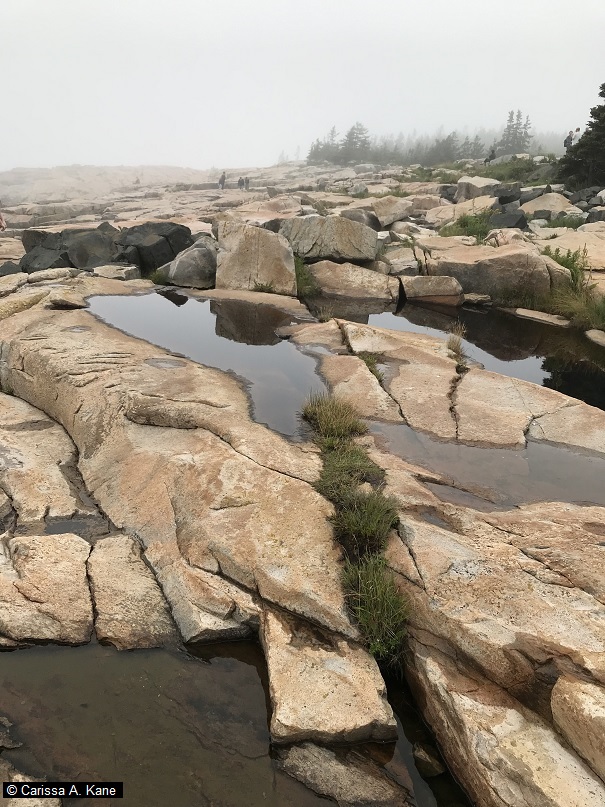
With the starting point blanketed in fog, one couldn’t help but wonder whether it would be worthwhile to venture out any further on this day. Yet, despite the limited visibility we carried on, coming across pockets that offered clearer vision—spots and places once hidden, where we could pause and gather our bearings. And as for the silence encompassing the mist all around, while at first eerie, with time becoming rather comforting, inspiring a sense of adventure and greater insight as we moved along the contours, crossed plateaus, and entered the ups and downs of our terrain.
Always a spot to rest, or safely step, provided when needed most.
Always a way around, over, or simply through, provided when needed most.
Always at the right time, in the right place, and in the right way, provided when needed most.
Interesting how most needs are met, in trusting, while moving toward, and searching for, what is truly needed.
He replied, “Rather, blessed are those who hear the word of God and observe it.” – Luke 11:28
Depending upon one’s experiences, certain words can bring to mind a particular image or situation. Hearing or seeing the word, “murmur,” many people might think of the human heart and the condition of a heart murmur, speaking in a low volume as in under one’s breath, or perhaps a hushed conversation between a number of people within a larger setting. Interestingly, in any of these cases, the murmur, or anything else that may be transpiring, can be of no significance, or the opposite. And, as always, the only way to know more certainly is by tuning in more closely.
While searching to discover what’s going on may seem pretty basic or obvious, human nature often leads us toward conjecture, murmuring amongst ourselves rather than seeking the source directly and looking for the answers or understanding there.
In the Gospel according to John, chapter 6, verses 41-51, the people are in disbelief, and maybe confused about Jesus’s statement that he is the bread of life that has come down to earth from heaven. Filled with questions, and likely doubt, with a limited knowledge of who Jesus really is, they are quietly speaking amongst themselves. They are looking for answers from each other, even though none of them understand what was said or what Jesus meant by it. What might this passage, and what follows from it, look like if instead of asking each other, the people asked Jesus directly about his statements, and took careful notice of his response together with his actions?
Moving forward to the way that Jesus responds to the hushed voices going on around him, regarding him, it is as if Jesus is simply saying, “Stop,” to the gossip and speculation. He does not enter into the grumbling. He does not succumb to it, and the questions the people were asking each other instead of engaging directly with Jesus, go unanswered, while Jesus continues to focus on Truth, and giving voice to it. After all, the fact of the matter is that more often than not, it really is as simple as continually asking Jesus for help in seeing something for what it is, saying, “Stop,” to nonsense, understanding and embracing what is of genuine importance, and listening, so as to recognize when and how to be moved.
The Jews murmured about Jesus because he said, “I am the bread that came down from heaven,” and they said, “Is this not Jesus, the son of Joseph? Do we not know his father and mother? Then how can he say, ‘I have come down from heaven’?” Jesus answered and said to them, “Stop murmuring among yourselves. No one can come to me unless the Father who sent me draw him, and I will raise him on the last day. It is written in the prophets: They shall all be taught by God. Everyone who listens to my Father and learns from him comes to me. Not that anyone has seen the Father except the one who is from God; he has seen the Father. Amen, amen, I say to you, whoever believes has eternal life. I am the bread of life. Your ancestors ate the manna in the desert, but they died; this is the bread that comes down from heaven so that one may eat it and not die. I am the living bread that came down from heaven; whoever eats this bread will live forever; and the bread that I will give is my flesh for the life of the world.”
Pulling into an open lot along a scenic road, initially it seemed as though there was no place from which to view the water. Bushes and trees were all around, as if a fortress blocking the way to the water gently waving behind it. However, stepping out into the fresh air, with each movement closer, possibilities arose, until at last, nearer still and despite any preconceived notions, a path, narrow as could be, but still present, a way through appeared.
Oftentimes, there is much more than one might see or think there to be, yet it can be tempting to refrain from asking, disregard the invitation, and instead turn back, embrace presumptions from afar, and choose a side, rather than trusting that call, choosing to discover (ask and receive), allowing paths to appear and Truth to become known.
In the passage below, what resonates most with you at this moment? Which person(s) do you identify with and in what ways? How do you desire to be, and to live? Where is God in that desire?
The whole Israelite community grumbled against Moses and Aaron. The Israelites said to them, “Would that we had died at the Lord’s hand in the land of Egypt, as we sat by our fleshpots and ate our fill of bread! But you had to lead us into this desert to make the whole community die of famine!”
Then the Lord said to Moses, “I will now rain down bread from heaven for you. Each day the people are to go out and gather their daily portion; thus will I test them, to see whether they follow my instructions or not.
On the sixth day, however, when they prepare what they bring in, let it be twice as much as they gather on the other days. So Moses and Aaron told all the Israelites, “At evening you will know that it was the Lord who brought you out of the land of Egypt; and in the morning you will see the glory of the Lord, when he hears your grumbling against him. But who are we that you should grumble against us?”
And Moses said, “When the Lord gives you meat to eat in the evening and in the morning your fill of bread, and hears the grumbling you utter against him, who then are we? Your grumbling is not against us, but against the Lord.”
Then Moses said to Aaron, “Tell the whole Israelite community: Approach the Lord, for he has heard your grumbling.” But while Aaron was speaking to the whole Israelite community, they turned in the direction of the wilderness, and there the glory of the Lord appeared in the cloud!
The Lord said to Moses: “I have heard the grumbling of the Israelites. Tell them: In the evening twilight you shall eat flesh, and in the morning you shall have your fill of bread, so that you may know that I, the Lord, am your God.”
In the evening quail came up and covered the camp. In the morning a dew lay all about the camp, and when the dew evaporated, there on the surface of the desert were fine flakes like hoarfrost on the ground. On seeing it, the Israelites asked one another, “What is this?” for they did not know what it was. But Moses told them, “This is the bread that the Lord has given you to eat.” – Exodus 16:2-15
After what seemed like quite a lot of time walking and winding our way, up, down, around, and through the wooded area embracing the large pond, we arrived at what appeared to be the center of our journey—the resting place. As we moved closer to the main building, designed for respite and a bite to eat, we were greeted by a wooden barrel holding purple and yellow flowers beckoning us to keep the journey going. Bright and beautiful flowers, they drew us—tired, hungry, weary travelers—in and lifted us up, raising the smile in our hearts to our lips and bringing the twinkle back to our eyes.
No matter the circumstances, the conditions along the way, or how far one travels, Peace is always reaching out, working from within, and waiting upon us.
Faith is the road, but communion with Jesus is the well from which the pilgrim drinks. ― Charles Haddon Spurgeon
Anima Christi
Soul of Christ, sanctify me. Body of Christ, save me. Blood of Christ, inebriate me. Water from the side of Christ, wash me. Passion of Christ, strengthen me. O good Jesus, hear me. Within Thy wounds hide me. Separated from Thee let me never be. From the malignant enemy, defend me. At the hour of death, call me. And close to Thee bid me. That with Thy saints I may be Praising Thee, forever and ever. Amen.
With lots of rain this past week and existing conditions around the globe, it certainly seems like stormy times continue to be the pattern. Not only that, but it’s like they are holding as if super glue. So why not embrace them?
We know that the perfect storm forms out of what can be predicted or seen combined with what is unforeseen or unplanned. That is why such a storm often catches us off guard; there is an opening. Similarly, anything in life that is mutually beneficial, or truly divine, comes to fruition. And, even in the times when we cannot perceive or name it, there is always something more than what meets the eye, seeking to bear fruit. Always something more working through whatever failings or inadequacies there may be, to spread light and love, and ultimately, to break through, bringing what is good into the world.
During all this storminess, sometimes it can be tempting to look at life through a smaller lens, as if a mathematical equation to be solved. As if you get out of it what you put in, and the sum of all our human efforts creates a whole or complete picture of the end sought from the beginning. Yet, although these philosophies may be true to some extent, there is a lot more that comes into play for any given situation.
Often, in times like these, there is an invitation to see more clearly, and a reminder that while the surface may seem clear cut, Truth is encompassed in the depths and cannot be erased. It draws for us a complete picture, and what is Whole, never lies.
Lord, let us see your kindness, and grant us your salvation. – Psalm 85:8
From childhood, the name Anthony has evoked two thoughts more prominently than others, spaghetti day and help in finding what has been lost— “St. Anthony, please come around: something is lost, and it cannot be found,” or the less formal, “Tony, Tony, look around. Something’s lost and must be found!”
Today, June 13th, is the feast day of St. Anthony of Padua whose life in words and actions is an inspiring example of participation in the Kingdom of God, here on earth, and everlasting. Anthony accepted the invitation, sought union with the Lord, and allowed himself to be led, leaving behind a path that guaranteed him earthly wealth and power. It seems so appropriate that the name Anthony means fortunate… blessed… praiseworthy… priceless. Words that create an image of abundance, and that one can also imagine applying to the Kingdom of God.
In the Book of the Prophet Ezekiel, it is written:
Thus says the Lord God: I, too, will take from the crest of the cedar, from its topmost branches tear off a tender shoot, and plant it on a high and lofty mountain; on the mountain heights of Israel I will plant it. It shall put forth branches and bear fruit, and become a majestic cedar. Birds of every kind shall dwell beneath it, every winged thing in the shade of its boughs. And all the trees of the field shall know that I, the Lord, bring low the high tree, lift high the lowly tree, wither up the green tree, and make the withered tree bloom. As I, the Lord, have spoken, so will I do. – Ez 17:22-24
Reading this passage, listening to the words and phrases within it, and considering the example of St. Anthony, one is reminded that just as the Lord stooped down, becoming one of, and with us, we also, are called to abandon lofty ideals, places, and practices. While the world, and all that is passing, might seek to grip and hold us down, God seeks to meet us on ground level, and elevate us to that which is eternal. In what ways, might this Divine invitation be accepted more fully?
“The creator of the heavens obeys a carpenter; the God of eternal glory listens to a poor virgin. Has anyone ever witnessed anything comparable to this? Let the philosopher no longer disdain from listening to the common laborer; the wise, to the simple; the educated, to the illiterate; a child of a prince, to a peasant.” – St. Anthony of Padua
Some days seem to arrive so suddenly, despite all the moments along the way building and leading up to them. Occasions can seem so far away, distant, or perhaps remote in possibility, but then in a blink of an eye, there they are, upon us.
Looking back, quite often we can see that there was a gradual unfolding. Bit by bit, being led, pushing back, falling into, twisting and turning, moving toward, and perhaps eventually all out embracing the process in the making. And, almost always, right before our very eyes, like the rising and setting of the sun, or the movement of the wind and drifting of the clouds.
Purpose and meaning, and yes, a point, even in the midst, or lack, of human understanding.
In the Gospel according to Mark, after the preparation and celebration of the Passover, on the day that would become known as the Lord’s supper, we read:
“Then, after singing a hymn, they went out to the Mount of Olives” (Mk 14:26).
To sing a song of thanksgiving to God would have been a very normal and traditional thing to do in bringing the Passover meal to a close. Yet what was revealed during the Lord’s supper and what was about to transpire, was not so traditional. Here is a look at it:
Jesus tells the disciples, “…one of you will betray me…” (14:18) leading to angst within each of them as they take turns asking, “Surely it is not I?” (14:19), he introduces and enters a new covenant where he, the Savior, is the sacrificial lamb (14:22-24), and then Jesus tells them, “I shall not drink again the fruit of the vine until the day when I drink it new in the kingdom of God” (14:25).
Imagine what it must have been like for the disciples as they experienced this, then sang a hymn of thanksgiving and praise, and prepared to go out to the Mount of Olives. They probably did not understand, or fully grasp, what had happened during the Passover meal.
Imagine also being told by Jesus, “All of you will have your faith shaken, for it is written: ‘I will strike the shepherd, and the sheep will be dispersed.’ But after I have been raised up, I shall go before you to Galilee.” (14:27-28). Yes, they were foretold the things that would happen, but still, they did not know the circumstances they were about to step into—the Agony in the Garden.
However, the disciples did know that they were with the Lord, and that the Lord was with them. They also had the experience of being in Jesus’ presence and a tradition of faith that had carried them throughout their lives, led them to the Lord’s supper, and would lead them through the moments that were ahead. Overall, one might say, all these things combined is what enabled them to trust, perhaps without even knowing that was what they were doing, as they left the Passover meal and stepped out, heading toward the Mount of Olives, and landing in the garden, and all that awaited them.
“I will take the cup of salvation, and call on the name of the Lord.” – Psalm 116:13
Inside seeking shelter on a very stormy day, I hear the wind howling… beckoning, come and see.
Looking out the window, great and mighty power, the surge before my eyes.
The wind, it whips and stirs. The waves, they’re in a frenzy, crashing down on all, in the way or not.
Rain, it’s driven sideways. I wonder if it minds.
Then, the birds. Something else. Just being birds, but more. Unphased by all the bother. Flying high, swooping low, drifting, diving, floating, gliding, in the winds that blow.
Beauty in the chaos. Stillness in the storm.
Trusting, not resisting.
All, it will be well.
Listening, not withdrawing, but drawing from within.













 HopeThatFloats
You must be logged in to post a comment.