In the Gospel passage for the Thirty-third Sunday in Ordinary Time (Mark 13:24-32), Jesus says, “Learn a lesson from the fig tree. When its branch becomes tender and sprouts leaves, you know that summer is near.” (v. 24). These words are part of his response to a question asked of him by the disciples, Peter, James, John, and Andrew.
Away from the others, and just after Jesus commented to his disciples on the destruction of the temple, they had asked him, “Tell us, when will this happen, and what sign will there be when all these things are about to come to an end?” (Mark 13:4). The first thing that Jesus says to them is, “See that no one deceives you.” (Mk 13:5). As he continues to tell them the signs and what will happen (trials and tribulations such as war, persecutions, etc.), he also continues to give them instructions as to how to handle themselves and the situations they will face. He says:
“… do not be alarmed” (v. 7)
“Watch out for yourselves.” or be aware (v. 9)
“… do not worry beforehand about what you are to say. But say whatever will be given to you at that hour. For it will not be you who are speaking but the holy Spirit.” (v. 11)
“Be watchful!” (v. 23)
Then he says these words that are part of the Gospel for today, “Learn a lesson from the fig tree. When its branch becomes tender and sprouts leaves, you know that summer is near.” (v. 28). And although Jesus says this as he continues to tell Peter, James, John, and Andrew about the signs that will occur at the end times, the gospel passage ends with Jesus saying, “But of that day or hour, no one knows, neither the angels in heaven, nor the Son, but only the Father.” (v. 32). In other words, perhaps Jesus is reminding us not to focus on the signs, but rather to focus on his instructions.
His last instruction, “Learn a lesson from the fig tree,” is intriguing. In chapter 11 of Mark’s Gospel, Jesus curses a fig tree for being fruitless:
“The next day as they were leaving Bethany he was hungry. Seeing from a distance a fig tree in leaf, he went over to see if he could find anything on it. When he reached it he found nothing but leaves; it was not the time for figs. And he said to it in reply, ‘May no one ever eat of your fruit again!’ And his disciples heard it.” (Mark 11:12-14).
In this earlier passage, there is a mention of time, “… it was not the time for figs.” And now, when Jesus is telling some of his disciples about the signs of the end times and instructing them on how to be prepared, he again, refers to figs and time (and not knowing the exact time of the end).
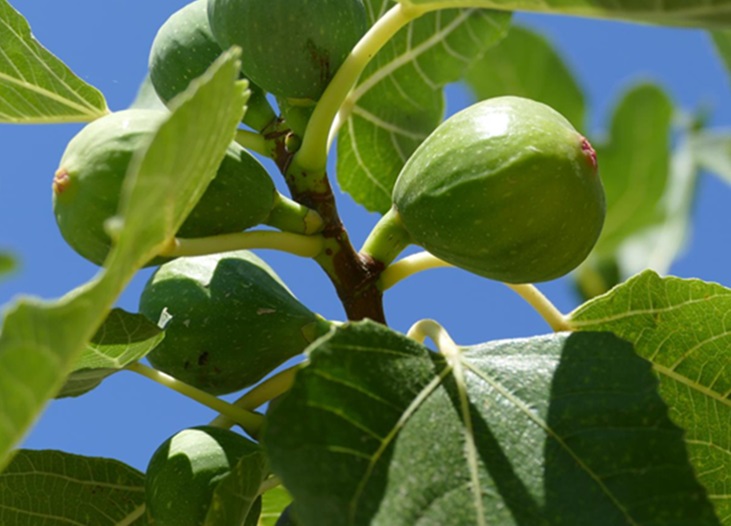
A few interesting things about figs and time… Fig trees, like other fruit trees, have leaves, but unlike other fruit trees, their fruit flowers internally. Also, each fig contains a collection of many flowers and seeds. And while one may think of a fig as a piece of fruit, they are actually an infructescence—a multiple fruit—that in a sense, is always in the process of blooming.
So, in both times of uncertainty and times of comfort, see that no one deceives you, do not worry, and learn from the fig tree, continuing to grow from within, knowing that the fruit will come at the time that is appointed.
“Lord, my allotted portion and my cup, you have made my destiny secure.” – Psalm 16:5
There’s the saying that attitude is everything, and there is no denying the importance and impact of attitude on behavior. The Gospel for the Thirty-third Sunday in Ordinary Time (Mt 25:14-30 shown below), provides an example of how attitude can affect choices. In this passage, referred to as the Parable of the Talents, Jesus tells the story of three servants and how they handled the possessions their master entrusted to them while he was away.
To start, we learn that the master gave each servant a different amount based upon their ability. This suggests that he had a sense of what they were capable of and perhaps a desire not to give them more than what they might be able to handle. But also, more importantly, the master gave something of value to each of them, allowing them room for growth. He would not have done that if he did not see potential in each of them.
Looking at how each servant responded, we can see that the ones who were entrusted with more (five and two talents respectively) produced more and the one entrusted with the least (one talent), produced the least. It can be tempting to look at this situation, and the master’s response upon his return, as a simple matter and to judge the servant who buried the talent instead of growing it as weak for allowing his actions to be driven by fear. However, there is more to this story than what is on the surface.
Think about the characteristics of Jesus and the way that he responds to people. He listens, he notices, he allows people to be who they are, and where they are in their journey, while at the same time loving or valuing them, and encouraging them toward growth and living in the light. There is always a path toward shedding whatever it is that is holding someone back from becoming more and more authentic as one created in the image of God.
When considering this passage in the light of attitudes, we can easily jump to a conclusion that two of the servants had what might be thought of as a healthier attitude and did something productive with what was entrusted to them. While on the other hand, the third servant focused on the unjust ways of his master, resulting in a poor attitude and therefore a lackluster performance. What about the master though?
What was the master’s attitude in this parable? At the beginning, it is implied that he saw less potential or expected less from the third servant. Also, upon his return, how did he receive the third servant’s choice and the reasons behind it?
The third servant says, “Master, I knew you were a demanding person, harvesting where you did not plant and gathering where you did not scatter; so out of fear I went off and buried your talent in the ground. Here it is back.” All the master seems to take in is the fact that the servant did not multiply what was entrusted to him. And his reaction to that is to assign the servant even less value (“You wicked, lazy servant!”) and to condemn him to darkness. How might his response have been different if he was able to consider the impact of his ways, and the fear it created in the servant?
Although the servant didn’t, at the time, possess the wherewithal to multiply what was given to him, he at least recognized its importance and preserved it. His fear held him back, but he did do something. It seems the master couldn’t appreciate that. If you think about Jesus and his interactions with people, in what ways does the master’s words and actions reflect the attitude and behavior of Jesus?
While the Parable of the Talents might be considered in terms of “what one does with what is given to them is important,” it can also serve as an invitation to consider roles and the attitudes that can accompany them. As you consider your own life, in what situations might you be one of the servants who multiplied the talents? the servant who was given one talent? the master? Reflect upon your demeanor in these roles. How, if at all, does your attitude shift in these different situations? Where is the light of God and in what ways is Jesus present to, and in, you?
Jesus told his disciples this parable: “A man going on a journey called in his servants and entrusted his possessions to them. To one he gave five talents; to another, two; to a third, one– to each according to his ability. Then he went away. Immediately the one who received five talents went and traded with them, and made another five. Likewise, the one who received two made another two. But the man who received one went off and dug a hole in the ground and buried his master’s money.
“After a long time the master of those servants came back and settled accounts with them. The one who had received five talents came forward bringing the additional five. He said, ‘Master, you gave me five talents. See, I have made five more.’ His master said to him, ‘Well done, my good and faithful servant. Since you were faithful in small matters, I will give you great responsibilities. Come, share your master’s joy.’ Then the one who had received two talents also came forward and said, ‘Master, you gave me two talents. See, I have made two more.’ His master said to him, ‘Well done, my good and faithful servant. Since you were faithful in small matters, I will give you great responsibilities. Come, share your master’s joy.’ Then the one who had received the one talent came forward and said, ‘Master, I knew you were a demanding person, harvesting where you did not plant and gathering where you did not scatter; so out of fear I went off and buried your talent in the ground. Here it is back.’ His master said to him in reply, ‘You wicked, lazy servant! So you knew that I harvest where I did not plant and gather where I did not scatter? Should you not then have put my money in the bank so that I could have got it back with interest on my return? Now then! Take the talent from him and give it to the one with ten. For to everyone who has, more will be given and he will grow rich; but from the one who has not, even what he has will be taken away. And throw this useless servant into the darkness outside, where there will be wailing and grinding of teeth.'” – Matthew 25:14-30



 HopeThatFloats
You must be logged in to post a comment.