A heart with a white center

What are you looking for…

With the news of yet another mass shooting in the United States along with violence and conflict around the world, on top of any personal challenges, from which no one is spared, a sense of doom or a feeling of imprisonment can hang in the air and weigh on one’s heart and mind. Yet, as we enter the Third Week of Advent, Gaudete (Rejoice) Sunday, our faith encourages us to remain a people of hope, holding firm to the Lord, and continuing to strive to be living testaments to the Way, knowing that there is something greater, and that God is with us.

In today’s Gospel (Matthew 11:2-11), it is written:

“Are you the one who is to come, or should we look for another?” – v. 3

This is the question that an imprisoned John the Baptist, having heard about “the works of the Christ,” (v.2) had his disciples ask Jesus.

With the events occurring around you, and in the world today, what are you looking for?

Taking a step back, in the First Reading (Isaiah 35:1-6a, 10), it is written:

Strengthen the hands that are feeble,
make firm the knees that are weak,
say to those whose hearts are frightened:
Be strong, fear not!
Here is your God,
he comes with vindication;
with divine recompense
he comes to save you.
– Isaiah 35:3-4

Spend some time recalling some of the ways that you have been strengthened by the Lord. What happens as you allow yourself to remember?

Read aloud today’s Psalm (146:6-10):

The Lord God keeps faith forever,
secures justice for the oppressed,
gives food to the hungry.
The Lord sets captives free.
The Lord gives sight to the blind;
the Lord raises up those who were bowed down.
The Lord loves the just;
the Lord protects strangers.
The fatherless and the widow he sustains,
but the way of the wicked he thwarts.
The Lord shall reign forever;
your God, O Zion, through all generations.

Reflecting on the qualities of God expressed in the Psalm, bring forth your own petitions, praying for the cares and concerns that are pulling at your heart at this time. Following each one, say the response, “Lord, come and save us.”

In the Letter of Saint James, from today’s Second Reading, it is written:

Be patient, brothers and sisters,
until the coming of the Lord.
See how the farmer waits for the precious fruit of the earth,
being patient with it
until it receives the early and the late rains.
You too must be patient.
Make your hearts firm,
because the coming of the Lord is at hand.
Do not complain, brothers and sisters, about one another,
that you may not be judged.
Behold, the Judge is standing before the gates.
Take as an example of hardship and patience, brothers and sisters,
the prophets who spoke in the name of the Lord.
– James 5:7-10

Share with Jesus, the ways or situations in which you are feeling challenged when it comes to patience, complaining/criticizing, and/or a heart firm in the Lord. Allow Jesus to impart his wisdom regarding this.

When you are ready for this prayer period to come to a close, offer an expression of gratitude, and ask the Lord to help you to draw inspiration from the experiences recalled and the insights gained during your prayer.
A heart with a white center

Lord, help me to discern what’s important as I face the moments before me today, and in the days to come. Help my choices to reflect your goodness, and my prayers to reflect your heart.


The Thing To Do…

The Gospel passage for the Third Sunday of Advent (Luke 3:10-18) begins with the question, “What then should we do?” What to do is a question that is asked of John the Baptist three times in this passage. And through his replies, John essentially instructs those who have what we might call an upper hand or an edge over others—a crowd, the tax collectors, and the soldiers who are seemingly among the first to make their way to the desert to be baptized—to share with those who are without, to refrain from over taxing others, and to stop abusing their position by using it to take advantage of others.

How do John’s instructions strike you?

It’s interesting that just prior to this passage, John had said to the first group of people mentioned (the crowd),

“You brood of vipers! Who warned you to flee from the coming wrath? Produce good fruits as evidence of your repentance; and do not begin to say to yourselves, ‘We have Abraham as our father,’ for I tell you, God can raise up children to Abraham from these stones. Even now the ax lies at the root of the trees. Therefore every tree that does not produce good fruit will be cut down and thrown into the fire.” – Luke 3:8-9.

What do you think caused the crowd to respond with, “What then should we do?”

Envisioning yourself in this crowd, and labeled by John the Baptist as “a brood of vipers,” are you surprised or shocked? What would you do at these words? What response or question would you have?

When presented with a situation that is unexpected, how do you decide what to do? What does your prayer process look like in terms of manner, taking time and a step back, desire and/or openness to new or different ways forward? How about when it comes to situations that are expected? How does your prayer process stay the same or fluctuate?

Spend some time in prayer, sharing with Jesus that which arises into your awareness, and seeking wisdom, guidance, and whatever else you feel you need at this moment. As your prayer comes to a close, express your desire as you go forward, and ask for the grace to receive, whole-heartedly, God’s love for you, and the desire Jesus has for you at this moment.

Then, on this Gaudete Sunday, rejoice in the Lord!

You do not need to know precisely what is happening, or exactly where it is all going. What you need is to recognize the possibilities and challenges offered by the present moment, and to embrace them with courage, faith and hope. – Thomas Merton

Discovering Joy…

The 3rd Sunday of Advent is referred to as Gaudete Sunday, as we move closer to Christmas, anticipating the joy and celebration of the birth of Jesus, the new Adam. The readings for this Sunday (Isaiah 61:1-2A, 6-7; Responsorial Psalm – Luke 1:46-50, 53-54, 1 Thessalonians 5:16-24, and John 1:6-8, 19-28) call upon us to embrace and rejoice in the Spirit of the Lord. What does that look like? How do you know when you’re embracing and rejoicing in the Spirit of the Lord?

In the Gospel, John the Baptist is asked by priests and Levites, “Who are you?” (John 1:22). Part of John’s response is, “I am the voice of one crying out in the desert, ‘make straight the way of the Lord,’” (John 1:23). Reflecting on John’s response, what do you imagine it was like for him? How would you respond to the question, “Who are you?” In what ways would your response be the same or different depending on who asks the question?

What’s it like to ponder that the same God who created John and inspired his words and actions, desires to do the same for all of us?

Continuing to consider this, in what places or situations do you desire your words and actions to be influenced more by God? What are the places or situations where you experience peace, joy, and a sense that your desire and God’s are united?

Prayer: Gracious and merciful Lord, over the course of the next few weeks, with all the busyness of the Advent and Christmas Season, help us to be open to your inspiration and to cooperate with the glue that is your Grace, so that we might discover that there is joy in each moment.

“Man is born broken; he lives by mending. The grace of God is the glue.” – Eugene O’Neill

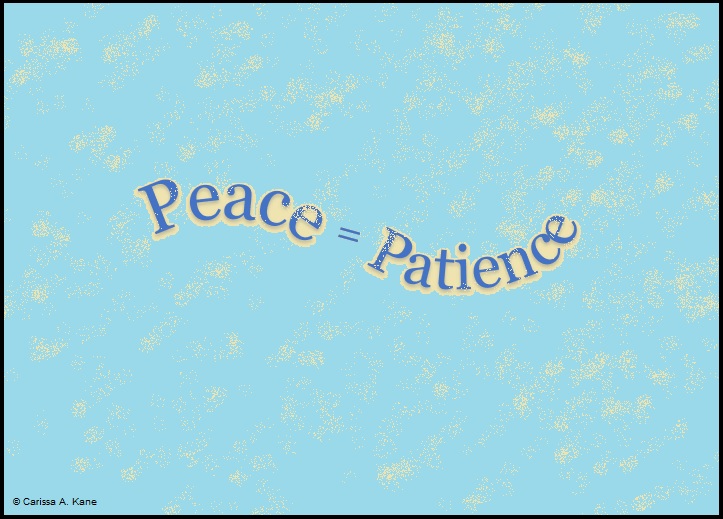
Time to Stop and Time to Go… Time for Peace?

Literally, the second the light turns green, horns are honking. Sometimes, it is from cars two or three deep in line! Imagine if instead of cars on the roads, it was just people, single file, moving on foot. Stop or go to the rhythm of the traffic lights. Perhaps it would be more like the game musical chairs than the one named “Simon Says,” but in today’s world, likely more dangerous, and certainly far more intense.

While in situations like driving, signs of impatience can be much easier to spot, at other times it can be harder to see when patience is absent or slipping away. The second reading for the Third Sunday of Advent (Jas 5:7-10), begins with, “Be patient, brothers and sisters.” It seems so fitting that during one of the busiest times of the year for many people, these verses in the Letter of James contain a form of the word, and urges patience four times, once each in three out of the four verses. And, as for the one verse that doesn’t use the word, it calls us to ponder one of the ways that human beings tend to handle displeasure with one another (“Do not complain, brothers, about one another, that you may not be judged.” – v.9).

Think of a recent experience where you were on the receiving end of your own or someone else’s impatience or displeasure. What happened? And what judgments were involved?

Now, think of a recent experience where you were the one responding with impatience or displeasure. What was going on? And what opinions or beliefs were involved?

In each situation, how might an increase of your own patience have improved the situation or the aftermath of it?

When pausing to think of recent experiences where patience was lacking or displeasure arose, on someone else’s part or on your part, which experience was easier to recall? Which experience came to mind more quickly?

It can be tempting to see patience in terms of something someone has or does not have. However, like any other attribute, it’s possible for it to exist in some situations and not in others. This is important because oftentimes it can be easy to think, “I’m patient,” or “I’m…” this or that based on a small sampling of situations that one’s ego might readily serve up to “pass the test” and move us along from further introspection and possibly attaining additional growth and greater freedom; things that are impossible without honestly looking across and considering the spectrum of one’s life experiences.

An Advent Prayer: Lord, help me to allow you to direct the pace of each day. Through my stopping and going, and all that may occur between, may my actions and responses reflect grace and genuine patience and understanding that flows from you, regardless of what I may or may not receive in return. And help me to continue to look to you, that you may grant me the grace to notice and appreciate the beauty and goodness of all creation, and the heart and soul of those I encounter each day.

Be patient, brothers and sisters,
until the coming of the Lord.
See how the farmer waits for the precious fruit of the earth,
being patient with it
until it receives the early and the late rains.
You too must be patient.
Make your hearts firm,
because the coming of the Lord is at hand.
Do not complain, brothers and sisters, about one another,
that you may not be judged.
Behold, the Judge is standing before the gates.
Take as an example of hardship and patience, brothers and sisters,
the prophets who spoke in the name of the Lord. – James 5:7-10