More than water at the Well…

The readings for the Third Sunday of Lent can be seen as an invitation to pray and reflect on our encounters with God and others, the conversations that arise during them as well as after, and how we determine what we hold onto and listen to.

After the prophet Moses led the Israelites out of Egypt and into the wilderness, they started to become disgruntled. God provided food for them in the form of quail and manna, however, as the days passed their unhappiness grew as they still did not know what was next and where they would end up. Their existence became a grind and a growing number of the people began to feel like maybe they would have been better off not following Moses; perhaps their current situation was worse than being enslaved in Egypt.

The First Reading (Exodus 17:3-7) has Moses receiving complaints and being well aware of the growing displeasure among the people. He’s in a “What now?” moment.

So Moses cried out to the Lord,
“What shall I do with this people?
a little more and they will stone me!” – v. 4

What strikes you most from the verse above? What are your conversations with God like during your “What now?” moments?

In the following verse, the Lord responds to Moses and tells him what to do. What do you notice about the Lord’s answer?

“Go over there in front of the people,
along with some of the elders of Israel,
holding in your hand, as you go,
the staff with which you struck the river.
I will be standing there in front of you on the rock in Horeb.
Strike the rock, and the water will flow from it
for the people to drink.” – v. 5-6

In what ways do you trust God to provide for you and others during challenging times? How about during less difficult times?

Recall a time when you cried out to God, and God provided for both you and others.

The First Reading ends with:

The place was called Massah and Meribah,
because the Israelites quarreled there
and tested the Lord, saying,
“Is the Lord in our midst or not?” – v. 7

What do you make of the people quarreling? How do you imagine something like that could impact a sense of trust in the community? And in God?

The response for the Psalm is:

“If today you hear God’s voice, harden not your hearts.” – Ps 95:8.

Again, thinking about your conversations with God, what level of transparency do they reflect? Are there areas where you may be holding back, or you feel like God is? Take some prayer time to express your thoughts and feelings on this and to allow room for God’s insight to be shared with you.

The Second Reading (Romans 5:1-2, 5-8), begins with: “Brothers and sisters:”

If you were to use this greeting, who would be included as brothers and sisters?

This letter to the Romans continues:

Since we have been justified by faith,
we have peace with God through our Lord Jesus Christ,
through whom we have gained access by faith
to this grace in which we stand,
and we boast in hope of the glory of God.

Have there been times when you have felt justified by faith? What made you feel that way or what were the signs? And what was it like?

The passage is completed with the following verses:

And hope does not disappoint,
because the love of God has been poured out into our hearts
through the Holy Spirit who has been given to us.
For Christ, while we were still helpless,
died at the appointed time for the ungodly.
Indeed, only with difficulty does one die for a just person,
though perhaps for a good person one might even find courage to die.
But God proves his love for us
in that while we were still sinners Christ died for us.

How has God’s love been poured out into your heart? What has the impact been? And how do your choices reflect that love to God, yourself, and to others?

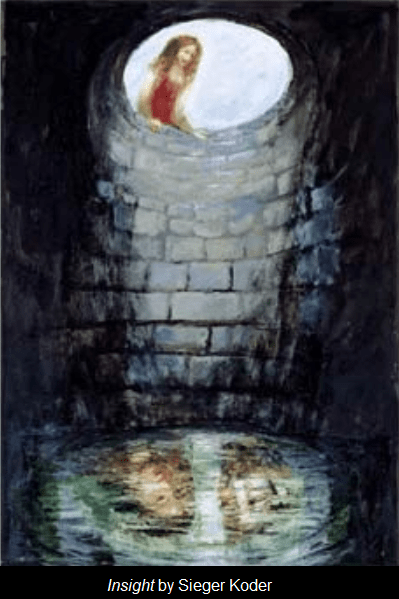
In the Gospel Reading (John 4:5-42), we read about Jesus, a Jew, and the woman at the well, a Samaritan. Each comes from a line of people who normally steer clear of each other. Thinking about this atypical exchange back then and life today, how do you desire to respond to the “atypical”?

Next, consider Jesus’s words around water and food, things that last a limited amount of time before one needs to acquire more, as an invitation to look more closely at what’s been on your plate and the concerns you are carrying. As you do so, contemplate what you are seeking and from where you are seeking it.

What does the Lord want to reveal to you?
Lord, you are truly the Savior of the world; give me living water, that I may never thirst again. – John 4:42, 15
Sunset

And When They Raised Their Eyes…

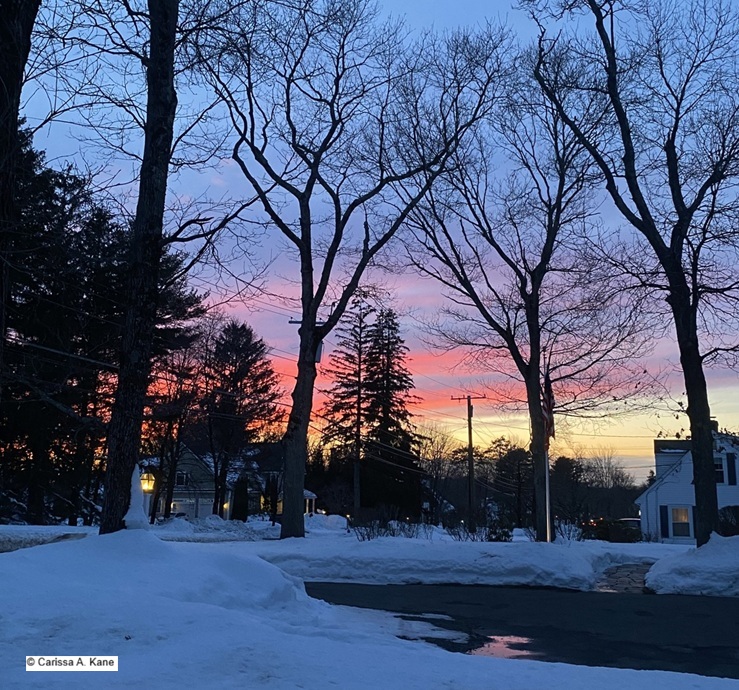
Late afternoon the other day as sunset was moving in, the sky displayed a beautiful spread of colors in between the homes and trees, utility poles and power lines. Through all the obstacles intruding on the view, there was light, not only persevering, but also bringing hope, showing up in shades of glory, working among its surroundings, in a most remarkable way.

When was the last time your attention was caught by light? Recall where you were and what was happening at the time. How were your heart and mind stirred by the experience? As you remember it, how are you touched by it today?

The following verses from the Gospel reading for the Second Sunday of Lent (Matthew 17:1-9) come after Peter, James, and John witness the Transfiguration of Jesus. The three disciples saw remarkable light as they watched Jesus, transfigured, speaking with the prophets, Moses and Elijah. Peter is all about wanting to build three tents at the site—one each for Jesus, Moses, and Elijah.

Take some time to consider what you seek to preserve and what kinds of things lead you to a sense of reverence or admiration?

While he was still speaking, behold,
a bright cloud cast a shadow over them,
then from the cloud came a voice that said,
“This is my beloved Son, with whom I am well pleased;
listen to him.”
When the disciples heard this, they fell prostrate
and were very much afraid. – v. 5-6

Envision yourself on the mountain alongside the three disciples. Like them, you hear the voice and fall to the ground, face down in fear. In that moment, it’s as if you’re alone. But then, Jesus puts his hand on your shoulder and says, “Rise, and do not be afraid.” (v. 7). You lift your head and the first thing you see, are Jesus’s eyes, tenderly looking into your eyes. You reach for and grab his hand as he helps you to stand up. Next, the two of you sit down, and Jesus asks you to tell him what you are afraid of, what is weighing on you or puts your gaze down toward the ground. What do you say? And how does Jesus respond?

What do you need from Jesus to continue raising your eyes toward Him?

Continue the conversation, taking time to reveal what’s on your heart and pausing to really listen to what Jesus wants you to know. When this exchange with Jesus feels complete, allow for some words or a gesture between you and Jesus as you prepare to rejoin the disciples for the trek back down the mountain.

What does Jesus want you to carry with you or to remember most at this moment?

Sunset

And when the disciples raised their eyes, they saw no one else but Jesus alone. – Matthew 17:8

Growth mindset

Thursday after Ash Wednesday…

In the Book of Deuteronomy, chapter 30, verses 15-20, after having presented God’s commandments to the people, Moses exhorts them to choose life over death by embracing and living by God’s “commandments, statutes and decrees”. This brings up an interesting question. Outside of obvious situations where the distinction is clear between a choice that is life giving and one that is not, how does one determine what they are really choosing, and perhaps more importantly, why?

There are few things in life that are clear cut and without the possibility for change. Yet, the human tendency leans toward wanting things to be one way or the other, to fit comfortably into categories or boxes, and to be “known for all time”. However, this leaves little to no room for new information or consideration of different circumstances.

Sometimes it can be helpful to flip things around, contemplating them from another angle or two and considering different points of view. Oftentimes, what is thought to be wrong, so different, or out of line, underneath the surface or layers upon first look, can be not so wrong, different, or out of line, at all.

During Lent, we try to renew or refresh our spirit and growth mindset. We open our hearts and minds to seeing and being anew and strengthening our faith and discipleship ways. We are reminded of what it is we profess to believe and why, as well as the desire to choose what is life giving so that even in death, we experience Life.

Take some time to contemplate Moses’ words about choosing life or death alongside the following poem from the Persian poet Rumi.

“I died as mineral and became a plant,
I died as plant and rose to animal,
I died as animal and I was human,
Why should I fear? When was I less by dying?
Yet once more I shall die human,
To soar with angels blessed above.
And when I sacrifice my angel soul
I shall become what no mind ever conceived.
As a human, I will die once more,
Reborn, I will with the angels soar.
And when I let my angel body go,
I shall be more than mortal mind can know.”
– Rumi

What influences your choices? How do you draw inspiration from the example of Jesus in making them? What grace(s) do you desire in this area? Invite Jesus into this conversation, taking time to listen and asking to be open to and to notice whatever insights might be revealed.

Blessed are those who trust in the Lord; the Lord will be their trust. – Jeremiah 17:7