The Spirit of…

Throughout the year, all around the world, people of all backgrounds prepare for various holidays, Holy days, and the festivities associated with them. There are many cultural as well as familial traditions. Among the countless possibilities, the fact remains that most people have their own ideas and preferences for what a holiday “should” be. Whether inherited and passed along as they were from their beginnings—with no change, put into practice with some variation of what came before, or created in an entirely new and different way, oftentimes we establish routines and even deadlines for the tasks that have become part of our preparation for a special day.

Yet, plan as we may, preparing the way can end up looking very different from what one may have set out to do, may have pictured, or expected from the image of years passed. Frequently though the places where there seems to be missteps, no time, no room, or where we may least expect something good, are exactly the places where we are apt encounter the gift of God’s grace. That is often the beauty and the blessing of holidays, Holy days, and the events that surround them. In our attempts to make them special and meaningful in our own ways, we often look up and around a little more, changing our ordinary routines just enough that we also, perhaps unknowingly, open ourselves and our environment up to more of the Extraordinary—the Divine.

When it is all said and done, it is not so much what we do that makes these days special, but rather what is behind our words and actions and the ways in which we are inspired to say and do them. As the holidays, Holy days, and festivities continue to arrive, embrace the “the splendor of glory from God” (Baruch 5:1). Live from it, allowing it to flow through you into the moments of each and every day, spreading peace, love, and joy wherever you may go; providing comfort, strength, restoration and healing wherever it is needed; and building and bridging relationships all around. In this Spirit, may we receive whomever and whatever may come as we are, that is blessed with the splendor of God’s glory.

Dove

The Point of Letting Go…

“The jar of flour did not go empty, nor the jug of oil run dry…” (1 Kings 17:16). Why? Because the Lord ordained it to be so.

In those days, Elijah the prophet went to Zarephath.
As he arrived at the entrance of the city,
a widow was gathering sticks there; he called out to her,
“Please bring me a small cupful of water to drink.”
She left to get it, and he called out after her,
“Please bring along a bit of bread.”
She answered, “As the LORD, your God, lives,
I have nothing baked; there is only a handful of flour in my jar
and a little oil in my jug.
Just now I was collecting a couple of sticks,
to go in and prepare something for myself and my son;
when we have eaten it, we shall die.”
Elijah said to her, “Do not be afraid.
Go and do as you propose.
But first make me a little cake and bring it to me.
Then you can prepare something for yourself and your son.
For the LORD, the God of Israel, says,
‘The jar of flour shall not go empty,
nor the jug of oil run dry,
until the day when the LORD sends rain upon the earth.'”
She left and did as Elijah had said.
She was able to eat for a year, and he and her son as well;
the jar of flour did not go empty,
nor the jug of oil run dry,
as the LORD had foretold through Elijah.

– 1 Kings 17:10-16

God sent Elijah to the widow and her son during a period of famine. God’s plan, always, is to provide sustenance for those who are receptive to it. Oftentimes in order to receive the grace that God has in store, one must let go of something that is “other.” More often than not, it involves changing; adjusting, fine-tuning, or altogether shedding that which we may have resigned ourselves to holding onto.

Certainly, it would have been easy as well as justifiable for the widow at Zarephath to hold onto the last of her flour and oil rather than to share any portion of it with Elijah, the stranger in her midst. At first, it seems to be her intention to do just that. However, she listens to the prophet’s words and trusts the way in which they resonate with her.

Although the prophet, and the widow and her son are different, the same God leads each of them. It is in cooperation with God that they recognize this in each other, and in doing so, become one with the grace waiting to be bestowed upon them.

God calls and sends Elijah to a new place. The same God helps the widow to let go of what little she has, instead of clinging to it, and to trust that it will be enough for all… and it is.

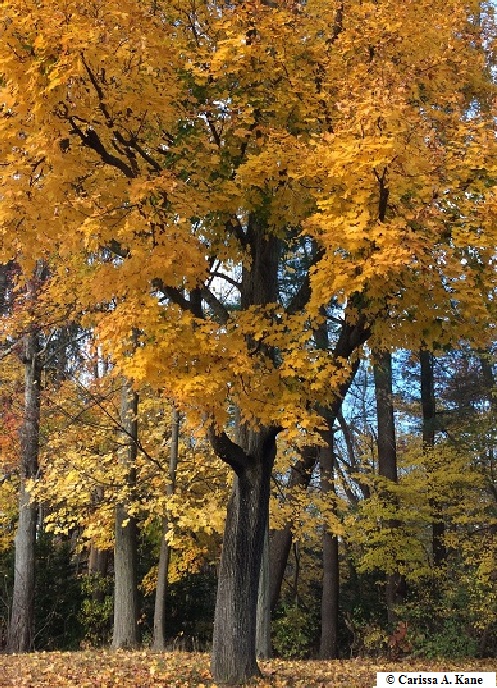
YellowFall2

Tapestry…

Just a few months ago it would have been hard to imagine such a pattern or striking array of color replacing the multitude of green leaves that seemed to be all around. And while the scene seemed so rich back then, it seems even more so now. Though the leaves will be falling soon, with the addition of greater diversity, they paint a splendid picture that brings a sense of joy along with hope and promise.

It is amazing how it can be so easy to appreciate the contrast, depth, and value provided by the many differences found in and among nature. That same beauty exists in a wide array through the variety found in humanity, yet oftentimes it is not seen as such. Whether it be difference in appearance, opinion, or fact, there is always a pearl to be discovered, something of great value to be learned.

Sometimes we can work together and other times we need to work apart, going in different directions. What we end up becoming or what we feel moved to do may look very different. When it is all said and done though, like the leaves on the trees, our uniqueness brought together creates the picture that is priceless, but only when we remain rooted in the Source.

Love the LORD, your God,
with all your heart,
and with all your soul,
and with all your strength. – Deuteronomy 6:5

AutumnLeaves

In the Way…

In the end, it is usually only one thing that gets in the way, time, and time again.

Throughout chapter ten of the Gospel according to Mark, one thing after another seems to be in the way. There are the Pharisees who see Jesus as being in the way and the disciples who see the people trying to bring the children to Jesus as being in the way. Then, the rich man’s possessions are in the way and the status of the disciples is in the way (when James and John ask to sit at the right and left of Jesus). Finally, there is Bartimaeus, the blind man, seen as being in the way by many in the crowd.

So what is the one thing that in the end is really in the way?

The answer starts, like many things, back at the beginning. In the first section of chapter ten, Jesus speaks about hardness of heart. To varying degrees, whether or not we are able to see and acknowledge it, none of us has a heart that is exempt from hardness. We all have moments, where our words, actions, or inclinations can be rigid and cold rather than pliable and warm.

Throughout the Bible, there are countless times when hardness of a heart(s) in one way or another prevents choices that are in union with God and one another. It can be difficult to recognize when hardness of heart is present or starts to build. However, like Bartimaeus, whether or not we may be in the way of others, we need not be afraid to set our hearts on the Lord, and let our guard down to cry out and say, “Master, I want to see.”

Mercy

As Jesus was leaving Jericho with his disciples and a sizable crowd,
Bartimaeus, a blind man, the son of Timaeus,
sat by the roadside begging.
On hearing that it was Jesus of Nazareth,
he began to cry out and say,
“Jesus, son of David, have pity on me.”
And many rebuked him, telling him to be silent.
But he kept calling out all the more,
“Son of David, have pity on me.”
Jesus stopped and said, “Call him.”
So they called the blind man, saying to him,
“Take courage; get up, Jesus is calling you.”
He threw aside his cloak, sprang up, and came to Jesus.
Jesus said to him in reply, “What do you want me to do for you?”
The blind man replied to him, “Master, I want to see.”
Jesus told him, “Go your way; your faith has saved you.”
Immediately he received his sight
and followed him on the way.

– Mark 10:46-52

Discovering the Path…

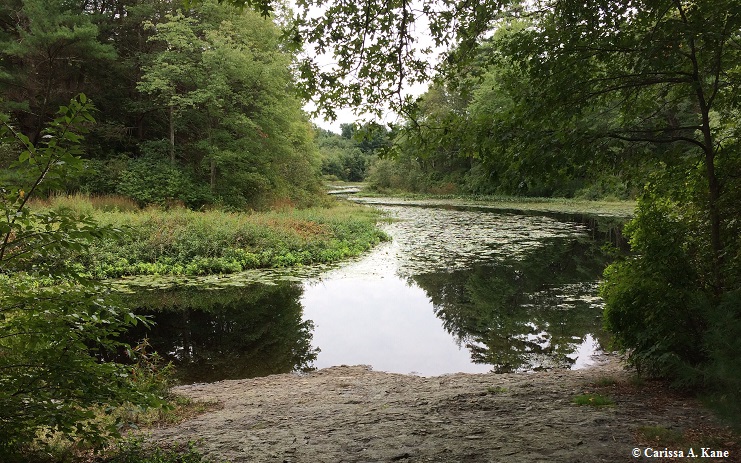
Upon reaching the other side of the bridge, a path of light appeared across the top of the water. Prior to that point, and from various other angles, there was no evidence of any such path. It was only through staying the course, while continuing to look around, that the reflection of light that was there all along could be seen as clear as day, creating a path where before there was none, or so it seemed.

“We are all faced with a series of great opportunities brilliantly disguised as impossible situations.” –Charles R. Swindoll

Each of us has unique characteristics. At times these qualities can surface in ways that may tempt us into being at odds with each other or seeing each other in lop-sided ways… as not having enough in common to make trying to work together and work through conflicts a worthwhile endeavor. It seems this is often the case in today’s world. However, in most cases, when both sides honestly strive to be united with God and each other, we are able to move into a position where the light shines and the path becomes abundantly clear.

A fish cannot drown in water,
A bird does not fall in air.
In the fire of creation,
gold does not vanish,
the fire brightens.
Each creature God made
must live in its own true nature,
how could I resist my nature,
that lives for oneness with God? – Mechthild of Magdeburg

Path


Opening Up…

A couple of days ago, the skies opened up, and the rain poured down as periods of thunder and lightning worked their way through the area. While the cloud masses wrestled, trying to push through to the other side, the torrential rain was unrelenting and seemed as if it could go on without end. It drenched everything in its path, washing away loose sediment and cleansing what remained.

Waiting in the car for a break or a slow-down in the rate of precipitation, I watched with apprehension as the thunder and lightning continued, the wind picked up, and a steady overflow of water traveled down the windows. After what seemed like an inordinate amount of time, rain still pouring, I made a dash, through the stream of water across the entire driveway, into the house. I too was now drenched. However, somewhere between the car and the house as the skies remained loud as well as fully opened, and the ground beyond soaked, trepidation gave way to a spirit of courage and excitement as I made my way to the threshold and crossed over it. Once inside, I looked back, amazed at both the way the rain continued to fall and how exhilarating it was to go through the rain and water to get to dry “land.”

There is always a way, even in times when it may seem like the roads are all washed out, or there are no paths to take. Listen, and as Jesus said, “Be opened!” (Mark 7:34)

Direction

For Goodness Sake…

Whether the day might seem to be stale or crying out with possibility, there is goodness to be experienced as well as exercised. As with many things, it is a matter of choice, and while the world may offer plenteous choices, oftentimes they can be boiled down to simply two. As Abraham Maslow stated, “In any given moment, we have two options: to step forward into growth or to step back into safety.”

When Jesus went back to the place of his roots, the people could have stepped forward, received his words, and taken them to heart. However, according to the Gospel of Mark (6:1-6), the majority overwhelmingly chose to cling to the past—the known, barring them from even giving his words and his way a chance for consideration.

So he was not able to perform any mighty deed there,
apart from curing a few sick people by laying his hands on them. – Mark 6:5

Despite what he encountered, within an environment so rigid and resistant, we are told that the glory of God was still at work through Jesus for those who were open to it… for those who had faith.

In Psalm 34, verse 8, it is written, “Taste and see that the Lord is good; blessed is the stalwart one who takes refuge in the Lord.” Like Jesus, we are called to be unwavering in our efforts to taste and see the goodness of God, as well as to allow it to live through us. Like Jesus, we need to let go of I, me, and mine… you, them, and us, and to truly let God be front and center, leading the way.

RedYellowNear

For example…

As I looked around, I saw so many faces. Some were familiar and some were new, but all were listening with great interest and intrigue. I felt overwhelmed with a sense of joy and gratitude. How good it was to be in a place that seemed to be filled with openness and a deep desire for good.

As we all listened, we were reminded of ways in which God is ever-present. Not only is God always with us, but also constantly emanating a love for all creation… a love that is boundless, alongside mercy and compassion that is endless.

We sat and listened to experiences that were shared and our hearts were touched as we marveled at the manner in which God brings people together for more than the good of just a select few or a particular group. Again, reminded of a Love that is not only beyond limit, but also beyond compare… a Love in which we share.

It was good to listen and to remember, but perhaps most important, it was liberating.

It is amazing what the power of example can do when there is openness to receiving it. Sometimes it helps to ask, “What am I holding onto? And how is it affecting me, and those around me?”

Let go and let God. Oftentimes, that is all that is needed.

HeartLeave2

If today you hear God’s voice, harden not your hearts.

Come, let us sing joyfully to the LORD;
let us acclaim the Rock of our salvation.
Let us come into his presence with thanksgiving;
let us joyfully sing psalms to him.

If today you hear God’s voice, harden not your hearts.

Come, let us bow down in worship;
let us kneel before the LORD who made us.
For he is our God,
and we are the people he shepherds, the flock he guides.

If today you hear God’s voice, harden not your hearts.

Oh, that today you would hear his voice:
“Harden not your hearts as at Meribah,
as in the day of Massah in the desert,
Where your fathers tempted me;
they tested me though they had seen my works.”

If today you hear God’s voice, harden not your hearts.

— Psalm 95:1-2, 6-7, 8-9.

The Great Wide Open…

In passing by and at times being surrounded by farmland over the past few months, the beauty and vastness of the countryside has been striking. Against the occasional backdrop of mountains and the many fields of crops and shades of green, there has been much to take in and a great sense of freedom and openness to be felt. There have also been the more confining structures one would expect to see, such as barns, fences and silos. These structures serve to protect what is within and in doing so they create boundaries and barriers. Of them, perhaps the silo, into which one cannot readily see, is the most compelling.

FarmSilos

A farm silo functions as a holding place for storing grains. It is a strong, tall, rounded container with generally no openings for the elements, including light, to penetrate. Its purpose is to prevent the grain inside from becoming compromised or spoiled. A silo does a great job of protecting grain and is both necessary and good. However, personally or in an organization… figuratively, a silo is bad news. It seeks to control the environment in ways that both compromise and spoil forward progress. It also holds back the spirit of integrity and ingenuity necessary to flourish and genuinely thrive.

As we go through life, we all come across situations, organizations and/or people through whom we experience a silo effect—having helpful information withheld, being undermined, being shut out, pushed away or alienated. Often we can easily point to or name such cases. However, it can be more difficult to see or name the instances where we may be helping to foster that experience or effect… allowing it to continue… perhaps even creating or contributing to the creation of even more silos.

The way of the world puts emphasis on acquiring and storing up things, status, reputation, chips on one’s shoulders, etc. Ultimately, they can, and often do, bring us down or cause us to be less than what we truly are. It can be difficult to recognize, yet alone to resist being swept up or carried away by this mentality, or even fighting against it. It can keep us from doing and from being… from living out our deepest, purest desires in a way that is encouraging and uplifting to others as well as ourselves. We can be led astray, fooled, or lulled over time by that which masquerades around providing a false sense of reality as well as security. We can be lured and led away from being a place of growth and harvest to a place of storage.

“You are confined only by the walls you build yourself.” – Andrew Murphy

From time to time, it is important to pause, to let the Light not only in but also to fully penetrate one’s soul, and to ask, am I a vessel or have I become a silo?

StoreHouses

Change – Are You Ready to Let Go?

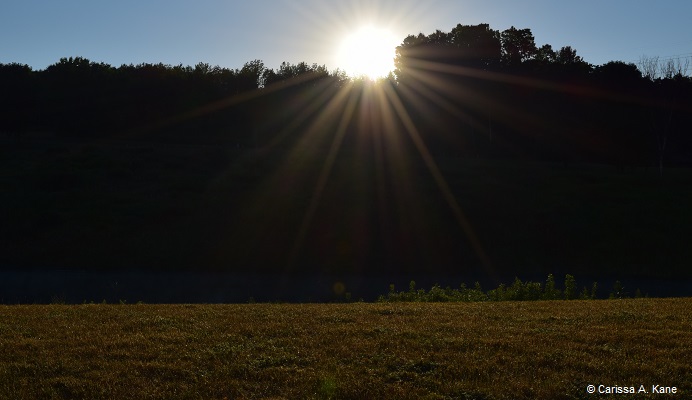
It serves us well to remember that while the sun greets each day and the moon bids it farewell, each day is not the same. Though the hours in a day remain the same, each day offers countless possibilities and opportunities. In order to pursue or partake of them, though, often requires one to make a change.

While we do need some things to be consistent and to have some structure, it is often good to re-evaluate our routines. Are there ways in which I have become closed off to that which is new or different? Is there room for change?

Change… Why is change so hard for some and seemingly not for others? Perhaps it is because there is often more to the story than meets the eye. Sometimes the need for change may not be recognized. Other times when we shy away from it, “resistance to change” is often the roommate of “struggling to let go.”

Usually one must let go of something, or perhaps multiple things, in order to make space for what is new or different. What that thing is can vary greatly. It might be a person, job, house, car or another material possession; or it might be something intangible such as an attitude or a perspective. Sometimes it can be hard to realize that whatever I cannot let go, “owns” me in some way, and, as long as it does, I will not be free to choose or be open to change.

A number of years ago as I prepared to direct my first weekend retreat, I recall feeling a sense of pressure – or greater responsibility – at the thought of working with people for such a short period of time. In looking more closely at what was going on and with a little help, I was able to recognize and name the worldly notion onto which I was holding: that somehow I alone was responsible for a fruitful weekend. Yes, my role as a spiritual director was important, and I needed to be mindful of that, but I also needed to remember that, ultimately, I was not “in charge” and the One who was, was more than capable. In doing so, I felt a greater sense of freedom and could carry on pressure-free as I met with retreatants. Letting go in this way enabled me to be more open. It also enabled me to be more patient with both myself and each retreatant, as if our time together would be endless, trusting that all desires brought to prayer are heard and responded to in time regardless of whether or not I had the privilege to witness the entire process. As the saying goes, I “let go and let God.”

Failing to let go of whatever may be holding us back, is like closing the door not only to change, but also to what may await on the horizon. We live in a world that tells us there is one shot to get it “right” and if we miss, we are out of luck. However, if we look to creation we can see that this is not true. Luckily, or rather blessedly, we often get more than one chance to rise to the occasion and embrace change.

SunRise2

SDIBlog