
A Time to Reflect…

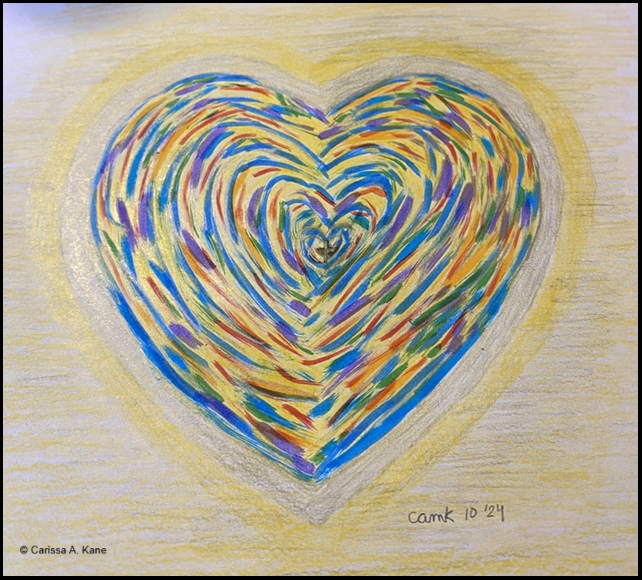
The Gospel acclamation for the Twenty-Seventh Sunday in Ordinary Time is, “If we love one another, God remains in us and his love is brought to perfection in us.” (1 John 4:12). Take some time to consider this verse.

What are the things that you heard and saw this past week that caught your attention? What values, notions, and ideas did they express?

It can be tempting to rush toward opinions and judgments based on listening to and watching what others are doing, what they have to say about situations, and about what’s happening in society and throughout the world. Not only that, but also to not really take time to honestly consider, reflect on, and discern the values being represented.

It can also be easy to be drawn in by a thing or two that may seem of the utmost importance, only to be swept up and moved along without recognizing movement away from values, expressed notions, and ideas that truly align with and promote the sentiments of Love.

In the coming days try to notice the words and actions to which not only your ears and eyes are exposed or drawn, but also your heart. What is stirred inside of you? and how are these things a reflection of Love?

Continuing to take these things to prayer, seek to see them as God sees them.

No one has ever seen God. Yet, if we love one another, God remains in us, and his love is brought to perfection in us. – 1 John 4:12

Beyond the Cover…

Spending the better part of the week surrounded by a plethora of books and various other media, it’s interesting to think about the variety of characteristics held within, as well as characters passing through, a public library.

Looking at the rows upon rows of books that are all around, it’s hard not to be fascinated by the fact that there’s always more to learn. This is not as in a conquest, but rather as in an opportunity, if one is open to it. And even more than that, no matter how vast, neatly ordered, and organized the books and other media may be, the contents of them serve everyone best, only when contemplated and taken into consideration with the range of human experience and love, and the knowledge it imparts into one’s heart.

Frequently viewed as a destination for those searching knowledge, know-how, a place to work, or a group of one sort or another, the library is also a place for those seeking shelter from outside. However, regardless of the time of day or reason for entering, when the library is open, none are turned away. Instead, they are welcome to come in as they are, and become a unique part of the inviting, peaceful environment. Imagine that in a place full of books!

Sometimes we think we know, but until we seek to look beyond the distortions, we honestly cannot.

Consequently…

Yes, every coin has two sides, and two sides only. Unlike coins, although people, stories, and situations also have more than one side, this does not mean that there are only two sides to matters regarding them. There are often more sides than there is the time that is taken to try to see them.

In the Gospel according to Matthew, the master of temptation seeks opportunities to blur the lines, create confusion, and make it more difficult to see clearly the choice that is, in fact, best for the time at hand.

At that time Jesus was led by the Spirit into the desert
to be tempted by the devil.
He fasted for forty days and forty nights,
and afterwards he was hungry.
The tempter approached and said to him,
“If you are the Son of God,
command that these stones become loaves of bread.”
He said in reply,
“It is written:
One does not live on bread alone,
but on every word that comes forth
from the mouth of God.”

Then the devil took him to the holy city,
and made him stand on the parapet of the temple,
and said to him, “If you are the Son of God, throw yourself down.
For it is written:
He will command his angels concerning you
and with their hands they will support you,
lest you dash your foot against a stone.”
Jesus answered him,
“Again it is written,
You shall not put the Lord, your God, to the test.”

Then the devil took him up to a very high mountain,
and showed him all the kingdoms of the world in their magnificence,
and he said to him, “All these I shall give to you,
if you will prostrate yourself and worship me.”
At this, Jesus said to him,
“Get away, Satan!
It is written:
The Lord, your God, shall you worship
and him alone shall you serve.”

Then the devil left him and, behold,
angels came and ministered to him. – Matthew 4:1-11

The trick that Jesus so masterfully avoids is the temptation to see what the devil presents to him in a two-dimensional way and thus respond or react based on that, rather than on a view or understanding that is multi-dimensional. That is, Jesus does not allow his view to be constricted by the fact that he is tired or hungry, or anything else. If he did, he would be lead to fall for the devil’s ploys, and then move toward making a choice(s) that at the root would solely benefit or be centered on himself, and meeting his personal needs at the expense of the greater good.

This passage provides a great example of the ways that are not of God, and that can go undetected and create interference. Temptation seeks to entice and distract us into living in a “going through the motions” kind of way or to distract us from being mindful and intentional. The more we partake of something, whatever it might be, the more likely it is to become rote, possibly lose meaning, and gradually remove us from the goodness of the original purpose and motivation. The devil counts on this, waiting for weakness to arrive. Notice how Jesus is pressed and tempted after being in the desert for 40 days, not right from the start of his stay or even mid-way through, but when he was physically at his weakest and likely to be less aware… when there was a potential opening for temptation to seep in.

During the season of Lent, as well as all year through, temptation seeks to draw us into seeing any, and all things as two-dimensional. Remember, though, as the saying goes, “The road to hell is paved with good intentions.” And, just because something is good, it does not mean it is always the best choice, for everyone, all the time. Only God can be the judge of that.

Coin

When Boughs Break…

For after all, the best thing one can do when it is raining, is to let it rain.
– Henry Wadsworth Longfellow

Throughout the past few days as I have been out and about, I have seen a great number of damaged trees from recent storms. Among many branches, there have been toppled trees, exposing the underside of the root systems that used to hold them upright. Then there have been trees leaning and resting upon the trunk or branches of a nearby tree. Finally, I have seen trees where the trunk simply snapped, leaving an inside view of what seems to be sturdy, living wood. Clearly, the root systems of these snapped trees were healthy; otherwise, the trees would have toppled.

However, even if a tree trunk is in perfect health, its root system is top notch, and the ground around it is not over-saturated, it can still withstand only so much force before succumbing to it. In fact, scientific studies have shown that once wind gusts reach 94 miles per hour, healthy trees with good ground conditions begin to snap and/or topple. Now, thankfully, the storms that blew through the area I live in did not have wind gusts that high. For these snapped trees, it is likely that there was some sort of imperfection, even if slight, causing weakness in their trunks. With time, culminating with the recent storms, it led to their downfall—through no fault of their own.

Taking in the view of these fallen trees, I cannot help but think that there is so much more to them than wood on the ground. At times it can be tempting to think that strong, healthy roots—a strong foundation—is the cure all. However, these broken trees are a good reminder that very few things are set in stone; also that black and white always make a shade of gray, whether we like it or not.

It is not very different with faith. There is so much more to it than any formula could ever capture. Whether high up in the sky or on the ground, there is always so much more than what meets the eye.

I will place my law within them and write it upon their hearts;
I will be their God, and they shall be my people.
No longer will they have need to teach their friends and relatives
how to know the LORD.
All, from least to greatest, shall know me, says the LORD,
for I will forgive their evildoing and remember their sin no more.

– Jeremiah 31:33-34

Tree1

Throwing Stones…

Stones

“Let the one among you who is without sin,
be the first to throw a stone at her.” – John 8:7

In the world in which we live, the above Bible verse has come to mean, to many people, it is not Christ-like to criticize wrongdoing. Is that interpretation accurate though? Is that really how Christ lived and taught? Is it true?

It is interesting how the truth is often twisted and how, throughout history, the truth, and speakers of the truth, have often been frowned upon. In the Gospel passage of the woman caught in adultery (John 8:1-11), Jesus, champion of truth, honesty and integrity, is put in a position where the authorities (the scribes and Pharisees) are looking for a reason to “take him down” so to speak. They see Jesus as a threat. If the truth becomes known…if their manipulation and ways of holding down and misleading the faithful become known, the faithful will no longer support them and their authority will fade away. This possibility makes them focus even more on trying to suppress or manipulate the truth. They are not open to anything other than efforts to hold onto their kingdom, no matter how that might affect the faithful.

While the scribes and Pharisees are trying to trap Jesus into going against Mosaic law, so that they can arrest him and eventually do away with him, Jesus turns the tables on them. Jesus knows that their motivation is self-serving; they are not concerned about the spiritual well-being of the woman they have brought before Jesus. They are using her, and Mosaic law, to try to get what they want. They are not pointing to the law for the purpose of which the law was made and certainly not for the well-being of the woman or the larger community.

So how does Jesus respond? He calls the scribes and Pharisees attention to the fact that they are not without sin; their hearts are not pure, and they slither away. The woman is left standing alone with Jesus.

While Jesus does not condemn the woman, he does hold her accountable and tells her not to sin any more.

Oftentimes, we can confuse holding someone accountable or to the truth as being judgmental. However, we need to be able to judge situations and, at times, we are called to speak the truth, even if that means it may be in conflict with another or requires holding another accountable.

In a scripture passage prior to the passage about the woman caught in adultery, Jesus says, “Whoever speaks on his own seeks his own glory, but whoever seeks the glory of the one who sent him is truthful, and there is no wrong in him. Did not Moses give you the law? Yet none of you keeps the law. Why are you trying to kill me?” The crowd answered, “You are possessed! Who is trying to kill you?” Jesus answered and said to them, “I performed one work and all of you are amazed because of it. Moses gave you circumcision—not that it came from Moses but rather from the patriarchs—and you circumcise a man on the Sabbath. If a man can receive circumcision on a Sabbath so that the law of Moses may not be broken, are you angry with me because I made a whole person well on a Sabbath? Stop judging by appearances, but judge justly.” (John 7:18-24)

If we come back to the woman caught in adultery, we see that Jesus doesn’t condemn her to death, but he does make a judgment. He tells her to sin no more. He tells her to stop.

When we look at our own lives, like with everything else, we need to follow Jesus’ example. We shouldn’t throw stones, but we should judge justly. When we see people doing wrong, we are called to speak the truth and to stand up for what is just. That is a big part of carrying one’s own cross…of being Christian.


Jesus went to the Mount of Olives.
But early in the morning he arrived again in the temple area,
and all the people started coming to him,
and he sat down and taught them.
Then the scribes and the Pharisees brought a woman
who had been caught in adultery
and made her stand in the middle.
They said to him,
“Teacher, this woman was caught
in the very act of committing adultery.
Now in the law, Moses commanded us to stone such women.
So what do you say?”
They said this to test him,
so that they could have some charge to bring against him.
Jesus bent down and began to write on the ground with his finger.
But when they continued asking him,
he straightened up and said to them,
“Let the one among you who is without sin
be the first to throw a stone at her.”
Again he bent down and wrote on the ground.
And in response, they went away one by one,
beginning with the elders.
So he was left alone with the woman before him.
Then Jesus straightened up and said to her,
“Woman, where are they?
Has no one condemned you?”
She replied, “No one, sir.”
Then Jesus said, “Neither do I condemn you.
Go, and from now on do not sin anymore.” – John 8:1-11
The Eye of the Beholder…

UpsideDownIMG_1486      RightSideUpIMG_1486

Sometimes right side up or upside down does not matter. Sometimes either way can make sense or be beautiful…either way can be a good thing.

I wonder how often people are discouraged, turned away or dismissed as not having the “right stuff” simply because of another’s inability to look beyond a piece(s) of the entire picture.

There is a saying about not judging a person by their appearance, but in this Year of Mercy, what about not judging a person, period? The thing is that no matter what I see in someone, or know of someone, I am not them. I do not know every step they have walked and what those steps have been like, and most importantly, I do not know what is in their hearts.

In addition, no matter how much I think I might know, the fact of the matter is, that I (we) very rarely have the whole picture. Without that, without taking the time to inquire and to look more closely, all we really have are assumptions and judgments, and all they do is limit the openness we have to another and the gifts he or she brings to this world. For all we know, we are holding each other back from being all we can be, and certainly, that must have a collective effect.

“Everybody can be great…because anybody can serve. You don’t have to have a college degree to serve. You don’t have to make your subject and verb agree to serve. You only need a heart full of grace. A soul generated by love.” – Martin Luther King, Jr.

Imagine a world where everyone replaced time spent judging, assessing and competing with one another with time spent encouraging, helping one another and sharing our gifts, talents, time, and treasure…our faith, hope, and love. The times in which we live would be drastically different. The world would be on fire!

While one may think, “Fantasy!” They may be right. It may seem, and probably is, too idealistic and highly unlikely for such a change to occur throughout the world, by what seems like the hands of a few. However, it is not impossible.

It all starts with faith…faith in God, in oneself and in each other. We are created in God’s image. Surely, God’s grace rests upon us and is within us. It enables us to see clearly…to see the whole picture and makes us capable of having hearts that are wide like God’s mercy.

Lord, in this Year of Mercy, and beyond, help us to set the world on fire with hearts more deeply rooted in You.

There’s a wideness in God’s mercy
like the wideness of the sea;
there’s a kindness in his justice,
which is more than liberty.

There is welcome for the sinner,
and more graces for the good;
there is mercy with the Savior;
there is healing in his blood.

There is no place where earth’s sorrows
are more felt than in heaven;
there is no place where earth’s failings
have such kind judgment given.

There is plentiful redemption
in the blood that has been shed;
there is joy for all the members
in the sorrows of the Head.

For the love of God is broader
than the measure of man’s mind;
and the heart of the Eternal
is most wonderfully kind.

If our love were but more faithful,
we should take him at his word;
and our life would be thanksgiving
for the goodness of the Lord.

Frederick William Faber