A Needle Pulling Thread…

At times, it can seem like there is a pervasive parasite on the face of society…a force intent on squashing any semblance of collaboration and working with, and out of, a spirit of love. These days it seems to be so rampant, penetrating more and more organizations. It can be disheartening to be involved in organizations where there has been a shift away from what originally drew one to become involved.

It can be challenging when what was once open and above board becomes secretive and closed off or when a place becomes one where who one knows or what one owns holds more weight than doing the work to be done. Even more than trying, it can be downright troubling, in an environment where one would expect the very opposite of what is experienced…sad to feel like one can no longer be involved in something that once brought great joy, meaning and sense of purpose.

So while one may become stuck in the muck that seems to rule the day—politics and ego…territorialism…greed…jealousy, etc.—or surrounded by it, one may also detach from it and look to do good in other ways and in other places. Doing what one can, where one can, as one can, and then perhaps, moving on.

The other day I was speaking with a lifelong friend and she was telling me about some sewing she had done for her niece. She was commenting on how she enjoyed what she had done and was surprised at how the little work she had done (in her eyes) seemed to bring much joy to her niece who was thrilled with the new hemline on her dress. My friend sewed that hemline with joy and love in her heart and her niece received it in kind.

It was uplifting to hear my friend speak of this simple experience. As I listened to her, and in light of some of our prior conversation, I thought, “That is God’s work.” It is not necessarily in a building, through an organization, or even in big things noticeable far and wide, but so often in the little things done with love and joy, and with sincerity in one’s heart.

NeedlePullingThread

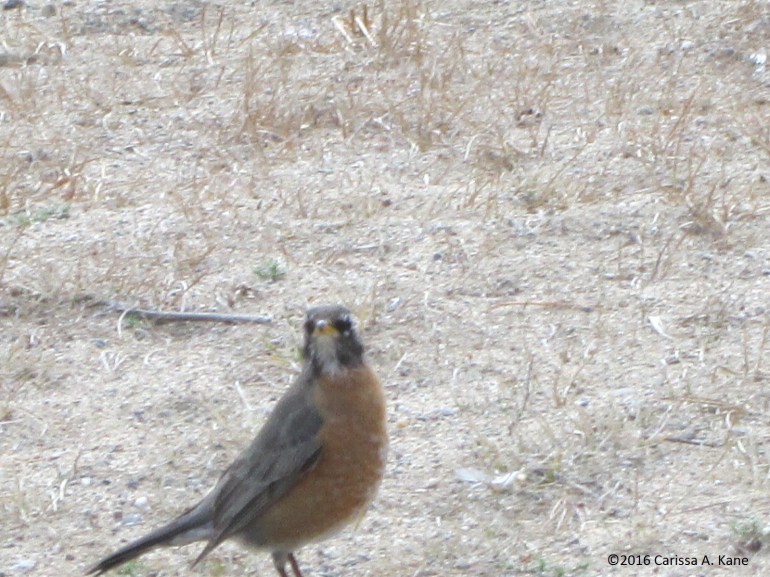
Dinosaurs and Birds…

“None of us is as smart as all of us.” – Ken Blanchard

In the course of being part of many different kinds of groups over the years, in both the for profit and non-profit arenas, as well as for business, ministry, and pleasure, it has been interesting to see how the spirit in which the group members come together far outweighs any talent, intellect, or circumstances that may come into play. More often than not, it does not matter how difficult the goal is to reach or the obstacles that may be present so much as it does the spirit and attitude with which each member enters and participates in the group.

In groups where members have helped to shape a clearly stated purpose(s) and remained focused on it while embracing diversity, listening to one another, and being open to the sharing of ideas and different approaches, seeing them as opportunities from which something might be gleaned, even if they seemed foreign to some within the group, much has been accomplished. Not only that, but through meaningful communication and working together, bonds have developed between group members. Through a spirit of cooperation, each individual has been better for having been part of the group. In addition, the fruit of the group has served a greater purpose; it reaches beyond the group.

In groups where this has not happened, far less has been accomplished and members have often either walked away in frustration or stayed, but with a diminished spirit and sense of purpose. Usually, these members become occasional participants or observers (more on the outside) rather than an active, engaged part of the group. Also operating within these kinds of groups, and larger than the collective purpose of the group, is often a smaller group of two or three driving things mostly to the exclusion of the rest of the group and all that others might bring to the table. There is not much working together in a sustainable way and the fruit of the group, as related to its purpose, doesn’t reach very far and is little to none.

The other day, a friend and I were talking about how sometimes it can be hard to know when to walk away and when to stay. Initially we talked about what would happen if more often than not people walked away. Then we discussed what it is like when they stay, diminished in spirit, present but not really vested; an environment of apathy. The more we talked the more we agreed that the latter was worse, but still as with most situations, for each seeker, eventually the path becomes clear and the way made known.

As I continue to reflect on our discussion, I think about how people and things come and go…as they have since the beginning. Then, I remember, as another friend said a while ago, sometimes it has to die in order to be born again with a new, enlivened spirit. Perhaps the choice is not to leave or to stay, but to embrace and face the unknown and the uncertain (death of what is known and of what we are sure) or to become extinct. For that, the location makes no difference…only the spirit.

InletView

Connections; Key Along the Way…

ConnectionsTree

Ezekiel connected dem dry bones,
Ezekiel in the Valley of Dry Bones,
Now hear the word of the Lord.

Toe bone connected to the foot bone
Foot bone connected to the heel bone
Heel bone connected to the ankle bone
Ankle bone connected to the shin bone
Shin bone connected to the knee bone
Knee bone connected to the thigh bone
Thigh bone connected to the hip bone
Hip bone connected to the back bone
Back bone connected to the shoulder bone
Shoulder bone connected to the neck bone
Neck bone connected to the head bone
Now hear the word of the Lord.

Dem bones, dem bones gonna walk around.
Now hear the word of the Lord.

—“Dem Bones” by James Weldon Johnson

Connections are vital for all living things. Our connections to people, places, and things often have great impact on our decisions and choices as we journey through life. Sometimes this can be a good thing, leading us to greater union with the Divine. Other times it can be a bad thing, pulling us away or clouding our vision from that which would lead us closer to God.

Whether someone of great experience or someone just starting out on her or his spiritual journey, like Ezekiel, we can all find ourselves in a valley of dry bones. It can be within us or around us. No matter how advanced we are—or we might think we are—if we are being honest, none of us are immune.

What exactly are dry bones? To me, dry bones are bones that cease to be aware or to be open to experiencing or learning something new. Dry bones shut out and close down. But dry bones are not hopeless or beyond repair. The choice is theirs.

It is only through slowing down and taking a closer look that we are able discover which connections are helpful and healthy, which might require some work, and which ones may be faulty or have become blocked and are no longer life-giving. None of this is possible though, without the most important part, listening, and the most important connection, “Now hear the word of the Lord.”

Bones full of life, rooted and strengthened or renewed in God, remain hopeful, see possibility, and recognize importance in both the big and the small. Bones full of life know that no connection is wasted and that each one holds something sacred. “Dem bones, dem bones gonna walk around!”

*The above is adapted from a post that I wrote for Spiritual Directors International’s blog and that was published on April 20.


To the Earth…

The glory of God is constantly in our midst. It is there in so many ways. Sometimes we are aware of it and sometimes we are not. As Earth Day (April 22) approaches, look around in the days to come. Bathe in the splendor of the earth. No matter where you are or how busy you might be, take time, even if just a moment or two, to seek and embrace the beauty of creation. Let joy spring from within and wash over you as you receive the glory of God; a gift to each of us, God’s beloved.

In celebration and honor of Earth Day, thanks be to God.

1SwanLake

2SnowCoveredTreesAtSunset

3Sunrise

4RockWashing

5DaffodilClose

6CrookedBranchTree

7Clouds

8MoonRising

9SnowOnHollyBush

10NiagaraBridge

11NiagaraRainbow

12Fall

13BAliveTrees

13MountainCross

14WhiteMountains

15OceanShimmer

16Sunset


For the beauty of the earth,
for the glory of the skies,
for the love which from our birth
over and around us lies.

Christ, our Lord, to you we raise
this, our hymn of grateful praise.

For the wonder of each hour
of the day and of the night,
hill and vale and tree and flower,
sun and moon and stars of light,

Christ, our Lord, to you we raise
this, our hymn of grateful praise.

For the joy of human love,
brother, sister, parent, child,
friends on earth, and friends above,
for all gentle thoughts and mild,

Christ, our Lord, to you we raise
this, our hymn of grateful praise.

For yourself, best gift divine,
to the world so freely given,
agent of God’s grand design:
peace on earth and joy in heaven.

Written by Folliott Sandford Pierpoint

Feed…Tend…Feed…

It is interesting to look at what goes on around us today through the lens of what transpired long ago. In one of his appearances after the Resurrection, the third time he appears to his disciples, Jesus has an interaction with Peter that affectively provides a bridge for Peter from his 3 denials of knowing Jesus to him fully embracing his role as a leader. (John 21:1-19)

Jesus says to Peter three times, “Do you love me?” When Peter answers each time in the affirmative, Jesus responds, “Feed my lambs,” “Tend my sheep,” and “Feed my sheep” respectively.

Jesus says, “Feed my lambs,” not “count them.”

Everywhere we go, we are numbered. We are given an identification number at birth or at a young age, a driver’s license number, a student ID number, a medical record number, etc. Numbers are all around us. How much, though, do numbers interfere with our spiritual life? There is another scripture passage where Jesus says, “where two or three are gathered in my name, there I am in the midst of them (Matthew 18:20). It seems, as with most matters, quality or substance (“gathered in my name”) outweighs quantity. We can all probably point to an experience(s) in our lives where our heart was moved and our attention captured by what was going on more than the dollars or the ticker counts. We live in a world where it can be tempting, a lot of the time, to focus on numbers or quantity over substance. Yet, time and time again, we can see examples throughout history that show us that numbers without substance (authentic, engaging and varied), usually become a passing fad rather than everlasting. Jesus says, “Feed my lambs,” not “count them.”

Jesus says, “Tend my sheep,” not “corral them.”

How do I take care of that which I have been given? According to Merriam-Webster, the definition of the word “tend” is “to move, direct, or develop one’s course in a particular direction.” If we are to take the example of Jesus and the call to discipleship, to tend His sheep would be to move, lead, or develop them in the direction of God. This is not the same thing as “corralling” (to gather into a pen or enclosure for confinement or capturing). We are not called to all line-up, speak the same, look the same, act the same, and to be the same. To “tend” is to nurture and to allow room to grow into one’s true self. Tending can be accomplished in countless ways. I have only to look at my experiences tending and being tended to, to see that there is more than one way, time or place to “tend.” Jesus says, “Tend my sheep,” not “corral them.”

Jesus says, “Feed my sheep,” not “shear them.”

Jesus uses the word “feed” again, emphasizing the importance of “feeding” which is an act of providing…providing for the benefit, development, sustenance, and well-being of. There are many sheep in the fold and Jesus instructs Peter, a second time, to provide for them…not to take from them. As the shepherd feeds the sheep, guides them, and protects them, the sheep grow strong and healthy. Their wool grows thick and is plentiful. If the shepherd continually shears the sheep, neglecting to properly feed and tend them as well, the wool becomes thinner and thinner, until it is gone. Jesus says, “Feed my sheep,” not “shear them.”

LakeMassapoag2

“At the end of life we will not be judged by how many diplomas we have received, how much money we have made, how many great things we have done. We will be judged by “I was hungry, and you gave me something to eat, I was naked and you clothed me. I was homeless, and you took me in.” ― Mother Teresa

May’s Way…

It is interesting how people come into our lives who, at times, remind us of those who went before us. A number of years ago, I recall feeling amazed one day as I realized how many women named Mary had recently come into my life. It was as if a whole army of warm, welcoming, faith-filled Marys were suddenly in my life. They were from different walks of life, but all named Mary, and all of them brought a smile, wisdom and a sense of peace with them.

As I sat in awe with this realization, tears came to my eyes and I thought of my Auntie May, named Mary at birth. The first Mary I ever knew and loved with all of my heart. She was a fixture of love from as far back as I can remember…gentle and faith-filled.

Auntie May…I can still see her beautiful face and hear her wise, calming voice. “Hi doll,” together with an embrace that felt so warm and loving. I can still see her beautiful fingers. She would take my hand and hold it between hers as we exchanged greetings. I could feel the love and care in her hands, the same hands that made such wonderful food—kibbe, cinnamon twists, and so much more.

I remember sitting, as a young child and as I grew in age, listening to her and the other adults speak. She spoke with such clarity and with a passion for all that is right and just, for all that is good and true. She was so knowledgeable, but at the same time so down to earth. She was a very interesting person, not to mention her sense of humor; and though she was gentle, she could be stern, too. She knew when to speak softly and when to speak more firmly and with greater conviction. She had such an amazing spirit…striking…so nurturing and life giving.

Auntie May, and all the Marys who followed, reminding me of all that was and all that is. It is fascinating how God sends people into our lives to help us or challenge us, as well as for us to help…sometimes simply by being ourselves.

There is a saying that the best thing one can do is to be one’s true self. That is, as one becomes more and more authentic, she or he makes a difference simply by being. There is an energy or a vibe, when being true to oneself, that extends without effort as we go about day to day activities.

As layers are peeled back and one uncovers or moves closer to her or his true self, we are summoned or we gravitate toward our true calling or vocation(s) within our life and within each situation. Connected to that call, to the source of that call, and continuing to remain faithful to it, the energy or the spirit remains, flowing through and radiating out with benefit for all with whom we interact.

So, while my Auntie May, may have been different things to different people throughout her life, she was true to herself and the love, spirit and energy that she brought to each thing she did and each role she fulfilled, remained the same. What was even more special was that she realized it was not hers to keep and that it could only continue by her letting go and letting flow as she went about her way.

A_White_Chrysanthemum

“Be who God meant you to be and you will set the world on fire.” – St. Catherine of Siena


A Regular Joe…

Joseph, the carpenter, faithful servant of the Lord, took Mary into his home as his wife and named his son Jesus.

Joseph, faithful servant of the Lord, took Mary and Jesus and fled to Egypt in the middle of the night, remaining there until the appointed time then returning to Nazareth.

Joseph, faithful servant of the Lord, husband of Mary, the mother of God, earthly father of Jesus, the Son of God, lived his faith.

Joseph, faithful servant of the Lord, did all that was spoken to him by the Angel of God.

St. Joseph, the patron Saint of the Universal Church, unborn children, fathers, workers, travelers, immigrants, and a happy death. We do not know much about St. Joseph. Not knowing much though is intriguing, because Joseph could be any of us—a “regular Joe” capable through his faith and God’s grace of facing the challenges of his life and the times in which he lived.

Perhaps, the best place to start though is with what we do know about St. Joseph. We know that he was a carpenter (MT 13:54-55). However, according to scholars the Greek word “Tekton” would have been used to describe Joseph, meaning that he was a craftsman or contractor; someone very skilled at working with wood, stones, and metals. It is also likely that he traveled quite a bit to seek work.

We also know from Bible verses, that St. Joseph was a husband (the husband of Mary the Blessed Virgin) and he was the “foster” or earthly father of Jesus. These two pieces of information, along with the fact that he was a working class man not only make St. Joseph relatable, but they also suggest he was a person of great faith, courage and wisdom. Think about it…the husband of Mary, the mother of God, and the earthly father of Jesus, the son of God.

From the passages in the Bible, we can also see ways that Joseph’s life and his choices exemplify those of someone striving to be faithful to God. We know that he had dreams in which he was visited by an Angel of God telling him to not be afraid to marry Mary (that she had conceived by the Holy Spirit), a dream to flee to Egypt, and then to return from Egypt. We know that Joseph listened, trusted and did as the Angel of God instructed in each case – Joseph married Mary, named his son Jesus, fled to Egypt, and later returned to Nazareth in Galilee all upon the instruction of the Angel of the Lord in dreams.

We can also see wisdom in the spiritual work of mercy exhibited by Joseph in bearing patience against wrongdoing or perceived wrongdoing. Mary, his betrothed, is found to be pregnant, yet they had not had any relations yet. We can only imagine what Joseph’s first thoughts to this news were. I doubt anyone would have trouble understanding if he was livid and decided to leave Mary. Also in that day and time in history, it would have been well within societal expectations for Mary to be stoned to death. Yet, here we have Joseph, deciding to quietly divorce Mary, not wanting her to be harmed. Despite what must have seemed and felt like a “betrayal,” he saw it in his heart, to show mercy and compassion. Joseph’s response, even before a visitation from the Angel of God, is remarkable and seems one only possible by someone very prayerful and inspired by God.

It leaves one to wonder, how am I able to show mercy when I am wronged? How am I able to be patient and to persevere? How can I, how can we, use St. Joseph as a model?

In each of the situations described in Scripture, Joseph dies unto himself, sacrifices and cooperates with God’s will. He shows openness to and focus on God’s will at each point. He was able to survive and make it through difficult and challenging circumstances such as the journey to Bethlehem with an expecting Mary. The journey to Bethlehem would not have been an easy one. Then there is the impending birth of Jesus with nowhere to stay, the flight to Egypt, the journey back to Nazareth and beyond.

How can we have the faith and patience of Joseph? How can we, like Joseph, recognize and accept that things happen in God’s time, not according to our time, and to remember that God is faithful to those who are faithful to God? Do I remind myself of the ways that God has been faithful to and patient with me along my journey so far? Do I allow past experiences to help me to remain patient and faithful, and to continue to trust in God and in God’s timing?

Joseph wasn’t given explicit plans or an outline of all that would happen in the dreams he had. In the Gospel of Luke, chapter 2, we are told that Jesus is laid in a manger because there was no room for them in the inn. We are also told at the presentation of Jesus in the temple that Simeon tells Mary and Joseph that Jesus would be glory for God’s people and that Mary’s heart would be pierced. It then says, “The child’s father and mother were amazed at what was said about him.” Joseph and Mary didn’t know all that was going to happen.

When we look at Joseph, he was just given a basic directive in his dreams…take Mary as your wife…flee to Egypt. He listened and let God lead him. He had faith in God, faith that we can only assume grew with each event in his life and most especially through the birth of Jesus and all that transpired in the time after his birth.

Martin Luther King said, “Faith is taking the first step, even when you don’t see the whole staircase.” That’s the hard part, the “not knowing.” If we knew all the details of what was going to happen, it might be very easy to be patient, to let go of wrongdoings and to trust in God and in God’s plan.

Faith…trusting even when we cannot see the next step…trusting that it will be there when it is time to take that step. Waiting until it is there, taking direction from God and acting once the step appears and the way is made clear. St. Joseph, from what we know of him, did all of this.

It is more likely than not, especially at that time in history, as a father, Joseph not only provided for and protected his family, but also led his family in the observance of prayer and religious custom. We read in Scripture, “Each year his parents went to Jerusalem for the feast of Passover, and when he was twelve years old, they went up according to festival custom.” (Lk 2:41)

With what we know of Joseph, it is not a stretch to imagine him as a very prayerful person.

For Joseph, the beginning of the journey that would lead him to emerge fully into who God created him to be and to fulfill his part in God’s plan, started with a dream, or a desire, long before the first dream, he had and that we read about in the Bible. The journey started with him saying “Yes” to letting God lead him, and continuing to say “Yes”, letting God continue to lead him all along the way. How can I, how can we, do the same?
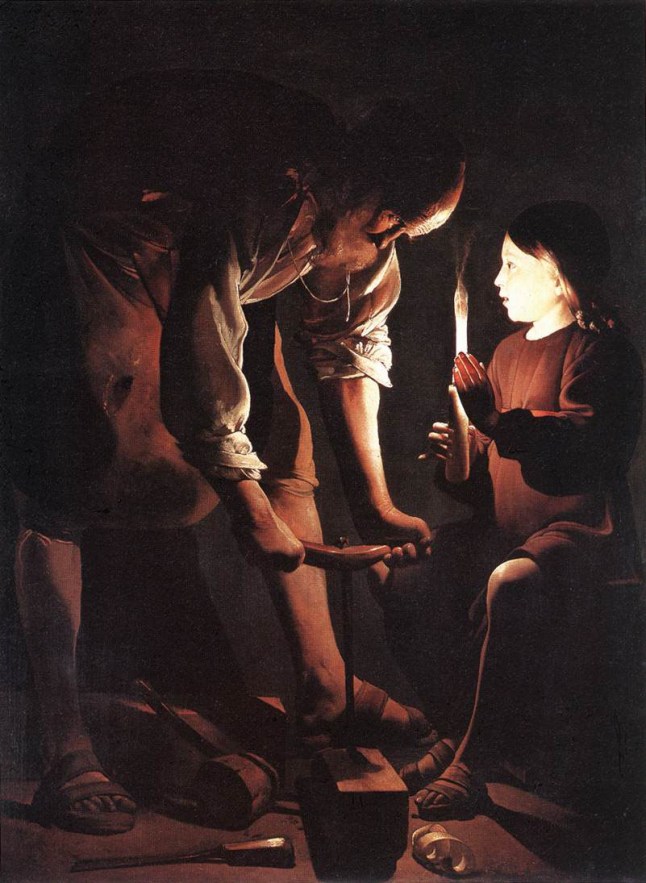
StJosephJoseph the Carpenter rendered by Georges de La Tour

Polished Stones…

PLUM2G

I woke up this morning with a U2 song in my head. I was particularly struck by the line, “The sea throws rocks together but time, leaves us polished stones.” As I look at stones collected from a local beach over the past number of years, I love how all the stones, of different shapes, sizes and colors, share a smooth texture. Sometimes I wonder from where each stone may have originated. How far did each one travel along its journey from out in the deep ocean to the sands of the beach? The stones, no matter where they came from or how they started out, all came to be smooth by being tossed about in the sea.

It is interesting how in the same way that the friction caused by water against stone and stone against stone has smoothed the edges over time, adversity can smooth our edges. Adversity can lead to growth.

It seems human nature to prefer the moments of smooth sailing, keeping quiet and avoiding potential conflict. However, as I reflect, it seems like so much more growth comes from moments of standing in the ocean and moving with the waves as they ebb and flow, as they rise and fall with the tide, and crash around during storm surges. Carrying hope in my heart and a desire to be all that I can be (and all that I was created to be) deep within my soul, I am able to own who I am. With each wave, through God’s grace and with openness and acceptance, the jagged edges are smoothed away. I am made new.

“Then we will no longer be infants, tossed back and forth by the waves, and blown here and there by every wind of teaching…” – Ephesians 4:14

Ordinary Love by U2

The sea wants to kiss the golden shore.
The sunlight warms your skin.
All the beauty that’s been lost before, wants to find us again.
I can’t fight you anymore; it’s you I’m fighting for.
The sea throws rocks together but time, leaves us polished stones.

We can’t fall any further if, we can’t feel ordinary love.
And we cannot reach any higher, if we can’t deal with ordinary love.

Birds fly high in the summer sky and rest on the breeze.
The same wind will take care of you and I, we’ll build our house in the trees.
Your heart is on my sleeve, did you put it there with a magic marker.
For years I would believe, that the world, couldn’t wash it away.

Cause we can’t fall any further if, we can’t feel ordinary love.
And we cannot reach any higher, if we can’t deal with ordinary love.

Are we tough enough, for ordinary love?

We can’t fall any further if, we can’t feel ordinary love.
And we cannot reach any higher, if we can’t deal with ordinary love.

Are we tough enough, for ordinary love?

The Choice Is Ours…

ChoiceIsOurs

From the snow covered branches to the rumble of snowplows, the hum of snow blowers and the sound of shovels against the ground. From the people driving or operating machines or shoveling to those simply playing in the winter wonderland. From those readying a place for loved ones returning from outdoors to those who are simply gazing in awe of the beauty that abounds…and, to all those in between, Alleluia!

Be it rain or snow or a storm of another kind, there is something so pure…so quiet…after a storm. There is something so precious in the time that follows the pouring down…and sometimes out and all around. Looking out the window after a recent snowstorm, I am struck by the way that everything is right in front of us, and the choice is ours.

While the storm may have caused almost all activity to come to a halt, it also washes clean (or white) for at least a little while. Then, it is time to clean up. Moved to work together, we help each other to restore the roads and the walkways so that once again they are open and safe for travel to and from.

Again, it seems that everything is right in front of us and the choice is ours.

A Boiled Seed Cannot Sprout – Author Unknown

An aging king woke up one day acutely aware of his own mortality.  He had no son, and his was a culture where only a male heir could take his place.

He decided that he would adopt a son who then could take his place, but he insisted that such an adopted son must be extraordinary in every sense of the word.  He considered each of his advisors and relatives in turn, but found them wanting.

So he launched a competition in his kingdom, open to all boys, no matter what their background. Ten boys made it to the very top. There was little to separate these boys in terms of intelligence and physical attributes and capabilities.

The king said to them, ‘I have one last test and whoever comes top will become my adopted son and heir to my throne.’ Then he said, ‘This kingdom depends solely on agriculture, so the king must know how to cultivate plants.  Here are seven seeds of grain for each of you. Take them home.  Plant and nurture them for six weeks. At the end of six weeks, we shall see who has done the best job of cultivating the grain.  That person will be my son and my heir. ‘

The boys took their seeds and hurried home.  Each got a pot, prepared soil, and sowed his seeds. There was much excitement in the kingdom as the people waited to see who was destined to be their next king.

In one home, the boy and his parents were almost heartbroken when the days stretched into weeks and the seeds failed to sprout. The boy did not know what had gone wrong. He had selected the soil carefully, he had applied the right quantity and type of fertilizer, he had been very dutiful in watering it at the right intervals, he had even prayed over it day and night and yet his seeds had turned out to be unproductive.

Some of his friends advised him to go and buy seed from the market and plant that. ‘After all,’ they said, ‘how can anyone tell seeds of grain one from another?’

But his parents who had always taught him the value of integrity reminded him that if the king wanted them to plant just any grain, he would have asked them to go for their own seed. ‘If you take anything different from what the king gave you that would be dishonest. Maybe we are not destined for the throne.  If so, let it be, but don’t be found to have deceived the king,’ they told him.

The appointed day came and the boys returned to the palace each of them proudly exhibiting a pot of healthy seedlings. It was obvious that the other nine boys had had great success with their seeds. The king began making his way down the line of eager boys and asked each of them, ‘Is this what came out of the seeds I gave you?’ And each boy responded, ‘Yes, your majesty.’ And the king would nod and move down the line.

The king finally got to the last boy in the line-up. The boy was shaking. He feared that the king might have him thrown into prison for wasting his seeds. ‘What did you do with the seeds I gave you?’ the king asked.

‘I planted them and cared for them diligently, Your Majesty, but alas they failed to sprout,’ the boy said.  He hung his head in shame, and the crowd jeered.

But the king raised his hands and signaled for silence. Then he said, ‘My people behold your next king.’

The people were confused. ‘Why that one?’ many asked.’ How can he be the right choice?’

The king took his place on his throne with the boy by his side and said, ‘I gave these boys boiled seeds. This test was not for cultivating grain.  It was a test of character; a test of integrity. It was the ultimate test.  If a king must have one quality, it must be that he should be above dishonesty. Only this boy passed the test. A boiled seed cannot sprout.’

Connecting the pieces…

puzzlepieces2

A year or so ago, and over the course of a number of weeks, I was in the waiting area of a medical center for a portion of each weekday morning. On the way to the waiting area there was coffee, hot water for tea, and small packages of graham crackers and salted crackers. The waiting area itself had chairs, a TV and magazines like most waiting areas, but it also had a table with a partially completed puzzle on it and all the remaining small pieces, also waiting.

I remember arriving each morning and after a short period of time, looking to see how much more of the puzzle was left to be done and how many pieces I might locate and place in the time that I was waiting. At first, this was how I spent at least a portion of my half hour wait each day. Then, as the weeks progressed there were more people in the waiting area and I found my time less and less filled with finding and placing pieces of the puzzle and more filled with conversation between and amongst fellow wait-ers. Those who were once strangers became familiar over a short period of time.

It is interesting how our lives intersect with the lives of others. And how, even over a brief period of time or through a short exchange, we can affect each other’s lives.

Each lifetime is the pieces of a jigsaw puzzle.
For some there are more pieces.
For others the puzzle is more difficult to assemble.
Some seem to be born with a nearly completed puzzle….

But know this. You do not have within yourself
All the pieces to your puzzle…

Everyone carries with them at least one and probably
Many pieces to someone else’s puzzle.
Sometimes they know it.
Sometimes they don’t.

                      – from “Eyes Remade for Wonder” by Rabbi Lawrence Kushner

As I continue to sit with the memory of that waiting area, I recall how it felt as if time was suspended or even ceased to exist. There was a reverence in the air as we listened to one another and shared conversation and laughter as we waited. It was as if we were on holy ground. A pleasant surprise…

Recently, I attended an 80th birthday party, and while it was much noisier than the waiting area of that medical center over a year ago, there was also a reverence in the room. At one side of the room there was a slideshow of pictures from throughout the years. As I sat and watched the pictures from old to new, seeing both family and friends…those who had passed and those who were present, sadness was replaced with gratitude as I was reminded…How precious life is! There was a feeling of holy ground in the pictures and in the room in the hugs and kisses, and in the smiles, greetings and conversations that were exchanged during the celebration of a “piece,” a special and beloved piece, that belongs to the puzzle of each of us present at the party, whether in spirit or in person.

So, I praise God as I say thank you Auntie D. for your beautiful spirit, your love, and your example throughout a lifetime. And, thank you to the nurses, technologists and patients in the waiting area of that medical center for your hospitality, sharing and caring during a short and uncertain period of time.

Each and every piece of the puzzle no matter the shape, size, or length is a gift, or has a lesson that is a gift. Sometimes that is easier to see than at other times. Either way, whether we see it now, or later, one spirit bowing to another is always a beautiful thing.