Hidden in a Catalog…

Each year as Christmas approaches, I fondly recall a childhood ritual of time spent with a couple of my siblings, huddled around a department store’s holiday edition catalog. The three of us would look at what seemed like endless pages of different games and toys, dreaming of what it would be like to call them our own. At the same time though, we knew that was not going to happen.

Still, each year, we would come together, at the kitchen table or lying on our stomachs on the rug in the family room, captivated by the pictures and descriptions. We were all on, or around, the same page, and not a page was turned until all three of us were ready to move on. Of course, sometimes, we would negotiate and come back to particular page or skip ahead to a different section, but always, we stayed together.

It’s interesting what sharing, can bring to a situation. Although my older sister, younger brother, and I were frequently drawn to different games or toys, we were consistently drawn together. Over the years, the experience of sharing our time with each other as well as our excitement and interest… hopes and dreams, made it seem like anything was possible in the sacred space we shared. 

This year, in a pandemic ridden world, where space is better not shared, perhaps another kind of invitation lies in waiting—a bridge of sorts. Maybe a chance to find that which has been overlooked, or what might otherwise be lost. An opportunity to remember or to see more than what we think we know. 

As a child looking at those pages of games and toys, I thought it was the catalog that brought such great excitement. However, while it was intriguing back then, now I understand it differently. So often, time and distance can bring perspective in a way that reveals truth or deeper understanding of any matter.      

On the 3rd Sunday of Advent, a time of waiting and reflecting, we read in the Gospel according to John that John the Baptist said, “…there is one among you whom you do not recognize…” (John 1:26-27), to the priests and Levites sent to question him. He was speaking of Jesus. Yet, we know that even today, there are moments where each of us can say to ourselves, “there is one among you whom you do not recognize.” Whether it is a person, place, or thing, when we think of it, how do we speak of, and to, Jesus?

A man named John was sent from God.
He came for testimony, to testify to the light,
so that all might believe through him.
He was not the light,
but came to testify to the light.

And this is the testimony of John.
When the Jews from Jerusalem sent priests
and Levites to him
to ask him, “Who are you?”
He admitted and did not deny it,
but admitted, “I am not the Christ.”
So they asked him,
“What are you then? Are you Elijah?”
And he said, “I am not.”
“Are you the Prophet?”
He answered, “No.”
So they said to him,
“Who are you, so we can give an answer to those who sent us?
What do you have to say for yourself?”
He said:
“I am the voice of one crying out in the desert,
‘make straight the way of the Lord,’”
as Isaiah the prophet said.”
Some Pharisees were also sent.
They asked him,
“Why then do you baptize
if you are not the Christ or Elijah or the Prophet?”
John answered them,
“I baptize with water;
but there is one among you whom you do not recognize,
the one who is coming after me,
whose sandal strap I am not worthy to untie.”
This happened in Bethany across the Jordan,
where John was baptizing. – John 1:6-8, 19-28          
The Glass Across the Way…

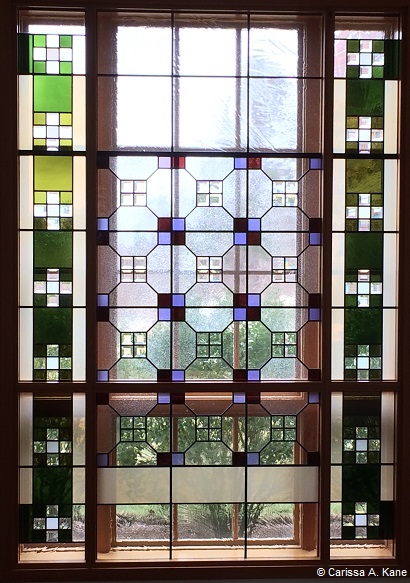
As I looked at the stained glass window across the hall, at first I took in its pattern and the colors in it. Then, it was interesting to notice the way the light came through it, and the way the different sections of glass distorted or hid what was on the other side. It was only at the base of the window that one could see pretty clearly, what was outside; and, I imagine, one who was outside could see in, too.

Oftentimes, situations, relationships, and interactions can be like looking through glass. They can range from those where the glass may seem impenetrable to those where the glass is transparent, with nothing to hide. Yet, even in those cases where the glass is very dark, light is still able to shine through it.

Look at Pilate, Herod, one of the criminals alongside Jesus, and the centurion (Luke 23:1-49). In the midst of all that was happening through the trial and crucifixion of Jesus, light was shed and truth was revealed to them. What did they do with it? What do we do with it?

This is what the Passion of our Lord and Savior Jesus Christ is all about. In all moments, even in the moments when life seems darkest or situations seem impossible, there is still light with and within us, and where there is light, there is always a way… the Way.

The more we can allow ourselves to be transparent in our relationship with God, the more we shine, and the more we shine, the better we are able to see, and live, the Way.    

EPWindow

The elders of the people, chief priests and scribes,
arose and brought Jesus before Pilate.
They brought charges against him, saying,
“We found this man misleading our people;
he opposes the payment of taxes to Caesar
and maintains that he is the Christ, a king.”
Pilate asked him, “Are you the king of the Jews?”
He said to him in reply, “You say so.”
Pilate then addressed the chief priests and the crowds,
“I find this man not guilty.”
But they were adamant and said,
“He is inciting the people with his teaching throughout all Judea,
from Galilee where he began even to here.”

On hearing this Pilate asked if the man was a Galilean;
and upon learning that he was under Herod’s jurisdiction,
he sent him to Herod who was in Jerusalem at that time.
Herod was very glad to see Jesus;
he had been wanting to see him for a long time,
for he had heard about him
and had been hoping to see him perform some sign.
He questioned him at length,
but he gave him no answer.
The chief priests and scribes, meanwhile,
stood by accusing him harshly.
Herod and his soldiers treated him contemptuously and mocked him,
and after clothing him in resplendent garb,
he sent him back to Pilate.
Herod and Pilate became friends that very day,
even though they had been enemies formerly.
Pilate then summoned the chief priests, the rulers, and the people
and said to them, “You brought this man to me
and accused him of inciting the people to revolt.
I have conducted my investigation in your presence
and have not found this man guilty
of the charges you have brought against him,
nor did Herod, for he sent him back to us.
So no capital crime has been committed by him.
Therefore I shall have him flogged and then release him.”

But all together they shouted out,
“Away with this man!
Release Barabbas to us.”
— Now Barabbas had been imprisoned for a rebellion
that had taken place in the city and for murder. —
Again Pilate addressed them, still wishing to release Jesus,
but they continued their shouting,
“Crucify him!  Crucify him!”
Pilate addressed them a third time,
“What evil has this man done?
I found him guilty of no capital crime.
Therefore I shall have him flogged and then release him.”
With loud shouts, however,
they persisted in calling for his crucifixion,
and their voices prevailed.
The verdict of Pilate was that their demand should be granted.
So he released the man who had been imprisoned
for rebellion and murder, for whom they asked,
and he handed Jesus over to them to deal with as they wished.

As they led him away
they took hold of a certain Simon, a Cyrenian,
who was coming in from the country;
and after laying the cross on him,
they made him carry it behind Jesus.
A large crowd of people followed Jesus,
including many women who mourned and lamented him.
Jesus turned to them and said,
“Daughters of Jerusalem, do not weep for me;
weep instead for yourselves and for your children
for indeed, the days are coming when people will say,
‘Blessed are the barren,
the wombs that never bore
and the breasts that never nursed.’
At that time people will say to the mountains,
‘Fall upon us!’
and to the hills, ‘Cover us!’
for if these things are done when the wood is green
what will happen when it is dry?”
Now two others, both criminals,
were led away with him to be executed.

When they came to the place called the Skull,
they crucified him and the criminals there,
one on his right, the other on his left.
Then Jesus said,
“Father, forgive them, they know not what they do.”
They divided his garments by casting lots.
The people stood by and watched;
the rulers, meanwhile, sneered at him and said,
“He saved others, let him save himself
if he is the chosen one, the Christ of God.”
Even the soldiers jeered at him.
As they approached to offer him wine they called out,
“If you are King of the Jews, save yourself.”
Above him there was an inscription that read,
“This is the King of the Jews.”

Now one of the criminals hanging there reviled Jesus, saying,
“Are you not the Christ?
Save yourself and us.”
The other, however, rebuking him, said in reply,
“Have you no fear of God,
for you are subject to the same condemnation?
And indeed, we have been condemned justly,
for the sentence we received corresponds to our crimes,
but this man has done nothing criminal.”
Then he said,
“Jesus, remember me when you come into your kingdom.”
He replied to him,
“Amen, I say to you,
today you will be with me in Paradise.”

It was now about noon and darkness came over the whole land
until three in the afternoon
because of an eclipse of the sun.
Then the veil of the temple was torn down the middle.
Jesus cried out in a loud voice,
“Father, into your hands I commend my spirit”;
and when he had said this he breathed his last.

The centurion who witnessed what had happened glorified God and said,
“This man was innocent beyond doubt.”
When all the people who had gathered for this spectacle
saw what had happened,
they returned home beating their breasts;
but all his acquaintances stood at a distance,
including the women who had followed him from Galilee
and saw these events. – Luke 23:1-49

Waiting for the Sun…

As the waves approached the shore, the sky grew lighter with each minute, casting out the darkness of night. Then far out on the water’s edge, a speck of light appeared. It steadily grew bigger and brighter as the sun made its way over the horizon, coming into full view. At last, there it was, in time and in all its glory, and there I was, in time and in all my glory… all by the grace of God.

I had been reluctant to sit in the dark, and had hemmed and hawed over whether or not to get up and go out. But now… what an inspiration to have witnessed the transformation as the light completely overcame the darkness that preceded it. How vastly different the experience would have been, had the darkness driven out my desire and extinguished any efforts to see the light and in the process the beauty of creation.

So many gifts! How precious and sacred creation, and the gifts of time and presence are. Life depends upon them. Oftentimes what one person may see or experience another may not. Yet, in time, the Truth is always revealed, and God’s presence made known, when we are ready and in the proper space to receive them—a willing participant so to speak.

Throughout the Gospels, Jesus is asked many times for signs to prove that he is Emmanuel (God with us). In today’s world, there seems to be so much darkness, and we, like the crowd, also seek signs. Oftentimes we may not see any, but nonetheless the signs are many and ever-present. When we stop, let go, and look around, they begin to appear; often in that which we may be taking for granted. For example, the sun rises each morning. In fact, the sun is always shining on some part of the earth, and is even there when covered by the clouds. We do not put it there or control it, yet every day it is present—and seen at the appointed time.

Sometimes, it is only through facing the risk, being in the quiet darkness, that we can truly see the Light.

SunRise

At the End of the Day…

The other day as I was in the car waiting to pick up one of my children, I was looking toward the top of the school steps as a sea of students flowed out of the building. As I was watching for my child, suddenly there was a knock on the car window. Startled at this unexpected knock, I turned toward the window to see my child’s face. While I was looking in one direction, my son had appeared from another direction. This was something new and completely unanticipated.

When the two disciples on the road to Emmaus encountered Jesus, they had no idea who he was (Luke 24:13-35). They were not expecting him and could not have anticipated that Jesus who had been crucified would appear to them. They were with him for quite some time and it was not until after he broke the bread and said the blessing that they were able to recognize him. It was as if in that moment everything came together and they turned their heads to see what was in front of them as they journeyed.

When they return to Jerusalem to tell the others about Jesus appearing to them, they learn that Jesus has appeared to Peter too. Then as they are recounting what happened to them along the way to Emmaus, Jesus appears again (Luke 24:36-49). Each time Jesus appears, it is unanticipated and unexpected. It is also in response to hearts that are troubled… hearts that are longing… hearts that believe and that are trying to find or to put the pieces back together… striving to continue to live out of a relationship that was, that is, like no other.

In all these cases where Jesus appears, it seems the person(s) to whom he appears is letting their guard down and openly thinking, speaking or trying to understand their experience. They are remembering and recounting what transpired. They are looking at where Jesus was, wondering about what happened and where he is now. They are also watching, waiting, and listening. In doing so, wherever they are, Jesus is suddenly with them and making himself known.

On the road to Emmaus, the two disciples recalled with each step all that transpired. Jesus joined them and their hearts were burning as he helped them to take an intimate look, to remember, and to see, perhaps with new eyes. The Lord also appears to others, including us, helping us to remember or to reclaim and to go forward or to wait… helping us to know more surely, more confidently, who we are and how to be.

As we go through life, God is with us from before our first steps, and all the way through. Sometimes we need to rest, and allow the Lord to help us recount and remember.

Our soul waits for the Lord,
Who is our help and shield.
For in the Lord our hearts rejoice;
In God’s holy name we trust.
May your mercy, Lord, be upon us;
As we put our hope in you. – Psalm 33:20-22

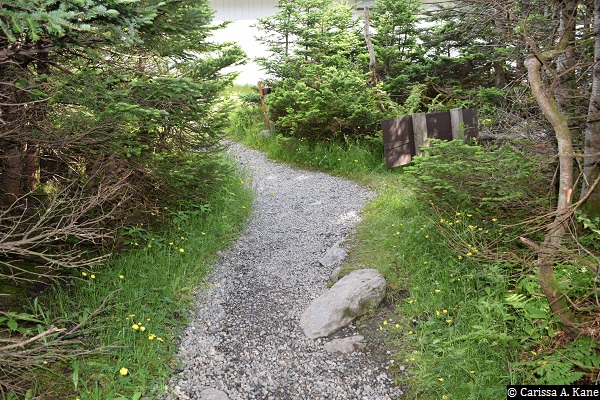
Path