Gifts from God are Everlasting…

About a week ago, it was the month and date of the last time I was together with all of my siblings. A number of us had traveled a good distance south to be there. The six of us were present and engaged, laughing and talking with each other.

I don’t recall what the weather was like that day, but the sun was shining. At least I remember feeling that way…surrounded by warmth and love. We were gathered in a room, eating lunch and spending time together prior to the youngest of us starting preparations for another bone marrow transplant. Despite the impending procedure, I recall feeling joy in the moments of our togetherness.

Our time together that day ended and some of us returned north. Afterward, I spoke with my younger brother by phone. We were talking about our lunch together with all of our older siblings. We spoke about how much we enjoyed being together. Then he said, “I wish we could be together all the time.” I remember saying, “Yeah, but we would probably get on each other’s nerves if we were together all the time.” Then we joked about how it would be fine as long as we had space to retreat to, we could live on a cul-de-sac with a house for each of us, numbered 1 through 6 of course…we laughed. Growing up many a thing was labeled with our birth order number so as for us to easily identify our belongings.

While seven years have passed now since that day in May, sometimes it seems as if it were just yesterday. None of us knew that day, that the next time we would be together would come so soon…and with one less voice. My brother passed away a little more than a month later.

Every year around the anniversary of that day, I feel such sadness and heartache at first. Then, as I recall the day and the spirit in which we were together I feel so grateful for that one last time all together, and all the days we had together leading up to it. Each time I recall that experience, or any other time with my younger brother, I can picture his handsome face and mischievous smile. It is as if, in that moment, our spirits bow to each other and I know he lives on…encouraging me to remember there is beauty in each moment…to embrace and cherish it. Reminding me that what really matters cannot be taken away, not even by death.

One Voice by The Wailin’ Jennys – https://www.youtube.com/watch?v=Bc6HloRYZGc

This is the sound of one voice
One spirit, one voice
The sound of one who makes a choice
This is the sound of one voice

This is the sound of voices two
The sound of me singing with you
Helping each other to make it through
This is the sound of voices two

This is the sound of voices three
Singing together in harmony
Surrendering to the mystery
This is the sound of voices three

This is the sound of all of us
Singing with love and the will to trust
Leave the rest behind it will turn to dust
This is the sound of all of us

This is the sound of one voice
One people, one voice
A song for every one of us
This is the sound of one voice

This is the sound of one voice

DJM2Drum

Connections; Key Along the Way…

ConnectionsTree

Ezekiel connected dem dry bones,
Ezekiel in the Valley of Dry Bones,
Now hear the word of the Lord.

Toe bone connected to the foot bone
Foot bone connected to the heel bone
Heel bone connected to the ankle bone
Ankle bone connected to the shin bone
Shin bone connected to the knee bone
Knee bone connected to the thigh bone
Thigh bone connected to the hip bone
Hip bone connected to the back bone
Back bone connected to the shoulder bone
Shoulder bone connected to the neck bone
Neck bone connected to the head bone
Now hear the word of the Lord.

Dem bones, dem bones gonna walk around.
Now hear the word of the Lord.

—“Dem Bones” by James Weldon Johnson

Connections are vital for all living things. Our connections to people, places, and things often have great impact on our decisions and choices as we journey through life. Sometimes this can be a good thing, leading us to greater union with the Divine. Other times it can be a bad thing, pulling us away or clouding our vision from that which would lead us closer to God.

Whether someone of great experience or someone just starting out on her or his spiritual journey, like Ezekiel, we can all find ourselves in a valley of dry bones. It can be within us or around us. No matter how advanced we are—or we might think we are—if we are being honest, none of us are immune.

What exactly are dry bones? To me, dry bones are bones that cease to be aware or to be open to experiencing or learning something new. Dry bones shut out and close down. But dry bones are not hopeless or beyond repair. The choice is theirs.

It is only through slowing down and taking a closer look that we are able discover which connections are helpful and healthy, which might require some work, and which ones may be faulty or have become blocked and are no longer life-giving. None of this is possible though, without the most important part, listening, and the most important connection, “Now hear the word of the Lord.”

Bones full of life, rooted and strengthened or renewed in God, remain hopeful, see possibility, and recognize importance in both the big and the small. Bones full of life know that no connection is wasted and that each one holds something sacred. “Dem bones, dem bones gonna walk around!”

*The above is adapted from a post that I wrote for Spiritual Directors International’s blog and that was published on April 20.


To the Earth…

The glory of God is constantly in our midst. It is there in so many ways. Sometimes we are aware of it and sometimes we are not. As Earth Day (April 22) approaches, look around in the days to come. Bathe in the splendor of the earth. No matter where you are or how busy you might be, take time, even if just a moment or two, to seek and embrace the beauty of creation. Let joy spring from within and wash over you as you receive the glory of God; a gift to each of us, God’s beloved.

In celebration and honor of Earth Day, thanks be to God.

1SwanLake

2SnowCoveredTreesAtSunset

3Sunrise

4RockWashing

5DaffodilClose

6CrookedBranchTree

7Clouds

8MoonRising

9SnowOnHollyBush

10NiagaraBridge

11NiagaraRainbow

12Fall

13BAliveTrees

13MountainCross

14WhiteMountains

15OceanShimmer

16Sunset


For the beauty of the earth,
for the glory of the skies,
for the love which from our birth
over and around us lies.

Christ, our Lord, to you we raise
this, our hymn of grateful praise.

For the wonder of each hour
of the day and of the night,
hill and vale and tree and flower,
sun and moon and stars of light,

Christ, our Lord, to you we raise
this, our hymn of grateful praise.

For the joy of human love,
brother, sister, parent, child,
friends on earth, and friends above,
for all gentle thoughts and mild,

Christ, our Lord, to you we raise
this, our hymn of grateful praise.

For yourself, best gift divine,
to the world so freely given,
agent of God’s grand design:
peace on earth and joy in heaven.

Written by Folliott Sandford Pierpoint

Feed…Tend…Feed…

It is interesting to look at what goes on around us today through the lens of what transpired long ago. In one of his appearances after the Resurrection, the third time he appears to his disciples, Jesus has an interaction with Peter that affectively provides a bridge for Peter from his 3 denials of knowing Jesus to him fully embracing his role as a leader. (John 21:1-19)

Jesus says to Peter three times, “Do you love me?” When Peter answers each time in the affirmative, Jesus responds, “Feed my lambs,” “Tend my sheep,” and “Feed my sheep” respectively.

Jesus says, “Feed my lambs,” not “count them.”

Everywhere we go, we are numbered. We are given an identification number at birth or at a young age, a driver’s license number, a student ID number, a medical record number, etc. Numbers are all around us. How much, though, do numbers interfere with our spiritual life? There is another scripture passage where Jesus says, “where two or three are gathered in my name, there I am in the midst of them (Matthew 18:20). It seems, as with most matters, quality or substance (“gathered in my name”) outweighs quantity. We can all probably point to an experience(s) in our lives where our heart was moved and our attention captured by what was going on more than the dollars or the ticker counts. We live in a world where it can be tempting, a lot of the time, to focus on numbers or quantity over substance. Yet, time and time again, we can see examples throughout history that show us that numbers without substance (authentic, engaging and varied), usually become a passing fad rather than everlasting. Jesus says, “Feed my lambs,” not “count them.”

Jesus says, “Tend my sheep,” not “corral them.”

How do I take care of that which I have been given? According to Merriam-Webster, the definition of the word “tend” is “to move, direct, or develop one’s course in a particular direction.” If we are to take the example of Jesus and the call to discipleship, to tend His sheep would be to move, lead, or develop them in the direction of God. This is not the same thing as “corralling” (to gather into a pen or enclosure for confinement or capturing). We are not called to all line-up, speak the same, look the same, act the same, and to be the same. To “tend” is to nurture and to allow room to grow into one’s true self. Tending can be accomplished in countless ways. I have only to look at my experiences tending and being tended to, to see that there is more than one way, time or place to “tend.” Jesus says, “Tend my sheep,” not “corral them.”

Jesus says, “Feed my sheep,” not “shear them.”

Jesus uses the word “feed” again, emphasizing the importance of “feeding” which is an act of providing…providing for the benefit, development, sustenance, and well-being of. There are many sheep in the fold and Jesus instructs Peter, a second time, to provide for them…not to take from them. As the shepherd feeds the sheep, guides them, and protects them, the sheep grow strong and healthy. Their wool grows thick and is plentiful. If the shepherd continually shears the sheep, neglecting to properly feed and tend them as well, the wool becomes thinner and thinner, until it is gone. Jesus says, “Feed my sheep,” not “shear them.”

LakeMassapoag2

“At the end of life we will not be judged by how many diplomas we have received, how much money we have made, how many great things we have done. We will be judged by “I was hungry, and you gave me something to eat, I was naked and you clothed me. I was homeless, and you took me in.” ― Mother Teresa

Without doubt, does seeing really lead to believing?

“I won’t believe it until I see it.” While society has taken the disciple Thomas and uses him as an example of what not to be like. One has to stop and think about the fact that the scripture passage in which Thomas says, “Unless I see the mark of the nails in his hands and put my finger into the nailmarks and put my hand into his side, I will not believe.” reveals so much more than “don’t be a doubting Thomas.”

The disciples are locked away in the upper room, but Thomas isn’t with them when Jesus appears. This suggests that Thomas had to have some level of courage and faith to have left the safety of the upper room where they had all been hiding out of fear.

Also, given all of the circumstances, it seems reasonable that Thomas, or anyone in his shoes, would question or have a hard time believing that Jesus appeared. Scripture states that Jesus showed his hands and his side to the disciples who were there in the upper room. This is curious. The other disciples had the benefit of not only seeing Jesus, but also seeing proof that it was really Jesus. Thomas did not have either. Jesus showed the disciples his hands and his side without them asking for proof. In essence, they are no different than Thomas, they did not believe without seeing either.

I cannot help but wonder if this passage would even be in the Bible if Thomas was not honest about his doubt, and instead responded, “How wonderful!” when the disciples told him that Jesus appeared to them. Thomas’ honesty is striking. He did not hide his doubt, but instead he was truthful, he made himself vulnerable, and gave voice to it.

As a result, look at what happens. Jesus appears again, a week later, to the disciples, including Thomas. While Jesus speaks about believing without seeing, He is not mad at Thomas and doesn’t kick him out of the “posse” for his doubt. Instead, Jesus meets Thomas where he is and gives him what he needs to believe and to trust. Jesus reveals the truth directly to him. Had Thomas denied or hidden his doubt…had he not given voice to it, the outcome would have been much different. Thomas would not have shared the experience of the Risen Lord in the upper room.

So, does seeing really lead to believing? No, but experience does.

“The key to wisdom is this – constant and frequent questioning, for by doubting we are led to question and by questioning we arrive at the truth.” – Peter Abelard, philosopher and theologian

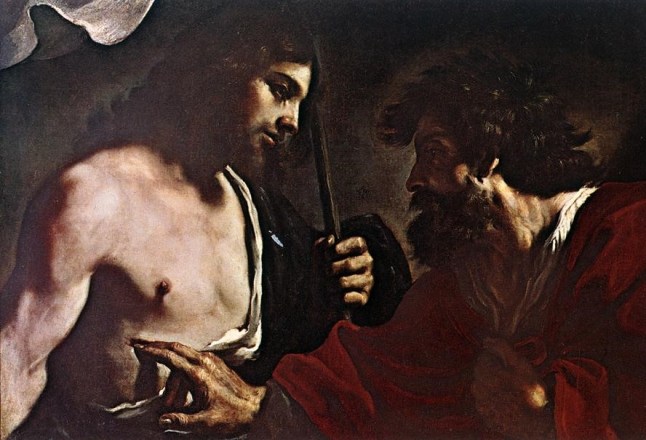
Doubting_Thomas_By_Guercino
Doubting Thomas by Guercino

On the evening of that first day of the week,
when the doors were locked, where the disciples were,
for fear of the Jews,
Jesus came and stood in their midst
and said to them, “Peace be with you.”
When he had said this, he showed them his hands and his side.
The disciples rejoiced when they saw the Lord.
Jesus said to them again, “Peace be with you.
As the Father has sent me, so I send you.”
And when he had said this, he breathed on them and said to them,
“Receive the Holy Spirit.
Whose sins you forgive are forgiven them,
and whose sins you retain are retained.”

Thomas, called Didymus, one of the Twelve,
was not with them when Jesus came.
So the other disciples said to him, “We have seen the Lord.”
But he said to them, “Unless I see the mark of the nails in his hands
and put my finger into the nailmarks
and put my hand into his side, I will not believe.”

Now a week later his disciples were again inside
and Thomas was with them.
Jesus came, although the doors were locked,
and stood in their midst and said, “Peace be with you.”
Then he said to Thomas, “Put your finger here and see my hands,
and bring your hand and put it into my side,
and do not be unbelieving, but believe.”
Thomas answered and said to him, “My Lord and my God!”
Jesus said to him, “Have you come to believe because you have seen me?
Blessed are those who have not seen and have believed.”

Now Jesus did many other signs in the presence of his disciples
that are not written in this book.
But these are written that you may come to believe
that Jesus is the Christ, the Son of God,
and that through this belief you may have life in his name.

-John 20:19-31

May’s Way…

It is interesting how people come into our lives who, at times, remind us of those who went before us. A number of years ago, I recall feeling amazed one day as I realized how many women named Mary had recently come into my life. It was as if a whole army of warm, welcoming, faith-filled Marys were suddenly in my life. They were from different walks of life, but all named Mary, and all of them brought a smile, wisdom and a sense of peace with them.

As I sat in awe with this realization, tears came to my eyes and I thought of my Auntie May, named Mary at birth. The first Mary I ever knew and loved with all of my heart. She was a fixture of love from as far back as I can remember…gentle and faith-filled.

Auntie May…I can still see her beautiful face and hear her wise, calming voice. “Hi doll,” together with an embrace that felt so warm and loving. I can still see her beautiful fingers. She would take my hand and hold it between hers as we exchanged greetings. I could feel the love and care in her hands, the same hands that made such wonderful food—kibbe, cinnamon twists, and so much more.

I remember sitting, as a young child and as I grew in age, listening to her and the other adults speak. She spoke with such clarity and with a passion for all that is right and just, for all that is good and true. She was so knowledgeable, but at the same time so down to earth. She was a very interesting person, not to mention her sense of humor; and though she was gentle, she could be stern, too. She knew when to speak softly and when to speak more firmly and with greater conviction. She had such an amazing spirit…striking…so nurturing and life giving.

Auntie May, and all the Marys who followed, reminding me of all that was and all that is. It is fascinating how God sends people into our lives to help us or challenge us, as well as for us to help…sometimes simply by being ourselves.

There is a saying that the best thing one can do is to be one’s true self. That is, as one becomes more and more authentic, she or he makes a difference simply by being. There is an energy or a vibe, when being true to oneself, that extends without effort as we go about day to day activities.

As layers are peeled back and one uncovers or moves closer to her or his true self, we are summoned or we gravitate toward our true calling or vocation(s) within our life and within each situation. Connected to that call, to the source of that call, and continuing to remain faithful to it, the energy or the spirit remains, flowing through and radiating out with benefit for all with whom we interact.

So, while my Auntie May, may have been different things to different people throughout her life, she was true to herself and the love, spirit and energy that she brought to each thing she did and each role she fulfilled, remained the same. What was even more special was that she realized it was not hers to keep and that it could only continue by her letting go and letting flow as she went about her way.

A_White_Chrysanthemum

“Be who God meant you to be and you will set the world on fire.” – St. Catherine of Siena


A Regular Joe…

Joseph, the carpenter, faithful servant of the Lord, took Mary into his home as his wife and named his son Jesus.

Joseph, faithful servant of the Lord, took Mary and Jesus and fled to Egypt in the middle of the night, remaining there until the appointed time then returning to Nazareth.

Joseph, faithful servant of the Lord, husband of Mary, the mother of God, earthly father of Jesus, the Son of God, lived his faith.

Joseph, faithful servant of the Lord, did all that was spoken to him by the Angel of God.

St. Joseph, the patron Saint of the Universal Church, unborn children, fathers, workers, travelers, immigrants, and a happy death. We do not know much about St. Joseph. Not knowing much though is intriguing, because Joseph could be any of us—a “regular Joe” capable through his faith and God’s grace of facing the challenges of his life and the times in which he lived.

Perhaps, the best place to start though is with what we do know about St. Joseph. We know that he was a carpenter (MT 13:54-55). However, according to scholars the Greek word “Tekton” would have been used to describe Joseph, meaning that he was a craftsman or contractor; someone very skilled at working with wood, stones, and metals. It is also likely that he traveled quite a bit to seek work.

We also know from Bible verses, that St. Joseph was a husband (the husband of Mary the Blessed Virgin) and he was the “foster” or earthly father of Jesus. These two pieces of information, along with the fact that he was a working class man not only make St. Joseph relatable, but they also suggest he was a person of great faith, courage and wisdom. Think about it…the husband of Mary, the mother of God, and the earthly father of Jesus, the son of God.

From the passages in the Bible, we can also see ways that Joseph’s life and his choices exemplify those of someone striving to be faithful to God. We know that he had dreams in which he was visited by an Angel of God telling him to not be afraid to marry Mary (that she had conceived by the Holy Spirit), a dream to flee to Egypt, and then to return from Egypt. We know that Joseph listened, trusted and did as the Angel of God instructed in each case – Joseph married Mary, named his son Jesus, fled to Egypt, and later returned to Nazareth in Galilee all upon the instruction of the Angel of the Lord in dreams.

We can also see wisdom in the spiritual work of mercy exhibited by Joseph in bearing patience against wrongdoing or perceived wrongdoing. Mary, his betrothed, is found to be pregnant, yet they had not had any relations yet. We can only imagine what Joseph’s first thoughts to this news were. I doubt anyone would have trouble understanding if he was livid and decided to leave Mary. Also in that day and time in history, it would have been well within societal expectations for Mary to be stoned to death. Yet, here we have Joseph, deciding to quietly divorce Mary, not wanting her to be harmed. Despite what must have seemed and felt like a “betrayal,” he saw it in his heart, to show mercy and compassion. Joseph’s response, even before a visitation from the Angel of God, is remarkable and seems one only possible by someone very prayerful and inspired by God.

It leaves one to wonder, how am I able to show mercy when I am wronged? How am I able to be patient and to persevere? How can I, how can we, use St. Joseph as a model?

In each of the situations described in Scripture, Joseph dies unto himself, sacrifices and cooperates with God’s will. He shows openness to and focus on God’s will at each point. He was able to survive and make it through difficult and challenging circumstances such as the journey to Bethlehem with an expecting Mary. The journey to Bethlehem would not have been an easy one. Then there is the impending birth of Jesus with nowhere to stay, the flight to Egypt, the journey back to Nazareth and beyond.

How can we have the faith and patience of Joseph? How can we, like Joseph, recognize and accept that things happen in God’s time, not according to our time, and to remember that God is faithful to those who are faithful to God? Do I remind myself of the ways that God has been faithful to and patient with me along my journey so far? Do I allow past experiences to help me to remain patient and faithful, and to continue to trust in God and in God’s timing?

Joseph wasn’t given explicit plans or an outline of all that would happen in the dreams he had. In the Gospel of Luke, chapter 2, we are told that Jesus is laid in a manger because there was no room for them in the inn. We are also told at the presentation of Jesus in the temple that Simeon tells Mary and Joseph that Jesus would be glory for God’s people and that Mary’s heart would be pierced. It then says, “The child’s father and mother were amazed at what was said about him.” Joseph and Mary didn’t know all that was going to happen.

When we look at Joseph, he was just given a basic directive in his dreams…take Mary as your wife…flee to Egypt. He listened and let God lead him. He had faith in God, faith that we can only assume grew with each event in his life and most especially through the birth of Jesus and all that transpired in the time after his birth.

Martin Luther King said, “Faith is taking the first step, even when you don’t see the whole staircase.” That’s the hard part, the “not knowing.” If we knew all the details of what was going to happen, it might be very easy to be patient, to let go of wrongdoings and to trust in God and in God’s plan.

Faith…trusting even when we cannot see the next step…trusting that it will be there when it is time to take that step. Waiting until it is there, taking direction from God and acting once the step appears and the way is made clear. St. Joseph, from what we know of him, did all of this.

It is more likely than not, especially at that time in history, as a father, Joseph not only provided for and protected his family, but also led his family in the observance of prayer and religious custom. We read in Scripture, “Each year his parents went to Jerusalem for the feast of Passover, and when he was twelve years old, they went up according to festival custom.” (Lk 2:41)

With what we know of Joseph, it is not a stretch to imagine him as a very prayerful person.

For Joseph, the beginning of the journey that would lead him to emerge fully into who God created him to be and to fulfill his part in God’s plan, started with a dream, or a desire, long before the first dream, he had and that we read about in the Bible. The journey started with him saying “Yes” to letting God lead him, and continuing to say “Yes”, letting God continue to lead him all along the way. How can I, how can we, do the same?
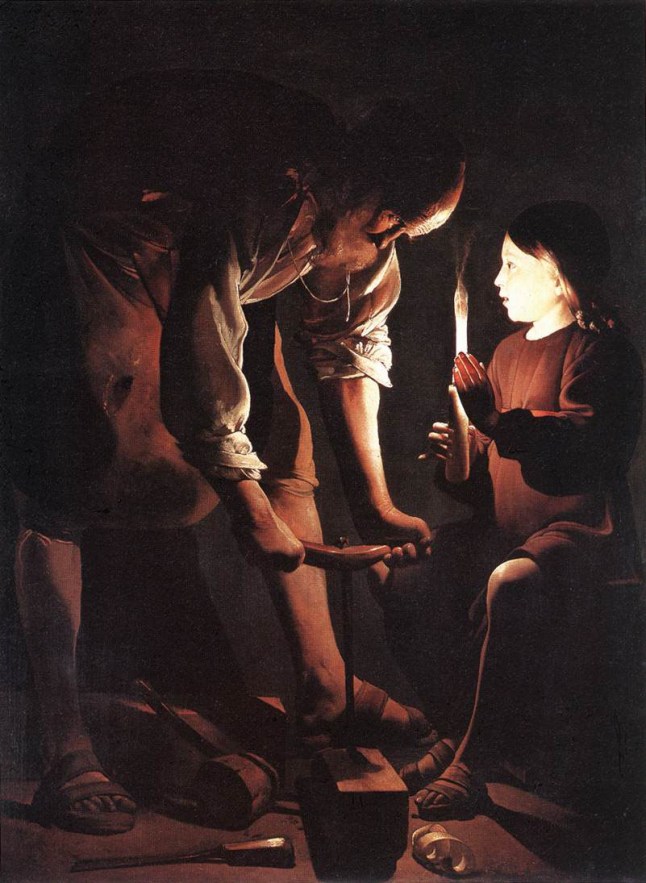
StJosephJoseph the Carpenter rendered by Georges de La Tour
Blossoming Day by Day…

“Where flowers bloom, so does hope” – Lady Bird Johnson

About a week ago, I received a gift of flowers—pink, red and white tulips. When I first opened the box in which they were delivered, the tulips were cold and the petals closed like a clenched fist, but still beautiful. After cutting the end of each stem at an angle, I placed the tulips in a glass vase with plant food and some water. I continued to add water as needed and in the warmth of my home, the petals loosened over the course of the week. Each flower transitioned from being fully closed to being in a state of full bloom; different then when they first arrived…even more beautiful.

Thinking back over the course of the past week, it strikes me that the tulips needed much more water in the first day or two than they did in the days beyond that. I remember at times looking at the flowers and the vase, and feeling surprised that more water was needed again. In fact, I think I added water 2-3 times in those first couple of days.

As I sit facing what are now fully opened tulips, I think about the work required to get to this point. I needed to continue to add water to the vase while the flowers needed to continue to take the water in. There was collaboration. Both things needed to occur in order for the tulips to fully open.

Overall, one might say that the environment needed to be conducive to growth. That is, there needed to be give and take, and room for change…inside (the vase) as well as outside. It is not really all that much different from human relationships. When the environment is conducive, it is much easier to work together, to give and take, and to allow room for change in a manner in which all may flourish.

TulipsFeb

Between the Lines…

BetweenLines

During the winter months, some animals hibernate, some migrate, and others adapt. All animals, whether of the hibernating, migrating or adapting kind, need to prepare for the change of seasons. What remains constant year-round, though, is the need for energy. Even the hibernating animals need energy throughout their deep sleep.

On what is a very cold day, on which a deep sleep can be very tempting, as I catch up with news from throughout the week, I find myself pondering the things that are written (and spoken). From where do these things come? What is the source?

It is written… (Luke 4).

As I reflect on the happenings of the week, I wonder, “Written by whom?” and “For what purpose?” Not only that but, “What led to ‘it’ being written?” There are so many questions one could ask and so many possible ways of answering them, but at the end of the day, the most important questions seem to be, “Who is being served by the questions? Who is being served by the answers? How is that which is written being used?”

Filled with the Holy Spirit, Jesus returned from the Jordan
and was led by the Spirit into the desert for forty days,
to be tempted by the devil.
He ate nothing during those days,
and when they were over he was hungry.
The devil said to him,
“If you are the Son of God, command this stone to become bread.”
Jesus answered him,
“It is written, One does not live on bread alone.
Then he took him up and showed him
all the kingdoms of the world in a single instant.
The devil said to him,
“I shall give to you all this power and glory;
for it has been handed over to me,
and I may give it to whomever I wish.
All this will be yours, if you worship me.”
Jesus said to him in reply,
“It is written: You shall worship the Lord, your God,
and him alone shall you serve.

Then he led him to Jerusalem,
made him stand on the parapet of the temple, and said to him,
“If you are the Son of God,
throw yourself down from here, for it is written:
He will command his angels concerning you, to guard you,
and:
With their hands they will support you,
lest you dash your foot against a stone.

Jesus said to him in reply,
“It also says,
You shall not put the Lord, your God, to the test.
When the devil had finished every temptation,
he departed from him for a time. – Luke 4:1-13

From Shaking Dust to Slaying Giants…

Whether one uses the verbiage of today, “Shake it off!”, or that of ancient times, “Shake the dust from your feet”, there are many ways to accomplish the task of not allowing people or situations to drag me down or to take me away from being or striving to be the best I can be (that is, my authentic self).

Jesus’ words to the disciples: “And as for those who do not welcome you, when you leave that town, shake the dust from your feet in testimony against them.”(Luke 9:5)

As I sit with the thought of shaking the dust, I wonder about the situations, where it seems like the dust cannot be shaken off. What about the situations where the dust is more like mud stuck in and around one’s sandals? What is to happen then? Does the “shake” need to become a “stomp” or some other more forceful action? Do the sandals need to be soaked in soapy water until the mud softens and can be washed away? Or, do they need to be removed and replaced with new ones?

Ultimately, any of the above, could be the answer. There could also be other possibilities. It all depends on whom I am and what I am being called to by God in the situation that I find myself.

Many people are familiar with the story of David and Goliath in the Bible, but perhaps not how he ended up standing in front of Goliath. David is the youngest of 8 sons. Between the ages of 10 and 13 he is anointed by the prophet Samuel.

“The LORD said, ‘There–anoint him, for this is he!’ Then Samuel, with the horn of oil in hand, anointed him in the midst of his brothers; and from that day on, the Spirit of the LORD rushed upon David.” – 1 Samuel 16:13

After the anointing and as a young man, David is summoned to Saul (the King) as a musician.

“Saul then told his servants, ‘Find me a good harpist and bring him to me.’ One of the servants spoke up: ‘I have observed that a son of Jesse of Bethlehem is a skillful harpist. He is also a brave warrior, an able speaker, and a handsome young man. The LORD is certainly with him.'” – 1 Samuel 16:17-18

Saul is pleased with David and makes him an armor-bearer. During this time, the Philistines and Israelites go to battle against each other. Goliath is a mammoth Philistine warrior. David, upon his father’s request, is bringing food to his brothers who are soldiers in the Israelite’s army camp. While there, he asks a question about the reward for defeating Goliath and wonders aloud who the giant is that he is against “the armies of the living God.” (1 Sam 17:26). David’s questions and the conversation that results get back to Saul who requests that David be brought to him.

David asks Saul to let him fight Goliath. Saul tells him, “You cannot go up against this Philistine and fight with him, for you are only a youth, while he has been a warrior from his youth.” (v33). David tells Saul how he has fought off lions and bears while tending his father’s sheep and that he will do the same to Goliath “because he has insulted the armies of the living God.” (v36) Then he says, “The same LORD who delivered me from the claws of the lion and the bear will deliver me from the hand of this Philistine.” (v37) Saul agrees and David battles Goliath.

While the battle and victory by David seem swift, it is not without what we might call “trash talk” by the giant who scoffs at the youth and size of David and his weapons (a slingshot and 5 stones). David stays his ground though and responds, loud and clear to Goliath, “For the battle is the LORD’s and the LORD shall deliver you into our hands.” (v47) … that is exactly what happens.

To follow the story of David from his birth order and anointing to his battle with Goliath and beyond, it seems clear that “the Spirit of the Lord rushed upon David” and that David let the Spirit of the Lord lead him. He did so no matter what giant he faced…in doing what seemed impossible (defeating Goliath) and in acknowledging his wrongdoing and turning back to the Lord after succumbing to his weaknesses (in 2 Sam 11-12). In the end, there was no dust or mud on his sandals.

“For the battle is the LORD’s.” When I let it stay that way, instead of making it my own, I know exactly when and how to shake, stomp, soak and wash, or remove and replace my sandals…there is no dust or mud on them.

“The Spirit of the Lord is upon me” (Is 61:1, Lk 4:18), upon us, how do we embrace It?

IMG_1644