Waterloo…

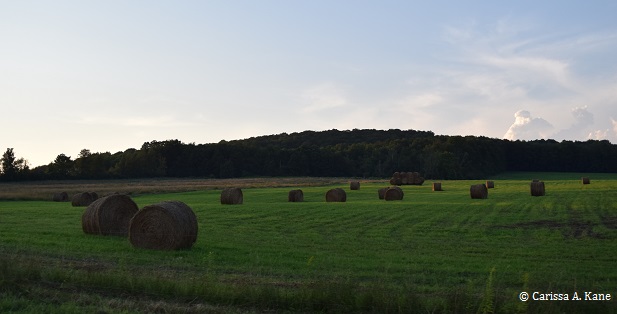
Surrender, keep doing it, I thought as I heard the beginning lyrics to the song. On the 18th of June, in 1815, Napoleon surrendered at the Battle of Waterloo, ending the 20 year span of Napoleonic Wars. Just five months earlier, on January 18th, the War of 1812 ended as the Battle of New Orleans came to a close, also with surrender by another general, from another country.

In all the years prior to 1815, and all those since, many a battle has been fought throughout the world. Sometimes they have been to make right, wrongs, and oftentimes they have been to take or keep hold of power, land, and possessions. Throughout time, who is “in charge” and of what they are in charge changes. Also over time, as things change, we may change, and our perceptions of events tend to shift too.

Just as battles have raged on, around the world throughout the centuries, they also occur within our souls. There is so much that perhaps we see only in hindsight. Why is that? Or, even better, what causes that?

Possessions, of one kind or another, clearly seem to take hold, to strike up life, and attempt to take root inside us, creating a fog along the way. However much that might seem to be part of human nature though, it does not have to be the rule. How so?

Seek to uncover, or if you have already discovered it, each and every day, seek to cling to and keep embracing, the truth of who you are, the ways in which you are blessed, and what your universal purpose is. That is, strive to be one with the mission and version of you that is simpatico with the good of all. Live from that place, and you will be set free of all that might otherwise possess you, and cull you into seeking possessions and territories.

And when you slip, or fall, because we all do, go back to that place, and “waterloo”.

Waterloo

The Great Wide Open…

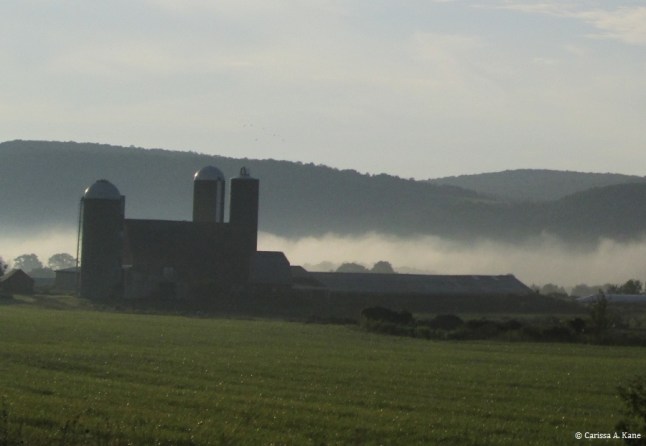
In passing by and at times being surrounded by farmland over the past few months, the beauty and vastness of the countryside has been striking. Against the occasional backdrop of mountains and the many fields of crops and shades of green, there has been much to take in and a great sense of freedom and openness to be felt. There have also been the more confining structures one would expect to see, such as barns, fences and silos. These structures serve to protect what is within and in doing so they create boundaries and barriers. Of them, perhaps the silo, into which one cannot readily see, is the most compelling.

FarmSilos

A farm silo functions as a holding place for storing grains. It is a strong, tall, rounded container with generally no openings for the elements, including light, to penetrate. Its purpose is to prevent the grain inside from becoming compromised or spoiled. A silo does a great job of protecting grain and is both necessary and good. However, personally or in an organization… figuratively, a silo is bad news. It seeks to control the environment in ways that both compromise and spoil forward progress. It also holds back the spirit of integrity and ingenuity necessary to flourish and genuinely thrive.

As we go through life, we all come across situations, organizations and/or people through whom we experience a silo effect—having helpful information withheld, being undermined, being shut out, pushed away or alienated. Often we can easily point to or name such cases. However, it can be more difficult to see or name the instances where we may be helping to foster that experience or effect… allowing it to continue… perhaps even creating or contributing to the creation of even more silos.

The way of the world puts emphasis on acquiring and storing up things, status, reputation, chips on one’s shoulders, etc. Ultimately, they can, and often do, bring us down or cause us to be less than what we truly are. It can be difficult to recognize, yet alone to resist being swept up or carried away by this mentality, or even fighting against it. It can keep us from doing and from being… from living out our deepest, purest desires in a way that is encouraging and uplifting to others as well as ourselves. We can be led astray, fooled, or lulled over time by that which masquerades around providing a false sense of reality as well as security. We can be lured and led away from being a place of growth and harvest to a place of storage.

“You are confined only by the walls you build yourself.” – Andrew Murphy

From time to time, it is important to pause, to let the Light not only in but also to fully penetrate one’s soul, and to ask, am I a vessel or have I become a silo?

StoreHouses

Along the Path…

Stepping out for a walk, not too far along the path, there it was, a most beautiful tree. It had a strong, healthy trunk and rather smooth bark, a bounty of branches and countless leaves of green. I had noticed it previously, but today, with the light from the morning sun it captured my attention more fully, beckoning for me to come closer. In doing so, I found myself under a canopy provided by the branches and leaves. Looking up, I was filled with awe.

At the base there appeared to be two trunks that, not all that high off the ground, had changed course and melded into one, continuing to grow strong for many, many more feet toward the sky. From the trunk, it was striking to see the branches of varying size growing out in many different directions and all holding leaves of green – full of character and life. And though each branch and leaf has its own peculiarities, essentially every part of the tree shared the same essence.

Marveling once again and breathing in, I think, “Freedom.” This is what freedom is. It is to stay connected, drawing strength and sustenance, inspiration and wisdom… to hold fast and firm to authenticity in environments of all kinds. Truly, freedom is to choose and walk the path, ever mindful and ever faithful to the Source.

But you are “a chosen race, a royal priesthood, a holy nation, a people of his own, so that you may announce the praises” of him who called you out of darkness into his wonderful light. – 1 Peter 2:9

BeechnutTree

Be the Church…

A lamp to my feet is your word, a light to my path. – Psalm 119:105

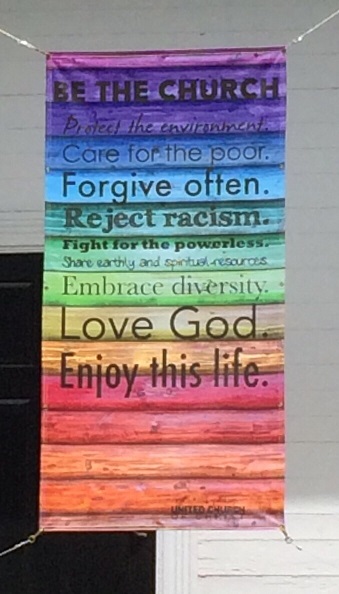
Venturing out on a beautiful day, I came across a banner with writing and a broad spectrum of colors in the background. Initially it was the array of color, against a mostly white backdrop, that caught my eye. However, upon further examination, what seemed to be horizontal bands of color, now appeared to be pieces of wood, shaped and stacked as if they were part of a log cabin.

The colors were beautiful, but underneath them, each piece…each log still showed signs of the grain that is part, and parcel, of wood. This background image, along with the words written across some of the logs, gave it character and made it compelling. Perhaps the most thought provoking part of the banner was the first line of words, “BE THE CHURCH.” I cannot help but wonder, what church? Is there a church that offers the experience of the words that followed (protect the environment …fight for the powerless …embrace diversity, etc.)?

“BE THE CHURCH.” Next I think, who? Who is to be the church? Is it the priests or ministers and staff, or the people who attend? Is it a combination? Is it for all to partake in?

Then, a childhood rhyme, one accompanied by hand and finger movement, comes to me. “Here is the church. / Here is the steeple. / Open the door, and see all the people.” It used to seem true. Only, I had just been to church and I did not see “all” the people.

“BE THE CHURCH.” Upon further reflection, I am sure many people already are the church, even if they are not “in” the church. In fact, I know many who take being the church to heart and strive to do so in their daily lives. Perhaps those who have left the building, do not enter because it lacks the character, diversity and integrity… because it is no longer (or maybe it never was) a place where they can truly “BE THE CHURCH.” Perhaps it is because so often, those who “run” the church forget about the people, and more importantly, lose sight of the purpose. Then again, that would be the people.

“BE THE CHURCH.” Be who God created you to be, and wherever you are, be faithful to God.

To truly serve and honor God is to serve and honor God’s people and all creation. We must remember that God’s people are ALL people.

BeTheChurchB

Legacy…

While oftentimes society can see “legacy” in terms of what meets the eye, and what can be measured, legacy is much deeper than that. William Shakespeare wrote, “No legacy is so rich as honesty,” in his play All’s Well That Ends Well (Act 3, Scene 5). Catherine of Siena wrote, “For people become like what they love,” in a portion of a letter (Letter T29) to Regina della Scala, a noblewoman. When fiction gives way to truth, and one scratches beyond the surface reaching the heart of the matter, therein lies what will be left behind and passed along, whether individually or collectively. What stands the test of time, whether for good or bad, is legacy.

Often a question or thought like, “What is this about?” or “There has to be something more than this,” leads one to pause and take notice. In spiritual direction, we strive to discern and live out choices that uncover and align with one’s deepest, God-given, desires. In the process, whether or not one is aware, the force within that often works to serve one’s own legacy becomes tamed, almost naturally. Over time, when one works consistently, in union with God, at being faithful and honest, persevering and following through, trusting the call to rise above and move beyond, though there may be moments of fear or shadows of doubt, the transformation occurs. When it does, legacy is turned toward serving that which is greater, the legacy that is God.

It does not stop there though. Perhaps that is the true beauty of legacy. In relationship with God, while the promise remains the same, we are called to be not only faithful, but also ever-growing and ever-changing. We are called to evolve. We are challenged to take stock of what is around us, and what is within us, as we go through life and each situation we encounter or interaction we have.

The lesser legacy (personal legacy) secretly seeks to keep us where we are spiritually. It seeks to keep one’s sight on the best way to reach one’s own personal goals and ultimately to serve oneself. While the legacy that is God always seeks the greater good. It reveals the way to move beyond and rise above that which would look to undermine, drive a wedge between us—or bring us down—individually or collectively.

Since the beginning of time, a divine desire for unity and wholeness has existed within and among all creation. Throughout time, many a soul has searched to discover, to become one with, and to live from that place of legacy. The contemplative, spiritual life is all about legacy. It is a shared legacy that calls us to remember, to see and to be the light. This is what truly makes us one with God and each other.

It can be good to ask oneself, from time to time, “How is legacy operating in my life?”

SunsetLakeMidday

SDIBlog

Here we go again…

The current state of affairs throughout the world, the vast unrest, seems so unreal. Have we really fallen this far? One can only imagine the reaction of all those who have come before us.

What is it that has led to what seems like an inability to be objective? How did behavior that wreaks of an “everyone out for herself or himself” attitude become so widely acceptable and celebrated? While there are so many things that one could debate, it seems reasonable to say that in the quest to win or be the best, integrity, fair-mindedness, and dignity have been obliterated.

Amongst all the hullabaloo and distractions, is there any substance? It seems that so often the meaningful is hidden, squashed or perverted to the point of being hardly recognizable as what it once was promoted as or intended to be. From where does this confusion come?

It leads one to think. What’s the point of all the non-sense going on in the world today? I guess that depends on what one’s goal is.

As unreal as the happenings in the world seem to be, they are not really all that new. We have been at the same, or very similar, crossroads many times before and have risen to the challenge. People of all different races, religions and cultures have persevered through faith, learning and re-learning to work together, from age to age since the beginning of time. We are no different. Believe…

“God of life, you believe in us, you enrich us,
you entrust us with the freedom to choose life…”
– Joyce Rupp, OSM

herewegoagain

Throwing Stones…

Stones

“Let the one among you who is without sin,
be the first to throw a stone at her.” – John 8:7

In the world in which we live, the above Bible verse has come to mean, to many people, it is not Christ-like to criticize wrongdoing. Is that interpretation accurate though? Is that really how Christ lived and taught? Is it true?

It is interesting how the truth is often twisted and how, throughout history, the truth, and speakers of the truth, have often been frowned upon. In the Gospel passage of the woman caught in adultery (John 8:1-11), Jesus, champion of truth, honesty and integrity, is put in a position where the authorities (the scribes and Pharisees) are looking for a reason to “take him down” so to speak. They see Jesus as a threat. If the truth becomes known…if their manipulation and ways of holding down and misleading the faithful become known, the faithful will no longer support them and their authority will fade away. This possibility makes them focus even more on trying to suppress or manipulate the truth. They are not open to anything other than efforts to hold onto their kingdom, no matter how that might affect the faithful.

While the scribes and Pharisees are trying to trap Jesus into going against Mosaic law, so that they can arrest him and eventually do away with him, Jesus turns the tables on them. Jesus knows that their motivation is self-serving; they are not concerned about the spiritual well-being of the woman they have brought before Jesus. They are using her, and Mosaic law, to try to get what they want. They are not pointing to the law for the purpose of which the law was made and certainly not for the well-being of the woman or the larger community.

So how does Jesus respond? He calls the scribes and Pharisees attention to the fact that they are not without sin; their hearts are not pure, and they slither away. The woman is left standing alone with Jesus.

While Jesus does not condemn the woman, he does hold her accountable and tells her not to sin any more.

Oftentimes, we can confuse holding someone accountable or to the truth as being judgmental. However, we need to be able to judge situations and, at times, we are called to speak the truth, even if that means it may be in conflict with another or requires holding another accountable.

In a scripture passage prior to the passage about the woman caught in adultery, Jesus says, “Whoever speaks on his own seeks his own glory, but whoever seeks the glory of the one who sent him is truthful, and there is no wrong in him. Did not Moses give you the law? Yet none of you keeps the law. Why are you trying to kill me?” The crowd answered, “You are possessed! Who is trying to kill you?” Jesus answered and said to them, “I performed one work and all of you are amazed because of it. Moses gave you circumcision—not that it came from Moses but rather from the patriarchs—and you circumcise a man on the Sabbath. If a man can receive circumcision on a Sabbath so that the law of Moses may not be broken, are you angry with me because I made a whole person well on a Sabbath? Stop judging by appearances, but judge justly.” (John 7:18-24)

If we come back to the woman caught in adultery, we see that Jesus doesn’t condemn her to death, but he does make a judgment. He tells her to sin no more. He tells her to stop.

When we look at our own lives, like with everything else, we need to follow Jesus’ example. We shouldn’t throw stones, but we should judge justly. When we see people doing wrong, we are called to speak the truth and to stand up for what is just. That is a big part of carrying one’s own cross…of being Christian.


Jesus went to the Mount of Olives.
But early in the morning he arrived again in the temple area,
and all the people started coming to him,
and he sat down and taught them.
Then the scribes and the Pharisees brought a woman
who had been caught in adultery
and made her stand in the middle.
They said to him,
“Teacher, this woman was caught
in the very act of committing adultery.
Now in the law, Moses commanded us to stone such women.
So what do you say?”
They said this to test him,
so that they could have some charge to bring against him.
Jesus bent down and began to write on the ground with his finger.
But when they continued asking him,
he straightened up and said to them,
“Let the one among you who is without sin
be the first to throw a stone at her.”
Again he bent down and wrote on the ground.
And in response, they went away one by one,
beginning with the elders.
So he was left alone with the woman before him.
Then Jesus straightened up and said to her,
“Woman, where are they?
Has no one condemned you?”
She replied, “No one, sir.”
Then Jesus said, “Neither do I condemn you.
Go, and from now on do not sin anymore.” – John 8:1-11


The Choice Is Ours…

ChoiceIsOurs

From the snow covered branches to the rumble of snowplows, the hum of snow blowers and the sound of shovels against the ground. From the people driving or operating machines or shoveling to those simply playing in the winter wonderland. From those readying a place for loved ones returning from outdoors to those who are simply gazing in awe of the beauty that abounds…and, to all those in between, Alleluia!

Be it rain or snow or a storm of another kind, there is something so pure…so quiet…after a storm. There is something so precious in the time that follows the pouring down…and sometimes out and all around. Looking out the window after a recent snowstorm, I am struck by the way that everything is right in front of us, and the choice is ours.

While the storm may have caused almost all activity to come to a halt, it also washes clean (or white) for at least a little while. Then, it is time to clean up. Moved to work together, we help each other to restore the roads and the walkways so that once again they are open and safe for travel to and from.

Again, it seems that everything is right in front of us and the choice is ours.

A Boiled Seed Cannot Sprout – Author Unknown

An aging king woke up one day acutely aware of his own mortality.  He had no son, and his was a culture where only a male heir could take his place.

He decided that he would adopt a son who then could take his place, but he insisted that such an adopted son must be extraordinary in every sense of the word.  He considered each of his advisors and relatives in turn, but found them wanting.

So he launched a competition in his kingdom, open to all boys, no matter what their background. Ten boys made it to the very top. There was little to separate these boys in terms of intelligence and physical attributes and capabilities.

The king said to them, ‘I have one last test and whoever comes top will become my adopted son and heir to my throne.’ Then he said, ‘This kingdom depends solely on agriculture, so the king must know how to cultivate plants.  Here are seven seeds of grain for each of you. Take them home.  Plant and nurture them for six weeks. At the end of six weeks, we shall see who has done the best job of cultivating the grain.  That person will be my son and my heir. ‘

The boys took their seeds and hurried home.  Each got a pot, prepared soil, and sowed his seeds. There was much excitement in the kingdom as the people waited to see who was destined to be their next king.

In one home, the boy and his parents were almost heartbroken when the days stretched into weeks and the seeds failed to sprout. The boy did not know what had gone wrong. He had selected the soil carefully, he had applied the right quantity and type of fertilizer, he had been very dutiful in watering it at the right intervals, he had even prayed over it day and night and yet his seeds had turned out to be unproductive.

Some of his friends advised him to go and buy seed from the market and plant that. ‘After all,’ they said, ‘how can anyone tell seeds of grain one from another?’

But his parents who had always taught him the value of integrity reminded him that if the king wanted them to plant just any grain, he would have asked them to go for their own seed. ‘If you take anything different from what the king gave you that would be dishonest. Maybe we are not destined for the throne.  If so, let it be, but don’t be found to have deceived the king,’ they told him.

The appointed day came and the boys returned to the palace each of them proudly exhibiting a pot of healthy seedlings. It was obvious that the other nine boys had had great success with their seeds. The king began making his way down the line of eager boys and asked each of them, ‘Is this what came out of the seeds I gave you?’ And each boy responded, ‘Yes, your majesty.’ And the king would nod and move down the line.

The king finally got to the last boy in the line-up. The boy was shaking. He feared that the king might have him thrown into prison for wasting his seeds. ‘What did you do with the seeds I gave you?’ the king asked.

‘I planted them and cared for them diligently, Your Majesty, but alas they failed to sprout,’ the boy said.  He hung his head in shame, and the crowd jeered.

But the king raised his hands and signaled for silence. Then he said, ‘My people behold your next king.’

The people were confused. ‘Why that one?’ many asked.’ How can he be the right choice?’

The king took his place on his throne with the boy by his side and said, ‘I gave these boys boiled seeds. This test was not for cultivating grain.  It was a test of character; a test of integrity. It was the ultimate test.  If a king must have one quality, it must be that he should be above dishonesty. Only this boy passed the test. A boiled seed cannot sprout.’