We are all teachers…

There is a saying that people learn what they live…what they experience. As I have gone through life there are many people who have had an impact on me through both their words and actions. With the month of August mid-way through and faith formation registrations in progress, I think of my first Sunday school teacher. I recall the love and care with which she taught and interacted with me and my fellow kindergarten classmates. I can still hear the sound of her voice as she taught and as she sang to us, and with us, “Yes, Jesus loves me. Yes, Jesus loves me…”

Years ago while I was driving, out of the blue, that long forgotten song came into my mind; a much needed reminder at the time. Only as I reminisced about that time in my life, did I realize how deeply touched I was by Mrs. Lahage’s words and actions, and the way they reflected her faith. Most of all, I remember her gentle, loving presence and the generosity with which she shared her faith with us; a faith so genuine and far greater than any obstacle that might occur.

As I think about how much I learned from that experience, I feel grateful to God for the gift that Mrs. Lahage was. I also feel thankful for the grace that has enabled something that happened so long ago to become a source of strength and inspiration today. There really is an appointed time and place for everything.

Continuing to reflect, there are many others who have made an impression on me and from whom I have learned. There are some who have made a more profound impact than others and some in more positive ways than others. There are also some who have done so perhaps knowingly and others not. Similarly, I also have impacted others along my journey. There are some of which I am aware and others of which I am sure that I am not.

In a sense we are all teachers in one way or another. Sometimes it is through a specific role and sometimes it is unknowingly as our words and actions may simply be observed by another. Rare, if it all, is the person whose life does not touch that of others. And, more often than not, it is the spirit in which we live and share with others rather than what we know or exactly how we do what we do that makes a difference as we make our way. Then, again, isn’t that what being a disciple is all about?

“Jesus passed through towns and villages, teaching as he went and making his way to Jerusalem.” – Luke 13:22

When you see a chance…

Over the weekend, I had the opportunity to visit with a sibling who resides out of state, but who was unexpectedly going to be in town for part of the day. The visit was on very short notice and was going to be very short in length too. However, it was wonderful to see and experience how in those few hours, there was so much quality. We had such an enjoyable visit. What a blessing.

When our time together was over, my sibling and her family headed back from where they came. We all felt so grateful for the time we had. It was amazing to me that such a brief time together could kindle such feelings of love, warmth and gratitude, strengthening the bond between us.

So often, brief and/or simple encounters with others can have such a profound effect. Oftentimes, though, it can be tempting to think that a small amount of time makes no difference or is not worth the effort. However, nothing could be further from the truth. In matters of life and death minutes…seconds or less, can be crucial, to the overall outcome.

I wonder, what might the world look like if time and use of time, no matter how small or big, was considered more in terms of life and death? While this may seem radical to some, and obvious to others, it is in essence what my faith calls me to…hoping for me to do.

As I journey, I am called to choose between life and death along the way. I (we) are called to be aware and to move toward the opportunities to be with, and to be there for others. Maybe more often than not, those opportunities come in small ways requiring a short amount of time, but in the middle, or in the heat of, our hectic lives. How do we recognize them? How do we allow ourselves to let go and to be guided to the opportunities before us?

PurpleNiagara

How Now?

Sometime ago I came across a poem titled “Wage Peace,” by Judyth Hill*. I found the title so striking as I had never seen the words “wage” and “peace” side-by-side before. How fitting. Given the current state of civilization, it seems to be exactly what we need. Instead of each person’s outrage, disbelief or heartache turning to anger, a sense of helplessness, hopelessness, or even worse, indifference, imagine what could be if it was turned into a passion for peace….a drive toward love.

While it may seem impossible or too big for individuals to make a difference in such a way, it is not, nor has it ever been. Throughout time, many an obstacle has been overcome and humankind been made better off through movements begun by an individual(s). In much the same way, movements that have led to our falling down…to our detriment, have been started. As always, the choice of which movement is ours, but indifference is not.

Movements fueled by hate and intolerance at the center can only continue if we allow them to be bigger and brighter than our passion for peace, love, and all that is truly good. There is no limit to the power of God. We have to believe in order to retrieve the passion to withstand and rise above the chaos and confusion…to stand up for what is right and just…to restore unity in our homes, in our communities, in our country, and in our world.

We are One. We need to take that to heart, to own it and promote it, before we are none.

How? Know yourself. Dive deep down into your core. Rediscover who you are, who you were created to be. Be rooted in that place, and be sincere to your true self in all your endeavors. By doing so, no matter what comes your way, you will be saved as will the world around you, through you. For God is faithful to those who are faithful to God.

LilyPadFlower2

“Believe! Everything is possible to one who has faith.” – Jesus Christ

“Peace comes from within. Do not seek it without.” – Buddha

“Just as ripples spread out when a single pebble is dropped into water, the actions of individuals can have far-reaching effects.” – Dalai Lama

“You are not a drop in the ocean. You are the entire ocean in a drop.” – Rumi

“There is no way to peace. Peace is the way.” – Mahatma Ghandi

“How wonderful is it that nobody need wait a single moment
before starting to improve the world.” – Anne Frank

“To put the world right in order, we must first put the nation in order; To put the nation in order, we must first put the family in order; To put the family in order, we must first cultivate our personal life; We must first set our hearts right.” – Confucius

“I alone cannot change the world, but I can cast a stone across the water
to create many ripples.” – Blessed Mother Teresa.

“You can’t cross the sea merely by standing and staring at the water.” – Rabindranath Tagore

“We cannot live in a world that is not our own, in a world that is interpreted for us by others. An interpreted world is not a home. Part of the terror is to take back our own listening, to use our own voice, to see our own light.” – Hildegard of Bingen

“There is a candle in your heart, ready to be kindled.” – Rumi

“So I say to you, ‘Ask and it will be given to you; search, and you will find;
knock, and the door will be opened for you.’” – Jesus Christ


*http://voiceseducation.org/content/38-judyth-hill-wage-peace


We Have Each Other…

About 15 years ago, my husband and I attended a party celebrating the anniversary of one of our relatives. It was a joyous occasion for a person who has been fulfilling her vocation with great devotion and passion, and most often with a smile on her face. At the end of our time together and as we were exchanging hugs and “so longs,” she said to us, “thank you for coming, for being part of this occasion. Did you get your gift?” We had not, but almost as soon as our faces shifted to what must have been quizzical expressions, she was off to get the gift, and before we knew it, we had it. The gift, a framed saying – “Joy shared is joy multiplied” – so appropriate for the person who gave it and the occasion on which it was given.

JoyShared

Over the past week, this saying and different variations of it have come to mind so frequently, across a number of settings. As I have stayed with it, I am reminded how through the years, in sharing, most definitely, joy has been multiplied, grief has been made bearable, and faith has been strengthened. As I look around, it seems we have everything we need…we have each other.

You Raise Me Up by Josh Groban 

When I am down and, oh, my soul, so weary;
When troubles come and my heart burdened be;
Then I am still and wait here in the silence,
Until you come and sit awhile with me.

You raise me up, so I can stand on mountains;
You raise me up to walk on stormy seas;
I am strong when I am on your shoulders;
You raise me up to more than I can be.


Feed…Tend…Feed…

It is interesting to look at what goes on around us today through the lens of what transpired long ago. In one of his appearances after the Resurrection, the third time he appears to his disciples, Jesus has an interaction with Peter that affectively provides a bridge for Peter from his 3 denials of knowing Jesus to him fully embracing his role as a leader. (John 21:1-19)

Jesus says to Peter three times, “Do you love me?” When Peter answers each time in the affirmative, Jesus responds, “Feed my lambs,” “Tend my sheep,” and “Feed my sheep” respectively.

Jesus says, “Feed my lambs,” not “count them.”

Everywhere we go, we are numbered. We are given an identification number at birth or at a young age, a driver’s license number, a student ID number, a medical record number, etc. Numbers are all around us. How much, though, do numbers interfere with our spiritual life? There is another scripture passage where Jesus says, “where two or three are gathered in my name, there I am in the midst of them (Matthew 18:20). It seems, as with most matters, quality or substance (“gathered in my name”) outweighs quantity. We can all probably point to an experience(s) in our lives where our heart was moved and our attention captured by what was going on more than the dollars or the ticker counts. We live in a world where it can be tempting, a lot of the time, to focus on numbers or quantity over substance. Yet, time and time again, we can see examples throughout history that show us that numbers without substance (authentic, engaging and varied), usually become a passing fad rather than everlasting. Jesus says, “Feed my lambs,” not “count them.”

Jesus says, “Tend my sheep,” not “corral them.”

How do I take care of that which I have been given? According to Merriam-Webster, the definition of the word “tend” is “to move, direct, or develop one’s course in a particular direction.” If we are to take the example of Jesus and the call to discipleship, to tend His sheep would be to move, lead, or develop them in the direction of God. This is not the same thing as “corralling” (to gather into a pen or enclosure for confinement or capturing). We are not called to all line-up, speak the same, look the same, act the same, and to be the same. To “tend” is to nurture and to allow room to grow into one’s true self. Tending can be accomplished in countless ways. I have only to look at my experiences tending and being tended to, to see that there is more than one way, time or place to “tend.” Jesus says, “Tend my sheep,” not “corral them.”

Jesus says, “Feed my sheep,” not “shear them.”

Jesus uses the word “feed” again, emphasizing the importance of “feeding” which is an act of providing…providing for the benefit, development, sustenance, and well-being of. There are many sheep in the fold and Jesus instructs Peter, a second time, to provide for them…not to take from them. As the shepherd feeds the sheep, guides them, and protects them, the sheep grow strong and healthy. Their wool grows thick and is plentiful. If the shepherd continually shears the sheep, neglecting to properly feed and tend them as well, the wool becomes thinner and thinner, until it is gone. Jesus says, “Feed my sheep,” not “shear them.”

LakeMassapoag2

“At the end of life we will not be judged by how many diplomas we have received, how much money we have made, how many great things we have done. We will be judged by “I was hungry, and you gave me something to eat, I was naked and you clothed me. I was homeless, and you took me in.” ― Mother Teresa

Without doubt, does seeing really lead to believing?

“I won’t believe it until I see it.” While society has taken the disciple Thomas and uses him as an example of what not to be like. One has to stop and think about the fact that the scripture passage in which Thomas says, “Unless I see the mark of the nails in his hands and put my finger into the nailmarks and put my hand into his side, I will not believe.” reveals so much more than “don’t be a doubting Thomas.”

The disciples are locked away in the upper room, but Thomas isn’t with them when Jesus appears. This suggests that Thomas had to have some level of courage and faith to have left the safety of the upper room where they had all been hiding out of fear.

Also, given all of the circumstances, it seems reasonable that Thomas, or anyone in his shoes, would question or have a hard time believing that Jesus appeared. Scripture states that Jesus showed his hands and his side to the disciples who were there in the upper room. This is curious. The other disciples had the benefit of not only seeing Jesus, but also seeing proof that it was really Jesus. Thomas did not have either. Jesus showed the disciples his hands and his side without them asking for proof. In essence, they are no different than Thomas, they did not believe without seeing either.

I cannot help but wonder if this passage would even be in the Bible if Thomas was not honest about his doubt, and instead responded, “How wonderful!” when the disciples told him that Jesus appeared to them. Thomas’ honesty is striking. He did not hide his doubt, but instead he was truthful, he made himself vulnerable, and gave voice to it.

As a result, look at what happens. Jesus appears again, a week later, to the disciples, including Thomas. While Jesus speaks about believing without seeing, He is not mad at Thomas and doesn’t kick him out of the “posse” for his doubt. Instead, Jesus meets Thomas where he is and gives him what he needs to believe and to trust. Jesus reveals the truth directly to him. Had Thomas denied or hidden his doubt…had he not given voice to it, the outcome would have been much different. Thomas would not have shared the experience of the Risen Lord in the upper room.

So, does seeing really lead to believing? No, but experience does.

“The key to wisdom is this – constant and frequent questioning, for by doubting we are led to question and by questioning we arrive at the truth.” – Peter Abelard, philosopher and theologian

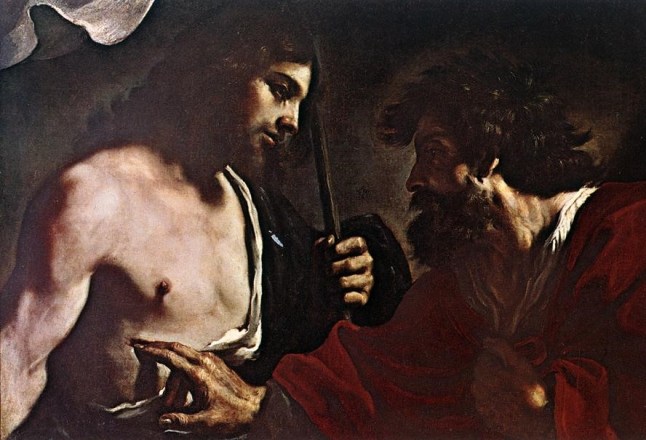
Doubting_Thomas_By_Guercino
Doubting Thomas by Guercino

On the evening of that first day of the week,
when the doors were locked, where the disciples were,
for fear of the Jews,
Jesus came and stood in their midst
and said to them, “Peace be with you.”
When he had said this, he showed them his hands and his side.
The disciples rejoiced when they saw the Lord.
Jesus said to them again, “Peace be with you.
As the Father has sent me, so I send you.”
And when he had said this, he breathed on them and said to them,
“Receive the Holy Spirit.
Whose sins you forgive are forgiven them,
and whose sins you retain are retained.”

Thomas, called Didymus, one of the Twelve,
was not with them when Jesus came.
So the other disciples said to him, “We have seen the Lord.”
But he said to them, “Unless I see the mark of the nails in his hands
and put my finger into the nailmarks
and put my hand into his side, I will not believe.”

Now a week later his disciples were again inside
and Thomas was with them.
Jesus came, although the doors were locked,
and stood in their midst and said, “Peace be with you.”
Then he said to Thomas, “Put your finger here and see my hands,
and bring your hand and put it into my side,
and do not be unbelieving, but believe.”
Thomas answered and said to him, “My Lord and my God!”
Jesus said to him, “Have you come to believe because you have seen me?
Blessed are those who have not seen and have believed.”

Now Jesus did many other signs in the presence of his disciples
that are not written in this book.
But these are written that you may come to believe
that Jesus is the Christ, the Son of God,
and that through this belief you may have life in his name.

-John 20:19-31

May’s Way…

It is interesting how people come into our lives who, at times, remind us of those who went before us. A number of years ago, I recall feeling amazed one day as I realized how many women named Mary had recently come into my life. It was as if a whole army of warm, welcoming, faith-filled Marys were suddenly in my life. They were from different walks of life, but all named Mary, and all of them brought a smile, wisdom and a sense of peace with them.

As I sat in awe with this realization, tears came to my eyes and I thought of my Auntie May, named Mary at birth. The first Mary I ever knew and loved with all of my heart. She was a fixture of love from as far back as I can remember…gentle and faith-filled.

Auntie May…I can still see her beautiful face and hear her wise, calming voice. “Hi doll,” together with an embrace that felt so warm and loving. I can still see her beautiful fingers. She would take my hand and hold it between hers as we exchanged greetings. I could feel the love and care in her hands, the same hands that made such wonderful food—kibbe, cinnamon twists, and so much more.

I remember sitting, as a young child and as I grew in age, listening to her and the other adults speak. She spoke with such clarity and with a passion for all that is right and just, for all that is good and true. She was so knowledgeable, but at the same time so down to earth. She was a very interesting person, not to mention her sense of humor; and though she was gentle, she could be stern, too. She knew when to speak softly and when to speak more firmly and with greater conviction. She had such an amazing spirit…striking…so nurturing and life giving.

Auntie May, and all the Marys who followed, reminding me of all that was and all that is. It is fascinating how God sends people into our lives to help us or challenge us, as well as for us to help…sometimes simply by being ourselves.

There is a saying that the best thing one can do is to be one’s true self. That is, as one becomes more and more authentic, she or he makes a difference simply by being. There is an energy or a vibe, when being true to oneself, that extends without effort as we go about day to day activities.

As layers are peeled back and one uncovers or moves closer to her or his true self, we are summoned or we gravitate toward our true calling or vocation(s) within our life and within each situation. Connected to that call, to the source of that call, and continuing to remain faithful to it, the energy or the spirit remains, flowing through and radiating out with benefit for all with whom we interact.

So, while my Auntie May, may have been different things to different people throughout her life, she was true to herself and the love, spirit and energy that she brought to each thing she did and each role she fulfilled, remained the same. What was even more special was that she realized it was not hers to keep and that it could only continue by her letting go and letting flow as she went about her way.

A_White_Chrysanthemum

“Be who God meant you to be and you will set the world on fire.” – St. Catherine of Siena


A Regular Joe…

Joseph, the carpenter, faithful servant of the Lord, took Mary into his home as his wife and named his son Jesus.

Joseph, faithful servant of the Lord, took Mary and Jesus and fled to Egypt in the middle of the night, remaining there until the appointed time then returning to Nazareth.

Joseph, faithful servant of the Lord, husband of Mary, the mother of God, earthly father of Jesus, the Son of God, lived his faith.

Joseph, faithful servant of the Lord, did all that was spoken to him by the Angel of God.

St. Joseph, the patron Saint of the Universal Church, unborn children, fathers, workers, travelers, immigrants, and a happy death. We do not know much about St. Joseph. Not knowing much though is intriguing, because Joseph could be any of us—a “regular Joe” capable through his faith and God’s grace of facing the challenges of his life and the times in which he lived.

Perhaps, the best place to start though is with what we do know about St. Joseph. We know that he was a carpenter (MT 13:54-55). However, according to scholars the Greek word “Tekton” would have been used to describe Joseph, meaning that he was a craftsman or contractor; someone very skilled at working with wood, stones, and metals. It is also likely that he traveled quite a bit to seek work.

We also know from Bible verses, that St. Joseph was a husband (the husband of Mary the Blessed Virgin) and he was the “foster” or earthly father of Jesus. These two pieces of information, along with the fact that he was a working class man not only make St. Joseph relatable, but they also suggest he was a person of great faith, courage and wisdom. Think about it…the husband of Mary, the mother of God, and the earthly father of Jesus, the son of God.

From the passages in the Bible, we can also see ways that Joseph’s life and his choices exemplify those of someone striving to be faithful to God. We know that he had dreams in which he was visited by an Angel of God telling him to not be afraid to marry Mary (that she had conceived by the Holy Spirit), a dream to flee to Egypt, and then to return from Egypt. We know that Joseph listened, trusted and did as the Angel of God instructed in each case – Joseph married Mary, named his son Jesus, fled to Egypt, and later returned to Nazareth in Galilee all upon the instruction of the Angel of the Lord in dreams.

We can also see wisdom in the spiritual work of mercy exhibited by Joseph in bearing patience against wrongdoing or perceived wrongdoing. Mary, his betrothed, is found to be pregnant, yet they had not had any relations yet. We can only imagine what Joseph’s first thoughts to this news were. I doubt anyone would have trouble understanding if he was livid and decided to leave Mary. Also in that day and time in history, it would have been well within societal expectations for Mary to be stoned to death. Yet, here we have Joseph, deciding to quietly divorce Mary, not wanting her to be harmed. Despite what must have seemed and felt like a “betrayal,” he saw it in his heart, to show mercy and compassion. Joseph’s response, even before a visitation from the Angel of God, is remarkable and seems one only possible by someone very prayerful and inspired by God.

It leaves one to wonder, how am I able to show mercy when I am wronged? How am I able to be patient and to persevere? How can I, how can we, use St. Joseph as a model?

In each of the situations described in Scripture, Joseph dies unto himself, sacrifices and cooperates with God’s will. He shows openness to and focus on God’s will at each point. He was able to survive and make it through difficult and challenging circumstances such as the journey to Bethlehem with an expecting Mary. The journey to Bethlehem would not have been an easy one. Then there is the impending birth of Jesus with nowhere to stay, the flight to Egypt, the journey back to Nazareth and beyond.

How can we have the faith and patience of Joseph? How can we, like Joseph, recognize and accept that things happen in God’s time, not according to our time, and to remember that God is faithful to those who are faithful to God? Do I remind myself of the ways that God has been faithful to and patient with me along my journey so far? Do I allow past experiences to help me to remain patient and faithful, and to continue to trust in God and in God’s timing?

Joseph wasn’t given explicit plans or an outline of all that would happen in the dreams he had. In the Gospel of Luke, chapter 2, we are told that Jesus is laid in a manger because there was no room for them in the inn. We are also told at the presentation of Jesus in the temple that Simeon tells Mary and Joseph that Jesus would be glory for God’s people and that Mary’s heart would be pierced. It then says, “The child’s father and mother were amazed at what was said about him.” Joseph and Mary didn’t know all that was going to happen.

When we look at Joseph, he was just given a basic directive in his dreams…take Mary as your wife…flee to Egypt. He listened and let God lead him. He had faith in God, faith that we can only assume grew with each event in his life and most especially through the birth of Jesus and all that transpired in the time after his birth.

Martin Luther King said, “Faith is taking the first step, even when you don’t see the whole staircase.” That’s the hard part, the “not knowing.” If we knew all the details of what was going to happen, it might be very easy to be patient, to let go of wrongdoings and to trust in God and in God’s plan.

Faith…trusting even when we cannot see the next step…trusting that it will be there when it is time to take that step. Waiting until it is there, taking direction from God and acting once the step appears and the way is made clear. St. Joseph, from what we know of him, did all of this.

It is more likely than not, especially at that time in history, as a father, Joseph not only provided for and protected his family, but also led his family in the observance of prayer and religious custom. We read in Scripture, “Each year his parents went to Jerusalem for the feast of Passover, and when he was twelve years old, they went up according to festival custom.” (Lk 2:41)

With what we know of Joseph, it is not a stretch to imagine him as a very prayerful person.

For Joseph, the beginning of the journey that would lead him to emerge fully into who God created him to be and to fulfill his part in God’s plan, started with a dream, or a desire, long before the first dream, he had and that we read about in the Bible. The journey started with him saying “Yes” to letting God lead him, and continuing to say “Yes”, letting God continue to lead him all along the way. How can I, how can we, do the same?
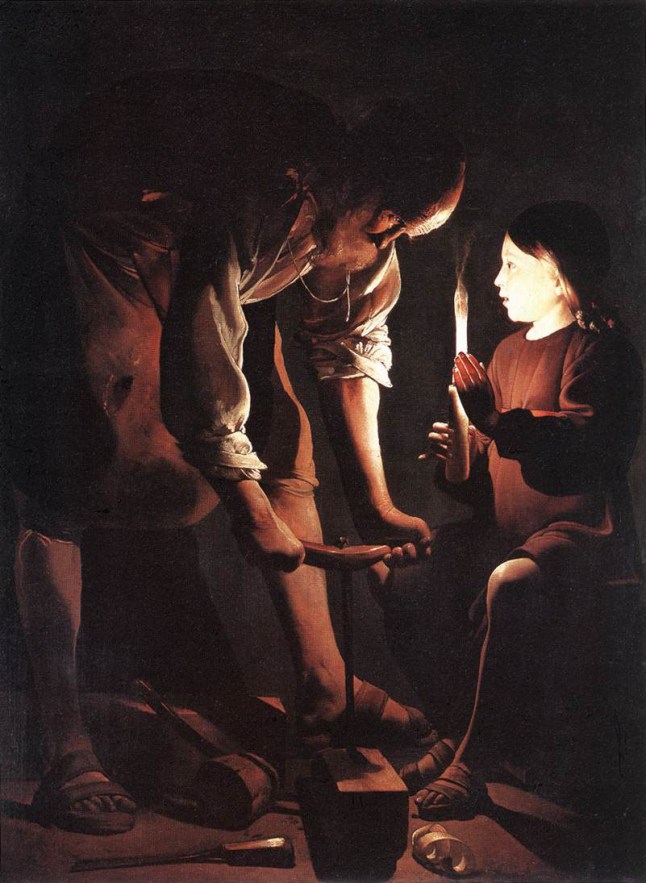
StJosephJoseph the Carpenter rendered by Georges de La Tour

Throwing Stones…

Stones

“Let the one among you who is without sin,
be the first to throw a stone at her.” – John 8:7

In the world in which we live, the above Bible verse has come to mean, to many people, it is not Christ-like to criticize wrongdoing. Is that interpretation accurate though? Is that really how Christ lived and taught? Is it true?

It is interesting how the truth is often twisted and how, throughout history, the truth, and speakers of the truth, have often been frowned upon. In the Gospel passage of the woman caught in adultery (John 8:1-11), Jesus, champion of truth, honesty and integrity, is put in a position where the authorities (the scribes and Pharisees) are looking for a reason to “take him down” so to speak. They see Jesus as a threat. If the truth becomes known…if their manipulation and ways of holding down and misleading the faithful become known, the faithful will no longer support them and their authority will fade away. This possibility makes them focus even more on trying to suppress or manipulate the truth. They are not open to anything other than efforts to hold onto their kingdom, no matter how that might affect the faithful.

While the scribes and Pharisees are trying to trap Jesus into going against Mosaic law, so that they can arrest him and eventually do away with him, Jesus turns the tables on them. Jesus knows that their motivation is self-serving; they are not concerned about the spiritual well-being of the woman they have brought before Jesus. They are using her, and Mosaic law, to try to get what they want. They are not pointing to the law for the purpose of which the law was made and certainly not for the well-being of the woman or the larger community.

So how does Jesus respond? He calls the scribes and Pharisees attention to the fact that they are not without sin; their hearts are not pure, and they slither away. The woman is left standing alone with Jesus.

While Jesus does not condemn the woman, he does hold her accountable and tells her not to sin any more.

Oftentimes, we can confuse holding someone accountable or to the truth as being judgmental. However, we need to be able to judge situations and, at times, we are called to speak the truth, even if that means it may be in conflict with another or requires holding another accountable.

In a scripture passage prior to the passage about the woman caught in adultery, Jesus says, “Whoever speaks on his own seeks his own glory, but whoever seeks the glory of the one who sent him is truthful, and there is no wrong in him. Did not Moses give you the law? Yet none of you keeps the law. Why are you trying to kill me?” The crowd answered, “You are possessed! Who is trying to kill you?” Jesus answered and said to them, “I performed one work and all of you are amazed because of it. Moses gave you circumcision—not that it came from Moses but rather from the patriarchs—and you circumcise a man on the Sabbath. If a man can receive circumcision on a Sabbath so that the law of Moses may not be broken, are you angry with me because I made a whole person well on a Sabbath? Stop judging by appearances, but judge justly.” (John 7:18-24)

If we come back to the woman caught in adultery, we see that Jesus doesn’t condemn her to death, but he does make a judgment. He tells her to sin no more. He tells her to stop.

When we look at our own lives, like with everything else, we need to follow Jesus’ example. We shouldn’t throw stones, but we should judge justly. When we see people doing wrong, we are called to speak the truth and to stand up for what is just. That is a big part of carrying one’s own cross…of being Christian.


Jesus went to the Mount of Olives.
But early in the morning he arrived again in the temple area,
and all the people started coming to him,
and he sat down and taught them.
Then the scribes and the Pharisees brought a woman
who had been caught in adultery
and made her stand in the middle.
They said to him,
“Teacher, this woman was caught
in the very act of committing adultery.
Now in the law, Moses commanded us to stone such women.
So what do you say?”
They said this to test him,
so that they could have some charge to bring against him.
Jesus bent down and began to write on the ground with his finger.
But when they continued asking him,
he straightened up and said to them,
“Let the one among you who is without sin
be the first to throw a stone at her.”
Again he bent down and wrote on the ground.
And in response, they went away one by one,
beginning with the elders.
So he was left alone with the woman before him.
Then Jesus straightened up and said to her,
“Woman, where are they?
Has no one condemned you?”
She replied, “No one, sir.”
Then Jesus said, “Neither do I condemn you.
Go, and from now on do not sin anymore.” – John 8:1-11

The Choice Is Ours…

ChoiceIsOurs

From the snow covered branches to the rumble of snowplows, the hum of snow blowers and the sound of shovels against the ground. From the people driving or operating machines or shoveling to those simply playing in the winter wonderland. From those readying a place for loved ones returning from outdoors to those who are simply gazing in awe of the beauty that abounds…and, to all those in between, Alleluia!

Be it rain or snow or a storm of another kind, there is something so pure…so quiet…after a storm. There is something so precious in the time that follows the pouring down…and sometimes out and all around. Looking out the window after a recent snowstorm, I am struck by the way that everything is right in front of us, and the choice is ours.

While the storm may have caused almost all activity to come to a halt, it also washes clean (or white) for at least a little while. Then, it is time to clean up. Moved to work together, we help each other to restore the roads and the walkways so that once again they are open and safe for travel to and from.

Again, it seems that everything is right in front of us and the choice is ours.

A Boiled Seed Cannot Sprout – Author Unknown

An aging king woke up one day acutely aware of his own mortality.  He had no son, and his was a culture where only a male heir could take his place.

He decided that he would adopt a son who then could take his place, but he insisted that such an adopted son must be extraordinary in every sense of the word.  He considered each of his advisors and relatives in turn, but found them wanting.

So he launched a competition in his kingdom, open to all boys, no matter what their background. Ten boys made it to the very top. There was little to separate these boys in terms of intelligence and physical attributes and capabilities.

The king said to them, ‘I have one last test and whoever comes top will become my adopted son and heir to my throne.’ Then he said, ‘This kingdom depends solely on agriculture, so the king must know how to cultivate plants.  Here are seven seeds of grain for each of you. Take them home.  Plant and nurture them for six weeks. At the end of six weeks, we shall see who has done the best job of cultivating the grain.  That person will be my son and my heir. ‘

The boys took their seeds and hurried home.  Each got a pot, prepared soil, and sowed his seeds. There was much excitement in the kingdom as the people waited to see who was destined to be their next king.

In one home, the boy and his parents were almost heartbroken when the days stretched into weeks and the seeds failed to sprout. The boy did not know what had gone wrong. He had selected the soil carefully, he had applied the right quantity and type of fertilizer, he had been very dutiful in watering it at the right intervals, he had even prayed over it day and night and yet his seeds had turned out to be unproductive.

Some of his friends advised him to go and buy seed from the market and plant that. ‘After all,’ they said, ‘how can anyone tell seeds of grain one from another?’

But his parents who had always taught him the value of integrity reminded him that if the king wanted them to plant just any grain, he would have asked them to go for their own seed. ‘If you take anything different from what the king gave you that would be dishonest. Maybe we are not destined for the throne.  If so, let it be, but don’t be found to have deceived the king,’ they told him.

The appointed day came and the boys returned to the palace each of them proudly exhibiting a pot of healthy seedlings. It was obvious that the other nine boys had had great success with their seeds. The king began making his way down the line of eager boys and asked each of them, ‘Is this what came out of the seeds I gave you?’ And each boy responded, ‘Yes, your majesty.’ And the king would nod and move down the line.

The king finally got to the last boy in the line-up. The boy was shaking. He feared that the king might have him thrown into prison for wasting his seeds. ‘What did you do with the seeds I gave you?’ the king asked.

‘I planted them and cared for them diligently, Your Majesty, but alas they failed to sprout,’ the boy said.  He hung his head in shame, and the crowd jeered.

But the king raised his hands and signaled for silence. Then he said, ‘My people behold your next king.’

The people were confused. ‘Why that one?’ many asked.’ How can he be the right choice?’

The king took his place on his throne with the boy by his side and said, ‘I gave these boys boiled seeds. This test was not for cultivating grain.  It was a test of character; a test of integrity. It was the ultimate test.  If a king must have one quality, it must be that he should be above dishonesty. Only this boy passed the test. A boiled seed cannot sprout.’