Starting in childhood, I remember holding onto an item or two (pictures, tickets, and other such mementos) from each event that was a milestone or that seemed special to me. I would place them in a metal tin for safekeeping. Every so often, I would get the tin, open it, and reminisce about the events connected to the items.
As I got older and life got busier and busier, the tin was opened less. Over time, some of the items came to hold meaning far beyond events associated with them. Or, maybe over time, the deeper meaning surrounding them had room to make itself known.
To this day, one of these items that I have held onto is a pendant. I do not recall exactly how it came into my possession, but I have had it for at least four decades now. Despite liking it and wanting to hold onto it, however, I do not recall ever actually wearing it.
In reading the Gospel according to Luke, chapter 15, verses 1-32 (the lost sheep, the lost coin, the lost son), I find myself thinking about the metal tin, the pendant, and the things (living or not), that one might consider as belonging to oneself. For many years, the pendant resided in the tin, tucked away, out of site, perhaps in some ways lost.
In time, it was only in looking more closely that I could see more clearly. What the pendant had come to represent needed to be stripped away in order to reveal the truth of what it was really all about. It was a rediscovering of sorts as the underlying message became the center—heart and soul.

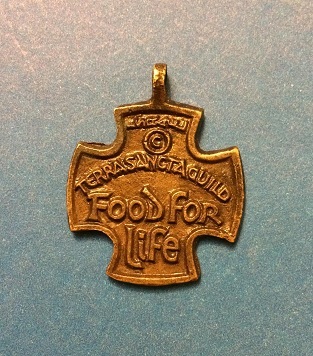
Relationship with God and one another can often be confused with or portrayed in terms of possession—man-made attempts of one kind or another to gain control, authority or whatever else it may be. However, at every turn, and despite all that is damaged or taken away, often by those entrusted to lead the way, the grace of God is not, nor will it ever be, something to be possessed by only some, or restrained and restricted by limitations contrived by the human mind.
Authentic relationship with God, and one another, builds up in ways that are just and true… meaningful and beneficial to many. It is never about possession or forced wills, but instead honesty, transparency, and striving toward unity. God is, after all, Universal.
Tax collectors and sinners were all drawing near to listen to Jesus,
but the Pharisees and scribes began to complain, saying,
“This man welcomes sinners and eats with them.”
So to them he addressed this parable.
“What man among you having a hundred sheep and losing one of them
would not leave the ninety-nine in the desert
and go after the lost one until he finds it?
And when he does find it,
he sets it on his shoulders with great joy
and, upon his arrival home,
he calls together his friends and neighbors and says to them,
‘Rejoice with me because I have found my lost sheep.’
I tell you, in just the same way
there will be more joy in heaven over one sinner who repents
than over ninety-nine righteous people
who have no need of repentance.“Or what woman having ten coins and losing one
would not light a lamp and sweep the house,
searching carefully until she finds it?
And when she does find it,
she calls together her friends and neighbors
and says to them,
‘Rejoice with me because I have found the coin that I lost.’
In just the same way, I tell you,
there will be rejoicing among the angels of God
over one sinner who repents.”Then he said,
“A man had two sons, and the younger son said to his father,
‘Father give me the share of your estate that should come to me.’
So the father divided the property between them.
After a few days, the younger son collected all his belongings
and set off to a distant country
where he squandered his inheritance on a life of dissipation.
When he had freely spent everything,
a severe famine struck that country,
and he found himself in dire need.
So he hired himself out to one of the local citizens
who sent him to his farm to tend the swine.
And he longed to eat his fill of the pods on which the swine fed,
but nobody gave him any.
Coming to his senses he thought,
‘How many of my father’s hired workers
have more than enough food to eat,
but here am I, dying from hunger.
I shall get up and go to my father and I shall say to him,
“Father, I have sinned against heaven and against you.
I no longer deserve to be called your son;
treat me as you would treat one of your hired workers.”’
So he got up and went back to his father.
While he was still a long way off,
his father caught sight of him,
and was filled with compassion.
He ran to his son, embraced him and kissed him.
His son said to him,
‘Father, I have sinned against heaven and against you;
I no longer deserve to be called your son.’
But his father ordered his servants,
‘Quickly bring the finest robe and put it on him;
put a ring on his finger and sandals on his feet.
Take the fattened calf and slaughter it.
Then let us celebrate with a feast,
because this son of mine was dead, and has come to life again;
he was lost, and has been found.’
Then the celebration began.
Now the older son had been out in the field
and, on his way back, as he neared the house,
he heard the sound of music and dancing.
He called one of the servants and asked what this might mean.
The servant said to him,
‘Your brother has returned
and your father has slaughtered the fattened calf
because he has him back safe and sound.’
He became angry,
and when he refused to enter the house,
his father came out and pleaded with him.
He said to his father in reply,
‘Look, all these years I served you
and not once did I disobey your orders;
yet you never gave me even a young goat to feast on with my friends.
But when your son returns,
who swallowed up your property with prostitutes,
for him you slaughter the fattened calf.’
He said to him,
‘My son, you are here with me always;
everything I have is yours.
But now we must celebrate and rejoice,
because your brother was dead and has come to life again;
he was lost and has been found.’” – Luke 15:1-32
 HopeThatFloats
You must be logged in to post a comment.